Personality means the set of qualities, feelings, and behaviors that make a person unique. For example, imagine a student who is kind, friendly, and helpful. Another student may be quiet, serious, and thoughtful. These qualities show that each person has a different personality.
The word personality is common in daily English. It also appears in books, school essays, job interviews, and everyday conversations.
Learning synonyms of personality helps English learners express ideas in different ways. However, not every synonym has the same meaning or emotional tone.
In this article, you will learn the meaning of personality, 30 useful synonyms, their pronunciations in American and British English, and examples. You will also explore its history, grammar, word formation, connotations, and antonyms.
Meaning of Personality
Personality (noun): The combination of qualities, thoughts, feelings, and behaviors that makes a person different from others.
Read more about:https://synonymhunting.com/synonyms-of-hurt/
Examples
- Her friendly personality makes everyone feel welcome.
- He has a calm personality and rarely gets angry.
Connotative Meaning
Connotation (the feelings or ideas that a word suggests beyond its basic meaning) helps us understand the emotional tone of a word.
- Positive tone: Personality can suggest charm, confidence, kindness, warmth, and uniqueness.
The word personality itself is generally neutral. Its tone depends on the words around it and the situation in which it is used.
Etymology of Personality
- Source language: Latin, through French.
- Latin root: Persona, meaning a person, character, or theatrical mask.
- French influence: Middle French personnalité helped shape the English word.
- Original idea: The identity or qualities associated with a person.
Short History of Personality
Old English (450–1100)
The modern word personality was not commonly used in Old English. People used other words and expressions to discuss a person’s nature, character, and behavior.
Middle English (1100–1500)
French and Latin influenced English vocabulary during this period. Words connected to persons, identity, and individual qualities became more common.
Modern English (1500–Present)
The word personality developed into a common term for individual character and behavior. Today, it is widely used in psychology, education, literature, and daily conversation.
Pronunciation of Personality
- US IPA: /ˌpɝː.səˈnæl.ə.t̬i/
- UK IPA: /ˌpɜː.səˈnæl.ə.ti/
- Syllables: per-son-al-i-ty
- Number of syllables: 5
- Word stress: The third syllable, nal, receives the main stress.
Affixation Pattern of Personality
Understanding word formation helps learners recognize related words and use them correctly.
- Root: Person, referring to an individual human being.
- Prefix: None in the modern English word.
- Suffix: -ality, which forms a noun expressing a state, quality, or condition. The word can also be analyzed as personal + -ity.
- Part of speech: Noun.
Word Formation of Personality
The following words are related to personality. They belong to different grammatical categories.
Word
Part of speech
Meaning
Person
Noun
An individual human being
Personal
Adjective
Belonging to or relating to one person
Personally
Adverb
In an individual or personal way
Personality
Noun
A person’s distinctive qualities
Personalize
Verb
To adapt something to a person’s needs
Personalization
Noun
The process of making something personal
Impersonal
Adjective
Not showing personal feelings or involvement
Impersonally
Adverb
In a way that lacks personal involvement
Impersonality
Noun
The quality of being impersonal
These are eight related forms besides the main word personality. Some share the same root, while others use additional prefixes or suffixes.
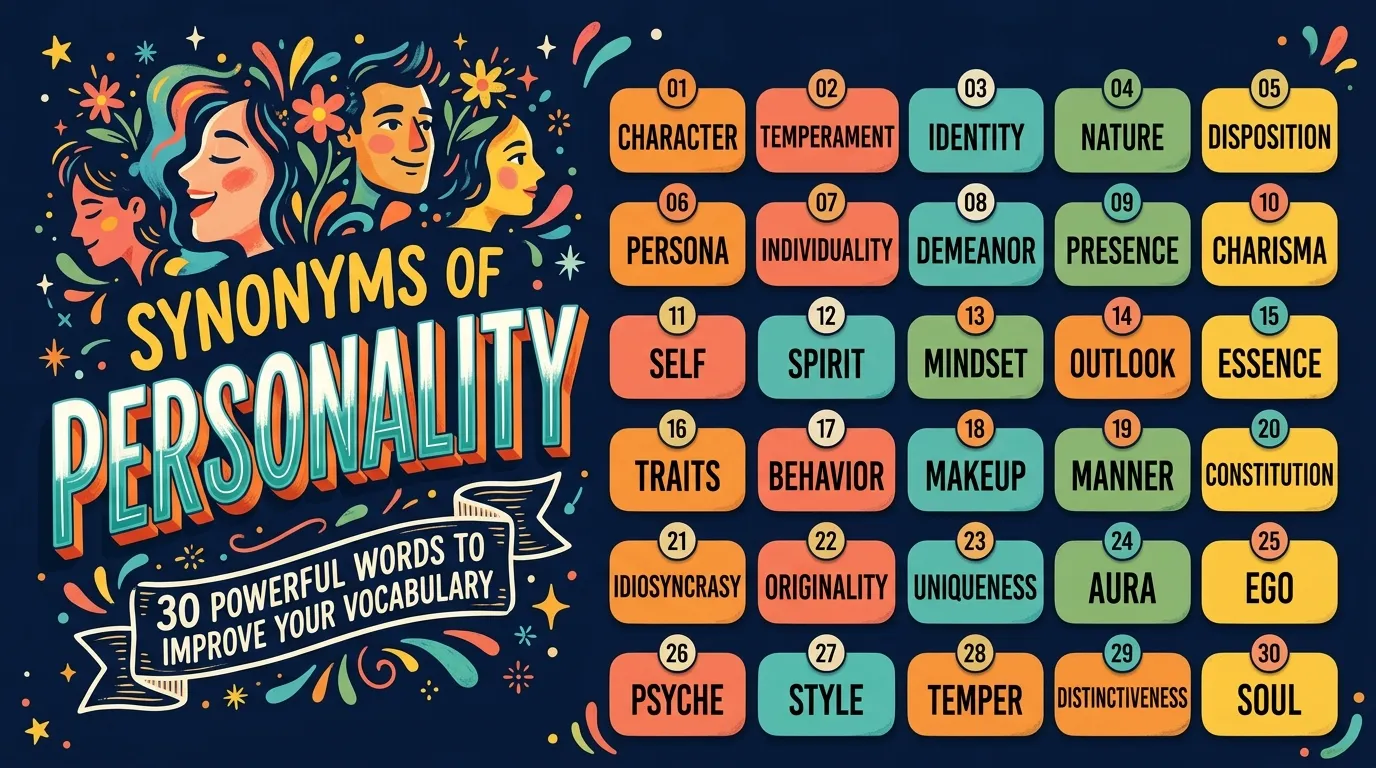
Synonyms of Personality :30 Powerful Words
The following words can replace personality in some situations. However, their meanings are not always identical. Choose the word that best fits your sentence.
1. Character (Noun) — US: /ˈkær.ək.tɚ/ | UK: /ˈkær.ək.tə/
Meaning: The qualities and moral traits that describe a person.
Examples:
- Her honest character makes her a trusted friend.
- Good character is important for a teacher.
2. Nature (Noun) — US: /ˈneɪ.tʃɚ/ | UK: /ˈneɪ.tʃə/
Meaning: The natural qualities or usual behavior of a person.
Examples:
- His gentle nature makes him easy to approach.
- She has a cheerful nature.
3. Temperament (Noun) — US: /ˈtem.pɚ.ə.mənt/ | UK: /ˈtem.pər.ə.mənt/
Meaning: A person’s usual emotional responses and mood.
Examples:
- The child has a calm temperament.
- Her lively temperament makes group activities fun.
4. Disposition (Noun) — US: /ˌdɪs.pəˈzɪʃ.ən/ | UK: /ˌdɪs.pəˈzɪʃ.ən/
Meaning: A person’s usual attitude or way of behaving.
Examples:
- He has a friendly disposition.
- Her cheerful disposition lifts everyone’s mood.
5. Character Traits (Noun Phrase) — US: /ˈkær.ək.tɚ treɪts/ | UK: /ˈkær.ək.tə treɪts/
Meaning: Specific qualities that describe how someone thinks and behaves.
Examples:
- Honesty and patience are valuable character traits.
- Teachers help students develop positive character traits.
6. Individuality (Noun) — US: /ˌɪn.dəˌvɪdʒ.uˈæl.ə.t̬i/ | UK: /ˌɪn.dɪ.vɪdʒ.uˈæl.ə.ti/
Meaning: The qualities that make someone different from others.
Examples:
- Her individuality makes her stand out.
- Good schools respect each student’s individuality.
7. Identity (Noun) — US: /aɪˈden.t̬ə.t̬i/ | UK: /aɪˈden.tɪ.ti/
Meaning: The qualities and characteristics that define who someone is.
Examples:
- Language plays a role in cultural identity.
- His identity is shaped by his experiences.
8. Demeanor (Noun) — US: /dɪˈmiː.nɚ/ | UK: /dɪˈmiː.nə/
Meaning: The way a person looks and behaves around others.
Examples:
- The teacher’s calm demeanor comforted the class.
- His professional demeanor impressed the manager.
9. Manner (Noun) — US: /ˈmæn.ɚ/ | UK: /ˈmæn.ə/
Meaning: The way someone behaves or does something.
Examples:
- She spoke in a polite manner.
- His cheerful manner made the meeting pleasant.
10. Behavior (Noun) — US: /bɪˈheɪ.vjɚ/ | UK: /bɪˈheɪ.vjə/
Meaning: The way a person acts in different situations.
Examples:
- Good behavior helps create a peaceful classroom.
- His behavior changed after the conversation.
11. Attitude (Noun) — US: /ˈæt̬.ə.tuːd/ | UK: /ˈæt.ɪ.tjuːd/
Meaning: The way a person thinks or feels about something.
Examples:
- She has a positive attitude toward learning.
- A respectful attitude improves teamwork.
12. Disposition of Mind (Noun Phrase) — US: /ˌdɪs.pəˈzɪʃ.ən əv maɪnd/ | UK: /ˌdɪs.pəˈzɪʃ.ən əv maɪnd/
Meaning: A person’s usual way of thinking and feeling.
Examples:
- His optimistic disposition of mind helps him face challenges.
- A calm disposition of mind can support clear decisions.
13. Psyche (Noun) — US: /ˈsaɪ.ki/ | UK: /ˈsaɪ.ki/
Meaning: The mind and inner mental life of a person.
Examples:
- Childhood experiences can affect the human psyche.
- The novel explores the main character’s psyche.
14. Makeup (Noun) — US: /ˈmeɪk.ʌp/ | UK: /ˈmeɪk.ʌp/
Meaning: The combination of qualities that form a person’s nature.
Examples:
- Patience is an important part of her emotional makeup.
- His personality makeup includes confidence and curiosity.
15. Persona (Noun) — US: /pɚˈsoʊ.nə/ | UK: /pəˈsəʊ.nə/
Meaning: The image or character a person presents to others.
Examples:
- The actor created a funny public persona.
- Her online persona is more confident than her real-life manner.
16. Presence (Noun) — US: /ˈprez.əns/ | UK: /ˈprez.əns/
Meaning: The noticeable effect or impression someone creates when present.
Examples:
- The speaker has a strong stage presence.
- Her warm presence made the guests feel comfortable.
17. Charisma (Noun) — US: /kəˈrɪz.mə/ | UK: /kəˈrɪz.mə/
Meaning: A special quality that attracts and inspires other people.
Examples:
- The leader’s charisma inspired the team.
- Her charisma helped her connect with the audience.
18. Charm (Noun) — US: /tʃɑːrm/ | UK: /tʃɑːm/
Meaning: A pleasing quality that attracts or delights others.
Examples:
- His natural charm makes him popular.
- The young speaker won the audience with her charm.
19. Individual Character (Noun Phrase) — US: /ˌɪn.dəˈvɪdʒ.u.əl ˈkær.ək.tɚ/ | UK: /ˌɪn.dɪˈvɪdʒ.u.əl ˈkær.ək.tə/
Meaning: The distinctive qualities that belong to one person.
Examples:
- Every student has an individual character.
- Her individual character shines through her writing.
20. Disposition of Character (Noun Phrase) — US: /ˌdɪs.pəˈzɪʃ.ən əv ˈkær.ək.tɚ/ | UK: /ˌdɪs.pəˈzɪʃ.ən əv ˈkær.ək.tə/
Meaning: A person’s general pattern of character and behavior.
Examples:
- His disposition of character is calm and thoughtful.
- A person’s disposition of character may influence relationships.
21. Emotional Makeup (Noun Phrase) — US: /ɪˈmoʊ.ʃən.əl ˈmeɪk.ʌp/ | UK: /ɪˈməʊ.ʃən.əl ˈmeɪk.ʌp/
Meaning: The emotional qualities and responses that shape a person.
Examples:
- Her emotional makeup helps her understand others.
- Stress can affect a person’s emotional makeup.
22. Social Style (Noun Phrase) — US: /ˈsoʊ.ʃəl staɪl/ | UK: /ˈsəʊ.ʃəl staɪl/
Meaning: The way someone communicates and interacts with others.
Examples:
- His social style is friendly and relaxed.
- Different social styles can work well in one team.
23. Personal Qualities (Noun Phrase) — US: /ˈpɝː.sən.əl ˈkwɑː.lə.t̬iz/ | UK: /ˈpɜː.sən.əl ˈkwɒl.ə.tiz/
Meaning: The features or traits that describe a person’s character.
Examples:
- Patience and kindness are important personal qualities.
- Employers often value strong personal qualities.
24. Traits (Noun) — US: /treɪts/ | UK: /treɪts/
Meaning: Particular qualities or features of a person’s character.
Examples:
- Creativity and honesty are useful traits.
- Some personality traits become clearer with age.
25. Disposition (Noun) — US: /ˌdɪs.pəˈzɪʃ.ən/ | UK: /ˌdɪs.pəˈzɪʃ.ən/
Meaning: A person’s natural tendency to act or feel in a certain way.
Examples:
- She has a natural disposition toward helping others.
- His friendly disposition makes teamwork easier.
26. Character Structure (Noun Phrase) — US: /ˈkær.ək.tɚ ˈstrʌk.tʃɚ/ | UK: /ˈkær.ək.tə ˈstrʌk.tʃə/
Meaning: The way a person’s different character traits fit together.
Examples:
- The psychologist studied the person’s character structure.
- Family life may influence character structure.
27. Personal Style (Noun Phrase) — US: /ˈpɝː.sən.əl staɪl/ | UK: /ˈpɜː.sən.əl staɪl/
Meaning: The distinctive way someone expresses themselves or behaves.
Examples:
- Her personal style is confident but polite.
- His personal style makes his presentations memorable.
28. Disposition of Temper (Noun Phrase) — US: /ˌdɪs.pəˈzɪʃ.ən əv ˈtem.pɚ/ | UK: /ˌdɪs.pəˈzɪʃ.ən əv ˈtem.pə/
Meaning: A person’s usual emotional nature and tendency to react.
Examples:
- His disposition of temper is calm and patient.
- A gentle disposition of temper can help during disagreements.
29. Nature of Character (Noun Phrase) — US: /ˈneɪ.tʃɚ əv ˈkær.ək.tɚ/ | UK: /ˈneɪ.tʃə əv ˈkær.ək.tə/
Meaning: The basic qualities that shape a person’s character.
Examples:
- Her nature of character is honest and caring.
- The story reveals the nature of the hero’s character.
30. Psychological Makeup (Noun Phrase) — US: /ˌsaɪ.kəˈlɑː.dʒɪ.kəl ˈmeɪk.ʌp/ | UK: /ˌsaɪ.kəˈlɒdʒ.ɪ.kəl ˈmeɪk.ʌp/
Meaning: The mental and emotional qualities that shape how someone thinks and behaves.
Examples:
- Life experiences can influence a person’s psychological makeup.
- The study examined the psychological makeup of the participants.
Vocabulary tip: Some entries above are related expressions rather than exact synonyms. Expressions such as psychological makeup are useful when discussing mental and emotional qualities.
Prototype Meaning of Personality
The prototype meaning of personality is the collection of qualities that makes someone recognizable as an individual. These qualities influence how a person communicates, responds to problems, and builds relationships. Personality includes more than appearance or a person’s behavior in one moment. It describes broader patterns that may appear across different situations.
Prototype Categorization of Personality Synonyms
Grouping synonyms by meaning helps writers select words that fit their message. Instead of using personality repeatedly, choose a more specific word.
- Character and moral qualities: Character, character traits, personal qualities, and traits. Use these when discussing honesty, kindness, responsibility, or courage.
- Natural behavior and emotions: Nature, temperament, and disposition. Use these to describe a person’s usual mood, reactions, and tendencies.
- Visible behavior and communication: Demeanor, manner, behavior, attitude, and social style. These words focus on how someone acts or interacts with others.
- Individual identity: Individuality, identity, and individual character. Use these when explaining what makes someone unique.
- Attraction and influence: Charisma, charm, and presence. These are useful when someone attracts attention or inspires others.
- Inner mental qualities: Psyche, emotional makeup, psychological makeup, and makeup. These are suitable for discussions about thoughts, feelings, and mental patterns.
- Public image and expression: Persona and personal style. Use these when discussing how someone presents themselves to the world.
Antonyms of Personality
Strictly speaking, personality has no single direct antonym because everyone has a personality.
Opposite idea
Example
Impersonality
Lack of personal warmth or involvement
The office felt cold and impersonal.
Anonymity
Lack of a clearly known identity
The writer published the story in anonymity.
Blandness
Lack of distinctive or interesting qualities
His speech lacked energy and felt bland.
Timidity
Lack of confidence or boldness
Timidity stopped her from speaking up.
Coldness
Lack of warmth or friendliness
His coldness made others uncomfortable.
Unfriendliness
Lack of friendliness
Her unfriendliness discouraged conversation.
Insensitivity
Lack of care for others’ feelings
His insensitivity hurt his friend.
Inflexibility
Lack of willingness to adapt
Inflexibility made teamwork difficult.
These are contextual opposites, not exact antonyms of personality. Their usefulness depends on the quality being discussed.
Short Questions and Answers
– What does personality mean?
Personality is the combination of qualities, feelings, and behaviors that makes a person unique.
– When should personality be used?
Use personality when describing someone’s general character, behavior, social style, or individual qualities.
– Is personality positive or negative?
The word is neutral. It can describe positive, negative, or ordinary qualities depending on the context.
– How is personality different from character?
Personality includes a person’s general behavior, emotional patterns, and social qualities. Character often focuses more on moral qualities, such as honesty and responsibility.
– What is the difference between personality and temperament?
Personality is broader. Temperament mainly refers to a person’s natural emotional responses and mood.
– What is the difference between personality and attitude?
Personality describes broader patterns of behavior and qualities. Attitude refers to how someone thinks or feels about a particular subject or situation.
– Can personality have synonyms?
Yes. Words such as character, nature, temperament, and disposition can be synonyms in suitable contexts.
– Why should English learners study personality synonyms?
Conclusion
Learning the meaning of personality and its synonyms can improve your English vocabulary and communication skills. Words such as character, nature, temperament, and disposition help you describe people more clearly. Other words, such as charisma, demeanor, and individuality, express more specific ideas.
Understanding pronunciation, grammar, word history, and emotional tone also helps you use these words correctly. For students and content writers, choosing the right synonym makes essays, blog posts, and conversations more natural. It also reduces repetition and helps readers understand the message.
Make vocabulary practice part of your daily routine. Learn three new words each day, write a sentence for each word, and use them in conversation. With regular practice, you can build stronger writing skills, speak with greater confidence, and express your ideas in simple, effective English.

I’m Zahid Abbas, an educator, researcher, and digital publishing strategist with a passion for linguistics, grammar, and clear communication. As a content creator and SEO specialist, I craft research-driven, reader-focused content that empowers learners and makes knowledge accessible worldwide.