Hurt means to feel pain or to cause pain to someone. For example, a child may hurt his knee while playing. A friend may also hurt your feelings by saying something unkind. We use the word hurt in daily life because pain is a common part of life. It can mean pain in the body or sadness in the heart.
Learning synonyms of hurt helps English learners use better words. It also helps students, teachers, and writers make their writing clear and strong. Using the same word again and again can make writing dull. Different words can show different kinds of pain.
In this article, you will learn the meaning of hurt and 30 useful synonyms. You will also learn their meanings, examples, pronunciation, word history, and grammar. These simple words will help you speak and write English with more skill and confidence.
Meaning of Hurt
Definition
Hurt (Verb/Noun/Adjective):
As a verb, hurt means to cause pain or feel pain. As a noun, it can mean pain or sadness.
Examples
- I hurt my foot while running.
- Her words hurt my feelings.
- He has a hurt arm.
Connotative Meaning
Connotation (the feeling or idea that a word gives beyond its basic meaning).
- Positive tone: Hurt can lead to care, kindness, and healing when people help each other.
- Negative tone: Hurt often shows pain, sadness, harm, or loss.
- Neutral tone: Hurt can simply describe an injury or a feeling without blaming anyone.
Read more about:https://synonymhunting.com/synonyms-of-aggressive/
Etymology
The word hurt has a long history in English.
- Source language: It came into English through Old French, from a Germanic word.
- Original meaning: It was linked to hitting, striking, or causing harm.
Short History of Hurt
- Old English (450–1100): The modern word hurt was not yet common in its present form.
- Middle English (1100–1500): The word entered English through Old French and was used for striking or causing harm.
- Modern English (1500–Present): Hurt came to mean physical pain, emotional pain, and damage. Today, it is common in everyday speech and writing.
Pronunciation
- US: /hɝːt/
- UK: /hɜːt/
Syllables
hurt — one syllable.
Affixation Pattern of Hurt
- Root: hurt
- Prefix: None
- Suffix: None in the basic word
- Word formation: The base word can form several related words and forms.
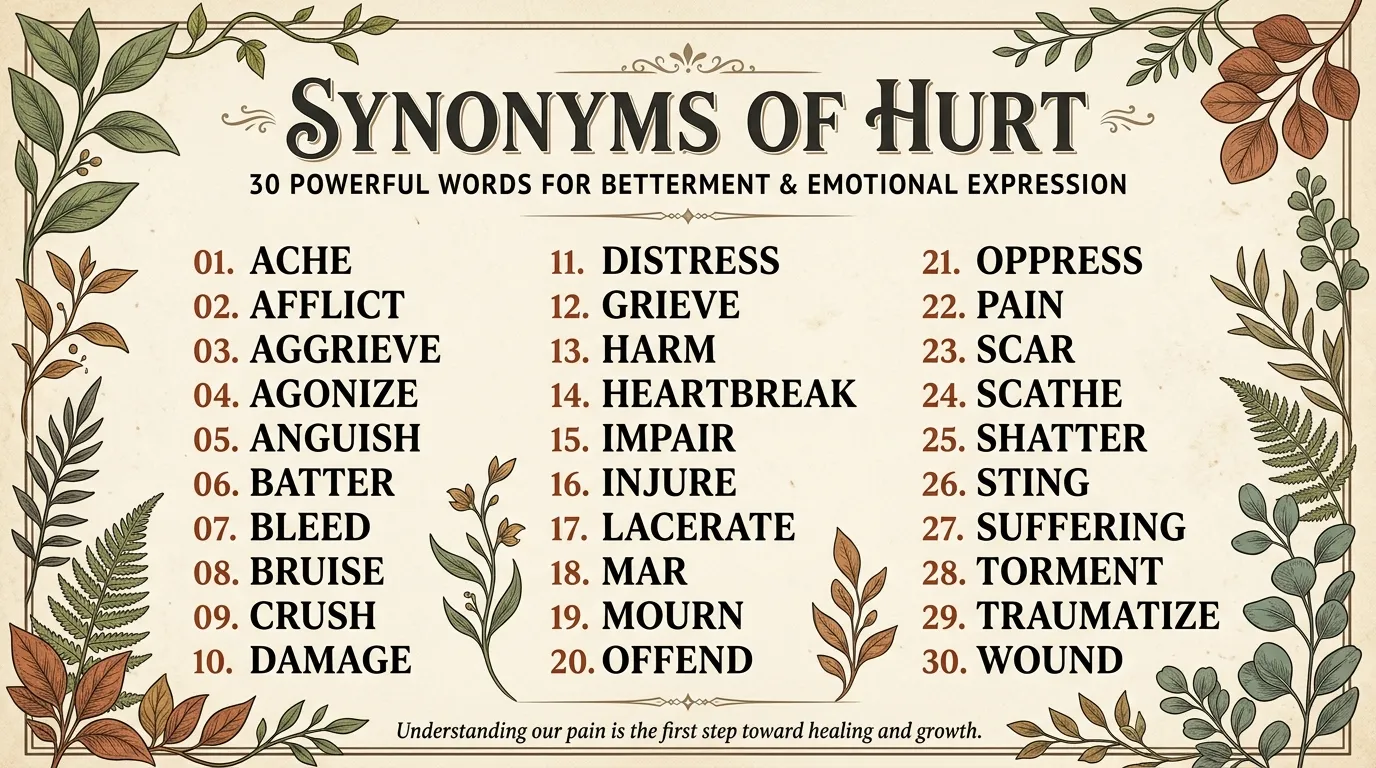
Synonyms of Hurt
These 30 words can replace hurt in some situations. The best choice depends on the type of pain and the sentence.
1. Injure (Verb) — US /ˈɪn.dʒɚ/ | UK /ˈɪn.dʒə/
Meaning: To cause physical harm to a person or animal.
Examples:
- He may injure his leg while playing.
- The fall injured her arm.
2. Wound (Verb/Noun) — US /wuːnd/ | UK /wuːnd/
Meaning: To cause an injury or a deep feeling of pain.
Examples:
- The sharp object wounded his hand.
- Her cruel words wounded his heart.
3. Harm (Verb/Noun) — US /hɑːrm/ | UK /hɑːm/
Meaning: To cause damage, pain, or trouble.
Examples:
- Too much sun can harm your skin.
- We should not harm animals.
4. Damage (Verb/Noun) — US /ˈdæm.ɪdʒ/ | UK /ˈdæm.ɪdʒ/
Meaning: To cause harm to something.
Examples:
- The fall damaged his knee.
- Harsh words can damage a friendship.
5. Pain (Verb/Noun) — US /peɪn/ | UK /peɪn/
Meaning: To cause or feel physical or emotional suffering.
Examples:
- My back pains me after work.
- His words caused her pain.
6. Ache (Verb/Noun) — US /eɪk/ | UK /eɪk/
Meaning: To feel a steady, often dull pain.
Examples:
- My legs ache after a long walk.
- Her head began to ache.
7. Injure Emotionally: Offend (Verb) — US /əˈfend/ | UK /əˈfend/
Meaning: To upset someone by saying or doing something rude.
Examples:
- I did not mean to offend you.
- His joke offended the teacher.
8. Upset (Verb/Adjective) — US /ʌpˈset/ | UK /ʌpˈset/
Meaning: To make someone feel sad, worried, or unhappy.
Examples:
- The bad news upset her.
- I felt upset after our talk.
9. Distress (Verb/Noun) — US /dɪˈstres/ | UK /dɪˈstres/
Meaning: To cause strong worry or sadness.
Examples:
- The news distressed his family.
- The lost child was in distress.
10. Sadden (Verb) — US /ˈsæd.ən/ | UK /ˈsæd.ən/
Meaning: To make someone feel sad.
Examples:
- The story saddened me.
- It saddens us to see animals suffer.
11. Grieve (Verb) — US /ɡriːv/ | UK /ɡriːv/
Meaning: To feel deep sadness, often after a loss.
Examples:
- The family grieved after his death.
- She still grieves for her friend.
12. Upset Emotionally: Disappoint (Verb) — US /ˌdɪs.əˈpɔɪnt/ | UK /ˌdɪs.əˈpɔɪnt/
Meaning: To make someone sad because things did not go as hoped.
Examples:
- I did not want to disappoint my parents.
- The lost match disappointed the team.
13. Trouble (Verb/Noun) — US /ˈtrʌb.əl/ | UK /ˈtrʌb.əl/
Meaning: To make someone worried or uneasy.
Examples:
- The news troubled him.
- Do not trouble yourself over small things.
14. Afflict (Verb) — US /əˈflɪkt/ | UK /əˈflɪkt/
Meaning: To cause pain or serious trouble.
Examples:
- The illness afflicted many people.
- Fear can afflict a person for years.
15. Torment (Verb/Noun) — US /tɔːrˈment/ | UK /tɔːˈment/
Meaning: To cause great pain or worry over time.
Examples:
- The bully tormented the young boy.
- His bad memories caused him torment.
16. Agonize (Verb) — US /ˈæɡ.ə.naɪz/ | UK /ˈæɡ.ə.naɪz/
Meaning: To feel great pain or worry.
Examples:
- She agonized over the hard choice.
- He agonized about his sick child.
17. Sting (Verb/Noun) — US /stɪŋ/ | UK /stɪŋ/
Meaning: To cause a sharp pain or a sudden feeling of sadness.
Examples:
- The bee stung my hand.
- His rude words stung her.
18. Burn (Verb/Noun) — US /bɝːn/ | UK /bɜːn/
Meaning: To cause a hot, sharp pain or injury.
Examples:
- Hot water burned his skin.
- My eyes burn in the smoke.
19. Bruise (Verb/Noun) — US /bruːz/ | UK /bruːz/
Meaning: To injure the body without breaking the skin, or to leave a dark mark.
Examples:
- I bruised my knee during the game.
- She had a bruise on her arm.
20. Cut (Verb/Noun) — US /kʌt/ | UK /kʌt/
Meaning: To make an opening or wound in the skin with something sharp.
Examples:
- He cut his finger with a knife.
- The cut on her hand was small.
21. Sore (Adjective/Noun) — US /sɔːr/ | UK /sɔː/
Meaning: Painful or tender to touch.
Examples:
- My feet are sore after walking.
- He has a sore throat.
22. Ache Emotionally: Yearn (Verb) — US /jɝːn/ | UK /jɜːn/
Meaning: To want someone or something so much that it causes sadness.
Examples:
- She yearned to see her family.
- He yearned for his old home.
23. Grieve Emotionally: Mourn (Verb) — US /mɔːrn/ | UK /mɔːn/
Meaning: To feel or show deep sadness after a death or loss.
Examples:
- They mourned the loss of their friend.
- The town mourned its old leader.
24. Crush (Verb) — US /krʌʃ/ | UK /krʌʃ/
Meaning: To press or break something with force, or to badly damage someone’s hopes.
Examples:
- The heavy box crushed his foot.
- The bad news crushed her hopes.
25. Shatter (Verb) — US /ˈʃæt̬.ɚ/ | UK /ˈʃæt.ə/
Meaning: To break something into pieces or badly damage someone’s feelings.
Examples:
- The fall shattered the glass.
- His lie shattered her trust.
26. Harass (Verb) — US /həˈræs/ | UK /ˈhær.əs/
Meaning: To keep bothering or troubling someone.
Examples:
- The bully harassed the new student.
- No one should harass others at school.
27. Abuse (Verb/Noun) — US /əˈbjuːs/ | UK /əˈbjuːs/ (verb)
Meaning: To treat someone in a cruel or harmful way.
Examples:
- We must never abuse animals.
- The child needed help after the abuse.
28. Violate (Verb) — US /ˈvaɪ.ə.leɪt/ | UK /ˈvaɪ.ə.leɪt/
Meaning: To break a rule or fail to respect someone’s rights.
Examples:
- The action violated school rules.
- Do not violate another person’s privacy.
29. Grate (Verb) — US /ɡreɪt/ | UK /ɡreɪt/
Meaning: To annoy someone or cause an unpleasant feeling.
Examples:
- His loud voice grated on my nerves.
- The rude tone grated on her.
30. Worry (Verb/Noun) — US /ˈwɝː.i/ | UK /ˈwʌr.i/
Meaning: To cause concern or feel uneasy about something.
Examples:
- Do not worry your mother with false news.
- I worry about my exam results.
Prototype Meaning
The most common meaning of hurt is to feel or cause pain. When people hear this word, they may think of a child who falls and hurts a knee. They may also think of a person who feels sad after hearing unkind words. Hurt can describe pain in the body, pain in the heart, or damage to a thing or relationship. The exact meaning depends on the sentence.
Prototype Categorization
Synonyms of hurt can be grouped by the kind of pain they describe.
- Physical injury: Injure, wound, bruise, cut, burn, and damage. Use these words for harm to the body or an object.
- Emotional pain: Upset, sadden, distress, offend, and disappoint. Use these words when someone feels sad or unhappy.
- Deep emotional pain: Grieve, mourn, torment, and agonize. Use these words for strong or lasting pain.
- Sharp or steady pain: Sting, burn, ache, and sore. Use these words for certain kinds of body pain or sudden emotional pain.
- Harmful actions: Harm, afflict, harass, abuse, and violate. Use these words when an action causes harm or treats someone badly.
- Worry and discomfort: Trouble, worry, and grate. Use these words when something causes concern or annoyance.
- Damage to hopes or trust: Crush and shatter. Use these words when someone loses hope or trust.
Antonyms of Hurt
Antonyms are words with opposite meanings.
- Heal: To make a person or injury better.
- Help: To give support to someone.
- Comfort: To help someone feel calm and safe.
- Soothe: To calm pain or worry.
- Protect: To keep someone safe from harm.
- Relieve: To make pain or worry less strong.
- Please: To make someone happy or glad.
- Encourage: To give someone hope or support.
- Mend: To repair something that is broken.
- Care for: To look after someone with kindness.
Short Questions and Answers
- What does hurt mean? Hurt means to feel pain or cause pain to someone or something.
- When should hurt be used? Use hurt for physical pain, emotional pain, or damage. For example, “I hurt my hand” or “Your words hurt me.”
- Is hurt positive or negative? Hurt usually has a negative meaning because it relates to pain or harm. The way people respond to hurt may lead to kindness and care.
- How is hurt different from similar words? Hurt is a general word. Injure often means physical harm. Offend means to upset someone with words or actions. Ache means to feel a steady pain.
Conclusion
Learning the synonyms of hurt can help you use English in a better way. The word hurt can describe pain in the body, sadness in the heart, or damage to a friendship. Words such as injure, ache, upset, wound, and distress help you explain these ideas with more care.
Using different words also makes your writing clear and less dull. You can use them in school work, stories, daily talks, and online content. Knowing the meaning and tone of each word helps you choose the right one for each situation.
Try to learn two or three new words each day. Write a short sentence with each word and use it in a real talk. With daily practice, your vocabulary will grow, your writing will improve, and you will feel more sure when speaking English.

I’m Zahid Abbas, an educator, researcher, and digital publishing strategist with a passion for linguistics, grammar, and clear communication. As a content creator and SEO specialist, I craft research-driven, reader-focused content that empowers learners and makes knowledge accessible worldwide.