The word claim means to say that something is true, to state that something belongs to you, or to ask for something you have a right to receive. For example, a student may claim that they completed their homework, while a worker may claim money for travel costs. The meaning depends on the situation.
People use “claim” in daily talks, schoolwork, news, business, and legal matters. It also helps students, bloggers, and content writers avoid using the same word too often.
In this article, you will learn the meaning of claim, its common uses, emotional tone, history, pronunciation, and word formation. You will also explore 30 synonyms with simple meanings and examples. These words will help you choose the right word for speaking, writing, and everyday communication.
Meaning of Claim
Definition
Claim (noun and verb): To say that something is true, to state that something belongs to you, or to ask for something you believe you have a right to receive.
Examples
- The student claims that he finished the work on time.
- She made a claim for her lost luggage.
As a noun: A statement that something is true or a request for something you believe you deserve.
Connotative Meaning
- Positive tone: “Claim” can suggest confidence or standing up for your rights. Example: She claimed her right to speak.
- Negative tone: It can suggest doubt when someone makes a statement without proof. Example: His claim seemed false.
- Neutral tone: It can simply describe a statement or request. Example: He filed a claim for insurance.
Read more about:https://synonymhunting.com/synonyms-of-marginalized/
Etymology of Claim
The word “claim” has a long history in English and comes through French from Latin.
- Source language: Latin, through Old French and Middle English.
- Original meaning: The Latin verb clamare meant “to cry out” or “to call aloud.”
- Related Latin word: Clamare is also linked to the idea of making a loud statement or calling for attention.
Short History of the Word
- Old English (450–1100): The modern word “claim” was not a common established English word in this period. English used other words to express ideas such as calling out or demanding.
- Middle English (1100–1500): The word entered English through Anglo-French and Old French forms related to claimer. It came to mean calling for something, demanding it, or stating a right to it.
- Modern English (1500–Present): “Claim” developed wider uses in law, business, insurance, everyday speech, and academic writing. Today, it can refer to a statement, a right, ownership, or a formal request.
Pronunciation of Claim
- US: /kleɪm/
- UK: /kleɪm/
- Syllables: claim (one syllable)
- Word stress: The whole word is stressed because it has only one syllable.
Affixation Pattern of Claim
- Root: claim
- Prefix: None in the base word.
- Suffix: None in the base word.
- Word formation: The word “claim” can form several related words by adding suffixes or combining it with other words.
Word
Grammatical category
Meaning
Claim
Noun/verb
A statement, request, or act of stating
Claimed
Verb/adjective
Stated as true or said to belong to someone
Claiming
Verb/noun
The act of stating or requesting
Claimant
Noun
A person who makes a claim
Claimable
Adjective
Able to be claimed
Claimless
Adjective
Without a claim; uncommon
Reclaim
Verb
To take back or recover
Reclaimed
Verb/adjective
Taken back or recovered
Reclaiming
Verb/noun
The act of taking something back
Counterclaim
Noun/verb
A claim made against another claim
These words share the root “claim,” but their meanings and grammatical uses can differ.
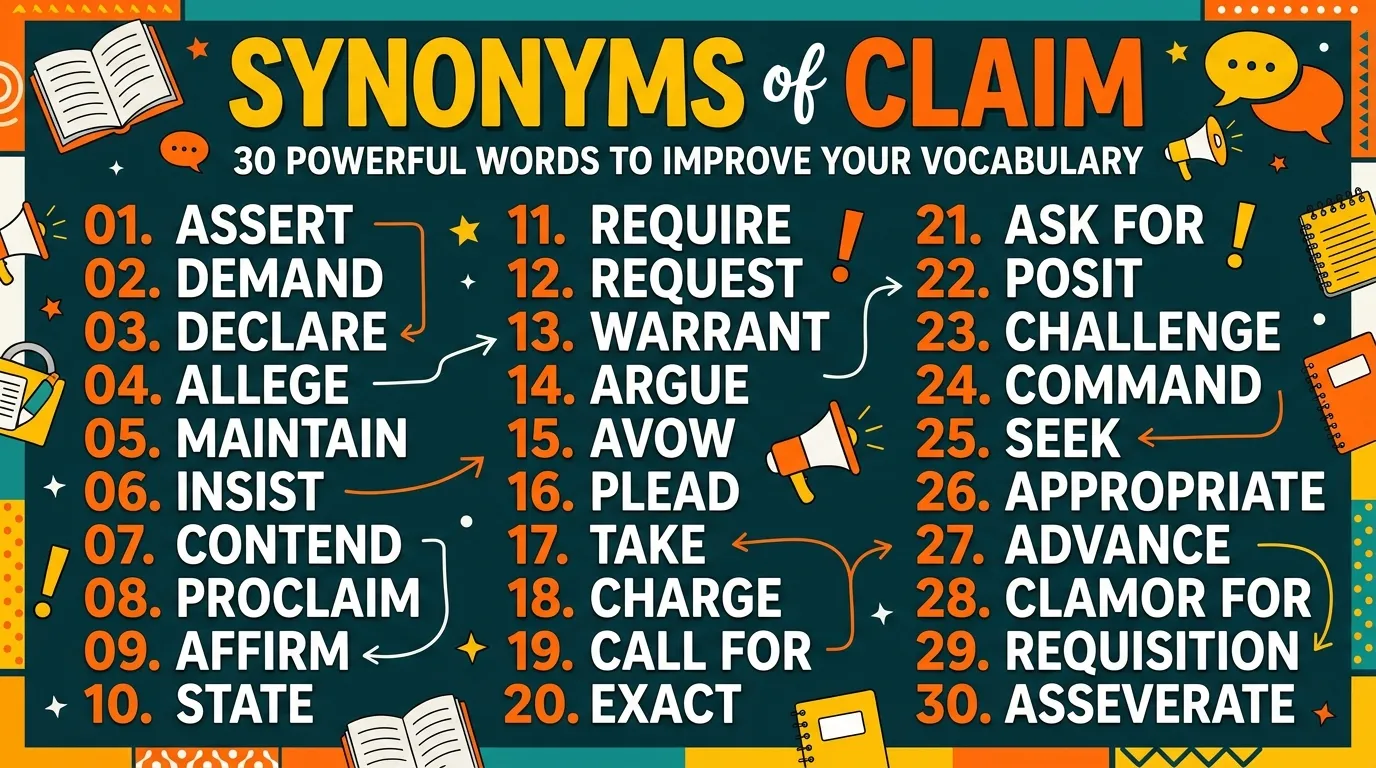
30 Synonyms of Claim
The best synonym depends on whether “claim” means making a statement, asking for something, or taking ownership. Some words below are close alternatives, while others fit only particular contexts.
1. Assert (Verb) — US /əˈsɝːt/ | UK /əˈsɜːt/
Meaning: To state something firmly or confidently.
Examples:
- She asserted that she had done nothing wrong.
- The teacher asserted that practice improves learning.
2. State (Verb) — US /steɪt/ | UK /steɪt/
Meaning: To express something clearly in words.
Examples:
- He stated that the report was correct.
- Please state your reason for being late.
3. Declare (Verb) — US /dɪˈkler/ | UK /dɪˈkleə/
Meaning: To announce something clearly or officially.
Examples:
- She declared that she was ready.
- The winner declared his support for the team.
4. Allege (Verb) — US /əˈledʒ/ | UK /əˈledʒ/
Meaning: To say that something happened without proving it.
Examples:
- The report alleges that money was stolen.
- He alleged that the rules were unfair.
5. Maintain (Verb) — US /meɪnˈteɪn/ | UK /meɪnˈteɪn/
Meaning: To continue saying that something is true.
Examples:
- She maintained that she was innocent.
- He maintains that the plan will work.
6. Insist (Verb) — US /ɪnˈsɪst/ | UK /ɪnˈsɪst/
Meaning: To say firmly that something is true or must happen.
Examples:
- He insisted that he had paid the bill.
- She insisted on speaking to the manager.
7. Contend (Verb) — US /kənˈtend/ | UK /kənˈtend/
Meaning: To argue that something is true.
Examples:
- The writer contends that education changes lives.
- They contend that the new rule is unfair.
8. Proclaim (Verb) — US /proʊˈkleɪm/ | UK /prəʊˈkleɪm/
Meaning: To announce something openly or publicly.
Examples:
- The leader proclaimed a new policy.
- She proclaimed her love for music.
9. Affirm (Verb) — US /əˈfɝːm/ | UK /əˈfɜːm/
Meaning: To state that something is true or correct.
Examples:
- He affirmed that the details were accurate.
- The witness affirmed her earlier statement.
10. Avow (Verb) — US /əˈvaʊ/ | UK /əˈvaʊ/
Meaning: To admit or declare something openly.
Examples:
- She avowed her loyalty to her friends.
- He avowed that he had made a mistake.
11. Assert a Right: Demand (Verb) — US /dɪˈmænd/ | UK /dɪˈmɑːnd/
Meaning: To ask firmly for something you believe you deserve.
Examples:
- Workers demanded fair pay.
- She demanded an explanation for the delay.
12. Request (Verb/Noun) — US /rɪˈkwest/ | UK /rɪˈkwest/
Meaning: To ask for something politely or formally.
Examples:
- He requested a refund for the damaged item.
- Her request for help was accepted.
13. Seek (Verb) — US /siːk/ | UK /siːk/
Meaning: To try to obtain or find something.
Examples:
- They seek compensation for their losses.
- She seeks permission to attend the event.
14. Petition (Verb/Noun) — US /pəˈtɪʃən/ | UK /pəˈtɪʃən/
Meaning: To make a formal request to an authority.
Examples:
- Residents petitioned the council for better roads.
- The group submitted a petition for change.
15. Apply (Verb) — US /əˈplaɪ/ | UK /əˈplaɪ/
Meaning: To make a formal request for something.
Examples:
- She applied for financial assistance.
- He applied for a refund after the mistake.
16. File (Verb) — US /faɪl/ | UK /faɪl/
Meaning: To submit an official document or request.
Examples:
- They filed a claim with the insurance company.
- She filed a complaint about the service.
17. Assert Ownership: Own (Verb) — US /oʊn/ | UK /əʊn/
Meaning: To have something as your property.
Examples:
- They own a small house near the school.
- He owns the car parked outside.
18. Take (Verb) — US /teɪk/ | UK /teɪk/
Meaning: To get, receive, or gain possession of something.
Examples:
- The team took first place in the contest.
- She took control of the project.
19. Appropriate (Verb) — US /əˈproʊpriˌeɪt/ | UK /əˈprəʊprieɪt/
Meaning: To take something for a particular use, sometimes without permission.
Examples:
- The agency appropriated funds for the project.
- He was accused of appropriating someone else’s work.
20. Assert a Right: Claim Ownership (Verb Phrase)
Meaning: To state that something belongs to you.
Examples:
- She claimed ownership of the painting.
- He claimed ownership of the land.
21. Maintain a Position: Argue (Verb) — US /ˈɑːrɡjuː/ | UK /ˈɑːɡjuː/
Meaning: To give reasons for why you believe something.
Examples:
- She argued that the test was too difficult.
- He argued that every child deserves an education.
22. Propose (Verb) — US /prəˈpoʊz/ | UK /prəˈpəʊz/
Meaning: To suggest an idea or plan for consideration.
Examples:
- The researcher proposed a new explanation.
- She proposed that the meeting begin earlier.
23. Purport (Verb) — US /pərˈpɔːrt/ | UK /pəˈpɔːt/
Meaning: To claim or appear to be something, often when the truth is uncertain.
Examples:
- The document purports to be an official record.
- The article purports to explain the whole event.
24. Testify (Verb) — US /ˈtestɪfaɪ/ | UK /ˈtestɪfaɪ/
Meaning: To give a statement, especially in court, about what you know.
Examples:
- The witness testified about what she saw.
- He agreed to testify in court.
25. Certify (Verb) — US /ˈsɝːtəˌfaɪ/ | UK /ˈsɜːtɪfaɪ/
Meaning: To confirm officially that something is true or meets a standard.
Examples:
- The officer certified that the copies were genuine.
- The school certified her training record.
26. Attest (Verb) — US /əˈtest/ | UK /əˈtest/
Meaning: To confirm that something is true, often based on knowledge or evidence.
Examples:
- The documents attest to his experience.
- Several witnesses attested to her honesty.
27. Conclude (Verb) — US /kənˈkluːd/ | UK /kənˈkluːd/
Meaning: To decide that something is true after considering information.
Examples:
- The researchers concluded that the method worked.
- We concluded that more evidence was needed.
28. Believe (Verb) — US /bɪˈliːv/ | UK /bɪˈliːv/
Meaning: To think that something is true.
Examples:
- I believe that she is telling the truth.
- He believes that hard work brings success.
29. Assertion (Noun) — US /əˈsɝːʃən/ | UK /əˈsɜːʃən/
Meaning: A statement that something is true.
Examples:
- His assertion surprised the audience.
- The writer supported her assertion with facts.
30. Accusation (Noun) — US /ˌækjuˈzeɪʃən/ | UK /ˌækjʊˈzeɪʃən/
Meaning: A statement that someone has done something wrong.
Examples:
- The accusation damaged his reputation.
- She denied the accusation against her.
Important usage note: These synonyms are not interchangeable in every sentence. For example, assert means to state firmly, allege often suggests an unproven accusation, request means to ask, and own means to possess. Choose the word that matches your intended meaning.
Prototype Meaning of Claim
The most typical meaning of “claim” is to state that something is true or to say that something belongs to you. For example, a student may claim that an answer is correct, while a customer may claim a refund. The exact meaning depends on the words around it. A claim may be true, false, proven, or unproven. Therefore, readers should look at the context before deciding what the word means.
Prototype Categorization
Synonyms of claim can be grouped by meaning. This helps writers select the most suitable word for each situation.
- Stating something as true: Assert, state, declare, affirm, allege, maintain, contend, and avow. Use these words when discussing opinions, facts, or statements.
- Making a strong statement: Insist, proclaim, and argue. These words can show confidence, emphasis, or disagreement.
- Asking for something officially: Request, demand, seek, petition, apply, and file. Use them when someone wants a service, payment, benefit, or decision.
- Showing ownership or control: Own, take, and claim ownership. These words describe possession or control, but their meanings differ.
- Giving proof or confirmation: Testify, certify, attest, and conclude. These words are useful in legal, academic, and professional writing.
- Expressing an idea or possibility: Propose, purport, and believe. These words describe suggestions, appearances, or personal views.
- Describing statements or accusations: Assertion and accusation. These nouns name particular kinds of statements.
Why Categorization Matters
Choosing the right synonym makes writing more accurate and natural. For example, assert is useful for a confident statement, while allege is often used when an accusation has not been proven. Similarly, request sounds more polite than demand. Grouping words by meaning helps English learners avoid mistakes and express ideas clearly.
Antonyms of Claim
An antonym is a word with an opposite or contrasting meaning. Because “claim” has several meanings, its antonyms depend on the context.
Antonym
Meaning
Example
Deny
Say something is not true
He denied the claim.
Disclaim
State that you do not claim or accept something
She disclaimed ownership of the item.
Retract
Take back a statement
The writer retracted his claim.
Withdraw
Remove a statement or request
They withdrew their claim.
Renounce
Give up a right or belief
He renounced his claim to the property.
Surrender
Give up possession or control
They surrendered their claim to the land.
Refute
Show that a statement is false
The evidence refuted the claim.
Disprove
Prove that something is not true
The test disproved the claim.
Reject
Refuse to accept something
The company rejected the claim.
Abandon
Give up an attempt or demand
She abandoned her claim to the prize.
These words are not exact opposites in every situation. For example, “deny” is an opposite of accepting a statement as true, while “withdraw” is an opposite of continuing to pursue a request.
Short Questions and Answers
– What does claim mean?
Claim means to say something is true, state that something belongs to you, or request something you believe you deserve.
– When should claim be used?
Use “claim” when making a statement, asserting ownership, or requesting something such as insurance money or compensation.
– Is claim positive or negative?
Claim is generally neutral. It can sound positive when someone stands up for their rights or negative when an unsupported statement raises doubt.
– How is claim different from similar words?
“Claim” has several meanings. “Assert” means to state firmly, “allege” means to make an often unproven statement, “demand” means to ask firmly, and “request” means to ask for something.
– What is the noun form of claim?
“Claim” is already a noun. It can refer to a statement, a right, or an official request.
– What is the verb form of claim?
“Claim” is also a verb. For example: They claim that the product is safe.
– What are the most common synonyms of claim?
Common alternatives include assert, state, declare, allege, maintain, and request. The best choice depends on the sentence.
– What is the opposite of claim?
Possible opposites include deny, retract, withdraw, and disclaim, depending on the meaning.
Conclusion
Learning the meaning of claim and its synonyms can improve your English vocabulary and communication skills. Words such as assert, state, declare, allege, and request help you express different ideas with greater accuracy. Understanding their meanings also helps you avoid repetition in essays, blog posts, school assignments, and everyday conversations.
It is important to remember that not every synonym can replace claim in every sentence. Some words express a firm statement, while others describe a request, an accusation, or a right to something. Learning their pronunciation, grammar, tone, and history can help you use them correctly.

I’m Zahid Abbas, an educator, researcher, and digital publishing strategist with a passion for linguistics, grammar, and clear communication. As a content creator and SEO specialist, I craft research-driven, reader-focused content that empowers learners and makes knowledge accessible worldwide.