Assimilate means to take in and understand new information, or to become part of a new group or culture. Imagine a student who moves to another country. At first, the student finds the language, food, and customs strange. Over time, the student learns the language, understands local habits, and becomes part of the community. This process is called assimilation.
The word assimilate is common in education, science, psychology, and discussions about culture. It can describe how people learn new ideas, how the body takes in nutrients, or how newcomers adapt to a society.
Learning synonyms of assimilate helps English learners express ideas more clearly. It also helps content writers avoid using the same word again and again. However, not every synonym has the same meaning or tone. In this guide, you will learn the definition, grammar, pronunciation, history, and connotative meaning of assimilate. You will also explore 30 useful synonyms, with simple meanings and examples, to help you choose the right word for speaking and writing.
Meaning of Assimilate
Definition
Assimilate (verb): To take in and understand information, or to become part of a group or culture by adapting to its ways.
Examples
- Students assimilate new ideas when they connect them with what they already know.
- The family began to assimilate into their new community.
Read more about:https://synonymhunting.com/synonyms-for-share/
Connotative Meaning
(Connotation is the feeling or idea that a word suggests beyond its basic meaning.)
- Positive tone: Assimilate can suggest learning, growth, understanding, and successful adaptation.
- Negative tone: It may suggest pressure to give up one’s cultural identity or follow the customs of a dominant group.
- Neutral tone: It can describe the normal process of taking in information, nutrients, or new cultural practices.
The tone depends on the situation. Assimilating new information is often positive, while forced cultural assimilation can be harmful.
Etymology of Assimilate
The word assimilate comes from Latin through French.
- Source language: Latin assimilare.
- Original meaning: To make similar or to make like.
- Word roots: The Latin ad- means “to” or “toward,” while similis means “similar” or “like.”
- Development: The word entered English through French and Latin forms and gradually gained meanings related to learning, absorption, and cultural adaptation.
Short History of Assimilate
- Old English period (450–1100): The modern English word assimilate was not a common established word in Old English. Related ideas were expressed through other words about likeness and becoming similar.
- Middle English period (1100–1500): French and Latin influenced English vocabulary. Learned words related to similarity and absorption became more familiar through education and scholarly writing.
- Modern English period (1500–present): Assimilate developed wider uses in science, education, and social discussions. Today, it can describe learning information, absorbing substances, or adapting to a culture.
Pronunciation of Assimilate
- US IPA: /əˈsɪməˌleɪt/
- UK IPA: /əˈsɪmɪleɪt/
Syllables
as-sim-i-late — 4 syllables.
Affixation Pattern of Assimilate
- Root: simil — related to similarity or likeness.
- Prefix: ad- — “to” or “toward”; it changes to as- through assimilation of sounds.
- Suffix: -ate — forms a verb.
- Word formation: Assimilate is a verb formed from a Latin-based word structure.
Related Word Forms
| Word | Grammatical category | Meaning |
| Assimilate | Verb | To absorb, understand, or adapt |
| Assimilates | Verb | Third-person singular present form |
| Assimilated | Verb/adjective | Absorbed or adapted |
| Assimilating | Verb/adjective | Taking in or adapting |
| Assimilation | Noun | The process of absorbing or adapting |
| Assimilator | Noun | A person or thing that assimilates |
| Assimilative | Adjective | Related to assimilation |
| Assimilable | Adjective | Able to be assimilated |
These related forms are useful when you want to discuss the same idea using different grammatical structures.
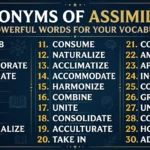
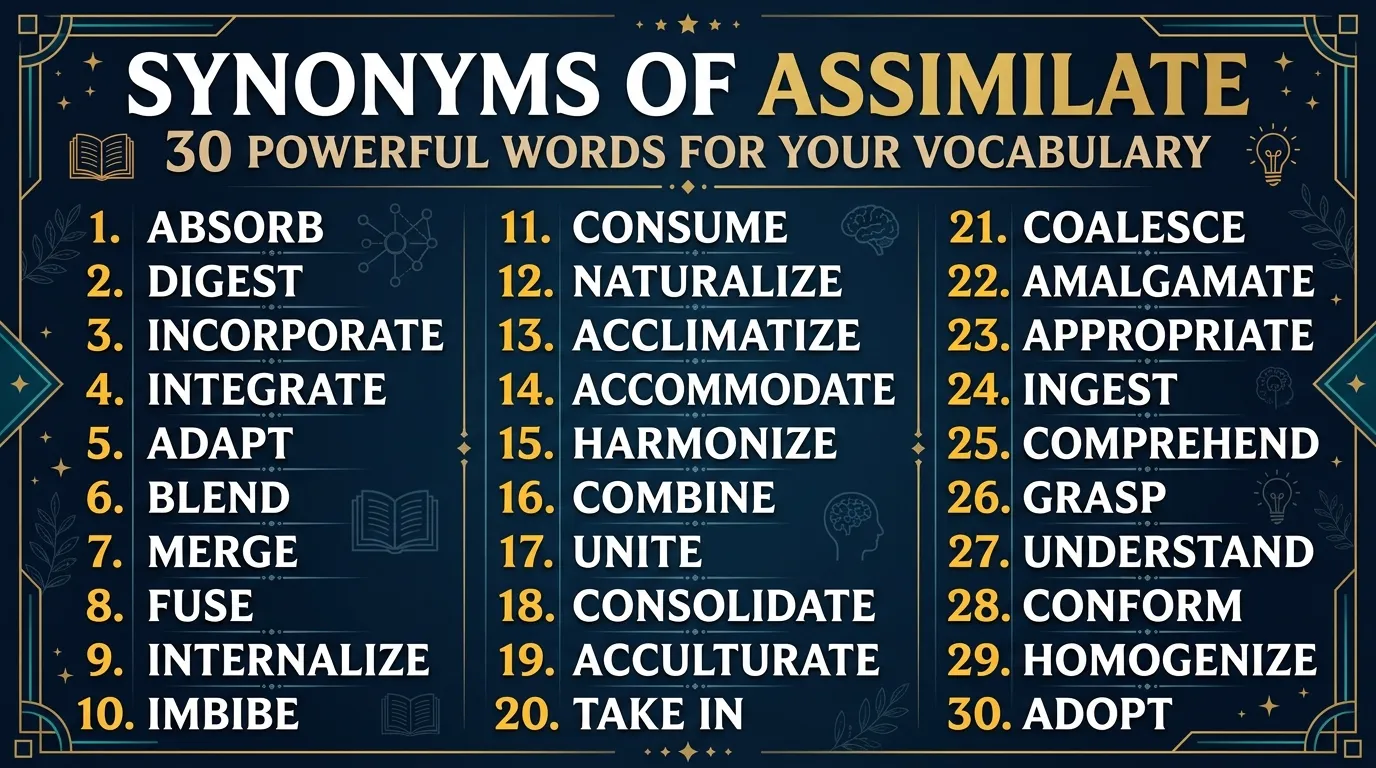
Synonyms of Assimilate
The best synonym depends on what assimilate means in a sentence. Some words describe learning, while others describe absorption, adaptation, or becoming part of a group.
1. Absorb (Verb) — US /əbˈzɔrb/ | UK /əbˈzɔːb/
Meaning: To take in information, liquid, energy, or another substance.
Examples:
- Children absorb new words quickly.
- The soil absorbs water after the rain.
2. Understand (Verb) — US /ˌʌndərˈstænd/ | UK /ˌʌndəˈstænd/
Meaning: To know the meaning of something or how it works.
Examples:
- I understand the main idea of the lesson.
- She understands how the machine works.
3. Comprehend (Verb) — US /ˌkɑmprɪˈhɛnd/ | UK /ˌkɒmprɪˈhɛnd/
Meaning: To understand something fully.
Examples:
- The student comprehended the difficult passage.
- He could not comprehend the teacher’s explanation.
4. Learn (Verb) — US /lɜrn/ | UK /lɜːn/
Meaning: To gain knowledge or a new skill.
Examples:
- Children learn new facts at school.
- She learned how to speak Spanish.
5. Grasp (Verb) — US /ɡræsp/ | UK /ɡrɑːsp/
Meaning: To understand an idea or concept.
Examples:
- He quickly grasped the main point.
- It took me time to grasp the new rule.
6. Digest (Verb) — US /daɪˈdʒɛst/ | UK /daɪˈdʒest/
Meaning: To process food or think carefully about information.
Examples:
- Give the students time to digest the lesson.
- She needed a few minutes to digest the news.
7. Internalize (Verb) — US /ɪnˈtɜrnəˌlaɪz/ | UK /ɪnˈtɜːnəlaɪz/
Meaning: To make an idea, belief, or skill part of your own thinking.
Examples:
- Students internalize rules through practice.
- He internalized the values taught by his parents.
8. Incorporate (Verb) — US /ɪnˈkɔrpəˌreɪt/ | UK /ɪnˈkɔːpəreɪt/
Meaning: To include something as part of a larger whole.
Examples:
- The teacher incorporated games into the lesson.
- She incorporated the new ideas into her report.
9. Integrate (Verb) — US /ˈɪntəˌɡreɪt/ | UK /ˈɪntɪɡreɪt/
Meaning: To combine things or help someone become part of a group.
Examples:
- The school helps new students integrate into the class.
- We integrated the new system into our daily work.
10. Adapt (Verb) — US /əˈdæpt/ | UK /əˈdæpt/
Meaning: To change to suit a new situation.
Examples:
- She adapted to life in a new city.
- Animals adapt to changes in their environment.
11. Acclimate (Verb) — US /ˈækləˌmeɪt/ | UK /ˈæklɪmeɪt/
Meaning: To become familiar with a new environment or climate.
Examples:
- The players needed time to acclimate to the heat.
- New workers acclimated to the office within a week.
12. Assimilate into (Verb phrase) — US /əˈsɪməˌleɪt ˈɪntuː/ | UK /əˈsɪmɪleɪt ˈɪntuː/
Meaning: To become part of a group or community by adopting some of its practices.
Examples:
- The newcomers assimilated into the local community.
- He found it easy to assimilate into the school.
13. Absorb into (Verb phrase) — US /əbˈzɔrb ˈɪntuː/ | UK /əbˈzɔːb ˈɪntuː/
Meaning: To take something into a larger group or system.
Examples:
- The company absorbed the smaller business into its main operations.
- The new team was absorbed into the larger department.
14. Ingest (Verb) — US /ɪnˈdʒɛst/ | UK /ɪnˈdʒest/
Meaning: To take food, drink, or another substance into the body.
Examples:
- The body ingests food through the mouth.
- Never ingest a chemical unless a qualified professional confirms it is safe.
15. Take in (Verb phrase) — US /teɪk ɪn/ | UK /teɪk ɪn/
Meaning: To receive or understand information, or to absorb a substance.
Examples:
- I could not take in all the details at once.
- Plants take in water through their roots.
16. Process (Verb) — US /ˈprɑsɛs/ | UK /ˈprəʊses/
Meaning: To deal with information or material through a series of steps.
Examples:
- The brain processes information from the senses.
- She needed time to process what had happened.
17. Interpret (Verb) — US /ɪnˈtɜrprɪt/ | UK /ɪnˈtɜːprɪt/
Meaning: To explain or understand the meaning of something.
Examples:
- Students interpreted the poem in different ways.
- He interpreted her silence as a sign of worry.
18. Comprehend fully (Verb phrase) — US /ˌkɑmprɪˈhɛnd ˈfʊli/ | UK /ˌkɒmprɪˈhend ˈfʊli/
Meaning: To understand all the important parts of something.
Examples:
- She comprehended the full impact of the decision.
- The class worked hard to comprehend the entire chapter.
19. Master (Verb) — US /ˈmæstər/ | UK /ˈmɑːstə/
Meaning: To learn a skill or subject very well.
Examples:
- He mastered the basics of English grammar.
- She mastered the piano after years of practice.
20. Familiarize (Verb) — US /fəˈmɪljəˌraɪz/ | UK /fəˈmɪliəraɪz/
Meaning: To help someone learn about or become familiar with something.
Examples:
- The guide familiarized us with the local customs.
- Familiarize yourself with the new rules before the test.
21. Accommodate (Verb) — US /əˈkɑməˌdeɪt/ | UK /əˈkɒmədeɪt/
Meaning: To adjust to someone’s needs or make room for a change.
Examples:
- The school accommodated students with different learning needs.
- The team accommodated the new schedule.
22. Conform (Verb) — US /kənˈfɔrm/ | UK /kənˈfɔːm/
Meaning: To behave according to a rule, standard, or group expectation.
Examples:
- Students must conform to the school’s safety rules.
- He refused to conform to every social expectation.
23. Blend (Verb) — US /blɛnd/ | UK /blend/
Meaning: To mix with something or become difficult to distinguish from it.
Examples:
- The new students blended into the class.
- The colors blend well together.
24. Merge (Verb) — US /mɜrdʒ/ | UK /mɜːdʒ/
Meaning: To combine two or more things into one.
Examples:
- The two departments merged last year.
- The river merges with the sea.
25. Unify (Verb) — US /ˈjuːnəˌfaɪ/ | UK /ˈjuːnɪfaɪ/
Meaning: To bring people or things together as one.
Examples:
- The shared goal unified the team.
- The leader tried to unify the divided community.
26. Encompass (Verb) — US /ɪnˈkʌmpəs/ | UK /ɪnˈkʌmpəs/
Meaning: To include or cover a wide range of things.
Examples:
- The course encompasses history, science, and art.
- The report encompasses several important issues.
27. Assimilate knowledge (Verb phrase) — US /əˈsɪməˌleɪt ˈnɑlɪdʒ/ | UK /əˈsɪmɪleɪt ˈnɒlɪdʒ/
Meaning: To take in new facts and understand how they connect with what you already know.
Examples:
- Students assimilate knowledge through reading and discussion.
- Practice helps learners assimilate knowledge more effectively.
28. Acculturate (Verb) — US /əˈkʌltʃəˌreɪt/ | UK /əˈkʌltʃəreɪt/
Meaning: To adopt or learn elements of another culture through contact with it.
Examples:
- The newcomers acculturated while keeping many of their traditions.
- Living abroad helped her acculturate to local customs.
29. Socialize (Verb) — US /ˈsoʊʃəˌlaɪz/ | UK /ˈsəʊʃəlaɪz/
Meaning: To learn social habits or spend time with other people.
Examples:
- Children socialize by playing and working together.
- The school helps new pupils socialize with their classmates.
30. Assimilative (Adjective) — US /əˈsɪməˌleɪtɪv/ | UK /əˈsɪmɪlətɪv/
Meaning: Related to the process of absorbing information or adapting to a group.
Examples:
- The teacher used an assimilative approach to help students connect new ideas with old ones.
- The study explored assimilative processes in cultural learning.
Note: The last entry is an adjective related to assimilate, rather than a direct verb synonym. It is useful for vocabulary development, but it should not replace the verb in every sentence.
Prototype Meaning of Assimilate
The most typical meaning of assimilate is to take in something and make it part of what you already know or are. When people hear this word in education, they often imagine a student learning new information and connecting it with existing knowledge. In cultural discussions, they may imagine a person learning a community’s language, customs, and social habits. In science, the word may describe how a living organism absorbs and uses nutrients. The central idea is that something new becomes part of a larger system, mind, or group.
Prototype Categorization
Synonyms can be grouped by their main meanings. This makes it easier to select a word that fits your sentence.
- Learning and understanding: understand, comprehend, learn, grasp, digest, internalize, master, interpret, comprehend fully.
- Absorption and processing: absorb, ingest, take in, process, absorb into, assimilate knowledge.
- Joining or combining: incorporate, integrate, merge, blend, unify, encompass.
- Adjustment and cultural change: adapt, acclimate, assimilate into, acculturate, accommodate, conform.
- Social learning and interaction: socialize, familiarize.
- Related descriptive word: assimilative.
These categories help writers avoid choosing a synonym that changes the meaning. For example, comprehend works well for understanding an idea, while integrate is better for joining something to a larger system. Acculturate is especially useful when discussing cultural change. Choosing the right synonym makes writing clearer and more natural.
Antonyms of Assimilate
Antonyms are words with opposite or contrasting meanings. The best opposite depends on the sense of assimilate being used.
- Reject — to refuse to accept something.
- Resist — to oppose or fight against something.
- Exclude — to keep someone or something out.
- Separate — to keep things apart.
- Isolate — to keep someone or something apart from others.
- Disregard — to pay no attention to something.
- Misunderstand — to understand something incorrectly.
- Forget — to fail to remember information.
- Expel — to force someone or something out.
- Disintegrate — to break into separate parts.
For example, integrate and exclude contrast when discussing group membership, while understand and misunderstand contrast when discussing knowledge.
Short Questions and Answers
– What does assimilate mean?
Assimilate means to take in and understand information or to become part of a group or culture.
– When should assimilate be used?
Use assimilate when describing the absorption of information or substances, or the process of adapting to a group or culture.
– Is assimilate positive or negative?
It can be positive, negative, or neutral. Learning new ideas may be positive, while forced cultural assimilation may be negative.
– How is assimilate different from similar words?
Assimilate often suggests taking something in and making it part of a larger whole. Understand focuses on meaning, absorb on taking something in, integrate on combining or joining, and adapt on adjusting to a new situation.
Conclusion
Learning the meaning of assimilate and its synonyms can help you become a stronger English speaker and writer. Words such as understand, absorb, integrate, and adapt express related ideas, but each has its own use. Knowing these differences helps you choose words that match your message.
A wider vocabulary also makes your writing more interesting. Instead of repeating one word, you can select a more precise alternative for each situation. This is especially useful for students, ESL learners, teachers, bloggers, and content writers.
To improve, learn a few synonyms each day. Write your own sentences, read English texts, and practice using new words in real conversations. Pay attention to meaning, pronunciation, and tone. With regular practice, you will express ideas more clearly, avoid repetition, and build confidence in English.

I’m Zahid Abbas, an educator, researcher, and digital publishing strategist with a passion for linguistics, grammar, and clear communication. As a content creator and SEO specialist, I craft research-driven, reader-focused content that empowers learners and makes knowledge accessible worldwide.