Avoid means to stay away from someone or something, or to keep something bad from happening. Imagine you are walking to school and see a road full of traffic. You choose another road to avoid being late. You have avoided a problem by making a simple choice.
The word avoid is common in daily speech, schoolwork, business, and online writing. We use it when we talk about danger, mistakes, trouble, people, and unwanted events. Learning synonyms of avoid helps English learners express their ideas in more ways. It also helps writers make their work clear and avoid repeating the same word too often.
However, not every synonym has the same meaning. Escape means getting free from something, while prevent means stopping something from happening. This guide explains the meaning, pronunciation, history, grammar, and tone of avoid. It also gives 30 related words, simple meanings, and useful examples to help you choose the right word.
Meaning of Avoid
Definition
Avoid (verb): To stay away from someone or something, or to stop something unwanted from happening.
Examples
- I avoid busy roads when I walk to school.
- She tried to avoid making the same mistake twice.
Connotative Meaning
- Positive tone: Avoid can suggest care, wisdom, and safety. Example: He avoided a dangerous road.
- Negative tone: It can suggest fear, dishonesty, or a lack of courage. Example: He avoided answering the question.
- Neutral tone: It can simply describe a choice to stay away from something. Example: I avoid coffee at night.
Etymology of Avoid
- Source language: Old French, with roots in Latin.
- Old French: Esvoidier and related forms carried the idea of emptying or clearing away.
- Original sense: The word developed from the idea of clearing something away or making it empty.
- Modern meaning: Over time, avoid came to mean keeping away from something, escaping it, or preventing an unwanted result.
A Short History of Avoid
- Old English (450–1100): Avoid was not a common established English word in this period. English used other words to express ideas such as escaping or staying away.
- Middle English (1100–1500): The word entered English through French forms. Its early uses included clearing away, leaving, or making something void.
- Modern English (1500–present): The meaning developed toward staying away from people or things and preventing unwanted events. Today, avoid is a common verb in both everyday and formal English.
Affixation Pattern of Avoid
- Root: void is part of the word’s historical background, but modern English treats avoid as a complete verb.
- Prefix: No separate productive prefix in modern English.
- Suffix: No separate suffix in the modern base form avoid.
Word Formation and Related Forms
Several words come from avoid:
- Avoid — verb: to stay away from something.
- Avoids — verb: the form used with he, she, or it.
- Avoided — verb: the past tense and past participle.
- Avoiding — verb form: the -ing form.
- Avoidance — noun: the act of avoiding something.
- Avoidable — adjective: able to be avoided.
- Unavoidable — adjective: impossible or very difficult to avoid.
- Avoidably — adverb: in a way that can be avoided.
- Avoider — noun: a person who avoids something.
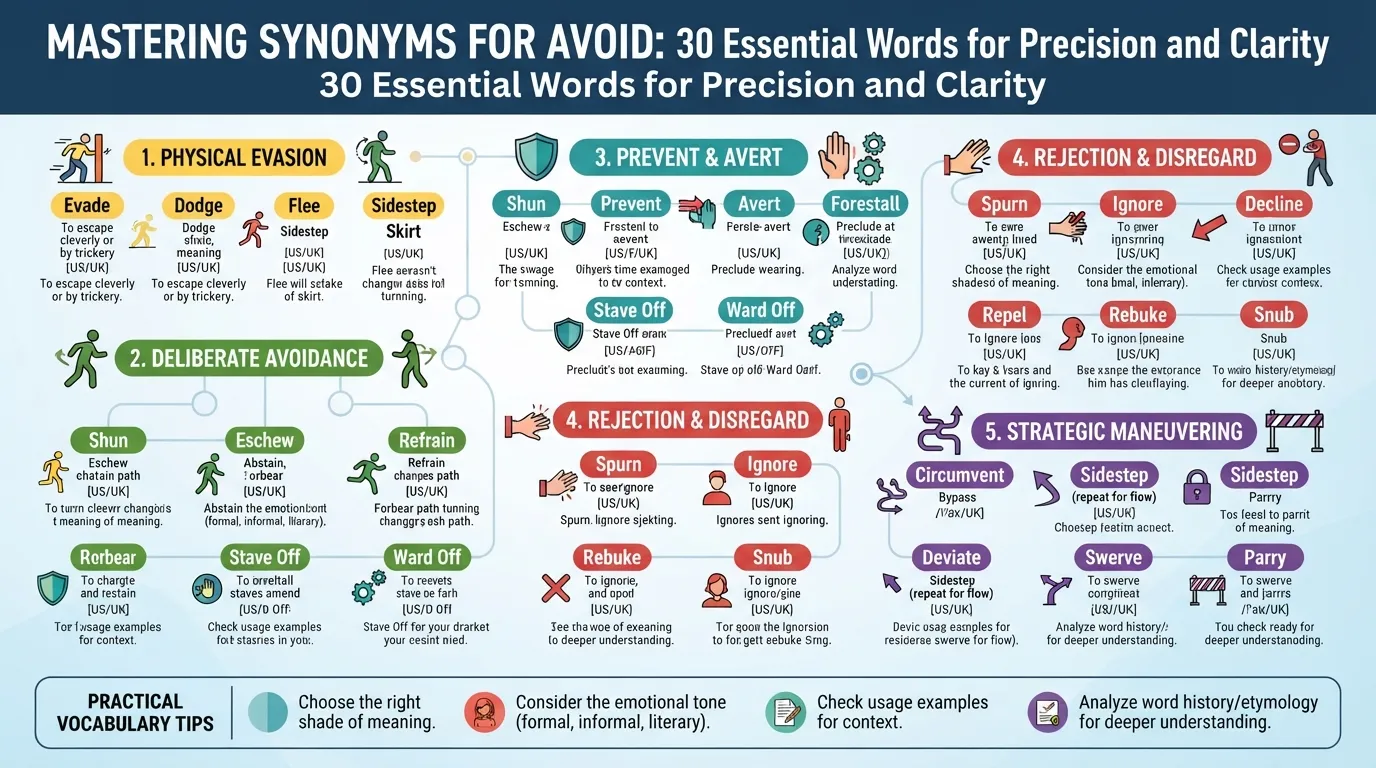
Synonyms of Avoid — 30 Powerful Words
The words below cover different meanings of avoid. Some mean staying away, some mean escaping, and others mean stopping a problem. Check the meaning and examples before choosing a synonym.
1. Evade (Verb) — US /ɪˈveɪd/ | UK /ɪˈveɪd/
Meaning: To avoid a person, duty, question, or problem, often in a clever or dishonest way.
Examples:
- He tried to evade the teacher’s question.
- The driver could not evade responsibility for the accident.
2. Escape (Verb) — US /ɪˈskeɪp/ | UK /ɪˈskeɪp/
Meaning: To get free from danger, control, or an unpleasant situation.
Examples:
- The cat escaped from the room.
- She escaped serious injury in the crash.
3. Dodge (Verb) — US /dɑːdʒ/ | UK /dɒdʒ/
Meaning: To move quickly out of the way or avoid something unwanted.
Examples:
- He dodged the ball.
- She tried to dodge a difficult question.
4. Elude (Verb) — US /ɪˈluːd/ | UK /ɪˈluːd/
Meaning: To escape from someone or avoid being caught, found, or understood.
Examples:
- The thief eluded the police.
- The answer eluded him for days.
5. Shun (Verb) — US /ʃʌn/ | UK /ʃʌn/
Meaning: To stay away from someone or something on purpose.
Examples:
- He shunned people who spread rumors.
- She chose to shun unhealthy habits.
6. Sidestep (Verb) — US /ˈsaɪdstɛp/ | UK /ˈsaɪdstɛp/
Meaning: To avoid a problem, question, or duty instead of facing it directly.
Examples:
- The leader sidestepped the hard question.
- We cannot sidestep this important issue.
7. Bypass (Verb) — US /ˈbaɪpæs/ | UK /ˈbaɪpɑːs/
Meaning: To go around something or avoid a usual step.
Examples:
- We took a side road to bypass the traffic.
- Do not bypass the safety check.
8. Prevent (Verb) — US /prɪˈvɛnt/ | UK /prɪˈvɛnt/
Meaning: To stop something from happening.
Examples:
- Washing your hands can help prevent illness.
- The team acted early to prevent a mistake.
9. Avert (Verb) — US /əˈvɝːt/ | UK /əˈvɜːt/
Meaning: To stop a bad event or danger from happening.
Examples:
- Quick action helped avert a crisis.
- The driver turned to avert a collision.
10. Refrain (Verb) — US /rɪˈfreɪn/ | UK /rɪˈfreɪn/
Meaning: To choose not to do something.
Examples:
- Please refrain from talking during the test.
- He refrained from making a rude comment.
11. Abstain (Verb) — US /əbˈsteɪn/ | UK /əbˈsteɪn/
Meaning: To choose not to take part in something or not to use something.
Examples:
- She chose to abstain from alcohol.
- Two members abstained from voting.
12. Eschew (Verb) — US /ɪsˈtʃuː/ | UK /ɪsˈtʃuː/
Meaning: To deliberately avoid something, often because you believe it is wrong or unwise.
Examples:
- He tries to eschew wasteful habits.
- The writer chose to eschew simple answers.
13. Circumvent (Verb) — US /ˌsɝːkəmˈvɛnt/ | UK /ˌsɜːkəmˈvɛnt/
Meaning: To find a way around a rule, problem, or barrier.
Examples:
- They tried to circumvent the new rule.
- The plan helped us circumvent a delay.
14. Skirt (Verb) — US /skɝːt/ | UK /skɜːt/
Meaning: To go around something or avoid dealing with it directly.
Examples:
- The path skirts the edge of the lake.
- He skirted the main issue during the meeting.
15. Duck (Verb) — US /dʌk/ | UK /dʌk/
Meaning: To lower your head or body quickly, or to avoid a duty or question.
Examples:
- She ducked to avoid the branch.
- He tried to duck his responsibilities.
Also for more Synonyms: https://synonymhunting.com/synonyms-for-effect/
16. Ward off (Phrasal verb) — US /ˌwɔːrd ˈɔːf/ | UK /ˌwɔːd ˈɒf/
Meaning: To protect yourself from something harmful or unwanted.
Examples:
- A warm coat can help ward off the cold.
- The guards worked to ward off the attackers.
17. Fend off (Phrasal verb) — US /ˌfɛnd ˈɔːf/ | UK /ˌfɛnd ˈɒf/
Meaning: To defend yourself against an attack, demand, or problem.
Examples:
- He used a stick to fend off the dog.
- She had to fend off many questions.
18. Repel (Verb) — US /rɪˈpɛl/ | UK /rɪˈpɛl/
Meaning: To push away or keep something unwanted from coming close.
Examples:
- This spray helps repel insects.
- The army repelled the attack.
19. Resist (Verb) — US /rɪˈzɪst/ | UK /rɪˈzɪst/
Meaning: To fight against something or stop yourself from giving in to it.
Examples:
- She tried to resist the urge to shout.
- He resisted pressure to change his answer.
20. Decline (Verb) — US /dɪˈklaɪn/ | UK /dɪˈklaɪn/
Meaning: To politely say no to an offer or invitation.
Examples:
- I had to decline the invitation.
- She declined the offer because she was busy.
21. Reject (Verb) — US /rɪˈdʒɛkt/ | UK /rɪˈdʒɛkt/
Meaning: To refuse to accept something or someone.
Examples:
- The editor rejected the article.
- He rejected the offer after careful thought.
22. Ignore (Verb) — US /ɪɡˈnɔːr/ | UK /ɪɡˈnɔː/
Meaning: To give no attention to someone or something.
Examples:
- Do not ignore the warning sign.
- She ignored the message until the next day.
23. Overlook (Verb) — US /ˌoʊvərˈlʊk/ | UK /ˌəʊvəˈlʊk/
Meaning: To fail to notice something or choose not to act on a fault.
Examples:
- We overlooked a small error in the report.
- The teacher overlooked his minor mistake.
24. Forgo (Verb) — US /fɔːrˈɡoʊ/ | UK /fɔːˈɡəʊ/
Meaning: To choose not to have or do something.
Examples:
- She decided to forgo dessert.
- He chose to forgo a holiday to save money.
25. Omit (Verb) — US /oʊˈmɪt/ | UK /əʊˈmɪt/
Meaning: To leave something out, on purpose or by mistake.
Examples:
- Do not omit your name from the form.
- The report omitted several key facts.
26. Avoid contact with (Verb phrase) — US /əˈvɔɪd ˈkɑːntækt wɪð/ | UK /əˈvɔɪd ˈkɒntækt wɪð/
Meaning: To stay away from a person or thing and not interact with it.
Examples:
- Please avoid contact with the wet paint.
- He chose to avoid contact with the angry customer.
27. Steer clear of (Verb phrase) — US /ˌstɪr ˈklɪr əv/ | UK /ˌstɪə ˈklɪər əv/
Meaning: To keep away from a person, place, or activity.
Examples:
- Steer clear of that unsafe road.
- I steer clear of gossip at work.
28. Keep away from (Verb phrase) — US /ˌkiːp əˈweɪ frəm/ | UK /ˌkiːp əˈweɪ frəm/
Meaning: To stay at a distance from someone or something.
Examples:
- Keep away from the broken glass.
- He keeps away from people who cause trouble.
29. Stay away from (Verb phrase) — US /ˌsteɪ əˈweɪ frəm/ | UK /ˌsteɪ əˈweɪ frəm/
Meaning: To not go near or get involved with someone or something.
Examples:
- Stay away from the deep water.
- She stayed away from the argument.
30. Withdraw (Verb) — US /wɪðˈdrɔː/ | UK /wɪðˈdrɔː/
Meaning: To move back, leave, or stop taking part in something.
Examples:
- He withdrew from the competition.
- She withdrew from the discussion when it became heated.
Prototype Meaning of Avoid
The most typical meaning of avoid is to stay away from something unwanted or stop it from happening. People may imagine someone taking a different road to miss traffic, staying away from danger, or choosing not to make a mistake. The word can describe a physical action, such as avoiding a falling object, or a choice, such as avoiding an argument. Its central idea is keeping away from something or preventing an unwanted result.
Prototype Categorization of Avoid Synonyms
- Staying away: shun, steer clear of, keep away from, stay away from. Use these when someone avoids a person, place, or thing.
- Escaping or avoiding capture: escape, evade, elude, dodge. Use these when someone gets away from danger, a question, or an attempt to catch them.
- Preventing harm or trouble: prevent, avert, ward off, fend off, repel. Use these when someone stops a problem or danger.
- Avoiding duties or direct answers: sidestep, circumvent, skirt, duck. Use these when someone avoids dealing with a question, rule, or responsibility.
- Choosing not to act: refrain, abstain, eschew, forgo. Use these when someone deliberately chooses not to do something.
- Refusing or not accepting: decline, reject. Use these when someone says no to an offer, request, or idea.
- Not paying attention or leaving something out: ignore, overlook, omit. Use these when something receives no attention or is left out.
- Moving away or resisting: withdraw, resist. Use these when someone leaves a situation or fights against pressure.
Antonyms of Avoid
Antonyms are words with opposite or contrasting meanings.
- Face: To deal with a problem directly.
- Confront: To deal with a difficult person or situation.
- Approach: To move closer to someone or something.
- Encounter: To meet or experience something.
- Accept: To agree to take or receive something.
- Attend: To be present at an event or meeting.
- Engage: To take part in an activity.
- Welcome: To receive someone or something gladly.
- Embrace: To accept an idea or experience willingly.
- Pursue: To try to reach or achieve something.
Examples:
- Instead of avoiding a problem, face it.
- She chose to confront the issue directly.
- He decided to accept the invitation rather than avoid the event.
Short Questions and Answers
– What does avoid mean?
Avoid means to stay away from someone or something, or to prevent an unwanted event.
– When should avoid be used?
Use it when someone stays away from a person, place, action, or problem, or tries to stop something bad from happening.
– Is avoid positive or negative?
It can be either. Avoiding danger is often wise, while avoiding responsibility may be seen as negative.
– How is avoid different from evade?
Avoid is a general word for staying away. Evade often suggests escaping a duty, question, or attempt to catch someone.
– What is the closest synonym for avoid?
Shun can mean deliberately staying away from someone or something. Evade is often closer when the meaning involves escaping a question or duty.
– What is the opposite of avoid?
Face or confront can be opposites when avoid means not dealing with a problem.
– Can avoid be followed by a verb?
Yes. Use the verb with -ing: “Try to avoid making mistakes.” Do not write “avoid to make mistakes.”
Conclusion
Learning synonyms for avoid and it can improve your English vocabulary and help you express ideas more clearly. The word is useful when talking about danger, mistakes, people, choices, and unwanted events. Its synonyms add detail to your writing. Evade can suggest escaping a question, prevent means stopping something from happening, and refrain means choosing not to act.
Understanding these differences helps you avoid repetition and choose words that fit each situation. It also strengthens your speaking, writing, and reading skills. English learners can use these words in schoolwork, emails, conversations, and articles.
Start by learning two or three synonyms each day. Write simple sentences with each word, then use them in your daily conversations. Check how each word works in context before using it. With regular practice, you will build a stronger vocabulary, express your thoughts with greater accuracy, and gain confidence in English.

I’m Zahid Abbas, an educator, researcher, and digital publishing strategist with a passion for linguistics, grammar, and clear communication. As a content creator and SEO specialist, I craft research-driven, reader-focused content that empowers learners and makes knowledge accessible worldwide.