Actions are things we do every day. We walk, speak, read, write, help others, and solve problems. These activities are all examples of actions. For example, imagine a student who helps a friend with homework. The student takes action by explaining a difficult question. Actions are an important part of daily life because they show what people do and how they behave.
Learning synonyms of actions helps English learners express ideas in different ways. The right synonym can make a sentence clearer and more interesting.
In this article, you will learn the meaning of actions, 30 useful synonyms, their pronunciations, and simple examples. You will also explore the word’s history, grammar, emotional tone, and related vocabulary.
Meaning of Actions
Definition
Actions (noun, plural): Things that people or other living beings do, or steps taken to achieve a purpose.
Examples
- Her actions showed that she cared about her friends.
- The teacher praised the students for their helpful actions.
Singular form: Action
Plural form: Actions
Connotative Meaning
- Positive tone: Actions can suggest kindness, courage, effort, and helpful behavior. Example: Her kind actions made everyone happy.
- Negative tone: Actions can suggest harm, dishonesty, or poor choices. Example: His careless actions caused trouble.
- Neutral tone: Actions can simply describe what someone does, without praise or blame. Example: The machine records the actions of its operator.
The emotional tone depends on the situation and the words used around actions.
Read more about:https://synonymhunting.com/synonyms-for-claim/
Etymology of Actions
The word actions comes from the noun action, which developed from Latin and Old French.
- Source language: Latin actio, meaning an act, performance, or doing.
- Latin root: agere, meaning to do, drive, or act.
- Old French: action carried the idea of an act or process.
Short History of the Keyword
Old English (450–1100)
English speakers often used native words such as dōn (to do) and dæd (deed) to describe what people did. The modern word action was not yet established in English in its later form.
Middle English (1100–1500)
After the Norman Conquest, French and Latin influenced English vocabulary. The word action entered English through French and became useful in legal and formal contexts.
Modern English (1500–Present)
The word became common in everyday speech, literature, science, law, and education. Today, actions can refer to physical movements, decisions, behaviors, or steps taken to reach a goal.
Pronunciation of Actions
- US IPA: /ˈæk.ʃənz/
- UK IPA: /ˈæk.ʃənz/
- Syllables: ac-tions
- Number of syllables: 2
- Word stress: The first syllable is stressed.
Affixation Pattern of Actions
- Root: Act
- Prefix: None
- Suffix: -ion forms the noun action from act; -s marks the plural.
- Base word: Act
- Singular noun: Action
- Plural noun: Actions
Word Formation of Action
The word family includes several grammatical forms:
Word
Part of speech
Meaning
Act
Verb or noun
To do something; a deed
Action
Noun
Something done
Actions
Plural noun
More than one act
Active
Adjective
Doing things or full of activity
Actively
Adverb
In an active way
Activity
Noun
An action or a task
Activate
Verb
To make something work
Activation
Noun
The process of making something active
Actor
Noun
A person who performs in a play or film
Acting
Noun, adjective, or verb form
Performing or doing a role
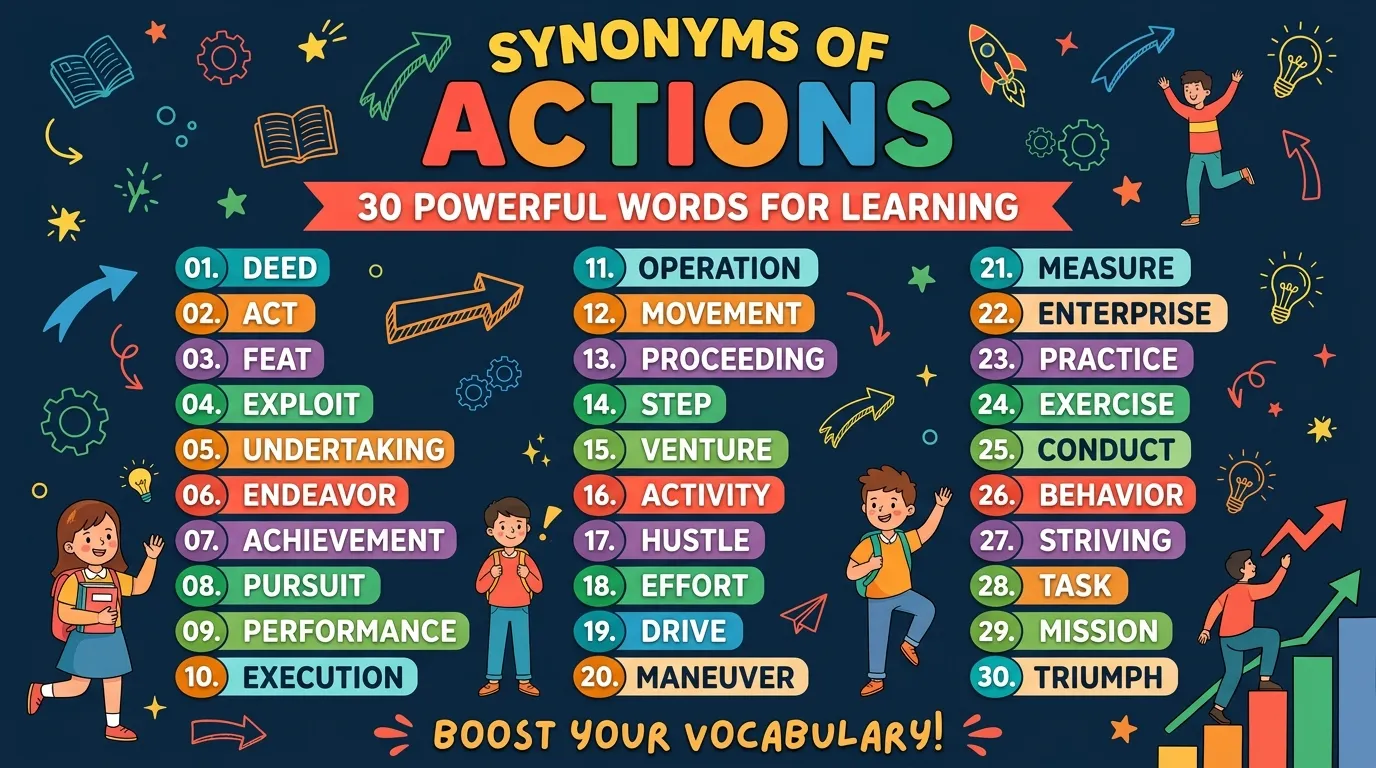
Synonyms of Actions: 30 Powerful Words
The following words are related to actions, but they do not all fit every sentence. Choose a synonym based on the meaning you want to express.
1. Acts (Noun) — US /ækts/ | UK /ækts/
Meaning: Things that someone does, especially individual deeds.
Examples:
- Her kind acts helped many poor families.
- His brave acts inspired the whole team.
2. Deeds (Noun) — US /diːdz/ | UK /diːdz/
Meaning: Things that a person does, often judged as good or bad.
Examples:
- Good deeds can make a community stronger.
- His deeds showed that he was honest.
3. Activities (Noun) — US /ækˈtɪvətiz/ | UK /ækˈtɪvətiz/
Meaning: Things that people do for work, learning, or enjoyment.
Examples:
- The school planned fun activities for the children.
- Outdoor activities help students stay active.
4. Behaviors (Noun) — US /bɪˈheɪvjərz/ | UK /bɪˈheɪvjəz/
Meaning: The ways in which people or animals act.
Examples:
- Teachers encourage good behaviors in the classroom.
- The child’s behaviors changed after the move.
5. Conduct (Noun) — US /ˈkɑːndʌkt/ | UK /ˈkɒndʌkt/
Meaning: The way a person behaves, especially in a particular situation.
Examples:
- The teacher praised his good conduct.
- Her conduct during the meeting was professional.
6. Deeds of Action (Noun Phrase) — US /diːdz əv ˈækʃən/ | UK /diːdz əv ˈækʃən/
Meaning: Specific things done to produce a result.
Examples:
- The team completed several deeds of action to support the project.
- Their deeds of action helped improve the local park.
Usage note: This phrase is uncommon and is not a standard synonym. In most sentences, use deeds, steps, or actions instead.
7. Efforts (Noun) — US /ˈefərts/ | UK /ˈefəts/
Meaning: Attempts to do something or achieve a goal.
Examples:
- Her efforts helped the team win the match.
- The students made great efforts to finish the project.
8. Moves (Noun) — US /muːvz/ | UK /muːvz/
Meaning: Steps or decisions taken to achieve something.
Examples:
- The manager made smart moves to save money.
- His next moves surprised his opponents.
9. Steps (Noun) — US /steps/ | UK /steps/
Meaning: Individual actions taken to reach a goal.
Examples:
- We took steps to keep the classroom clean.
- The first step is to understand the problem.
10. Measures (Noun) — US /ˈmeʒərz/ | UK /ˈmeʒəz/
Meaning: Actions taken to deal with a problem or situation.
Examples:
- The school took measures to improve safety.
- New measures helped reduce waste.
11. Operations (Noun) — US /ˌɑːpəˈreɪʃənz/ | UK /ˌɒpəˈreɪʃənz/
Meaning: Organized activities carried out to achieve a particular purpose.
Examples:
- The rescue operations began early in the morning.
- Daily operations continued without any problems.
12. Procedures (Noun) — US /prəˈsiːdʒərz/ | UK /prəˈsiːdʒəz/
Meaning: Established ways of doing something.
Examples:
- Follow the safety procedures carefully.
- The office updated its procedures last month.
13. Tasks (Noun) — US /tæsks/ | UK /tɑːsks/
Meaning: Pieces of work that need to be completed.
Examples:
- I finished my daily tasks before lunch.
- The teacher gave the class three simple tasks.
14. Deeds of Courage (Noun Phrase) — US /diːdz əv ˈkɜːrɪdʒ/ | UK /diːdz əv ˈkʌrɪdʒ/
Meaning: Brave things that people do in difficult situations.
Examples:
- The firefighter’s deeds of courage saved lives.
- Stories of deeds of courage inspire young people.
Usage note: This is a descriptive phrase rather than a direct synonym. Brave acts is usually more natural.
15. Performances (Noun) — US /pərˈfɔːrmənsɪz/ | UK /pəˈfɔːmənsɪz/
Meaning: Ways in which someone carries out a task or presents a show.
Examples:
- Her performances impressed the audience.
- The team’s performances improved during the season.
16. Gestures (Noun) — US /ˈdʒestʃərz/ | UK /ˈdʒestʃəz/
Meaning: Movements or acts that express a feeling or message.
Examples:
- He made a friendly gesture to welcome us.
- Small gestures of kindness can mean a lot.
17. Responses (Noun) — US /rɪˈspɑːnsɪz/ | UK /rɪˈspɒnsɪz/
Meaning: Reactions or answers to something that happens.
Examples:
- Her responses showed that she understood the lesson.
- The team prepared responses to customer questions.
18. Reactions (Noun) — US /riˈækʃənz/ | UK /riˈækʃənz/
Meaning: Things people do or feel in reply to an event.
Examples:
- His reactions to the news were surprising.
- The teacher observed the students’ reactions to the experiment.
19. Behaviors and Deeds (Noun Phrase) — US /bɪˈheɪvjərz ən diːdz/ | UK /bɪˈheɪvjəz ən diːdz/
Meaning: The ways people behave and the things they do.
Examples:
- We study people’s behaviors and deeds to understand their choices.
- Her behaviors and deeds showed a strong sense of care.
Usage note: This phrase combines related ideas. Usually, behavior or deeds alone is clearer.
20. Undertakings (Noun) — US /ˌʌndərˈteɪkɪŋz/ | UK /ˌʌndəˈteɪkɪŋz/
Meaning: Tasks or projects that someone agrees to carry out.
Examples:
- The company began several new undertakings.
- Completing the project was a major undertaking.
21. Initiatives (Noun) — US /ɪˈnɪʃətɪvz/ | UK /ɪˈnɪʃətɪvz/
Meaning: New plans or efforts started to solve a problem or improve something.
Examples:
- The school launched initiatives to reduce bullying.
- Community initiatives helped keep the streets clean.
22. Interventions (Noun) — US /ˌɪntərˈvenʃənz/ | UK /ˌɪntəˈvenʃənz/
Meaning: Actions taken to improve a situation or stop a problem.
Examples:
- Early interventions helped struggling students.
- The doctor recommended further interventions.
23. Engagements (Noun) — US /ɪnˈɡeɪdʒmənts/ | UK /ɪnˈɡeɪdʒmənts/
Meaning: Activities or commitments that involve taking part in something.
Examples:
- Student engagements increased during group work.
- The manager had several business engagements.
Usage note: This word has several meanings, including appointments and commitments. Activities may be clearer in everyday writing.
24. Endeavors (Noun) — US /ɪnˈdevərz/ | UK /ɪnˈdevəz/
Meaning: Serious efforts to achieve something.
Examples:
- Her educational endeavors opened new opportunities.
- The team continued its endeavors despite setbacks.
25. Pursuits (Noun) — US /pərˈsuːts/ | UK /pəˈsjuːts/
Meaning: Activities or efforts aimed at achieving a goal or following an interest.
Examples:
- He spent his free time on creative pursuits.
- Her academic pursuits helped her develop new skills.
26. Practices (Noun) — US /ˈpræktɪsɪz/ | UK /ˈpræktɪsɪz/
Meaning: Regular ways of doing something.
Examples:
- Good study practices help students learn.
- The company changed its working practices.
27. Motions (Noun) — US /ˈmoʊʃənz/ | UK /ˈməʊʃənz/
Meaning: Movements of the body or parts of it.
Examples:
- The dancer’s motions were smooth and graceful.
- The machine repeated the same motions all day.
28. Maneuvers (Noun) — US /məˈnuːvərz/ | UK /məˈnuːvəz/
Meaning: Carefully planned movements or actions used to achieve a goal.
Examples:
- The driver made careful maneuvers in the narrow street.
- The team used clever maneuvers to gain an advantage.
29. Transactions (Noun) — US /trænˈzækʃənz/ | UK /trænˈzækʃənz/
Meaning: Exchanges or dealings, often involving money or business.
Examples:
- The bank records all financial transactions.
- Online transactions have become common.
30. Executions (Noun) — US /ˌeksɪˈkjuːʃənz/ | UK /ˌeksɪˈkjuːʃənz/
Meaning: The carrying out of plans, instructions, or tasks.
Examples:
- The successful executions of the plans required teamwork.
- The project manager checked the executions of each task.
Usage note: Execution is more natural when discussing the way a plan is carried out. The plural form is less common. The word can also mean carrying out a death sentence, so use it carefully.
Prototype Meaning of Actions
The most typical meaning of actions is the things that people do in daily life. People often imagine physical movements, decisions, or steps taken to complete a task. For example, helping a friend, writing a letter, cleaning a room, and solving a problem are all actions. Some actions are planned, while others happen naturally in response to a situation.
Prototype Categorization
Synonyms of actions can be grouped according to their meanings. These groups help writers choose words that fit their purpose.
- General acts and deeds: Acts, deeds. Use these for individual things people do.
- Daily work and activities: Activities, tasks, practices. Use these for regular work or things done during the day.
- Steps toward a goal: Steps, measures, moves. Use these for plans or efforts to solve a problem.
- Behavior and character: Behaviors, conduct. Use these when describing how someone acts.
- Effort and achievement: Efforts, endeavors, undertakings, pursuits. Use these for hard work or attempts to reach a goal.
- Organized work: Operations, procedures, initiatives, interventions. Use these for planned activities in schools, businesses, or organizations.
- Physical movements and signals: Motions, gestures, maneuvers. Use these when describing body movements or controlled movements.
- Reactions and communication: Responses, reactions, performances. Use these when describing replies, results, or the way a task is carried out.
- Business and formal dealings: Transactions, engagements, executions. Use these in suitable professional or formal contexts.
Antonyms of Actions
Antonyms are words with opposite or contrasting meanings. Since actions has several meanings, it does not have one perfect opposite in every situation.
Antonym or contrasting word
Meaning
Example
Inaction
Failure to act
Inaction allowed the problem to grow.
Idleness
A state of doing little or no work
Idleness can waste valuable time.
Inactivity
Lack of activity
Long periods of inactivity may reduce fitness.
Passivity
Accepting things without taking action
Passivity stopped him from speaking up.
Rest
A period without work or activity
After a busy day, she needed rest.
Stillness
A lack of movement
The stillness of the room was peaceful.
Omission
Failure to do or include something
The omission of one step caused an error.
Short Questions and Answers
– What does actions mean?
– When should actions be used?
Use actions when talking about two or more things someone does or steps taken in a situation.
– Is actions positive or negative?
The word is neutral by itself. Actions can be helpful, harmful, brave, careless, or ordinary.
– How is actions different from similar words?
Actions is a broad word. Deeds often suggests acts that can be judged as good or bad. Behavior describes how someone acts, while steps usually refers to parts of a plan.
– What is the singular form of actions?
The singular form is action.
– What are the best synonyms of actions?
Common choices include acts, deeds, activities, steps, and measures. The best choice depends on the sentence.
– Can actions be used in formal writing?
Yes. It is suitable for academic, professional, and everyday writing.
– Why should English learners study synonyms of actions?
Conclusion
Learning the meaning of actions and its synonyms can improve your English vocabulary and communication skills. Words such as acts, deeds, activities, steps, and measures help you describe different types of actions with greater accuracy. Each word has its own meaning, so it is important to choose one that fits the sentence.
Using synonyms also makes your writing more natural and helps you avoid repetition. This is useful for students, teachers, bloggers, and content writers. Learning pronunciation, word history, grammar, and emotional tone can help you understand how each word works.
To build confidence, practice a few new words every day. Write simple sentences, read English articles, and use new vocabulary in daily conversations.

I’m Zahid Abbas, an educator, researcher, and digital publishing strategist with a passion for linguistics, grammar, and clear communication. As a content creator and SEO specialist, I craft research-driven, reader-focused content that empowers learners and makes knowledge accessible worldwide.