A narcissist is a person who has an excessive interest in themselves and often wants attention, praise, or admiration from others. Imagine a friend who always talks about their success, ignores your feelings, and becomes upset when someone else gets praised. You may describe this person as a narcissist, depending on their behavior.
The word “narcissist” is common in daily conversations, social media, psychology, and personal relationships. People use it to describe someone who seems self-centered or cares too much about their own importance. However, the word should be used carefully because self-centered behavior does not always mean a person has a mental health condition.
Learning synonyms of narcissist helps English learners understand different shades of meaning. It also helps content writers create clear, engaging, and varied content without repeating the same word. In this article, you will learn the meaning, pronunciation, history, grammar, and 30 useful synonyms of narcissist, with simple definitions and examples.
Meaning of Narcissist
Definition
Narcissist (Noun): A person who has an excessive focus on themselves and may seek admiration while showing little concern for other people’s feelings.
Examples
- He acts like a narcissist because he always wants to be the center of attention.
- A narcissist may find it hard to accept criticism or share praise with others.
Connotative Meaning
Connotation (the feelings or ideas that a word suggests beyond its basic meaning).
The word “narcissist” usually carries a negative emotional tone.
- Positive tone: The word itself rarely has a positive tone. However, healthy self-confidence and self-respect are positive qualities that should not be confused with narcissism.
- Negative tone: It may suggest selfishness, arrogance, an excessive need for praise, or a lack of concern for others.
- Neutral tone: In psychology or academic writing, the word may be used as a descriptive term. A formal discussion should distinguish everyday behavior from a clinical diagnosis.
Etymology of Narcissist
- Source language: The word comes from Greek through Latin and later European languages.
- Original meaning: It is linked to Narcissus, a figure in Greek mythology who became fascinated with his own reflection.
- Related word: “Narcissism” describes excessive self-focus or admiration of oneself.
Read more about:https://synonymhunting.com/synonyms-for-share/
Short History of the Keyword
Old English (450–1100)
The word “narcissist” was not part of Old English. People used other words and expressions to describe pride, vanity, and selfish behavior.
Middle English (1100–1500)
The word was still not in common English use during this period. Ideas about pride and excessive self-love were expressed through other terms.
Modern English (1500–Present)
The word entered English much later, after the study of Narcissus and the concept of narcissism gained attention. By the late nineteenth and early twentieth centuries, narcissism had become an important term in psychology. Today, “narcissist” is used in everyday speech as well as psychological discussions.
Pronunciation of Narcissist
- US: /ˈnɑːr.sɪ.sɪst/
- UK: /ˈnɑː.sɪ.sɪst/
Note: Pronunciation can vary slightly by accent.
Syllables
nar-cis-sist — 3 syllables
Affixation Pattern of Narcissist
- Root: Narciss-
- Prefix: None in the modern English word.
- Suffix: -ist, which often refers to a person associated with a belief, practice, or characteristic.
Word Formation
The word family includes several related forms:
| Word | Grammatical category | Meaning |
| Narcissist | Noun | A person with narcissistic traits |
| Narcissism | Noun | Excessive self-focus or admiration |
| Narcissistic | Adjective | Showing traits of narcissism |
| Narcissistically | Adverb | In a narcissistic manner |
| Narcissistic personality | Noun phrase | A personality description involving narcissistic traits |
These forms help writers discuss people, behavior, and ideas with greater grammatical accuracy.
Synonyms of Narcissist
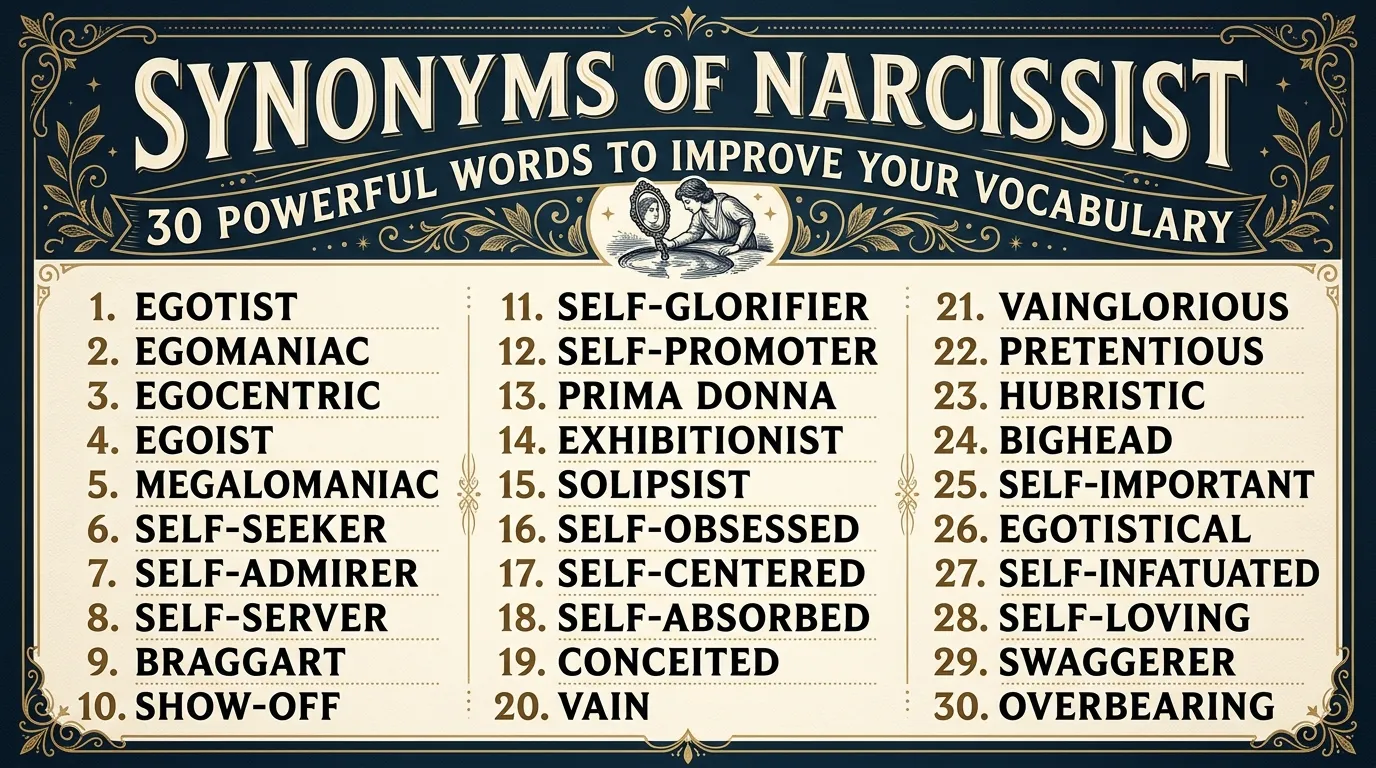
The following 30 words describe different aspects of self-centeredness, excessive pride, or a desire for admiration. They are not exact substitutes in every situation. Choose a word that matches the person’s behavior and the tone of your sentence.
1. Egomaniac (Noun) — US: /ˌiː.ɡoʊˈmeɪ.ni.æk/ | UK: /ˌiː.ɡəʊˈmeɪ.ni.æk/
Meaning: A person who is extremely focused on their own importance and desires.
Examples:
- The egomaniac talked about his achievements all evening.
- Everyone became tired of listening to the egomaniac brag.
2. Egotist (Noun) — US: /ˈiː.ɡoʊ.tɪst/ | UK: /ˈiː.ɡəʊ.tɪst/
Meaning: A person who talks too much about themselves and their importance.
Examples:
- The egotist turned every conversation toward his success.
- She did not enjoy working with such an egotist.
3. Self-centered Person (Noun Phrase) — US: /ˌself ˈsen.tɚd ˈpɝː.sən/ | UK: /ˌself ˈsen.təd ˈpɜː.sən/
Meaning: Someone who thinks mainly about their own needs and feelings.
Examples:
- A self-centered person may ignore a friend’s problems.
- He seemed self-centered when he refused to listen.
4. Egoist (Noun) — US: /ˈiː.ɡoʊ.ɪst/ | UK: /ˈiː.ɡəʊ.ɪst/
Meaning: A person who puts personal interests above the interests of others.
Examples:
- The egoist cared more about winning than helping the team.
- An egoist may struggle to put others first.
5. Egocentric Person (Noun Phrase) — US: /ˌiː.ɡoʊˈsen.trɪk ˈpɝː.sən/ | UK: /ˌiː.ɡəʊˈsen.trɪk ˈpɜː.sən/
Meaning: Someone who sees situations mainly from their own point of view.
Examples:
- The egocentric person assumed everyone agreed with him.
- Her egocentric attitude made teamwork difficult.
6. Self-absorbed Person (Noun Phrase) — US: /ˌself əbˈzɔːrbd ˈpɝː.sən/ | UK: /ˌself əbˈzɔːbd ˈpɜː.sən/
Meaning: Someone who is so focused on themselves that they pay little attention to others.
Examples:
- He was too self-absorbed to notice her sadness.
- A self-absorbed person may miss important social signals.
7. Egoist in Behavior: Selfish Person (Noun Phrase) — US: /ˈsel.fɪʃ ˈpɝː.sən/ | UK: /ˈsel.fɪʃ ˈpɜː.sən/
Meaning: Someone who cares mainly about their own benefit.
Examples:
- The selfish person took the largest share of the food.
- Being selfish can harm close relationships.
8. Arrogant Person (Noun Phrase) — US: /ˈer.ə.ɡənt ˈpɝː.sən/ | UK: /ˈær.ə.ɡənt ˈpɜː.sən/
Meaning: Someone who acts as if they are better or more important than others.
Examples:
- The arrogant person dismissed everyone’s suggestions.
- His arrogant manner made the meeting uncomfortable.
9. Conceited Person (Noun Phrase) — US: /kənˈsiː.tɪd ˈpɝː.sən/ | UK: /kənˈsiː.tɪd ˈpɜː.sən/
Meaning: Someone who has an overly high opinion of their own abilities or appearance.
Examples:
- The conceited actor believed he was the best in the room.
- She sounded conceited when she praised herself constantly.
10. Vain Person (Noun Phrase) — US: /veɪn ˈpɝː.sən/ | UK: /veɪn ˈpɜː.sən/
Meaning: Someone who cares too much about their appearance, success, or public image.
Examples:
- The vain man checked his reflection repeatedly.
- Her vain behavior made every photo session last longer.
11. Boaster (Noun) — US: /ˈboʊ.stɚ/ | UK: /ˈbəʊ.stə/
Meaning: A person who often talks proudly about their achievements or possessions.
Examples:
- The boaster claimed he was the smartest student in class.
- Nobody believed the boaster’s exaggerated stories.
12. Braggart (Noun) — US: /ˈbræɡ.ɚt/ | UK: /ˈbræɡ.ət/
Meaning: Someone who talks too proudly about themselves.
Examples:
- The braggart kept talking about his expensive car.
- People avoided the braggart because he never stopped boasting.
13. Show-off (Noun) — US: /ˈʃoʊ.ɔːf/ | UK: /ˈʃəʊ.ɒf/
Meaning: A person who tries to attract attention by displaying their abilities or possessions.
Examples:
- The show-off performed tricks to impress everyone.
- He acted like a show-off during the school event.
14. Prima Donna (Noun) — US: /ˌpriː.mə ˈdɑː.nə/ | UK: /ˌpriː.mə ˈdɒn.ə/
Meaning: A person who expects special treatment and reacts badly when things do not go their way.
Examples:
- The actor behaved like a prima donna backstage.
- The manager had little patience for prima donna behavior.
15. Tyrant (Noun) — US: /ˈtaɪ.rənt/ | UK: /ˈtaɪ.rənt/
Meaning: A person who uses power in a cruel or unfair way.
Examples:
- The tyrant refused to listen to his workers.
- The leader became a tyrant who controlled every decision.
16. Bully (Noun) — US: /ˈbʊl.i/ | UK: /ˈbʊl.i/
Meaning: A person who hurts, threatens, or frightens others to gain control.
Examples:
- The bully mocked students who disagreed with him.
- A bully may use fear to get what they want.
17. Manipulator (Noun) — US: /məˈnɪp.jəˌleɪ.tɚ/ | UK: /məˈnɪp.jʊˌleɪ.tə/
Meaning: A person who tries to control others through unfair or dishonest methods.
Examples:
- The manipulator made his friends feel guilty.
- She recognized the manipulator’s attempt to change the story.
18. Exploiter (Noun) — US: /ɪkˈsplɔɪ.tɚ/ | UK: /ɪkˈsplɔɪ.tə/
Meaning: Someone who unfairly uses other people for personal gain.
Examples:
- The exploiter took credit for the team’s hard work.
- An exploiter may use another person’s kindness for profit.
19. Control Freak (Noun Phrase) — US: /kənˈtroʊl friːk/ | UK: /kənˈtrəʊl friːk/
Meaning: A person who wants to control nearly every detail or decision.
Examples:
- The control freak chose every task for the group.
- Working with a control freak can be stressful.
20. Attention Seeker (Noun Phrase) — US: /əˈten.ʃən ˌsiː.kɚ/ | UK: /əˈten.ʃən ˌsiː.kə/
Meaning: Someone who often acts to make others notice them.
Examples:
- The attention seeker interrupted the conversation with loud jokes.
- He posted dramatic messages because he wanted attention.
21. Self-Promoter (Noun) — US: /ˌself prəˈmoʊ.tɚ/ | UK: /ˌself prəˈməʊ.tə/
Meaning: A person who actively promotes their own achievements or abilities.
Examples:
- The self-promoter spoke about every award he had won.
- A self-promoter may be good at gaining public attention.
22. Glory Seeker (Noun Phrase) — US: /ˈɡlɔːr.i ˌsiː.kɚ/ | UK: /ˈɡlɔː.ri ˌsiː.kə/
Meaning: Someone who seeks fame, praise, or recognition.
Examples:
- The glory seeker wanted credit for every success.
- The glory seeker cared more about praise than teamwork.
23. Status Seeker (Noun Phrase) — US: /ˈsteɪ.təs ˌsiː.kɚ/ | UK: /ˈsteɪ.təs ˌsiː.kə/
Meaning: Someone who tries to gain social importance or prestige.
Examples:
- The status seeker bought costly items to impress others.
- A status seeker may judge people by their wealth.
25. Self-important Person (Noun Phrase) — US: /ˌself ɪmˈpɔːr.tənt ˈpɝː.sən/ | UK: /ˌself ɪmˈpɔː.tənt ˈpɜː.sən/
Meaning: Someone who believes they are more important than they really are.
Examples:
- The self-important person demanded a special seat.
- He sounded self-important when he discussed his position.
26. Pompous Person (Noun Phrase) — US: /ˈpɑːm.pəs ˈpɝː.sən/ | UK: /ˈpɒm.pəs ˈpɜː.sən/
Meaning: Someone who behaves in an overly grand or self-important way.
Examples:
- The pompous speaker used difficult words to impress the crowd.
- His pompous attitude annoyed his classmates.
27. Haughty Person (Noun Phrase) — US: /ˈhɔː.ti ˈpɝː.sən/ | UK: /ˈhɔː.ti ˈpɜː.sən/
Meaning: Someone who acts as if other people are beneath them.
Examples:
- The haughty guest barely spoke to the staff.
- Her haughty expression made others feel unwelcome.
28. Supercilious Person (Noun Phrase) — US: /ˌsuː.pɚˈsɪl.i.əs ˈpɝː.sən/ | UK: /ˌsuː.pəˈsɪl.i.əs ˈpɜː.sən/
Meaning: Someone who shows that they think they are better or more intelligent than others.
Examples:
- The supercilious student laughed at simple questions.
- His supercilious tone made the discussion unpleasant.
29. Self-Serving Person (Noun Phrase) — US: /ˌself ˈsɝː.vɪŋ ˈpɝː.sən/ | UK: /ˌself ˈsɜː.vɪŋ ˈpɜː.sən/
Meaning: Someone who acts mainly to gain personal benefits.
Examples:
- The self-serving official ignored the needs of the public.
- Her self-serving decision helped her but harmed the team.
30. Vanity-Driven Person (Noun Phrase) — US: /ˈvæn.ə.ti ˌdrɪv.ən ˈpɝː.sən/ | UK: /ˈvæn.ə.ti ˌdrɪv.ən ˈpɜː.sən/
Meaning: Someone whose actions are strongly guided by pride in their appearance, image, or achievements.
Examples:
- The vanity-driven celebrity cared deeply about public opinion.
- His vanity-driven choices often focused on looking successful.
Prototype Meaning
The typical meaning of “narcissist” is a person who places too much importance on themselves and often wants admiration from others. People usually imagine someone who talks about their achievements, expects special treatment, dislikes criticism, or struggles to consider other people’s feelings. However, not every confident, proud, or selfish person is a narcissist. The word describes a pattern of behavior, and a clinical diagnosis requires assessment by a qualified mental health professional.
Prototype Categorization
Synonyms can be grouped by the main behavior they describe. This helps writers select a word that fits the situation instead of using “narcissist” for every kind of difficult behavior.
- Self-focus: Egotist, egoist, egocentric person, self-centered person, and self-absorbed person. Use these when someone focuses mainly on their own needs or opinions.
- Excessive pride: Egomaniac, conceited person, vain person, arrogant person, pompous person, haughty person, and supercilious person. These words highlight an inflated view of one’s importance.
- Boasting and attention: Boaster, braggart, show-off, attention seeker, self-promoter, glory seeker, and status seeker. Use them when someone wants praise, recognition, or attention.
- Control and mistreatment: Tyrant, bully, manipulator, exploiter, and control freak. These words describe harmful actions or attempts to control others. They are not exact synonyms for narcissist.
- Self-interest: Selfish person and self-serving person. Use these when personal gain matters more to someone than other people’s needs.
- Special treatment: Prima donna and self-important person. These describe people who expect others to treat them as unusually important.
Categorization helps writers express the exact idea they mean. For example, “braggart” highlights boasting, while “manipulator” highlights controlling behavior. Choosing the right word makes writing clearer, more accurate, and less repetitive.
Antonyms of Narcissist
An antonym is a word with an opposite or contrasting meaning. Since “narcissist” describes a person, its antonyms are usually words for people with contrasting qualities.
- Altruist: A person who cares about the welfare of others.
- Empath: A person who is sensitive to other people’s feelings.
- Humanitarian: A person who works to improve other people’s lives.
- Selfless person: Someone who puts others’ needs before personal gain.
- Humble person: Someone who does not think they are better than others.
- Modest person: Someone who does not boast about their achievements.
- Considerate person: Someone who thinks about other people’s needs and feelings.
- Compassionate person: Someone who shows care and concern for others.
- Generous person: Someone who willingly gives time, help, or resources.
- Team player: Someone who cooperates and works well with others.
These words are useful contrasts, although none is a perfect opposite in every context.
Short Questions and Answers
- What does narcissist mean?
A narcissist is a person who has an excessive focus on themselves and may strongly seek admiration or special treatment. - When should narcissist be used?
Use it when describing a pattern of self-focused behavior, excessive pride, or a strong need for admiration. Avoid using it as a casual diagnosis. - Is narcissist positive or negative?
It is usually negative because it suggests excessive self-focus or difficulty considering other people. - How is narcissist different from similar words?
A narcissist is associated with excessive self-focus and a need for admiration. An egotist talks too much about themselves, a braggart boasts, and a bully uses intimidation. These words describe different traits and behaviors. - What is a simple synonym for narcissist?
“Self-centered person” is a simple alternative when you mean someone who focuses mainly on themselves. - What is the difference between narcissism and confidence?
Confidence means believing in your abilities. Narcissism involves excessive self-focus and may include a strong need for admiration or a sense of special importance. - Can a narcissist change their behavior?
People can learn healthier ways to communicate and relate to others. Change may take time, self-awareness, and professional support when needed.
Conclusion
Learning the meaning of narcissist and its 30 related words can improve your English vocabulary and communication skills. Each synonym describes a different quality, such as arrogance, selfishness, boasting, or a desire for attention. Understanding these differences helps you choose words that express your ideas clearly.
Using varied vocabulary also strengthens writing and speaking. Instead of repeating “narcissist,” you can select a more precise word, such as “egotist,” “braggart,” or “self-centered person.” However, remember that these words are not exact replacements in every sentence. Choose them based on the person’s behavior and the context.
For better results, learn two or three new words each day. Write your own sentences, practise pronunciation, and use the words in conversations. With regular practice, you can avoid repetition, improve your writing, and build confidence in English.

I’m Zahid Abbas, an educator, researcher, and digital publishing strategist with a passion for linguistics, grammar, and clear communication. As a content creator and SEO specialist, I craft research-driven, reader-focused content that empowers learners and makes knowledge accessible worldwide.