The word got is a common English word. It is the past tense of get. It can mean received, obtained, became, found, or understood something. For example, imagine that you got a gift from a friend. You can say, “I got a gift,” or “I received a gift.” Both sentences share a similar meaning.
People use got in daily conversations, emails, stories, and online writing. It is short and easy to use. However, using it too often can make writing sound less clear or less interesting.
Learning synonyms of got helps English learners build stronger vocabulary. It also helps students, bloggers, and content writers express ideas in better ways. Still, not every synonym fits every sentence. The right choice depends on the meaning and context.
In this article, you will learn the meaning of got, 30 useful synonyms, their US and UK pronunciations, example sentences, word history, grammar, emotional tone, and related word groups.
Meaning of Got
Definition
Got (verb): The past tense of get, used to describe receiving, obtaining, becoming, reaching, or understanding something.
Got can also appear in common expressions such as “got to,” “have got,” and “got it.” Its meaning changes with the sentence.
Examples
- I got a new book for my birthday.
- She got tired after a long walk.
Connotative Meaning
Connotation is the feeling or idea a word suggests beyond its basic meaning.
- Positive tone: “I got a great job.” This suggests success or good news.
- Negative tone: “He got into trouble.” This suggests an unwanted result.
- Neutral tone: “I got your message.” This simply states that a message was received.
The word got is not positive or negative by itself. Its tone depends on the words around it and the situation.
Read more aout:https://synonymhunting.com/synonyms-for-eventually/
Etymology of Got
- Source language: Old Norse and other Germanic language influences helped shape the history of get. The word got developed as the past-tense form of get in English.
- Original meaning: The older meanings of get included obtaining, acquiring, or coming to have something.
A Short History of Got
- Old English (450–1100): English had related Germanic words and forms, but get in its later familiar form was not a common native Old English verb.
- Middle English (1100–1500): Get became established in English, influenced in part by Old Norse. Its meanings included obtaining and acquiring.
- Modern English (1500–Present): Got became a common past-tense form. It now appears in many expressions, including “got home,” “got better,” and “got the answer.”
Pronunciation of Got
- US IPA: /ɡɑːt/ or /ɡɑt/, depending on accent
- UK IPA: /ɡɒt/
- Syllables: got (one syllable)
Affixation Pattern of Got
- Root: get
- Prefix: None
- Suffix: No productive suffix is added to form got; it is an irregular past-tense form of get.
- Word formation: Got is mainly used as a verb form. It also appears in phrases and expressions that serve different grammatical purposes.
Related forms of get include:
- Get (verb): I get the bus every day.
- Gets (verb): She gets good results.
- Getting (verb or gerund): He is getting ready.
- Got (past-tense verb): We got home late.
- Gotten (past participle, mainly US English): She has gotten much better.
- Got (past participle, common in UK English): I have got a new phone.
Note that got and gotten are not interchangeable in every expression. For example, “I have got a car” often means “I own a car,” while “I have gotten a car” often describes obtaining one in American English.
Synonyms of Got — 30 Powerful Words
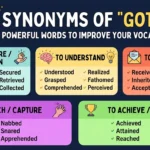
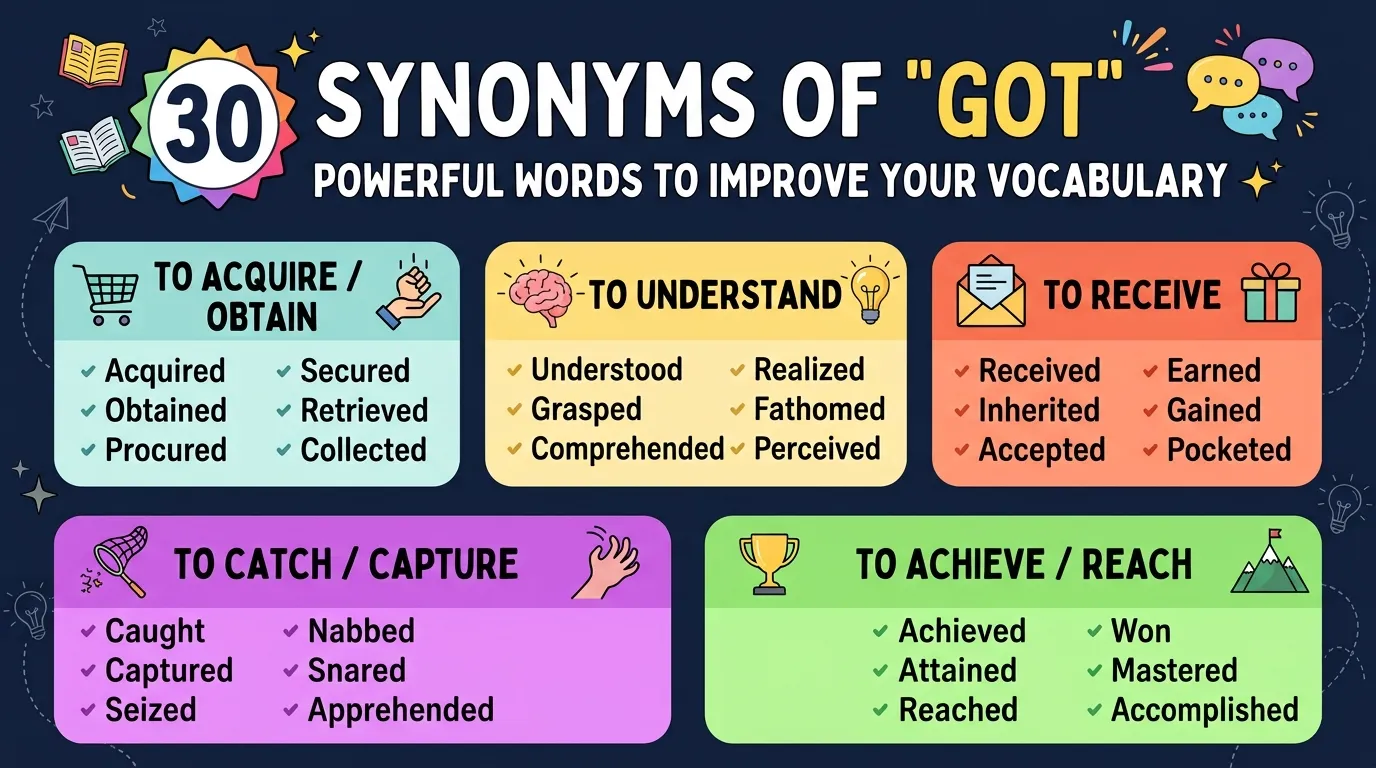
The best synonym for got depends on what happened.The following 30 words can help you express these meanings more clearly.
1. Received (Verb) — US /rɪˈsiːvd/ | UK /rɪˈsiːvd/
Meaning: Accepted or was given something.
Examples:
- I received a letter from my friend.
- She received a gift on her birthday.
2. Obtained (Verb) — US /əbˈteɪnd/ | UK /əbˈteɪnd/
Meaning: Got something through effort, action, or a process.
Examples:
- He obtained permission to leave early.
- She obtained a copy of the report.
3. Acquired (Verb) — US /əˈkwaɪərd/ | UK /əˈkwaɪəd/
Meaning: Gained or came to own something.
Examples:
- He acquired a new skill.
- The company acquired a smaller business.
4. Gained (Verb) — US /ɡeɪnd/ | UK /ɡeɪnd/
Meaning: Obtained something useful, such as knowledge, strength, or experience.
Examples:
- She gained more confidence.
- I gained valuable experience at work.
5. Earned (Verb) — US /ɝːnd/ | UK /ɜːnd/
Meaning: Received something through work, effort, or achievement.
Examples:
- He earned a good salary.
- She earned the respect of her team.
6. Secured (Verb) — US /sɪˈkjʊrd/ | UK /sɪˈkjʊəd/
Meaning: Successfully obtained or arranged something.
Examples:
- She secured a place at college.
- They secured a deal with the client.
7. Won (Verb) — US /wʌn/ | UK /wʌn/
Meaning: Achieved victory or received a prize in a contest.
Examples:
- Our team won the match.
- He won a prize at school.
8. Collected (Verb) — US /kəˈlɛktɪd/ | UK /kəˈlektɪd/
Meaning: Picked up or gathered something.
Examples:
- I collected my parcel yesterday.
- She collected the books from the library.
9. Retrieved (Verb) — US /rɪˈtriːvd/ | UK /rɪˈtriːvd/
Meaning: Got something back or brought it from a place.
Examples:
- He retrieved his keys from the car.
- She retrieved the file from her computer.
10. Found (Verb) — US /faʊnd/ | UK /faʊnd/
Meaning: Discovered something after looking for it or by chance.
Examples:
- I found my missing wallet.
- She found a useful website.
11. Bought (Verb) — US /bɔːt/ | UK /bɔːt/
Meaning: Obtained something by paying money for it.
Examples:
- I bought a new pair of shoes.
- He bought a gift for his sister.
12. Purchased (Verb) — US /ˈpɝːtʃəst/ | UK /ˈpɜːtʃəst/
Meaning: Bought something, often in a more formal context.
Examples:
- She purchased a laptop online.
- We purchased tickets for the show.
13. Borrowed (Verb) — US /ˈbɑːroʊd/ | UK /ˈbɒrəʊd/
Meaning: Took something for temporary use with permission.
Examples:
- I borrowed a book from my friend.
- He borrowed some money from his brother.
14. Accepted (Verb) — US /əkˈsɛptɪd/ | UK /əkˈseptɪd/
Meaning: Agreed to take or receive something.
Examples:
- She accepted the job offer.
- He accepted my invitation.
15. Secured (Verb) — US /sɪˈkjʊrd/ | UK /sɪˈkjʊəd/
Meaning: Made sure that something was obtained or safely arranged.
Examples:
- They secured funding for the project.
- He secured a seat near the front.
16. Became (Verb) — US /bɪˈkeɪm/ | UK /bɪˈkeɪm/
Meaning: Changed into a new state or condition.
Examples:
- She became tired after work.
- The weather became cold at night.
17. Grew (Verb) — US /ɡruː/ | UK /ɡruː/
Meaning: Developed or changed over time.
Examples:
- He grew stronger after training.
- She grew more confident with practice.
18. Turned (Verb) — US /tɝːnd/ | UK /tɜːnd/
Meaning: Changed into a different state or condition.
Examples:
- The sky turned dark.
- His face turned red with embarrassment.
19. Developed (Verb) — US /dɪˈvɛləpt/ | UK /dɪˈveləpt/
Meaning: Began to have or gradually built a quality, skill, or condition.
Examples:
- She developed an interest in science.
- He developed a better understanding of the topic.
20. Experienced (Verb) — US /ɪkˈspɪriənst/ | UK /ɪkˈspɪəriənst/
Meaning: Went through an event, feeling, or situation.
Examples:
- We experienced heavy rain yesterday.
- She experienced great joy at the news.
21. Reached (Verb) — US /riːtʃt/ | UK /riːtʃt/
Meaning: Arrived at a place, level, or goal.
Examples:
- We reached home before sunset.
- She reached her sales target.
22. Arrived (Verb) — US /əˈraɪvd/ | UK /əˈraɪvd/
Meaning: Came to a place or destination.
Examples:
- He arrived at school early.
- Our package arrived this morning.
23. Understood (Verb) — US /ˌʌndərˈstʊd/ | UK /ˌʌndəˈstʊd/
Meaning: Knew the meaning of something.
Examples:
- I understood the teacher’s lesson.
- She understood why he was upset.
24. Learned (Verb) — US /lɝːnd/ | UK /lɜːnd/
Meaning: Gained knowledge or a skill through study or experience.
Examples:
- I learned a new English word.
- He learned how to use the computer.
25. Discovered (Verb) — US /dɪˈskʌvərd/ | UK /dɪˈskʌvəd/
Meaning: Found something new or became aware of something.
Examples:
- She discovered a mistake in the report.
- We discovered a quiet place to study.
26. Managed (Verb) — US /ˈmænɪdʒd/ | UK /ˈmænɪdʒd/
Meaning: Succeeded in doing something, often with effort.
Examples:
- I managed to finish my work.
- She managed to solve the problem.
27. Captured (Verb) — US /ˈkæptʃərd/ | UK /ˈkæptʃəd/
Meaning: Caught or recorded something, such as an image or attention.
Examples:
- He captured a beautiful photo.
- The story captured my attention.
28. Inherited (Verb) — US /ɪnˈherɪtɪd/ | UK /ɪnˈherɪtɪd/
Meaning: Received money, property, or a trait from a family member.
Examples:
- She inherited a house from her aunt.
- He inherited his father’s blue eyes.
29. Experienced (Verb) — US /ɪkˈspɪriənst/ | UK /ɪkˈspɪəriənst/
Meaning: Felt or went through something in life.
Examples:
- They experienced a difficult winter.
- I experienced a sense of relief.
30. Comprehended (Verb) — US /ˌkɑːmprɪˈhendɪd/ | UK /ˌkɒmprɪˈhendɪd/
Meaning: Fully understood an idea or message.
Examples:
- The student comprehended the passage.
- She comprehended the main point of the speech.
Prototype Meaning of Got
The most typical meaning of got is receiving or obtaining something. When people hear this word, they often imagine someone getting a gift, buying an item, or receiving news. However, got also describes changes, experiences, and understanding. For example, “I got a book” means you obtained a book, while “I got tired” means you became tired. In “I got the answer,” it can mean you found or understood the answer. The sentence helps readers identify the intended meaning. This is why choosing the right synonym matters in both speaking and writing.
Prototype Categorization
Synonyms of got can be grouped by their meaning and use.
- Receiving something: received, accepted, inherited. Use these words when someone takes or receives something.
- Obtaining something: obtained, acquired, gained, secured, earned, won, landed. These words describe getting something through effort, work, or success.
- Buying or taking something: bought, purchased, borrowed, collected, retrieved. Choose the word that explains how the item was obtained.
- Becoming different: became, grew, turned, developed. These words describe changes in a person, feeling, or condition.
- Experiencing something: experienced, suffered. Use these for events, feelings, difficulties, or situations.
- Finding or discovering something: found, discovered, captured. These words relate to finding, noticing, recording, or gaining attention.
- Reaching a place or goal: reached, arrived. Use these when someone comes to a destination or achieves a target.
- Understanding or learning: understood, learned, comprehended. These words describe gaining knowledge or understanding.
- Succeeding in an action: managed. Use this when someone completes something, often after difficulty.
Categorization helps writers choose words that match their exact message. For example, received works well for a gift, earned fits a salary, and became fits a change in condition. Using the right word makes writing more natural and precise.
Antonyms of Got
There is no single antonym of got because its meaning changes with context. Here are some useful opposites.
| Word or phrase | Antonym or opposite | Example |
| Got (received) | Gave | I got a gift. / I gave a gift. |
| Got (obtained) | Lost | She got her keys. / She lost her keys. |
| Got (bought) | Sold | He got a car. / He sold his car. |
| Got (accepted) | Rejected | She got the offer. / She rejected the offer. |
| Got (became stronger) | Weakened | He got stronger. / He weakened. |
| Got (understood) | Misunderstood | I got the point. / I misunderstood the point. |
| Got (arrived) | Departed | We got home. / We departed from home. |
| Got (gained) | Lost | She got confidence. / She lost confidence. |
Short Questions and Answers
– What does got mean?
Got is the past tense of get. It can mean received, obtained, became, reached, or understood.
– When should got be used?
Use got in informal conversations and many everyday sentences. In formal writing, a more precise word, such as received or obtained, may be better.
– Is got positive or negative?
It is usually neutral. Its tone depends on the context. “Got a prize” sounds positive, while “got into trouble” sounds negative.
– How is got different from similar words?
Got has many meanings. Received focuses on being given something, obtained focuses on acquiring it, and became describes a change in condition.
Conclusion
Learning the meaning of got and its synonyms can improve your English vocabulary. It helps you choose words that express your ideas clearly. For example, received works well for a message, earned fits a salary, and understood describes learning the meaning of something.
Using different words also makes your writing more interesting. Students can improve their essays, English learners can speak with greater confidence, and content writers can avoid repeating the same word too often.
However, remember that synonyms do not always have the same meaning. Always consider the sentence before replacing got with another word. Start by learning three new synonyms each day. Write your own sentences and use the words in daily conversations. With regular practice, you can build a stronger vocabulary and communicate in English with greater ease.

I’m Zahid Abbas, an educator, researcher, and digital publishing strategist with a passion for linguistics, grammar, and clear communication. As a content creator and SEO specialist, I craft research-driven, reader-focused content that empowers learners and makes knowledge accessible worldwide.