A monster is a frightening or dangerous creature that people often imagine in scary stories, films, and fairy tales. For example, a child may hear a story about a monster hiding under the bed and feel afraid. However, the word can also describe a cruel person, a huge animal, or something very large and powerful.
People commonly use the word monster in books, movies, games, and everyday conversations. It can express fear, anger, surprise, or even admiration for something extremely powerful. It also helps students, bloggers, and content writers avoid repeating the same word. . These simple explanations will help you choose the right word for different situations.
Meaning of Monster
Monster (noun): A frightening, unusual, or dangerous creature; the word can also describe a very cruel person or something extremely large.
Examples
- The monster appeared in the forest at night.
- The story describes a monster with sharp teeth and glowing eyes.
Connotative Meaning
(Connotation is the feeling or idea that a word suggests beyond its basic meaning.)
- Positive tone: Monster can suggest great power or impressive size in informal expressions, such as “a monster performance.”
- Negative tone: It can suggest fear, cruelty, danger, or evil, as in “The villain was a monster.”
- Neutral tone: It can refer to a fictional creature or an unusually large object without expressing a strong personal judgment.
Etymology of Monster
- Source language: Latin, through Old French.
- Original meaning: The Latin word monstrum referred to an unusual sign, wonder, or warning.
- Related Latin word: Monere, meaning “to warn,” is linked to the word’s historical development.
Read more about:https://synonymhunting.com/synonyms-for-avoid/
Short History of the Word
- Old English (450–1100): The modern English word monster was not yet commonly used in its present form. Related ideas of strange and frightening creatures appeared in early stories and religious writings.
- Middle English (1100–1500): The word entered English through Old French monstre and Latin monstrum. It was used for strange creatures, unusual beings, and things seen as signs or warnings.
- Modern English (1500–Present): Monster became a common word for frightening creatures in stories and folklore. Today, it can also describe cruel people, huge objects, powerful machines, and extraordinary performances.
Pronunciation
Syllables
mon-ster — 2 syllables.
Affixation Pattern of Monster
- Root: Monster — the complete base word in modern English.
- Prefix: None in the standard word.
- Suffix: None in the standard word.
- Word formation: Monster is a noun. Common related forms include monstrous (adjective), monstrously (adverb), monstrosity (noun), and monstrosities (plural noun). The verb monstrify is rare and not commonly used in everyday English.
These related forms help writers describe a creature, an action, or a quality in different ways.
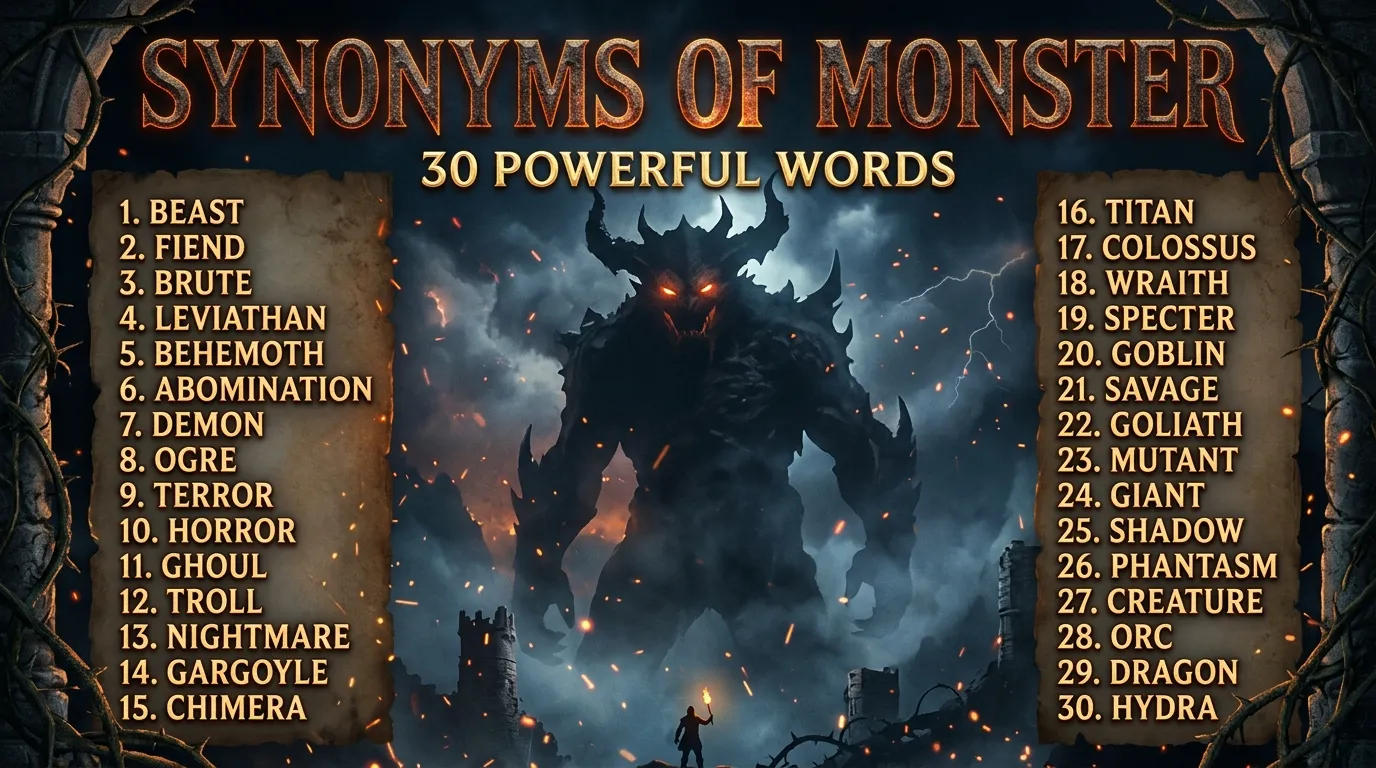
Synonyms of Monster — 30 Powerful Words
The best synonym depends on what monster describes. Some words mean a frightening creature, while others describe a cruel person, a huge animal, or something unusually large.
1. Beast (Noun) — US: /biːst/ | UK: /biːst/
Meaning: An animal, especially one that is large, strong, or frightening.
Examples:
- A wild beast lived deep in the forest.
- The hero fought a dangerous beast.
2. Creature (Noun) — US: /ˈkriː.tʃɚ/ | UK: /ˈkriː.tʃə/
Meaning: A living being, especially one that is strange or imaginary.
Examples:
- A strange creature appeared near the lake.
- The movie features a friendly creature from space.
3. Fiend (Noun) — US: /fiːnd/ | UK: /fiːnd/
Meaning: An evil or cruel person, or an imaginary evil being.
Examples:
- The story’s hero fought a powerful fiend.
- The villagers feared the fiend in the old castle.
4. Demon (Noun) — US: /ˈdiː.mən/ | UK: /ˈdiː.mən/
Meaning: An evil spirit or supernatural being, often linked with harm or fear.
Examples:
- The legend tells of a demon in the mountains.
- The hero faced a demon in the dark cave.
5. Ogre (Noun) — US: /ˈoʊ.ɡɚ/ | UK: /ˈəʊ.ɡə/
Meaning: A large, ugly, and frightening creature in fairy tales.
Examples:
- The ogre lived in a lonely tower.
- The children read a story about a hungry ogre.
6. Giant (Noun) — US: /ˈdʒaɪ.ənt/ | UK: /ˈdʒaɪ.ənt/
Meaning: A person or imaginary being of enormous size.
Examples:
- A giant guarded the entrance to the castle.
- The giant walked across the valley.
7. Brute (Noun) — US: /bruːt/ | UK: /bruːt/
Meaning: A violent, rough, or cruel person or animal.
Examples:
- The cruel brute frightened the villagers.
- The story’s hero stood up to the brute.
8. Horror (Noun) — US: /ˈhɔːr.ɚ/ | UK: /ˈhɒr.ə/
Meaning: Something or someone that causes great fear or disgust.
Examples:
- The monster was a horror from an ancient legend.
- The abandoned house became a place of horror.
9. Abomination (Noun) — US: /əˌbɑː.məˈneɪ.ʃən/ | UK: /əˌbɒm.ɪˈneɪ.ʃən/
Meaning: Something considered extremely unpleasant, hateful, or morally wrong.
Examples:
- The king called the cruel experiment an abomination.
- The villagers saw the creature as an abomination.
10. Mutant (Noun) — US: /ˈmjuː.tənt/ | UK: /ˈmjuː.tənt/
Meaning: A living thing with a genetic change that creates a different trait or form.
Examples:
- The science-fiction film features a giant mutant.
- The story follows a mutant with unusual powers.
11. Freak (Noun) — US: /friːk/ | UK: /friːk/
Meaning: Something unusual or unexpected; it can also be an insulting term for a person.
Examples:
- The film features a strange creature called a freak.
- A freak storm damaged several buildings.
Note: When used for a person, this word can be offensive.
12. Horror Show (Noun Phrase) — US: /ˈhɔːr.ɚ ʃoʊ/ | UK: /ˈhɒr.ə ʃəʊ/
Meaning: A frightening scene, event, or situation; sometimes used figuratively for something terrible.
Examples:
- The haunted house looked like a horror show.
- The ruined room was a horror show after the storm.
13. Terror (Noun) — US: /ˈter.ɚ/ | UK: /ˈter.ə/
Meaning: A person, creature, or thing that causes extreme fear.
Examples:
- The monster became the terror of the village.
- The fierce creature was a terror to nearby travelers.
14. Nightmare (Noun) — US: /ˈnaɪtˌmer/ | UK: /ˈnaɪt.meə/
Meaning: A frightening dream or something that causes great fear or distress.
Examples:
- The monster appeared in her nightmare.
- The huge creature became a nightmare for the villagers.
15. Devil (Noun) — US: /ˈdev.əl/ | UK: /ˈdev.əl/
Meaning: An evil supernatural being; informally, a very troublesome or cruel person.
Examples:
- The tale describes a devil living underground.
- The villain acted like a devil toward his enemies.
16. Villain (Noun) — US: /ˈvɪl.ən/ | UK: /ˈvɪl.ən/
Meaning: A person who does evil things, especially in a story.
Examples:
- The villain created a monster to frighten the town.
- The hero defeated the villain at the end.
17. Behemoth (Noun) — US: /bɪˈhiː.mɑːθ/ | UK: /bɪˈhiː.mɒθ/
Meaning: Something enormous and powerful, often an animal, machine, or organization.
Examples:
- A behemoth of a machine stood outside the factory.
- The fantasy story describes a behemoth guarding a cave.
18. Colossus (Noun) — US: /kəˈlɑː.səs/ | UK: /kəˈlɒs.əs/
Meaning: A person, creature, or thing of enormous size or power.
Examples:
- A stone colossus stood at the castle gate.
- The giant robot looked like a metal colossus.
19. Leviathan (Noun) — US: /ləˈvaɪ.ə.θən/ | UK: /lɪˈvaɪ.ə.θən/
Meaning: A huge sea creature or, figuratively, something of immense size and power.
Examples:
- The sailors feared the leviathan beneath the waves.
- A leviathan of a ship entered the harbor.
20. Monstrosity (Noun) — US: /mɑːnˈstrɑː.sə.t̬i/ | UK: /mɒnˈstrɒs.ə.ti/
Meaning: Something extremely ugly, unnatural, or shocking.
Examples:
- The artist created a fictional monstrosity for the film.
- The ruined building was called a monstrosity by its neighbors.
21. Abnormality (Noun) — US: /ˌæb.nɔːrˈmæl.ə.t̬i/ | UK: /ˌæb.nɔːˈmæl.ə.ti/
Meaning: Something that differs from what is usual or expected.
Examples:
- The scientist noticed an abnormality in the fictional creature.
- The strange shape was an abnormality in the model.
22. Horror Creature (Noun Phrase) — US: /ˈhɔːr.ɚ ˈkriː.tʃɚ/ | UK: /ˈhɒr.ə ˈkriː.tʃə/
Meaning: An imaginary being designed to frighten people in stories or films.
Examples:
- A horror creature crawled out of the cave.
- The film’s horror creature had glowing eyes.
24. Predator (Noun) — US: /ˈpred.ə.t̬ɚ/ | UK: /ˈpred.ə.tə/
Meaning: An animal that hunts other animals for food; figuratively, a person who exploits others.
Examples:
- The monster acted like a predator in the dark forest.
- The predator waited silently for its prey.
25. Goliath (Noun) — US: /ɡəˈlaɪ.əθ/ | UK: /ɡəˈlaɪ.əθ/
Meaning: A person or thing of enormous size or strength.
Examples:
- A Goliath of a creature blocked the road.
- The small team faced a corporate Goliath.
26. Juggernaut (Noun) — US: /ˈdʒʌɡ.ɚ.nɔːt/ | UK: /ˈdʒʌɡ.ə.nɔːt/
Meaning: A powerful force that is difficult to stop.
Examples:
- The giant robot became an unstoppable juggernaut.
- The team turned into a sporting juggernaut.
27. Monster (Noun, Figurative Use) — US: /ˈmɑːn.stɚ/ | UK: /ˈmɒn.stə/
Meaning: A person or thing that displays extreme cruelty or extraordinary power.
Examples:
- The cruel ruler became a monster in the eyes of his people.
- The athlete was a monster on the field.
28. Ogreish Figure (Noun Phrase) — US: /ˈoʊ.ɡɚ.ɪʃ ˈfɪɡ.jɚ/ | UK: /ˈəʊ.ɡə.rɪʃ ˈfɪɡ.ə/
Meaning: A person or imagined being with a frightening, ogre-like appearance or manner.
Examples:
- An ogreish figure stood at the end of the hallway.
- The artist painted an ogreish figure with a huge nose.
29. Chimera (Noun) — US: /kaɪˈmɪr.ə/ | UK: /kaɪˈmɪə.rə/
Meaning: A mythical creature made from parts of different animals; it can also mean an impossible dream or idea.
Examples:
- The ancient legend describes a chimera with a lion’s head.
- The fantasy artist drew a chimera with wings and a serpent’s tail.
30. Hydra (Noun) — US: /ˈhaɪ.drə/ | UK: /ˈhaɪ.drə/
Meaning: A many-headed monster from Greek mythology; figuratively, a problem that grows new difficulties when one is solved.
Examples:
- Hercules fought the many-headed hydra in Greek mythology.
- The story features a hydra that grows two heads when one is cut off.
Prototype Meaning of Monster
The most typical meaning of monster is a frightening, unusual creature that people imagine in horror stories, fairy tales, and fantasy films. It may have sharp teeth, huge claws, strange eyes, or unusual powers. Some monsters are imaginary, while others represent danger or cruelty. When people hear this word, they often picture a large, scary creature that threatens people. However, the meaning changes with context. A person who behaves cruelly may be called a monster, while a very powerful athlete may be described as a monster in a positive, informal sense.
Prototype Categorization of Monster Synonyms
Grouping synonyms helps writers select words that fit the meaning, mood, and purpose of a sentence.
- Frightening creatures: Ogre, demon, fiend, hydra, chimera, horror creature. Use these words in fantasy stories, myths, and horror writing.
- Cruel or evil people: Brute, villain, fiend, devil. These words describe harmful actions or an evil character.
- Huge and powerful beings: Giant, behemoth, colossus, leviathan, Goliath. Use them to show enormous size or strength.
- Fear and frightening experiences: Terror, nightmare, horror, horror show. These words focus on the fear caused by a monster or a frightening event.
- Strange or unnatural things: Mutant, freak, monstrosity, abnormality. These words suggest something unusual, although some may sound insulting or negative.
- These words can describe a fierce animal or a dangerous character.
- Powerful forces: Juggernaut and behemoth. These are useful for describing a powerful team, machine, business, or force.
- Mythological monsters: Hydra, chimera, leviathan. These are especially useful in myths, legends, and fantasy stories.
Not every word above is an exact synonym. For example, nightmare describes a frightening experience, while predator describes a hunter.
Antonyms of Monster
An antonym is a word with the opposite or contrasting meaning.
| Antonym | Meaning |
| Angel | A kind or good being |
| Hero | A person admired for courage or good actions |
| Friend | Someone who cares about or supports you |
| Saint | A very holy or morally good person |
| Gentle creature | A being that is calm and not aggressive |
| Innocent | Free from guilt or wrongdoing |
| Protector | Someone who keeps others safe |
| Benefactor | Someone who helps others |
| Humanitarian | A person who works to improve human welfare |
| Beauty | Someone or something pleasing to look at |
The best antonym depends on the intended meaning. For a cruel person, hero or saint may provide a contrast. For a frightening creature, gentle creature may be more suitable.
.
Short Questions and Answers
– What does monster mean?
A monster is a frightening or unusual creature. The word can also describe a cruel person or something extremely large.
– When should monster be used?
Use monster when describing a scary creature, a cruel person, or something unusually large or powerful.
– Is monster positive or negative?
It is usually negative because it suggests fear or cruelty. In informal speech, it can be positive when describing someone exceptionally powerful or skilled.
– How is monster different from similar words?
A beast is usually an animal, an ogre is a fairy-tale creature, a demon is a supernatural evil being, and a giant is mainly known for enormous size. Monster is a broader word.
– What is the easiest synonym for monster?
Beast is a useful, simple alternative when describing a frightening animal or creature.
– Can monster describe a person?
Yes. It can describe someone who acts with extreme cruelty, but the word is very strong and insulting.
– What is the plural of monster?
The plural is monsters. For example, “The children imagined monsters under their beds.”
– What is the adjective form of monster?
Monstrous is the common adjective. It can mean extremely large, frightening, or cruel.
Conclusion
Learning the word monster and its synonyms can improve your English vocabulary and help you express ideas more clearly. Words such as beast, ogre, demon, and giant add variety to stories, while behemoth and juggernaut can describe enormous size or great power. Understanding each word’s meaning, pronunciation, and emotional tone also helps you choose the right word for the right situation. This skill is useful for students, English learners, bloggers, and content writers. It can strengthen both speaking and writing, reduce repetition, and build confidence in English. For better results, learn two or three new synonyms each day, write your own sentences, and review them regularly. With steady practice, you can use English in a more natural, clear, and engaging way.

I’m Zahid Abbas, an educator, researcher, and digital publishing strategist with a passion for linguistics, grammar, and clear communication. As a content creator and SEO specialist, I craft research-driven, reader-focused content that empowers learners and makes knowledge accessible worldwide.