Eventually means something happens after some time, delay, or effort. Imagine a student who studies hard for months but does not get good marks at first. The student keeps learning and trying. After many tests, the student finally succeeds. We can say the student eventually reached the goal.
The word eventually is common in daily speech, stories, news, and formal writing. It helps explain how events unfold over time. It can show that something happened after a wait, a struggle, or a series of changes.
Learning synonyms of eventually helps English learners express time and results in more precise ways. It also helps content writers avoid repeating the same word in every paragraph. Words such as finally, ultimately, and in the end are close in meaning, but they do not always fit the same sentence.
In this guide, you will learn the meaning, pronunciation, history, and grammar of eventually. You will also explore 30 related words, with simple meanings and examples to help you choose the right word for each situation.
Meaning of Eventually
Eventually (adverb): After some time, delay, or a series of events; in the end.
Examples
- She eventually passed her driving test.
- The rain stopped, and the sun eventually came out.
Connotative Meaning
- Positive tone: Eventually can suggest success, hope, or a good result after hard work.
- Negative tone: It can suggest a long wait, delay, or a result that came too late.
- Neutral tone: It can simply show that something happened later, without expressing a feeling.
Examples:
- Positive: He eventually achieved his dream.
- Negative: The repair team eventually arrived, but the damage was already done.
- Neutral: The road eventually leads to the town.
Etymology of Eventually
- Source language: Latin, through French and later English word formation.
- Root word: Eventual, meaning “happening at a later time” or “dependent on future events.”
- Latin connection: Eventus means “outcome,” “result,” or “event.”
- Suffix: -ly turns the adjective eventual into the adverb eventually.
A Short History
- Old English (450–1100): Eventually was not used in Old English. Speakers used other words and phrases to express ideas about what happened later or in the end.
- Middle English (1100–1500): English gained many words from French and Latin. The roots linked to event and eventual developed through these influences.
- Modern English (1500–present): Eventually became established as an adverb meaning “in the end” or “after some time.” It is now common in speech and writing.
Pronunciation of Eventually
- US: /ɪˈvɛn.tʃu.ə.li/
- UK: /ɪˈvɛn.tʃu.ə.li/
Syllables
e-ven-tu-al-ly — 5 syllables
Affixation Pattern of Eventually
- Root: event — related to something that happens.
- Prefix: None in the modern word.
- Suffixes: -ual forms the adjective eventual; -ly forms the adverb eventually.
- Word formation: Event is a noun. Eventual is an adjective. Eventually is an adverb. Eventuality is a noun that refers to a possible future event or outcome.
Related forms:
- Event (noun): Something that happens.
- Eventual (adjective): Happening or expected at a later time.
- Eventually (adverb): After some time or in the end.
- Eventuality (noun): A possible future event or result.
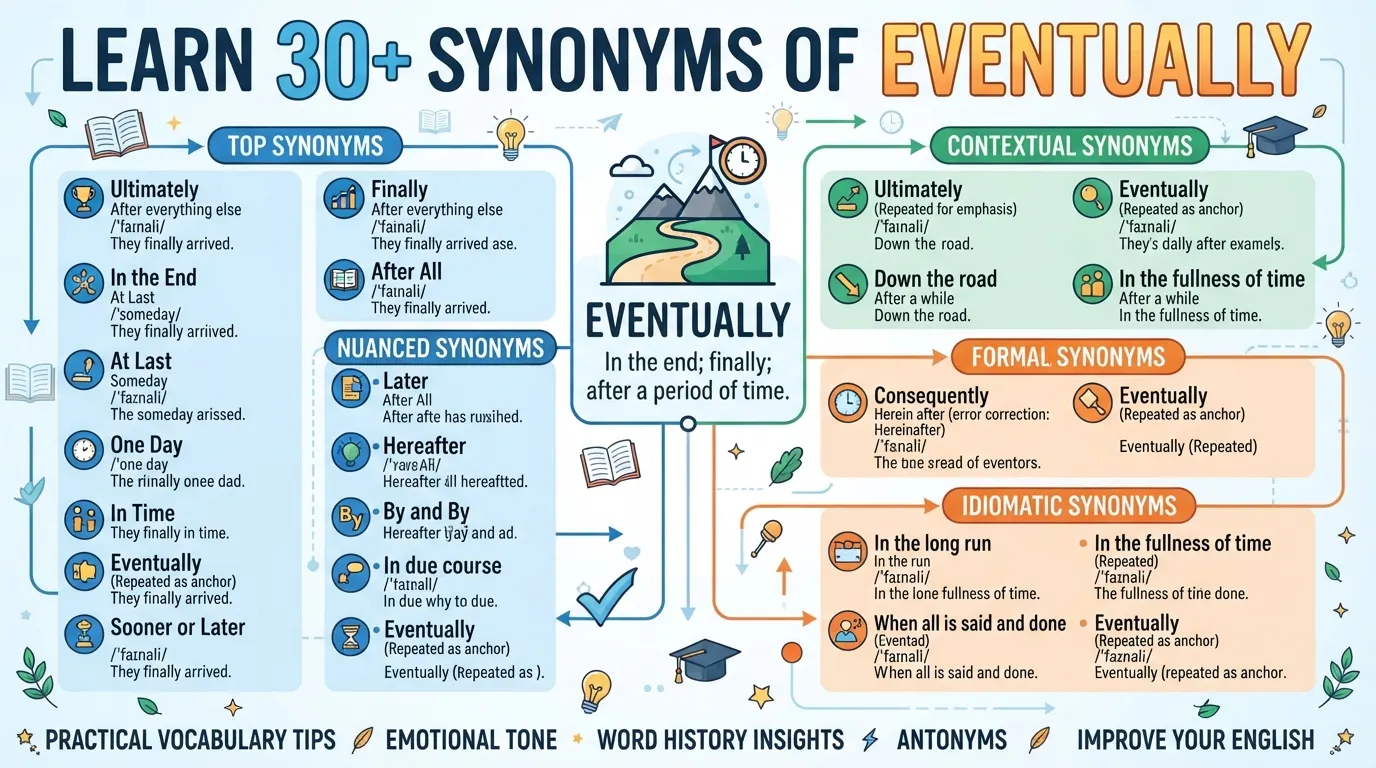
Synonyms of Eventually — 30 Powerful Words
These words and phrases can replace eventually in some situations. However, their meanings are not always the same. Check the context before choosing a synonym.
1. Finally (Adverb) — US /ˈfaɪnəli/ | UK /ˈfaɪnəli/
Meaning: After a wait or a series of events; at last.
Examples:
- She finally found her lost keys.
- We finally reached the hotel after a long drive.
2. Ultimately (Adverb) — US /ˈʌltəmətli/ | UK /ˈʌltɪmətli/
Meaning: When everything is considered or after all events have taken place.
Examples:
- Hard work ultimately led to his success.
- The choice will ultimately be yours.
3. At last (Adverbial phrase) — US /æt ˈlæst/ | UK /æt ˈlɑːst/
Meaning: After a long wait or delay.
Examples:
- At last, the bus arrived.
- She smiled when the results came at last.
4. In the end (Adverbial phrase) — US /ɪn ði ˈɛnd/ | UK /ɪn ði ˈɛnd/
Meaning: After everything has happened or been considered.
Examples:
- In the end, they chose the smaller house.
- We disagreed at first, but in the end we became friends.
5. Sooner or later (Adverbial phrase) — US /ˌsuːnər ɔːr ˈleɪtər/ | UK /ˌsuːnə ɔː ˈleɪtə/
Meaning: At some time in the future, even if it is not known when.
Examples:
- Sooner or later, you must make a choice.
- If you keep practicing, you will improve sooner or later.
6. In time (Adverbial phrase) — US /ɪn ˈtaɪm/ | UK /ɪn ˈtaɪm/
Meaning: Early enough or after enough time has passed.
Examples:
- The doctor arrived in time to help.
- With practice, she learned to speak clearly in time.
Note: “In time” can mean “before it is too late,” so it is not always interchangeable with eventually.
7. After a while (Adverbial phrase) — US /ˌæftər ə ˈwaɪl/ | UK /ˌɑːftər ə ˈwaɪl/
Meaning: After some time has passed.
Examples:
- After a while, the baby fell asleep.
- He felt better after a while.
8. In due course (Adverbial phrase) — US /ɪn ˌduː ˈkɔːrs/ | UK /ɪn ˌdjuː ˈkɔːs/
Meaning: At the proper or expected time.
Examples:
- You will receive your results in due course.
- The company will share more details in due course.
9. At length (Adverbial phrase) — US /æt ˈlɛŋkθ/ | UK /æt ˈleŋkθ/
Meaning: After a long time or delay.
Examples:
- At length, the guests arrived.
- The team at length reached an agreement.
10. Afterward (Adverb) — US /ˈæftərwərd/ | UK /ˈɑːftəwəd/
Meaning: At a later time after something else.
Examples:
- We ate dinner and went for a walk afterward.
- She spoke to her teacher afterward.
Note: Afterward points to a later time, but it does not always mean “eventually.”
11. Thereafter (Adverb) — US /ˌðerˈæftər/ | UK /ˌðeərˈɑːftə/
Meaning: After that time or event.
Examples:
- He moved to London and lived there thereafter.
- The rule took effect in June and remained in force thereafter.
12. Subsequently (Adverb) — US /ˈsʌbsɪkwəntli/ | UK /ˈsʌbsɪkwəntli/
Meaning: After something else has happened.
Examples:
- She missed the first train and subsequently arrived late.
- The plan was approved and subsequently put into action.
13. Later (Adverb) — US /ˈleɪtər/ | UK /ˈleɪtə/
Meaning: At a time after the present or another event.
Examples:
- I will call you later.
- He later became a well-known writer.
14. One day (Adverbial phrase) — US /ˌwʌn ˈdeɪ/ | UK /ˌwʌn ˈdeɪ/
Meaning: At some unknown time in the future or past, depending on the context.
Examples:
- One day, she hopes to own a home.
- He believed one day he would succeed.
15. In the long run (Adverbial phrase) — US /ɪn ðə ˌlɔːŋ ˈrʌn/ | UK /ɪn ðə ˌlɒŋ ˈrʌn/
Meaning: Over a long period or when the final effects become clear.
Examples:
- Saving money helps in the long run.
- The extra training paid off in the long run.
Explore Related Synonyms: https://synonymhunting.com/synonyms-for-avoid/
16. Eventually (Adverb) — US /ɪˈvɛn.tʃu.ə.li/ | UK /ɪˈvɛn.tʃu.ə.li/
Meaning: After some time, delay, or a series of events.
Examples:
- The truth eventually came out.
- They eventually agreed on a plan.
Note: This entry repeats the main word for reference rather than offering a new synonym. For a strict list of 30 distinct alternatives, replace it with “after all” only when the sentence means “when everything is considered.”
17. After all (Adverbial phrase) — US /ˌæftər ˈɔːl/ | UK /ˌɑːftər ˈɔːl/
Meaning: When everything has been considered, or to explain a reason.
Examples:
- After all, it was the best choice for the family.
- She decided to try again; after all, she had nothing to lose.
18. By and by (Adverbial phrase) — US /ˌbaɪ ən ˈbaɪ/ | UK /ˌbaɪ ən ˈbaɪ/
Meaning: After some time; eventually.
Examples:
- By and by, the children grew tired.
- The clouds cleared by and by.
19. In the fullness of time (Adverbial phrase) — US /ɪn ðə ˌfʊlnəs əv ˈtaɪm/ | UK /ɪn ðə ˌfʊlnəs əv ˈtaɪm/
Meaning: At the right time in the future, after enough time has passed.
Examples:
- In the fullness of time, the project may succeed.
- She believed the answer would become clear in the fullness of time.
20. At some point (Adverbial phrase) — US /æt sʌm ˈpɔɪnt/ | UK /æt sʌm ˈpɔɪnt/
Meaning: At an unknown time.
Examples:
- At some point, we must talk about the problem.
- He will need to make a choice at some point.
21. In the long term (Adverbial phrase) — US /ɪn ðə ˌlɔːŋ ˈtɜːrm/ | UK /ɪn ðə ˌlɒŋ ˈtɜːm/
Meaning: Over a long period or when looking far into the future.
Examples:
- Exercise can improve health in the long term.
- The change may save money in the long term.
22. At the end of the day (Adverbial phrase) — US /æt ði ˌɛnd əv ðə ˈdeɪ/ | UK /æt ði ˌɛnd əv ðə ˈdeɪ/
Meaning: When everything is considered; in the final view.
Examples:
- At the end of the day, safety matters most.
- At the end of the day, the decision is yours.
Note: This phrase often expresses a final judgment, not simply a later event.
23. Eventually thereafter (Adverbial phrase) — US /ɪˈvɛn.tʃu.ə.li ðerˈæftər/ | UK /ɪˈvɛn.tʃu.ə.li ðeərˈɑːftə/
Meaning: At a later time after a particular event.
Examples:
- The law was passed and eventually thereafter enforced.
- The two groups met and eventually thereafter worked together.
Note: This wording is uncommon and often awkward. In most writing, use later, thereafter, or subsequently instead.
24. Ultimately speaking (Adverbial phrase) — US /ˈʌltəmətli ˈspiːkɪŋ/ | UK /ˈʌltɪmətli ˈspiːkɪŋ/
Meaning: When looking at the final result or main point.
Examples:
- Ultimately speaking, trust matters more than money.
- Ultimately speaking, the team must choose what works best.
Note: This phrase is not a common fixed expression. Usually, ultimately alone is more natural.
25. At some later time (Adverbial phrase) — US /æt sʌm ˈleɪtər taɪm/ | UK /æt sʌm ˈleɪtə taɪm/
Meaning: At a time in the future that has not been specified.
Examples:
- We may return to the issue at some later time.
- The office will review the request at some later time.
26. After some time (Adverbial phrase) — US /ˈæftər sʌm ˈtaɪm/ | UK /ˈɑːftə sʌm ˈtaɪm/
Meaning: Once a period of time has passed.
Examples:
- After some time, the noise stopped.
- The plants began to grow after some time.
27. When all is said and done (Adverbial phrase) — US /wɛn ɔːl ɪz ˌsɛd ən ˈdʌn/ | UK /wen ɔːl ɪz ˌsed ən ˈdʌn/
Meaning: After everything has been considered or completed.
Examples:
- When all is said and done, family is important.
- When all is said and done, the team did its best.
28. In the final analysis (Adverbial phrase) — US /ɪn ðə ˌfaɪnəl əˈnæləsɪs/ | UK /ɪn ðə ˌfaɪnəl əˈnæləsɪs/
Meaning: After considering all the facts.
Examples:
- In the final analysis, the plan was too costly.
- In the final analysis, honesty matters most.
29. At the end (Adverbial phrase) — US /æt ði ˈɛnd/ | UK /æt ði ˈɛnd/
Meaning: At the final part of a period, event, or process.
Examples:
- At the end of the meeting, everyone agreed.
- The answer appeared at the end of the book.
Note: Use this phrase with a clear context, such as “at the end of the day” or “at the end of the meeting.”
30. In the course of time (Adverbial phrase) — US /ɪn ðə ˌkɔːrs əv ˈtaɪm/ | UK /ɪn ðə ˌkɔːs əv ˈtaɪm/
Meaning: As time passes.
Examples:
- In the course of time, their friendship grew stronger.
- The town changed in the course of time.
Prototype Meaning of Eventually
The most common meaning of eventually is that something happens after time has passed or after several events have taken place. People often imagine someone waiting, working toward a goal, facing problems, or moving through a process before reaching a result.
For example, a student may struggle with English for months but eventually become a confident speaker. The word does not tell us exactly when success happens. It tells us that success comes later.
Prototype Categorization: Groups of Eventually Synonyms
Different alternatives express different shades of meaning. Grouping them helps writers choose words that fit their sentences.
- After a delay: finally, at last, after a while, at length, after some time, by and by. These work when something takes time to happen.
- Final result or outcome: ultimately, in the end, in the final analysis, when all is said and done. These focus on the final result or judgment.
- A later event: later, afterward, thereafter, subsequently, at some point, at a later time. These show when something happens in relation to another event.
- A future time: sooner or later, one day, in due course, in due time, when the time comes. These refer to an event expected in the future.
- Long-term effects: in the long run, in the long term, in the course of time, as time goes by. These focus on changes or results over time.
- Early enough: in time. Use this when something happens before it is too late.
Antonyms of Eventually
Because eventually refers to something happening after time has passed, its opposites depend on the sentence.
- Immediately: At once, without delay.
- Instantly: At the very moment something happens.
- Right away: Without waiting.
- At once: Immediately.
- Promptly: Without unnecessary delay.
- Straightaway: Immediately; without waiting.
- Early: Before the expected time.
- Previously: Before the time being discussed.
- Already: Before now or before a stated time.
- First: Before another event or action.
Examples:
- Eventually, the doctor arrived. → The doctor arrived immediately.
- She eventually replied. → She replied right away.
Short Questions and Answers
What does eventually mean?
It means after some time, delay, or a series of events; in the end.
When should eventually be used?
Use it when something happens later than expected or after a process, wait, or struggle.
Is eventually positive or negative?
It is neutral. The result can be good, bad, or neither.
How is eventually different from finally?
Both can mean that something happens after a wait. Finally often stresses the end of a wait, while eventually stresses that something happens after time or events have passed.
What is the closest synonym for eventually?
Finally is often a close synonym, but the best choice depends on the sentence.
Can eventually be used at the start of a sentence?
Yes. For example: “Eventually, the storm passed.”
– Is eventually formal or informal? It works in both everyday speech and formal writing.
Conclusion
Learning synonyms for eventually and it helps you explain time, change, and results more clearly. The word is useful when something happens after a wait, a struggle, or a series of events. Alternatives such as finally, ultimately, and in the end can make your writing more varied, but each has its own use.
For example, at last often shows relief after a long wait, while ultimately focuses on the final result. Phrases such as later and subsequently show that one event follows another. Choosing the right word helps you avoid repetition and express your ideas with greater care.
To improve your vocabulary, learn two or three words each day. Read their meanings, study their pronunciation, and write your own examples. Then use them in real conversations or short paragraphs. With regular practice, you can improve your English, write with more confidence, and choose words that fit your meaning.

I’m Zahid Abbas, an educator, researcher, and digital publishing strategist with a passion for linguistics, grammar, and clear communication. As a content creator and SEO specialist, I craft research-driven, reader-focused content that empowers learners and makes knowledge accessible worldwide.