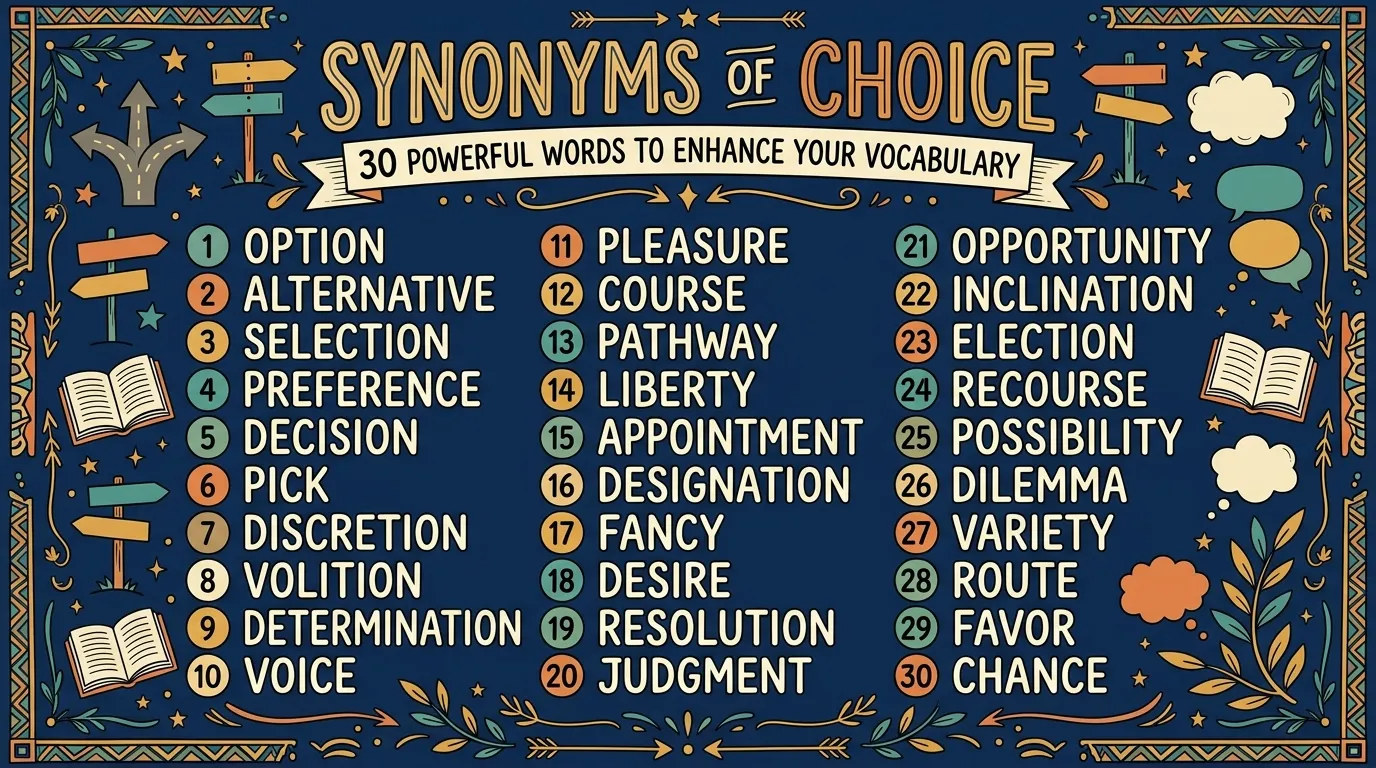
Choice means the act of selecting one person, thing, or option from two or more possibilities. Everyone makes choices every day. For example, a student may choose between studying English and watching television. A shopper may choose between two shirts. In both cases, the word choice describes the act or result of selecting something.
The word is common in daily conversations, schoolwork, business, and writing. Learning synonyms of choice helps English learners express ideas in different ways.
Meaning of Choice
Definition
Choice (noun): The act of selecting something or the thing selected from two or more options.
Examples
- You have a choice between tea and coffee.
- Reading every day is a good choice for students.
Connotative Meaning
(Connotation is the feeling or idea that a word suggests beyond its basic meaning.)
- Positive tone: Choice can suggest freedom, opportunity, and control. Example: “She made a wise choice.”
- Negative tone: Choice can suggest difficulty, pressure, or regret. Example: “It was a difficult choice.”
- Neutral tone: Choice can simply describe selecting an option. Example: “You can make your choice now.”
The emotional tone depends on the situation and the words around it.
Read more about:https://synonymhunting.com/synonyms-for-consider/
Etymology of Choice
The word choice has a long history in the English language.
- Source language: Old French chois or choisir, meaning a choice or to choose.
- Earlier origin: The word is linked to the Germanic roots of the verb choose.
- Original meaning: The act of selecting or preferring one thing over another.
Short History of Choice
Old English (450–1100)
The modern noun choice was not used in its present form during most of the Old English period. People used older Germanic words, including ceosan, meaning “to choose.”
Middle English (1100–1500)
After the Norman Conquest, French influenced English vocabulary. Forms related to choice and choose became more common. The noun developed the meaning of selecting or preferring something.
Modern English (1500–Present)
The word choice became widely used in everyday speech and writing. Today, it refers to both the act of selecting and the option selected. It also appears in expressions such as “first choice,” “free choice,” and “choice of words.”
- US pronunciation: /tʃɔɪs/
- UK pronunciation: /tʃɔɪs/
- Syllables: choice (one syllable)
- Word pattern: choice
Pronunciation of Choice
The word begins with the “ch” sound, as in chair, and ends with an “s” sound.
Affixation Pattern of Choice
- Root: choose (the related verb)
- Prefix: None in the base word choice.
- Suffix: The noun ending -ice is part of the historical form; it is not a productive suffix added to choose in modern English.
Word Formation of Choice
Several related words can be formed from or associated with choice and choose.
Word
Grammatical category
Meaning
Choose
Verb
To select something
Choice
Noun
An act or result of selecting
Choices
Plural noun
More than one choice
Chosen
Verb form/adjective
Selected
Chooser
Noun
A person who chooses
Chooseable
Adjective, uncommon
Able to be chosen
Choiceful
Adjective, rare
Involving choices
Note: Choosable is a more established spelling than chooseable. Some related forms are uncommon and may not suit everyday writing.
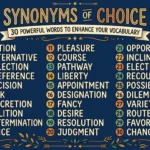
Synonyms of Choice
The best synonym depends on the sentence. Some words describe the act of choosing, while others describe an available option or a decision.
1. Selection (Noun) — US /sɪˈlɛkʃən/ | UK /sɪˈlɛkʃən/
Meaning: The act of choosing something or a group of available options.
Examples:
- The selection of a school is important.
- The shop offers a wide selection of books.
2. Option (Noun) — US /ˈɑːpʃən/ | UK /ˈɒpʃən/
Meaning: One of the possible things a person can choose.
Examples:
- You have the option to study online.
- Taking the bus is another option.
3. Alternative (Noun) — US /ɔːlˈtɝːnətɪv/ | UK /ɔːlˈtɜːnətɪv/
Meaning: Another possibility that can replace the first one.
Examples:
- We need an alternative to plastic bags.
- Walking is a healthy alternative to driving.
4. Decision (Noun) — US /dɪˈsɪʒən/ | UK /dɪˈsɪʒən/
Meaning: A conclusion reached after thinking about different possibilities.
Examples:
- She made a decision to learn English.
- His decision changed the plan.
5. Preference (Noun) — US /ˈprɛfərəns/ | UK /ˈprɛfərəns/
Meaning: A greater liking for one thing over another.
Examples:
- My preference is tea without sugar.
- She has a preference for simple clothes.
6. Pick (Noun) — US /pɪk/ | UK /pɪk/
Meaning: A person or thing selected from several possibilities.
Examples:
- This book is my first pick.
- The blue shirt was his pick.
7. Selection Process (Noun Phrase) — US /sɪˈlɛkʃən ˈprɑːsɛs/ | UK /sɪˈlɛkʃən ˈprəʊsɛs/
Meaning: The steps used to choose a person or thing.
Examples:
- The selection process took two days.
- Our school has a fair selection process.
8. Alternative Option (Noun Phrase) — US /ɔːlˈtɝːnətɪv ˈɑːpʃən/ | UK /ɔːlˈtɜːnətɪv ˈɒpʃən/
Meaning: Another possible course of action.
Examples:
- We discussed an alternative option.
- Online classes are an alternative option for busy students.
9. Preference-Based Selection (Noun Phrase) — US /ˈprɛfərəns beɪst sɪˈlɛkʃən/ | UK /ˈprɛfərəns beɪst sɪˈlɛkʃən/
Meaning: A selection made according to someone’s likes or needs.
Examples:
- The website uses preference-based selection.
- Preference-based selection can improve the shopping experience.
10. Judgment (Noun) — US /ˈdʒʌdʒmənt/ | UK /ˈdʒʌdʒmənt/
Meaning: The ability or act of deciding what is best.
Examples:
- Good judgment helps us make wise choices.
- The teacher used her judgment to solve the problem.
11. Discretion (Noun) — US /dɪˈskrɛʃən/ | UK /dɪˈskrɛʃən/
Meaning: The freedom to decide what should be done.
Examples:
- The manager has discretion to approve the request.
- Use your discretion when sharing personal information.
12. Alternative Course (Noun Phrase) — US /ɔːlˈtɝːnətɪv kɔːrs/ | UK /ɔːlˈtɜːnətɪv kɔːs/
Meaning: Another way to act or achieve a goal.
Examples:
- We considered an alternative course of action.
- The team found an alternative course after the road closed.
13. Possibility (Noun) — US /ˌpɑːsəˈbɪləti/ | UK /ˌpɒsəˈbɪləti/
Meaning: Something that may happen or be done.
Examples:
- Moving abroad is one possibility.
- We must consider every possibility.
14. Opportunity (Noun) — US /ˌɑːpərˈtuːnəti/ | UK /ˌɒpəˈtjuːnəti/
Meaning: A suitable chance to do or achieve something.
Examples:
- This course gives students an opportunity to learn.
- She had an opportunity to work abroad.
15. Preference Choice (Noun Phrase) — US /ˈprɛfərəns tʃɔɪs/ | UK /ˈprɛfərəns tʃɔɪs/
Meaning: A selection based on personal liking.
Examples:
- The final preference choice was a blue dress.
- Your preference choice may differ from mine.
16. Election (Noun) — US /ɪˈlɛkʃən/ | UK /ɪˈlɛkʃən/
Meaning: A formal process of choosing a person for a position, usually by voting.
Examples:
- The election will take place next month.
- Citizens made their choice in the election.
17. Nomination (Noun) — US /ˌnɑːməˈneɪʃən/ | UK /ˌnɒmɪˈneɪʃən/
Meaning: The act of formally suggesting someone for a position or award.
Examples:
- Her nomination surprised the team.
- The committee announced his nomination.
18. Alternative Selection (Noun Phrase) — US /ɔːlˈtɝːnətɪv sɪˈlɛkʃən/ | UK /ɔːlˈtɜːnətɪv sɪˈlɛkʃən/
Meaning: A different selection made when the first one is unsuitable.
Examples:
- We made an alternative selection after checking the price.
- The school offered an alternative selection of courses.
19. Resolution (Noun) — US /ˌrɛzəˈluːʃən/ | UK /ˌrɛzəˈluːʃən/
Meaning: A firm decision to do something or settle a problem.
Examples:
- She made a resolution to read daily.
- The team reached a resolution after a long discussion.
20. Preference Order (Noun Phrase) — US /ˈprɛfərəns ˈɔːrdər/ | UK /ˈprɛfərəns ˈɔːdə/
Meaning: A list that places preferred options in order.
Examples:
- Students submitted their preference order.
- Put your favorite subjects in preference order.
21. Alternative Plan (Noun Phrase) — US /ɔːlˈtɝːnətɪv plæn/ | UK /ɔːlˈtɜːnətɪv plæn/
Meaning: A backup plan used if the first plan fails.
Examples:
- We need an alternative plan for rainy weather.
- The teacher prepared an alternative plan for the lesson.
22. Course of Action (Noun Phrase) — US /kɔːrs əv ˈækʃən/ | UK /kɔːs əv ˈækʃən/
Meaning: A way of acting in a particular situation.
Examples:
- We must decide on the best course of action.
- Calling the manager was the right course of action.
23. Preference List (Noun Phrase) — US /ˈprɛfərəns lɪst/ | UK /ˈprɛfərəns lɪst/
Meaning: A list of things arranged according to personal liking.
Examples:
- I made a preference list before shopping.
- The students submitted a preference list of subjects.
24. Election Choice (Noun Phrase) — US /ɪˈlɛkʃən tʃɔɪs/ | UK /ɪˈlɛkʃən tʃɔɪs/
Meaning: A candidate or option selected in an election.
Examples:
- Voters discussed their election choice.
- Each citizen can make an election choice.
25. Discretionary Decision (Noun Phrase) — US /dɪˈskrɛʃəˌnɛri dɪˈsɪʒən/ | UK /dɪˈskrɛʃənəri dɪˈsɪʒən/
Meaning: A decision made using personal authority or judgment.
Examples:
- The manager made a discretionary decision.
- The policy allows a discretionary decision in special cases.
26. Preference Option (Noun Phrase) — US /ˈprɛfərəns ˈɑːpʃən/ | UK /ˈprɛfərəns ˈɒpʃən/
Meaning: An available option that matches someone’s liking.
Examples:
- The app remembers your preference option.
- Choose the preference option that suits you best.
27. Alternative Possibility (Noun Phrase) — US /ɔːlˈtɝːnətɪv ˌpɑːsəˈbɪləti/ | UK /ɔːlˈtɜːnətɪv ˌpɒsəˈbɪləti/
Meaning: Another possible outcome or way forward.
Examples:
- We explored an alternative possibility.
- The team discussed an alternative possibility before deciding.
28. Judgment Call (Noun Phrase) — US /ˈdʒʌdʒmənt kɔːl/ | UK /ˈdʒʌdʒmənt kɔːl/
Meaning: A decision based on personal judgment rather than a clear rule.
Examples:
- Choosing the best design was a judgment call.
- The coach made a judgment call during the match.
29. Preference Decision (Noun Phrase) — US /ˈprɛfərəns dɪˈsɪʒən/ | UK /ˈprɛfərəns dɪˈsɪʒən/
Meaning: A decision guided by personal likes or priorities.
Examples:
- Choosing a quiet place was a preference decision.
- The final preference decision belonged to the customer.
30. Selection Choice (Noun Phrase) — US /sɪˈlɛkʃən tʃɔɪs/ | UK /sɪˈlɛkʃən tʃɔɪs/
Meaning: A choice made from a set of available items.
Examples:
- The customer made a selection choice from the menu.
- Our selection choice depended on the price and quality.
Prototype Meaning of Choice
The most typical meaning of choice is selecting one option from several available options. People usually imagine a person comparing two or more things and deciding which one they want. For example, a student may choose a subject, a customer may select a product, or a family may decide where to go on holiday. A choice can be easy or difficult, personal or professional, and small or important. The word often suggests that a person has some control over the final decision.
Prototype Categorization
Synonyms can be grouped according to their meanings and uses. These categories help writers select a word that fits the exact situation.
- Selecting something: selection, pick. Use these when describing the act of choosing or the item selected.
- Available possibilities: option, alternative, possibility. Use these when talking about different things someone could do.
- Thinking and deciding: decision, judgment, resolution. Use these when focusing on the process or result of deciding.
- Personal likes: preference. Use this when describing what someone likes or wants most.
- Freedom and authority: discretion. Use this when someone has the power to decide independently.
- Formal selection: election, nomination. Use these in voting, leadership, and award-related situations.
- Plans and actions: alternative plan, course of action. Use these when discussing what to do next.
Categorization helps writers avoid incorrect word choices. For example, option refers to a possible alternative, while decision usually refers to the result of choosing.
Antonyms of Choice
Antonyms are words with opposite or contrasting meanings. The best antonym depends on how choice is used.
- Compulsion: Being forced to do something.
- Coercion: Making someone act through pressure or threats.
- Constraint: A limit that restricts freedom.
- Restriction: A rule or condition that limits available options.
- Necessity: Something that must be done or is required.
- Obligation: A duty that a person is expected to fulfill.
- Imposition: Something forced on a person without their free agreement.
For example, “She made her own choice” contrasts with “She acted under compulsion.”
Short Questions and Answers
– What does choice mean?
Choice means selecting something from two or more options, or the option that has been selected.
– When should choice be used?
Use choice when talking about selecting something, having options, or describing the result of a selection.
– Is choice positive or negative?
Choice is usually neutral. It can have a positive tone when it suggests freedom and a negative tone when the decision is difficult.
– How is choice different from similar words?
– Can choice be used as a verb?
No. Choice is a noun. The related verb is choose. For example, “I choose a book” and “My choice is this book.”
– What is the plural of choice?
The plural is choices. For example, “Students have many choices.”
Conclusion
Learning the meaning of choice and its synonyms can improve your English vocabulary and communication skills. Words such as option, selection, decision, and preference help you express ideas more clearly. They also make your writing more natural and reduce unnecessary repetition.
For English learners, understanding the differences between similar words is just as important as memorizing their meanings. Each word has its own use, tone, and context. Content writers can use this knowledge to create useful articles, stronger sentences, and engaging content.
Practice one or two new words every day. Write simple sentences, read English articles, and use the words in real conversations. Over time, regular practice will strengthen your writing and speaking skills and help you feel more confident when using English.

I’m Zahid Abbas, an educator, researcher, and digital publishing strategist with a passion for linguistics, grammar, and clear communication. As a content creator and SEO specialist, I craft research-driven, reader-focused content that empowers learners and makes knowledge accessible worldwide.