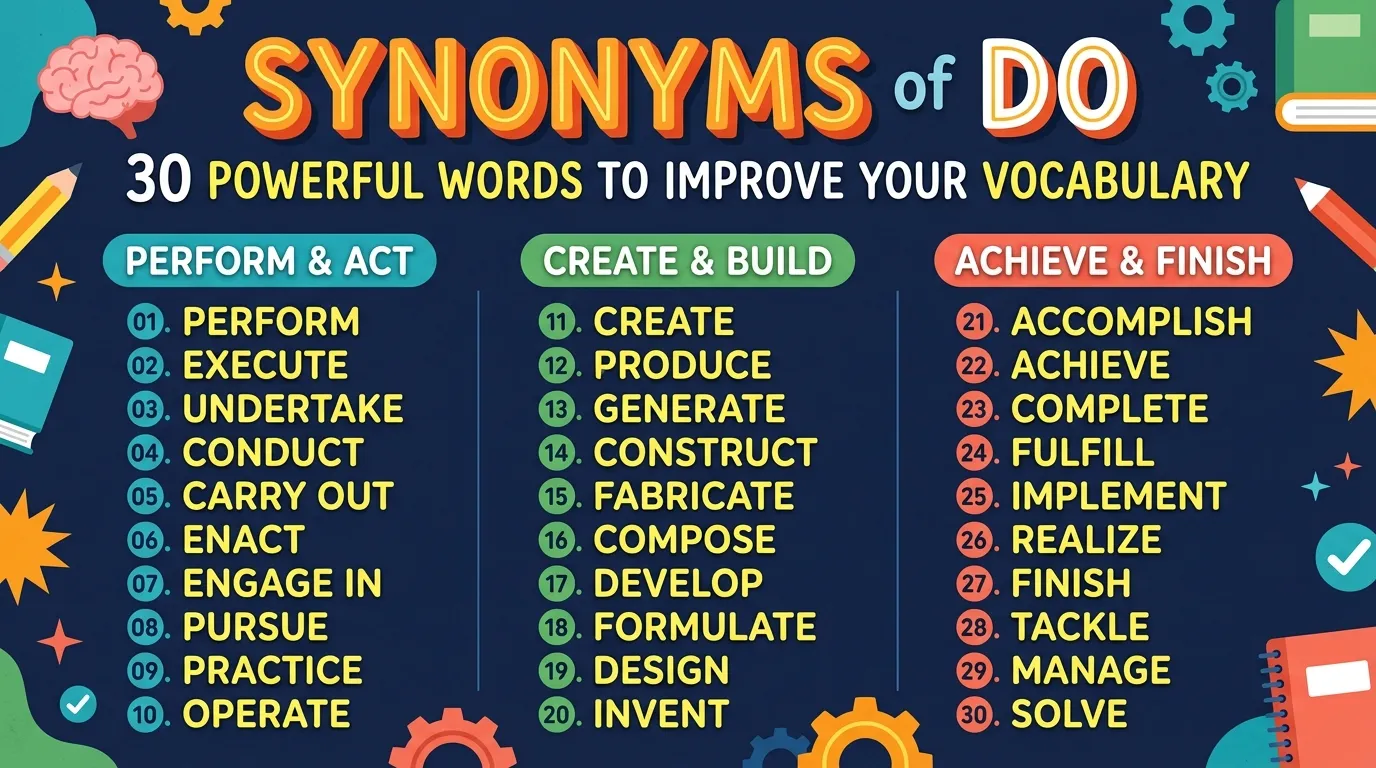
The word do means to perform an action, finish a task, or carry out work. We use it every day. For example, you may do your homework, do the dishes, or do your best in class. It is a small word, but it has many uses.
English learners often use “do” in many sentences. This is normal, but using the same word again and again can make writing sound dull. Learning synonyms helps you choose better words. It also helps you speak with more ease and write clear sentences.
In this guide, you will learn the meaning of “do” and 30 useful synonyms. Each word has a simple meaning and two examples. You will also learn about its tone, history, pronunciation, word forms, and opposite words. These tips will help you use English in a clear and natural way.
Meaning of Do
Definition
Do (Verb): To perform an action, complete a task, or carry out work.
Examples
- I do my homework every evening.
- We do our best to help others.
Connotative Meaning
(Connotation means the feeling or idea that a word gives beyond its basic meaning.)
- Positive tone: “Do your best” shows effort, care, and a wish to succeed.
- Negative tone: “Do harm” means to cause pain or damage.
- Neutral tone: “Do the work” simply means to complete a task.
The word “do” is not good or bad on its own. Its tone depends on the words around it.
Read more about:https://synonymhunting.com/synonyms-of-stuff/
Etymology
- Source language: Old English.
- Original form: Dōn.
- Original meaning: To act, make, or perform.
Short History of Do
Old English (450–1100)
The word came from Old English dōn. People used it to talk about actions and tasks. It was an important word in daily speech.
Middle English (1100–1500)
The word changed in sound and spelling over time. Forms such as doon appeared in Middle English writing. Its use also grew in questions and negative sentences.
Modern English (1500–Present)
Today, “do” is one of the most common English verbs. We use it to talk about actions, tasks, and duties. It also helps us form questions, such as “Do you like tea?” and negative sentences, such as “I do not know.”
Pronunciation (US & UK – IPA)
- US: /duː/
- UK: /duː/
Syllables
do — one syllable.
Affixation Pattern of Do
- Root: do
- Prefix: None in the basic word.
- Suffix: None in the basic word.
Word Formation
The verb “do” has several useful forms:
- Do: Base form — I do my work.
- Does: Present form for he, she, and it — She does her work.
- Did: Past form — He did the task.
- Doing: -ing form — I am doing my work.
- Done: Past participle — I have done my work.
- Redo: A new action using the prefix re- — I must redo the task.
- Undo: To reverse an action — I can undo the change.
- Overdo: To do too much — Do not overdo the exercise.
- Doer: A person who takes action — She is a doer, not just a talker.
- Doing: A noun in some sentences — Doing good feels nice.
These forms belong to different grammatical groups, including verbs, participles, and nouns. The exact number of words related to “do” depends on the dictionary and the forms counted.
Synonyms of Do
The best synonym depends on the sentence. Some words mean to perform a task. Others mean to make, finish, or carry out an action.
1. Perform (Verb) — US /pərˈfɔːrm/ | UK /pəˈfɔːm/
Meaning: To carry out an action or task.
Examples:
- The nurse will perform the test.
- We perform simple tasks every day.
2. Act (Verb) — US /ækt/ | UK /ækt/
Meaning: To do something or take action.
Examples:
- You must act with care.
- She acted fast to help the child.
3. Execute (Verb) — US /ˈɛksɪˌkjuːt/ | UK /ˈeksɪkjuːt/
Meaning: To carry out a plan or task.
Examples:
- The team will execute the plan.
- He executed the task with care.
4. Complete (Verb) — US /kəmˈpliːt/ | UK /kəmˈpliːt/
Meaning: To finish something.
Examples:
- I will complete my homework today.
- She completed the class project.
5. Finish (Verb) — US /ˈfɪnɪʃ/ | UK /ˈfɪnɪʃ/
Meaning: To bring a task to an end.
Examples:
- Please finish your meal.
- He finished the work on time.
6. Accomplish (Verb) — US /əˈkɑːmplɪʃ/ | UK /əˈkʌmplɪʃ/
Meaning: To succeed in doing something.
Examples:
- We accomplished our goal.
- She accomplished a hard task.
7. Achieve (Verb) — US /əˈtʃiːv/ | UK /əˈtʃiːv/
Meaning: To reach a goal through effort.
Examples:
- He worked hard to achieve his goal.
- You can achieve great things with practice.
8. Carry Out (Verb) — US /ˌkæri ˈaʊt/ | UK /ˌkæri ˈaʊt/
Meaning: To do a task or follow a plan.
Examples:
- The school will carry out a survey.
- We carried out the teacher’s plan.
9. Conduct (Verb) — US /kənˈdʌkt/ | UK /kənˈdʌkt/
Meaning: To organize and carry out an activity.
Examples:
- The teacher will conduct a test.
- They conducted a study on reading.
10. Undertake (Verb) — US /ˌʌndərˈteɪk/ | UK /ˌʌndəˈteɪk/
Meaning: To agree to do a task or job.
Examples:
- She will undertake the new project.
- He undertook the task with care.
11. Handle (Verb) — US /ˈhændəl/ | UK /ˈhændəl/
Meaning: To deal with a task or problem.
Examples:
- I can handle this job.
- She handled the problem well.
12. Manage (Verb) — US /ˈmænɪdʒ/ | UK /ˈmænɪdʒ/
Meaning: To deal with or control a task.
Examples:
- He can manage the shop.
- I managed to finish my work.
13. Tackle (Verb) — US /ˈtækəl/ | UK /ˈtækəl/
Meaning: To try to solve a problem or task.
Examples:
- We must tackle this problem.
- She tackled the hard question first.
14. Address (Verb) — US /əˈdres/ | UK /əˈdres/
Meaning: To deal with a problem or issue.
Examples:
- The school will address the issue.
- We need to address this problem now.
15. Deal With (Verb) — US /ˈdiːl wɪð/ | UK /ˈdiːl wɪð/
Meaning: To take action to handle something.
Examples:
- I will deal with the complaint.
- She deals with many tasks each day.
16. Make (Verb) — US /meɪk/ | UK /meɪk/
Meaning: To create or produce something.
Examples:
- I will make a paper boat.
- They made a cake for the party.
Note: “Make” is useful when “do” means to create something, but it does not fit every use of “do.”
17. Create (Verb) — US /kriˈeɪt/ | UK /kriˈeɪt/
Meaning: To bring something new into being.
Examples:
- The pupils created a wall chart.
- She created a new game.
18. Build (Verb) — US /bɪld/ | UK /bɪld/
Meaning: To make or develop something.
Examples:
- They built a small house.
- We can build good habits.
19. Produce (Verb) — US /prəˈduːs/ | UK /prəˈdjuːs/
Meaning: To make or bring out something.
Examples:
- The farm produces fresh milk.
- The class produced a short play.
20. Prepare (Verb) — US /prɪˈper/ | UK /prɪˈpeə/
Meaning: To get something ready.
Examples:
- I will prepare the lesson.
- She prepared food for the guests.
21. Arrange (Verb) — US /əˈreɪndʒ/ | UK /əˈreɪndʒ/
Meaning: To put things in order or plan them.
Examples:
- We arranged the chairs in rows.
- He arranged a meeting with the head teacher.
22. Organize (Verb) — US /ˈɔːrɡənaɪz/ | UK /ˈɔːɡənaɪz/
Meaning: To plan or put things in order.
Examples:
- The school will organize a sports day.
- She organized her books by subject.
23. Complete (Verb) — US /kəmˈpliːt/ | UK /kəmˈpliːt/
Meaning: To finish all parts of a task.
Examples:
- Please complete the form.
- We completed the work before lunch.
24. Accomplish (Verb) — US /əˈkɑːmplɪʃ/ | UK /əˈkʌmplɪʃ/
Meaning: To do something successfully.
Examples:
- They accomplished the task together.
- He accomplished more than he expected.
25. Fulfil (Verb) — US /fʊlˈfɪl/ | UK /fʊlˈfɪl/
Meaning: To do what is required or promised.
Examples:
- She fulfilled her promise.
- We must fulfil our duties.
26. Apply (Verb) — US /əˈplaɪ/ | UK /əˈplaɪ/
Meaning: To use a rule, idea, or method.
Examples:
- Apply this rule to the question.
- He applied what he learned in class.
27. Practice (Verb) — US /ˈpræktɪs/ | UK /ˈpræktɪs/
Meaning: To do something often to improve a skill.
Examples:
- I practice English every day.
- She practices the piano after school.
28. Try (Verb) — US /traɪ/ | UK /traɪ/
Meaning: To make an effort to do something.
Examples:
- Try to answer the question.
- He tried to fix the broken chair.
29. Work (Verb) — US /wɜːrk/ | UK /wɜːk/
Meaning: To do a job or task.
Examples:
- We work hard at school.
- She worked all morning on the report.
30. Serve (Verb) — US /sɜːrv/ | UK /sɜːv/
Meaning: To help others or meet a need.
Examples:
- He serves his community with care.
- This tool serves a useful purpose.
Prototype Meaning
The most common meaning of “do” is to perform an action or complete a task. When people hear this word, they may think of homework, housework, a job, or a daily duty. For example, a child does homework, a cook does the cooking, and a worker does a job. The word can also appear in questions and negative sentences. Its exact meaning depends on the words around it.
Prototype Categorization
Synonyms can be grouped by the kind of action they describe.
- Doing an action: act, perform, execute.
- Finishing a task: complete, finish, accomplish, achieve.
- Handling a problem: handle, manage, tackle, address, deal with.
- Making something: make, create, build, produce.
- Planning work: prepare, arrange, organize.
- Meeting a duty: undertake, fulfil, serve.
- Using or improving a skill: apply, practice, try, work.
- Carrying out a plan: carry out, conduct.
These groups help writers choose the right word. For example, use “finish” when a task ends, “create” when something new is made, and “handle” when a problem needs care. This makes writing clear and avoids mistakes.
Antonyms of Do
There is no single opposite for every meaning of “do.” The best antonym depends on the sentence.
- Avoid: to stay away from something.
- Neglect: to fail to give care or attention.
- Omit: to leave something out.
- Abandon: to stop doing something before it is finished.
- Undo: to reverse an action.
- Hinder: to make an action harder.
- Prevent: to stop something from happening.
- Delay: to make something happen later.
Examples:
- Do your work. / Neglect your work.
- Complete the task. / Abandon the task.
- Make a change. / Undo a change.
Short Questions and Answers
- What does “do” mean?
It means to perform an action or complete a task. - When should “do” be used?
Use it for actions, jobs, tasks, and duties. It is also used in questions and negative sentences. - Is “do” positive or negative?
It is usually neutral. The words around it can give it a positive or negative tone. - How is “do” different from similar words?
“Do” is a general word. “Create” means to make something new, “finish” means to end a task, and “manage” means to handle a task or problem.
Conclusion
The word “do” is simple, but it has many uses in English. Learning its synonyms can help you speak and write in a better way. Words such as “perform,” “finish,” “create,” and “manage” make your meaning clear. They also help you avoid using the same word too often.
Each synonym has its own meaning and use. So, it is important to choose the word that fits your sentence. Read the examples, say the words aloud, and try to use them in daily life. You can learn three new words each day and write a sentence with each one. Small steps can lead to big gains. With regular practice, you can build a stronger vocabulary and feel more sure when you use English.

I’m Zahid Abbas, an educator, researcher, and digital publishing strategist with a passion for linguistics, grammar, and clear communication. As a content creator and SEO specialist, I craft research-driven, reader-focused content that empowers learners and makes knowledge accessible worldwide.