The word stuff means things, items, or materials. It is a common word in daily English. People use it when they do not want to name each thing. For example, you may say, “Please put your stuff in the bag.” This can mean books, pens, clothes, or other items.
We use the word stuff at home, at school, and at work. It is easy to say and understand. However, using it too often can make writing less clear. Learning synonyms helps you choose better words for each situation.
English learners can use synonyms to build strong vocabulary. Content writers can also use them to make articles clear and useful. In this guide, you will learn the meaning of stuff, its synonyms, examples, grammar, history, pronunciation, and word groups. These simple tips will help you speak and write better English.
Meaning of Stuff
Stuff (Noun and Verb):
Definition: Stuff means things or materials when we do not name them one by one. As a verb, it means to fill something with things.
Examples
- I put my school stuff in my bag.
- Please do not stuff too many clothes into the box.
Connotative Meaning
(Connotation means the feeling or idea that a word gives beyond its basic meaning.)
- Positive tone: Stuff can mean useful or special things, such as art stuff or baby stuff.
- Negative tone: It can mean unwanted items or things that make a place messy.
- Neutral tone: It can simply mean things, items, or materials.
The tone depends on the sentence and the speaker.
Etymology
The word stuff has a long history.
- Source language: Old French estoffe, meaning material or supplies.
- Older root: The word came from a Germanic root linked to material and things.
- Original sense: It referred to materials used to make or fill something.
Short History of Stuff
- Old English (450–1100): The modern word stuff was not yet in common English use. Related Germanic words referred to materials and objects.
- Middle English (1100–1500): English adopted stuff through Old French. It often meant material, supplies, or things used for a purpose.
- Modern English (1500–Present): The word gained wider use. Today, it can mean many kinds of things, materials, or personal items. It is also used as a verb.
Read more about:https://synonymhunting.com/synonyms-of-tiny/
Pronunciation
- US: /stʌf/
- UK: /stʌf/
Syllables: stuff (one syllable)
Affixation Pattern of Stuff
- Root: stuff
- Prefix: None
- Suffix: None in the basic word
- Word formation: The word can form several related words and forms.
Word
Grammatical category
Stuff
Noun, verb
Stuffed
Past tense verb, adjective
Stuffing
Noun, verb form
Stuffer
Noun
Stuffless
Adjective, uncommon
These forms are related to the main word, but they do not all have the same meaning or level of use.
Synonyms of Stuff
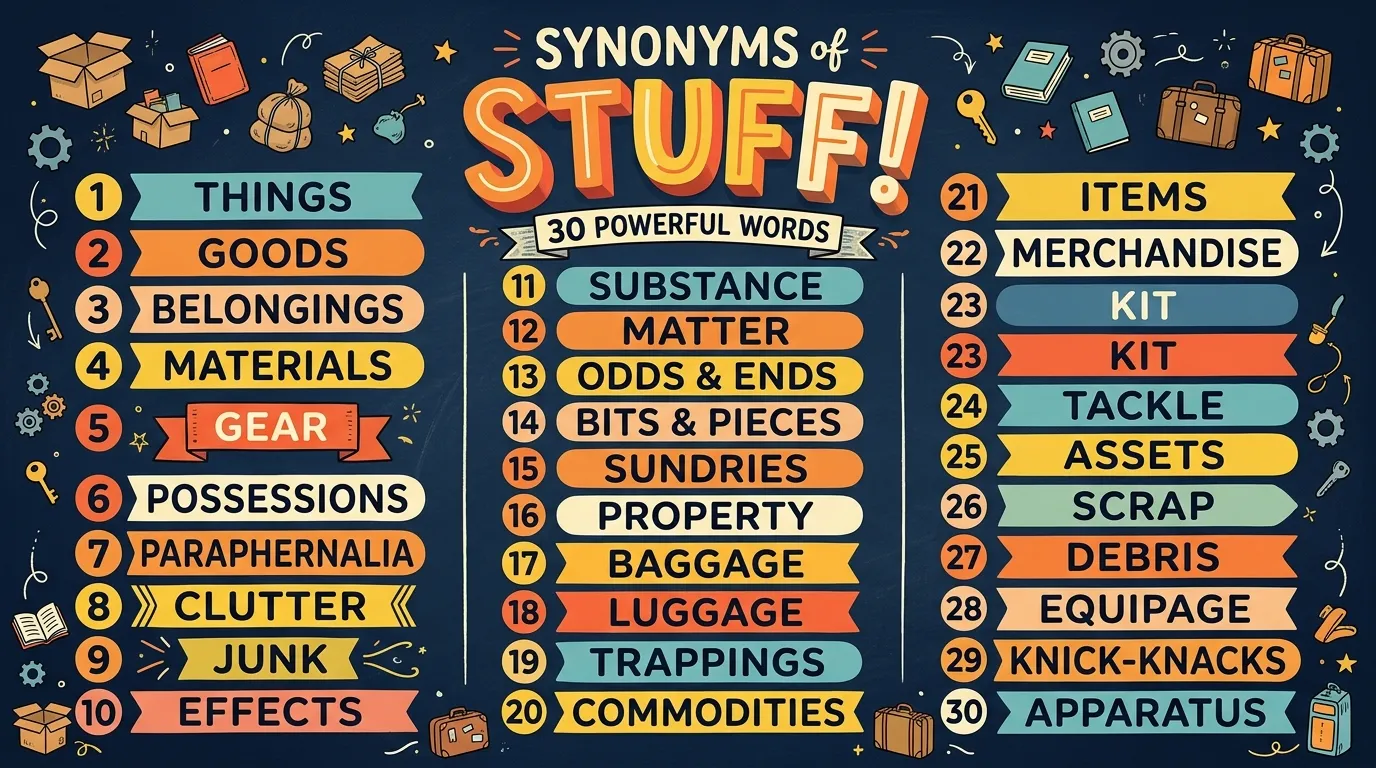
The best synonym depends on what you mean. Stuff can refer to objects, materials, personal items, or information. Here are 30 useful words with simple meanings, pronunciations, and examples.
1. Things (Noun) — US /θɪŋz/ | UK /θɪŋz/
Meaning: Things are objects or items that we use or talk about.
Examples:
- I packed my things for school.
- Please put these things on the table.
2. Items (Noun) — US /ˈaɪtəmz/ | UK /ˈaɪtəmz/
Meaning: Items are separate objects in a group or list.
Examples:
- I bought three items from the shop.
- Check all the items in your bag.
3. Objects (Noun) — US /ˈɑːbdʒekts/ | UK /ˈɒbdʒekts/
Meaning: Objects are things that you can see or touch.
Examples:
- The box holds small objects.
- Keep sharp objects away from children.
4. Belongings (Noun) — US /bɪˈlɔːŋɪŋz/ | UK /bɪˈlɒŋɪŋz/
Meaning: Belongings are things that a person owns.
Examples:
- She packed her belongings.
- Keep your belongings in a safe place.
5. Possessions (Noun) — US /pəˈzeʃənz/ | UK /pəˈzeʃənz/
Meaning: Possessions are things that belong to someone.
Examples:
- He keeps his possessions in a box.
- Her books are her most valued possessions.
6. Materials (Noun) — US /məˈtɪriəlz/ | UK /məˈtɪəriəlz/
Meaning: Materials are things used to make or build something.
Examples:
- We need materials for the school project.
- Wood and metal are useful materials.
7. Supplies (Noun) — US /səˈplaɪz/ | UK /səˈplaɪz/
Meaning: Supplies are things needed for a task.
Examples:
- The teacher bought school supplies.
- We need more food supplies.
8. Goods (Noun) — US /ɡʊdz/ | UK /ɡʊdz/
Meaning: Goods are things made or sold.
Examples:
- The shop sells fresh goods.
- The truck carried goods to the market.
9. Products (Noun) — US /ˈprɑːdəkts/ | UK /ˈprɒdʌkts/
Meaning: Products are things made to be sold or used.
Examples:
- This shop sells beauty products.
- The company makes food products.
10. Equipment (Noun) — US /ɪˈkwɪpmənt/ | UK /ɪˈkwɪpmənt/
Meaning: Equipment means the tools or items needed for a task.
Examples:
- The school bought sports equipment.
- We need safety equipment for this work.
11. Gear (Noun) — US /ɡɪr/ | UK /ɡɪə/
Meaning: Gear means equipment or clothing used for an activity.
Examples:
- Pack your camping gear.
- The players checked their sports gear.
12. Items of Clothing (Noun Phrase) — US /ˈaɪtəmz əv ˈkloʊðɪŋ/ | UK /ˈaɪtəmz əv ˈkləʊðɪŋ/
Meaning: Items of clothing are clothes worn on the body.
Examples:
- I packed five items of clothing.
- These items of clothing need washing.
13. Clothes (Noun) — US /kloʊðz/ | UK /kləʊðz/
Meaning: Clothes are things that people wear.
Examples:
- Put your clothes in the cupboard.
- She bought new clothes for winter.
14. Junk (Noun) — US /dʒʌŋk/ | UK /dʒʌŋk/
Meaning: Junk means old or unwanted things.
Examples:
- We threw away the junk.
- His desk is full of junk.
15. Odds and Ends (Noun Phrase) — US /ˌɑːdz ən ˈendz/ | UK /ˌɒdz ən ˈendz/
Meaning: Odds and ends are small things that do not belong to one clear group.
Examples:
- The drawer holds odds and ends.
- I packed a few odds and ends.
16. Miscellaneous Items (Noun Phrase) — US /ˌmɪsəˈleɪniəs ˈaɪtəmz/ | UK /ˌmɪsəˈleɪniəs ˈaɪtəmz/
Meaning: Miscellaneous items are different things that do not fit one group.
Examples:
- The box contains miscellaneous items.
- Put the miscellaneous items on this shelf.
17. Contents (Noun) — US /ˈkɑːntents/ | UK /ˈkɒntents/
Meaning: Contents are the things inside something.
Examples:
- She checked the contents of the bag.
- The box’s contents were safe.
18. Cargo (Noun) — US /ˈkɑːrɡoʊ/ | UK /ˈkɑːɡəʊ/
Meaning: Cargo is goods carried by a ship, plane, or truck.
Examples:
- The ship carried heavy cargo.
- The plane delivered cargo on time.
19. Freight (Noun) — US /freɪt/ | UK /freɪt/
Meaning: Freight means goods carried from one place to another.
Examples:
- The train carried freight.
- The company sends freight by road.
20. Substance (Noun) — US /ˈsʌbstəns/ | UK /ˈsʌbstəns/
Meaning: A substance is a type of matter or material.
Examples:
- The bottle contains a clear substance.
- Water is a common substance.
21. Matter (Noun) — US /ˈmætər/ | UK /ˈmætə/
Meaning: Matter is anything that has mass and takes up space.
Examples:
- Air is made of matter.
- Scientists study matter and energy.
22. Material (Noun) — US /məˈtɪriəl/ | UK /məˈtɪəriəl/
Meaning: Material is a substance used to make something.
Examples:
- This bag is made of strong material.
- We need material for the new curtains.
23. Information (Noun) — US /ˌɪnfərˈmeɪʃən/ | UK /ˌɪnfəˈmeɪʃən/
Meaning: Information is knowledge or facts about something.
Examples:
- The teacher gave us useful information.
- I need more information about the course.
24. Details (Noun) — US /ˈdiːteɪlz/ | UK /ˈdiːteɪlz/
Meaning: Details are small facts about a person, thing, or event.
Examples:
- Please share the details of the plan.
- She explained the details clearly.
25. Data (Noun) — US /ˈdeɪtə/ | UK /ˈdeɪtə/
Meaning: Data are facts or figures used to learn or make decisions.
Examples:
- The team collected data from students.
- We use data to study the results.
26. Business (Noun) — US /ˈbɪznəs/ | UK /ˈbɪznəs/
Meaning: Business can mean a task, matter, or work that needs attention.
Examples:
- I have some business to finish today.
- Let’s talk about school business later.
27. Affairs (Noun) — US /əˈferz/ | UK /əˈfeəz/
Meaning: Affairs are matters or activities linked to a person or group.
Examples:
- She manages her own affairs.
- The meeting covered school affairs.
28. Work (Noun) — US /wɝːk/ | UK /wɜːk/
Meaning: Work is a task or activity that needs effort.
Examples:
- I have a lot of work today.
- Please finish your work before lunch.
29. Stuffing (Noun) — US /ˈstʌfɪŋ/ | UK /ˈstʌfɪŋ/
Meaning: Stuffing is material used to fill something, such as a cushion or toy.
Examples:
- The pillow has soft stuffing.
- The toy needs more stuffing.
30. Things and Materials (Noun Phrase) — US /θɪŋz ən məˈtɪriəlz/ | UK /θɪŋz ən məˈtɪəriəlz/
Meaning: Things and materials refers to objects and substances used for different purposes.
Examples:
- We gathered things and materials for the project.
- The room held things and materials for art class.
Prototype Meaning
The most common meaning of stuff is a group of things that someone owns, uses, or needs. When people hear this word, they may think of clothes, books, toys, tools, or items in a bag. For example, “Move your stuff” often means to move your personal items. The word is broad and informal, so it is useful in daily speech. In formal writing, a more exact word, such as materials, equipment, or belongings, can make the meaning clearer.
Prototype Categorization
Synonyms can be placed into groups based on their meanings.
- General things: things, items, objects. Use these when you do not need to name each object.
- Personal property: belongings, possessions, clothes. Use these for things owned or worn by a person.
- Work and school needs: supplies, materials, equipment, gear. Use these for tasks, lessons, or activities.
- Goods for sale or transport: products, goods, cargo, freight. Use these in business and shipping.
- Unwanted things: junk, odds and ends. Use these for old, messy, or mixed items.
- Information and facts: information, details, data. Use these when stuff refers to ideas or facts.
- Matter and filling: substance, matter, material, stuffing. Use these for physical substances or things used to fill an object.
- Tasks and matters: work, business, affairs. Use these when stuff refers to duties or matters that need attention.
Grouping words helps writers choose the right term. It also makes writing clearer and avoids using the same word too often.
Antonyms of Stuff
Stuff has no single antonym because it has many meanings. These words may work as opposites in some contexts:
- Nothing: no thing at all.
- Emptiness: the state of having nothing inside.
- Void: an empty space.
- Vacancy: an empty place or space.
- Lack: a state of not having something.
For example, “The bag is full of stuff” is the opposite in meaning to “The bag is empty.”
Short Questions and Answers
– What does stuff mean? Stuff means things, items, or materials. It can also mean to fill something.
– When should stuff be used? Use it in casual speech when you do not need to name each thing.
– Is stuff positive or negative? It can be positive, negative, or neutral. The meaning depends on the context.
– How is stuff different from similar words? Stuff is broad and informal. Items means separate objects, materials are used to make things, and belongings are things a person owns.
Conclusion
Learning the word stuff and its synonyms can help you improve your English. You can use words such as items, belongings, materials, and supplies to make your meaning clear. Each word has its own use, so it is important to choose the right one.
Using synonyms also helps you avoid repeating the same word in your writing. This makes your schoolwork, blog posts, and daily messages easier to read. You can also speak with more confidence when you know different words for the same idea.

I’m Zahid Abbas, an educator, researcher, and digital publishing strategist with a passion for linguistics, grammar, and clear communication. As a content creator and SEO specialist, I craft research-driven, reader-focused content that empowers learners and makes knowledge accessible worldwide.