The word uncomfortable means not feeling relaxed, happy, or at ease. Imagine wearing shoes that are one size too small, or sitting on a wooden chair that feels a bit too hard. That awkward, uneasy feeling in your body or mind is what we call uncomfortable.
We use synonyms for uncomfortable to describe tight clothes, itchy sweaters, hard seats, or feeling shy and nervous around new people. Learning new ways to say uncomfortable helps learners make their story writing expressive.
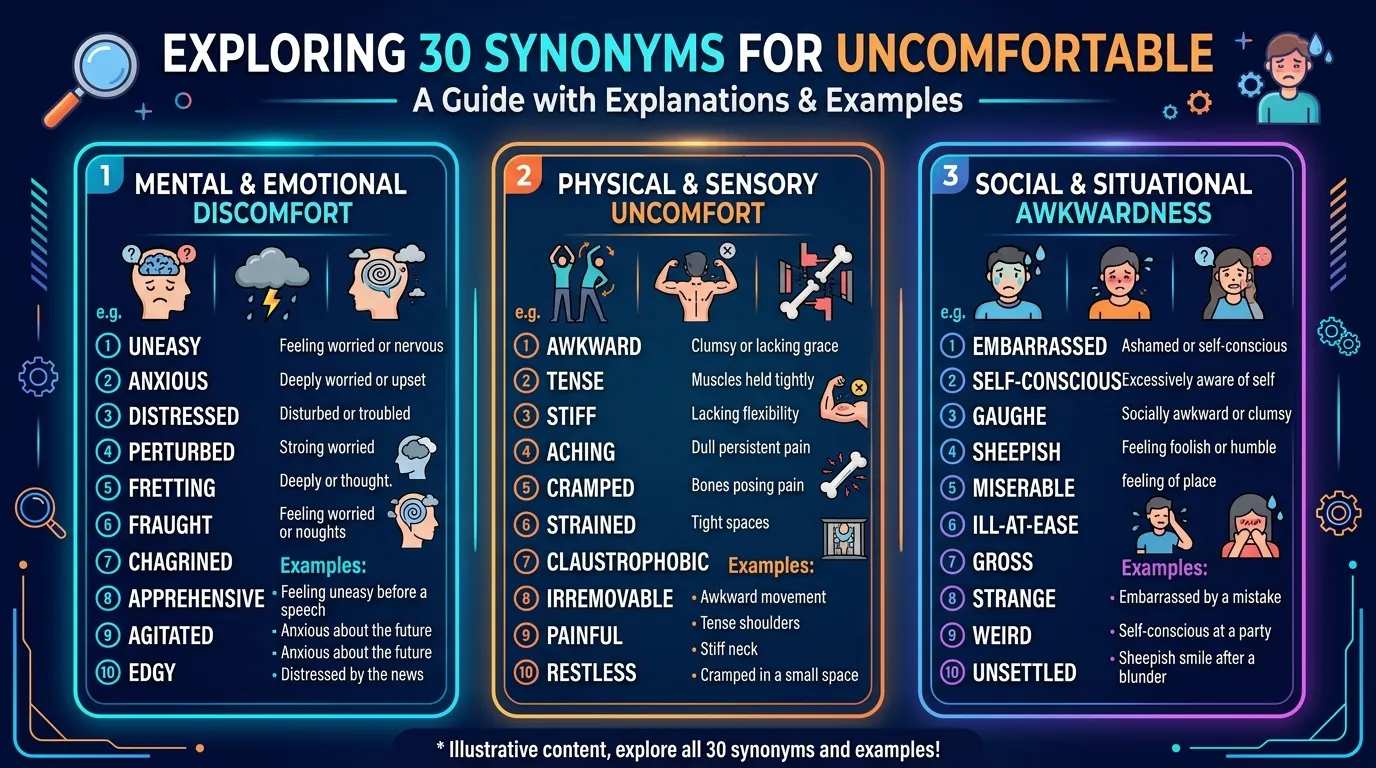
This guide gives you 30 simple synonyms for uncomfortable. Along with easy sentences, word origins, pronunciation guides, and clear categories.
Meaning of Uncomfortable
Definition
Uncomfortable (Adjective): Causing physical discomfort, or feeling nervous and uneasy.
Examples
- This itchy wool sweater feels very uncomfortable.
- He felt uncomfortable speaking in front of a big crowd.
Connotative Meaning
- Positive tone: Rarely positive, but pointing out discomfort helps people fix a problem.
- Negative tone: Expresses pain, itchiness, tightness, worry, or shyness.
- Neutral tone: Simply describes a physical object like a stiff chair or tight shoe.
Etymology
- Source language: Came from Latin and Old French roots long ago.
- Prefix: Un- (means not).
- Root: Comfort (means to make strong, give relief, or bring ease).
- Modern English: Literally means not feeling relaxed or at ease!
Pronunciation
- US: /ʌnˈkʌmftərbli/
- UK: /ʌnˈkʌmfətəbl/
Syllables
un-com-fort-a-ble (5 parts)
Affixation Pattern of Uncomfortable
- Root: Comfort (means ease or relief)
- Prefix: Un- (means not)
- Suffix: -able (makes an adjective)
- Word Formation:
- Noun: Discomfort / Uncomfortableness
- Adjective: Uncomfortable
- Adverb: Uncomfortably
Also read more about https://synonymhunting.com/synonyms-for-despite/
Synonyms for Uncomfortable
1. Uneasy (Adjective) — US: /ʌnˈiːzi/ | UK: /ʌnˈiːzi/
Meaning: Feeling slightly worried, nervous, or unsafe.
Examples:
The dark woods made the hikers feel uneasy.
She had an uneasy feeling before taking the pop quiz.
2. Awkward (Adjective) — US: /ˈɔːkwərd/ | UK: /ˈɔːkwəd/
Meaning: Feeling clumsy, shy, or out of place.
Examples:
He felt awkward dancing at the school party.
There was an awkward silence when no one knew the answer.
3. Painful (Adjective) — US: /ˈpeɪnfl/ | UK: /ˈpeɪnfl/
Meaning: Causing physical hurt or body soreness.
Examples:
Walking on the sharp rocks was very painful.
She had a painful sunburn on her shoulders.
4. Itchy (Adjective) — US: /ˈɪtʃi/ | UK: /ˈɪtʃi/
Meaning: Making your skin want to scratch.
Examples:
This brand-new wool scarf feels itchy on my neck.
Grass gave him itchy spots on his legs.
5. Tight (Adjective) — US: /taɪt/ | UK: /taɪt/
Meaning: Fitting too closely and pressing against your body.
Examples:
My old shoes are far too tight now.
The tight belt made it hard to bend down.
6. Stiff (Adjective) — US: /stɪf/ | UK: /stɪf/
Meaning: Hard to bend and not soft or flexible.
Examples:
The new leather boots felt cold and stiff.
Sitting still for two hours made his back feel stiff.
7. Rough (Adjective) — US: /rʌf/ | UK: /rʌf/
Meaning: Not smooth or soft against your skin.
Examples:
The rough blanket scratched my chin.
The rough wooden bench was hard to sit on.
8. Restless (Adjective) — US: /ˈrɛstləs/ | UK: /ˈrestləs/
Meaning: Unable to stay still or relax comfortably.
Examples:
The kids grew restless during the long bus ride.
He spent a restless night tossing and turning in bed.
9. Nervous (Adjective) — US: /ˈnɜːrvəs/ | UK: /ˈnɜːvəs/
Meaning: Feeling worried or afraid of making a mistake.
Examples:
She felt nervous on her first day at a new school.
My hands shook because I was so nervous.
10. Scratchy (Adjective) — US: /ˈskrætʃi/ | UK: /ˈskrætʃi/
Meaning: Rough material that tickles or stings skin.
Examples:
The tag on my shirt feels scratchy today.
He wore a scratchy costume to the play.
11. Hard (Adjective) — US: /hɑːrd/ | UK: /hɑːd/
Meaning: Not soft or cushiony to sit or lie on.
Examples:
Sleeping on the hard ground hurt my back.
We sat on hard plastic chairs in the hallway.
12. Distressed (Adjective) — US: /dɪˈstrɛst/ | UK: /dɪˈstrest/
Meaning: Feeling very upset, worried, or in pain.
Examples:
The lost puppy looked distressed in the rain.
She felt distressed when she dropped her ice cream.
13. Self-conscious (Adjective) — US: /ˌsɛlfˈkɑːnʃəs/ | UK: /ˌselfˈkɒnʃəs/
Meaning: Too worried about what other people think of you.
Examples:
He felt self-conscious wearing his new bright glasses.
She was self-conscious about her new haircut.
14. Troubled (Adjective) — US: /ˈtrʌbld/ | UK: /ˈtrʌbld/
Meaning: Full of worry, problems, or uneasy thoughts.
Examples:
He had a troubled look on his face after reading the letter.
Her mind felt troubled by the loud noise.
15. Clumsy (Adjective) — US: /ˈklʌmzi/ | UK: /ˈklʌmzi/
Meaning: Moving awkwardly without good balance.
Examples:
Wearing oversized boots made him feel clumsy.
The clumsy bear bumped into the wooden table.
16. Inconvenient (Adjective) — US: /ˌɪnkənˈviːniənt/ | UK: /ˌɪnkənˈviːniənt/
Meaning: Causing trouble, extra work, or awkward timing.
Examples:
The sudden rain was very inconvenient for our picnic.
It is inconvenient when the bus arrives late.
17. Irritating (Adjective) — US: /ˈɪrɪteɪtɪŋ/ | UK: /ˈɪrɪteɪtɪŋ/
Meaning: Annoying or causing a stinging feeling.
Examples:
The loud buzzing mosquito was very irritating.
This soap is irritating to sensitive skin.
18. Anxious (Adjective) — US: /ˈæŋkʃəs/ | UK: /ˈæŋkʃəs/
Meaning: Feeling worried, afraid, or fearful about what will happen.
Examples:
He felt anxious before his big piano recital.
The cat looked anxious near the big dog.
19. Disagreeable (Adjective) — US: /ˌdɪsəˈɡriːəbl/ | UK: /ˌdɪsəˈɡriːəbl/
Meaning: Unpleasant or not nice to experience.
Examples:
The medicine had a very disagreeable taste.
Cold, rainy weather can feel disagreeable.
20. Cramped (Adjective) — US: /kræmpt/ | UK: /kræmpt/
Meaning: Not having enough space to move freely.
Examples:
We felt cramped sitting four in the back seat.
The tiny tent felt very cramped at night.
21. Ill-at-ease (Adjective Phrase) — US: /ɪl æt iːz/ | UK: /ɪl æt iːz/
Meaning: Feeling nervous and not relaxed around others.
Examples:
He looked ill-at-ease standing at the formal dinner.
She felt ill-at-ease in the quiet library.
22. Sore (Adjective) — US: /sɔːr/ | UK: /sɔː/
Meaning: Hurting or feeling tender from hard use or exercise.
Examples:
My legs were sore after running around the track.
I have a sore throat today.
23. Disquieted (Adjective) — US: /dɪsˈkwaɪətɪd/ | UK: /dɪsˈkwaɪətɪd/
Meaning: Feeling calm interrupted by secret worry.
Examples:
The strange shadow made her feel disquieted.
He felt disquieted by the sudden loud noise.
24. Chafing (Adjective) — US: /ˈtʃeɪfɪŋ/ | UK: /ˈtʃeɪfɪŋ/
Meaning: Rubbing against skin to make it red and sore.
Examples:
Wet socks can cause chafing during a hike.
The tight collar felt chafing on his neck.
25. Distasteful (Adjective) — US: /dɪsˈteɪstfl/ | UK: /dɪsˈteɪstfl/
Meaning: Giving an unpleasant or gross feeling.
Examples:
The spoiled milk had a distasteful smell.
He found the rude joke very distasteful.
26. Discomforting (Adjective) — US: /dɪsˈkʌmfərtɪŋ/ | UK: /dɪsˈkʌmfətɪŋ/
Meaning: Making someone feel uneasy or embarrassed.
Examples:
It was a discomforting thought to lose his favorite toy.
Her sharp stare felt discomforting.
27. Unhandy (Adjective) — US: /ʌnˈhændi/ | UK: /ʌnˈhændi/
Meaning: Not easy to use or hold comfortably.
Examples:
This big heavy mug is quite unhandy for small hands.
The giant tool felt unhandy to carry.
28. Inflexible (Adjective) — US: /ɪnˈflɛksəbl/ | UK: /ɪnˈfleksəbl/
Meaning: Hard and unwilling to bend or stretch comfortably.
Examples:
The new plastic boots were stiff and inflexible.
His inflexible routine made changes difficult.
29. Out of place (Adverb Phrase) — US: /aʊt əv pleɪs/ | UK: /aʊt əv pleɪs/
Meaning: Feeling like you don’t belong in a group or location.
Examples:
Wearing my raincoat indoors made me feel out of place.
She felt out of place at the big older kids’ table.
30. Pinching (Adjective) — US: /ˈpɪntʃɪŋ/ | UK: /ˈpɪntʃɪŋ/
Meaning: Pressing tightly together so it hurts skin or toes.
Examples:
Her new shoes were pinching her toes.
He loosened the pinching belt right away.
Prototype Meaning
When children hear uncomfortable, they picture squirming in a hard wooden chair, scratching an itchy wool sweater tag, or standing shyly in a room full of strangers with their arms crossed.
Prototype Categorization
- Clothes, Shoes & Skin Feeling: Itchy, Tight, Scratchy, Chafing, Pinching, Rough.
- Hard Objects & Tight Spaces: Hard, Stiff, Cramped, Inflexible, Unhandy, Sore, Painful.
- Shyness & Embarrassment: Awkward, Self-conscious, Clumsy, Out of place, Ill-at-ease.
- Worry & Nervous Mind: Uneasy, Restless, Nervous, Anxious, Troubled, Distressed, Disquieted, Discomforting.
- Unpleasant Situations: Inconvenient, Irritating, Disagreeable, Distasteful.
Antonyms of Uncomfortable
- Comfortable
- Cozy
- Relaxed
- Soft
- Easygoing
- At ease
Short Questions and Answers
- What does uncomfortable mean?
- It means not feeling relaxed, happy, soft, or at ease in your body or mind.
- When should I use uncomfortable?
- Use it when writing about tight shoes, itchy clothes, hard seats, or feeling shy and nervous around people.
- Is uncomfortable an adjective or an adverb?
- It is an adjective because it describes nouns like clothes, seats, or feelings!
- How is uncomfortable different from painful?
- Painful means something hurts badly, while uncomfortable usually means feeling awkward, tight, itchy, or slightly uneasy.
Conclusion
Synonyms for uncomfortable can help you describe difficult feelings and situations in a clearer way. Words such as uneasy, awkward, unpleasant, nervous, and restless can make your English natural. Each synonym has a slightly different meaning, so knowing these words helps you choose the best one. for each situation. For English learners, learning synonyms for uncomfortable can improve writing, speaking and reading. They also help you avoid repeating the same word too often. Try using a few synonyms for uncomfortable synonyms in simple sentences each day. With regular practice, you can build a stronger vocabulary.

I’m Zahid Abbas, an educator, researcher, and digital publishing strategist with a passion for linguistics, grammar, and clear communication. As a content creator and SEO specialist, I craft research-driven, reader-focused content that empowers learners and makes knowledge accessible worldwide.