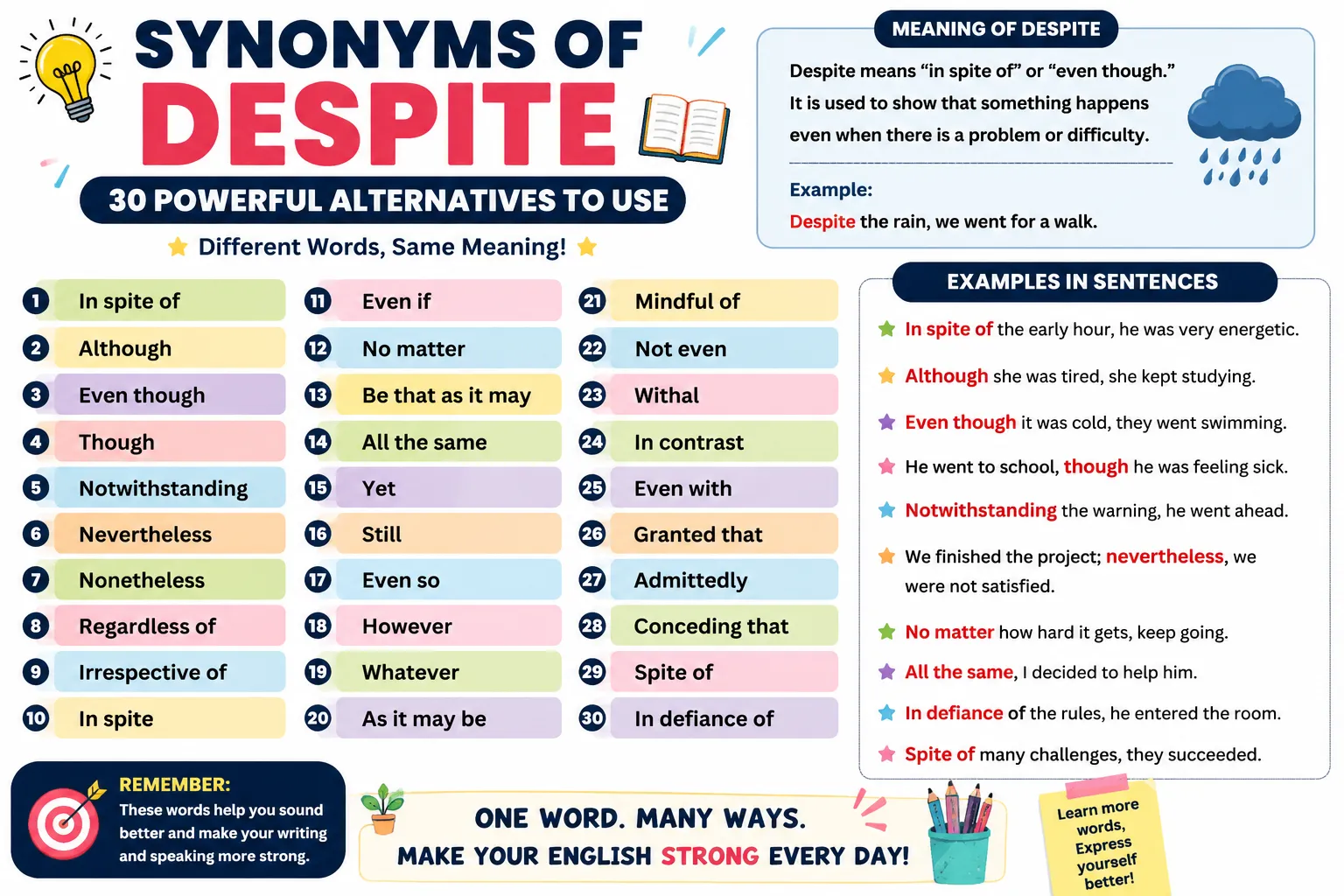
The word despite means without being stopped or affected by something else. Imagine walking outside to play, and even though it is raining heavily, you still put on your raincoat and have fun in the park. The rain tried to stop you, but you went outside anyway! That idea of doing something even when a problem stands in your way is what we call despite.
We use synonyms for despite every day when talking about winning a match. Even when tired, going to school when it is cold, or trying hard when a task is tricky. Learning new ways to say despite and synonyms for despite helps learners make their writing clear.Engish learner and content writer need synonyms for despite too.
This guide gives you 30 simple synonyms and alternative phrases for despite. Along with easy sentences, word origins, pronunciation guides, and clear categories.
Meaning of Despite
Definition
Despite (Preposition): Without being affected by; in spite of something happening or being true.
Examples
- She went for a walk despite the cold wind.
- Despite feeling tired, he finished his homework.
Connotative Meaning
- Positive tone: Shows determination, courage, strength, and overcoming challenges.
- Negative tone: None (it highlights bravery and persistence).
- Neutral tone: Connects two facts where one does not stop the other.
Etymology
- Source language: Came into Middle English from Old French despit (meaning contempt or defiance).
- Latin: Derived from despectus (meaning looking down upon or ignoring).
- Modern English (1500–Present): Shifted over time to mean ignoring an obstacle and moving forward anyway!
Pronunciation
- US: /dɪˈspaɪt/
- UK: /dɪˈspaɪt/
Syllables
de-spite (2 parts)
Affixation Pattern of Despite
- Root: Despite
- Prefix: None
- Suffix: None
- Word Formation:
- Preposition: Despite
- Noun: Spite (historical root)
- Adjective: Spiteful
- Adverb: Spitefully
Synonyms for Despite
1. In spite of (Prepositional Phrase) — US: /ɪn spaɪt əv/ | UK: /ɪn spaɪt əv/
Meaning: Without being stopped by something.
Examples:
We had fun in spite of the rain.
He smiled in spite of his bad day.
2. Regardless of (Prepositional Phrase) — US: /rɪˈɡɑːrdləs əv/ | UK: /rɪˈɡɑːdləs əv/
Meaning: Without paying attention to warnings or obstacles.
Examples:
They played soccer regardless of the muddy field.
She kept practicing regardless of how hard it was.
3. Notwithstanding (Preposition/Adverb) — US: /ˌnɑːtwɪθˈstændɪŋ/ | UK: /ˌnɒtwɪðˈstændɪŋ/
Meaning: Formal term for despite or in spite of.
Examples:
Notwithstanding the heat, the runners completed the race.
The event was a success, notwithstanding a small delay.
4. Even with (Prepositional Phrase) — US: /ˈiːvn wɪð/ | UK: /ˈiːvn wɪð/
Meaning: Even though a specific condition exists.
Examples:
Even with a broken pencil, she drew a beautiful picture.
He ran fast even with heavy boots.
5. Even though (Conjunction) — US: /ˈiːvn ðoʊ/ | UK: /ˈiːvn ðəʊ/
Meaning: Used to connect two clauses when one makes the other surprising.
Examples:
He won the race even though he started late.
She was happy even though it was raining.
6. Although (Conjunction) — US: /ɔːlˈðoʊ/ | UK: /ɔːlˈðəʊ/
Meaning: In spite of the fact that.
Examples:
Although it was dark, they found the lost ball.
She liked the toy although it was old.
7. Even so (Adverbial Phrase) — US: /ˈiːvn soʊ/ | UK: /ˈiːvn səʊ/
Meaning: In spite of that fact; nevertheless.
Examples:
The test was hard; even so, he scored well.
It was cold; even so, they ate ice cream.
8. Despite the fact that (Phrase) — US: /dɪˈspaɪt ðə fækt ðæt/ | UK: /dɪˈspaɪt ðə fækt ðæt/
Meaning: A full phrase form used before a sentence clause.
Examples:
She smiled despite the fact that she lost the game.
They cheered despite the fact that it was late.
9. Irrespective of (Prepositional Phrase) — US: /ˌɪrɪˈspɛktɪv əv/ | UK: /ˌɪrɪˈspektɪv əv/
Meaning: Not taking something into account.
Examples:
Everyone can join irrespective of their age.
Rules apply to all irrespective of who they are.
10. For all (Prepositional Phrase) — US: /fɔːr ɔːl/ | UK: /fə rɔːl/
Meaning: In spite of having something or something being true.
Examples:
For all his complaints, he still enjoyed the trip.
For all its small size, the puppy was very brave.
11. Even if (Conjunction) — US: /ˈiːvn ɪf/ | UK: /ˈiːvn ɪf/
Meaning: Whether or not a condition is met.
Examples:
I will try my best even if it gets difficult.
We will go camping even if it rains.
12. Though (Conjunction) — US: /ðoʊ/ | UK: /ðəʊ/
Meaning: A shorter form of although.
Examples:
Though tired, the team kept running.
She laughed, though she felt nervous.
13. Undeterred by (Adjective Phrase) — US: /ˌʌndɪˈtɜːrd baɪ/ | UK: /ˌʌndɪˈtɜːd baɪ/
Meaning: Not stopped or discouraged by difficulty.
Examples:
Undeterred by the steep hill, they hiked to the top.
He kept building undeterred by mistakes.
14. Unmoved by (Adjective Phrase) — US: /ˌʌnˈmuːvd baɪ/ | UK: /ˌʌnˈmuːvd baɪ/
Meaning: Not affected by emotions, hardship, or danger.
Examples:
She stayed calm, unmoved by the loud noise.
Unmoved by the weather, the guard stood firm.
15. Unaffected by (Adjective Phrase) — US: /ˌʌnəˈfɛktɪd baɪ/ | UK: /ˌʌnəˈfektɪd baɪ/
Meaning: Not changed or hurt by an event or problem.
Examples:
The sturdy house was unaffected by the storm.
He remained cheerful, unaffected by the harsh words.
16. In the face of (Prepositional Phrase) — US: /ɪn ðə feɪs əv/ | UK: /ɪn ðə feɪs əv/
Meaning: When dealing directly with a threat or hardship.
Examples:
They showed courage in the face of danger.
She stayed polite in the face of anger.
17. In defiance of (Prepositional Phrase) — US: /ɪn dɪˈfaɪəns əv/ | UK: /ɪn dɪˈfaɪəns əv/
Meaning: Boldly resisting or disobeying an obstacle or rule.
Examples:
The small plant grew in defiance of the dry soil.
He smiled in defiance of the cold weather.
18. Against (Preposition) — US: /əˈɡɛnst/ | UK: /əˈɡenst/
Meaning: In opposition to or despite opposing odds.
Examples:
They won the trophy against all odds.
The bird flew against the strong wind.
19. Albeit (Conjunction) — US: /ɔːlˈbiːɪt/ | UK: /ɔːlˈbiːɪt/
Meaning: A formal word meaning although or even if.
Examples:
He answered the question, albeit slowly.
She accepted the gift, albeit with a shy smile.
20. Nevertheless (Adverb) — US: /ˌnɛvərðəˈlɛs/ | UK: /ˌnevəðəˈles/
Meaning: In spite of that; however.
Examples:
The work was hard; nevertheless, they finished on time.
It rained heavily; nevertheless, the match continued.
21. Nonetheless (Adverb) — US: /ˌnʌnðəˈlɛs/ | UK: /ˌnʌnðəˈles/
Meaning: Despite what has just been said.
Examples:
The journey was long, but it was exciting nonetheless.
He was tired, but he helped his sister nonetheless.
22. Still (Adverb) — US: /stɪl/ | UK: /stɪl/
Meaning: Even after that; despite what happened.
Examples:
It was cold outside, but still they went swimming.
The puzzle was tricky, but she still solved it.
23. Yet (Conjunction/Adverb) — US: /jɛt/ | UK: /jet/
Meaning: In spite of that; but at the same time.
Examples:
The task was simple, yet very important.
He was small, yet remarkably strong.
24. Regardless (Adverb) — US: /rɪˈɡɑːrdləs/ | UK: /rɪˈɡɑːdləs/
Meaning: Without paying attention to difficulties.
Examples:
It started snowing, but we kept walking regardless.
He knew it was late, but he pushed on regardless.
25. Anyway (Adverb) — US: /ˈɛniweɪ/ | UK: /ˈeniweɪ/
Meaning: In spite of something; besides.
Examples:
It was raining, but we went to the park anyway.
She did not know the game, but she tried anyway.
26. Anyhow (Adverb) — US: /ˈɛnihaʊ/ | UK: /ˈenihaʊ/
Meaning: In any case; despite obstacles.
Examples:
The bus was late, but we reached school anyhow.
He felt nervous, but he spoke clearly anyhow.
27. Be that as it may (Idiom) — US: /biː ðæt æz ɪt meɪ/ | UK: /biː ðæt æz ɪt meɪ/
Meaning: Accepting a fact while moving past it.
Examples:
The test was unfair; be that as it may, we must study harder.
It was cold; be that as it may, we went out.
28. Granted that (Conjunctional Phrase) — US: /ˈɡræntɪd ðæt/ | UK: /ˈɡrɑːntɪd ðæt/
Meaning: Accepting an obstacle as true while continuing.
Examples:
Granted that the puzzle is hard, we can still solve it together.
Granted that it is late, we should clean up quickly.
29. Even with all (Phrase) — US: /ˈiːvn wɪð ɔːl/ | UK: /ˈiːvn wɪð ɔːl/
Meaning: In spite of having many obstacles or advantages.
Examples:
Even with all the noise, the baby slept peacefully.
Even with all his success, he remained humble.
30. Hardships notwithstanding (Formal Phrase) — US: /ˈhɑːrdʃɪps ˌnɑːtwɪθˈstændɪŋ/ | UK: /ˈhɑːdʃɪps ˌnɒtwɪðˈstændɪŋ/
Meaning: Continuing across difficulties without stopping.
Examples:
Hardships notwithstanding, the team won the championship.
Rain notwithstanding, our picnic was very fun.
Also read more about https://synonymhunting.com/synonyms-for-activities/
Prototype Meaning
When children hear despite, they picture someone putting on boots to play outside. During a rainy day, or a brave character pushing through a tricky puzzle without giving up.
Prototype Categorization
- Everyday Preposition Alternatives: In spite of, Regardless of, Even with, For all.
- Sentence Connectors & Conjunctions: Even though, Although, Though, Even if, Albeit, Despite the fact that.
- Linking Sentences (Transition Words): Nevertheless, Nonetheless, Even so, Still, Yet, Anyway, Anyhow, Regardless.
- Courage & Standing Firm: Undeterred by, Unmoved by, Unaffected by, In the face of, In defiance of, Against.
- Formal & Academic Alternatives: Notwithstanding, Irrespective of, Granted that, Be that as it may.
Antonyms of Despite
- Because of
- Due to
- Owing to
- Thanks to
- On account of
- As a result of
Short Questions and Answers
- What does despite mean?
- It means doing something without being stopped or affected by a problem or obstacle.
- When should I use despite?
- Use it when writing about overcoming challenges, bad weather, or trying your best when things are hard.
- How is “despite” used correctly?
- Say despite the rain (DO NOT say “despite of the rain”). If you want to use “of”, say in spite of the rain.
- How is it different from “because of”?
- Despite shows that an obstacle failed to stop you, while because of shows that something caused the action to happen.
Conclusion
Synonyms for despite can help you express contrast in a clearer and more natural way. Phrases such as in spite of, regardless of, , even though, and although can show that something happens despite a problem. Knowing these alternatives helps English learners avoid repeating the same word. Synonyms for despite also help to choose the right expression for each sentence. Synonyms for despite also improve writing, speaking, and reading skills. By practicing synonyms for despite in sentences, you can understand how they work. Try to learn a few new alternatives each day and use them in your own writing. With regular practice, your vocabulary will grow and your confidence will become stronger.

I’m Zahid Abbas, an educator, researcher, and digital publishing strategist with a passion for linguistics, grammar, and clear communication. As a content creator and SEO specialist, I craft research-driven, reader-focused content that empowers learners and makes knowledge accessible worldwide.