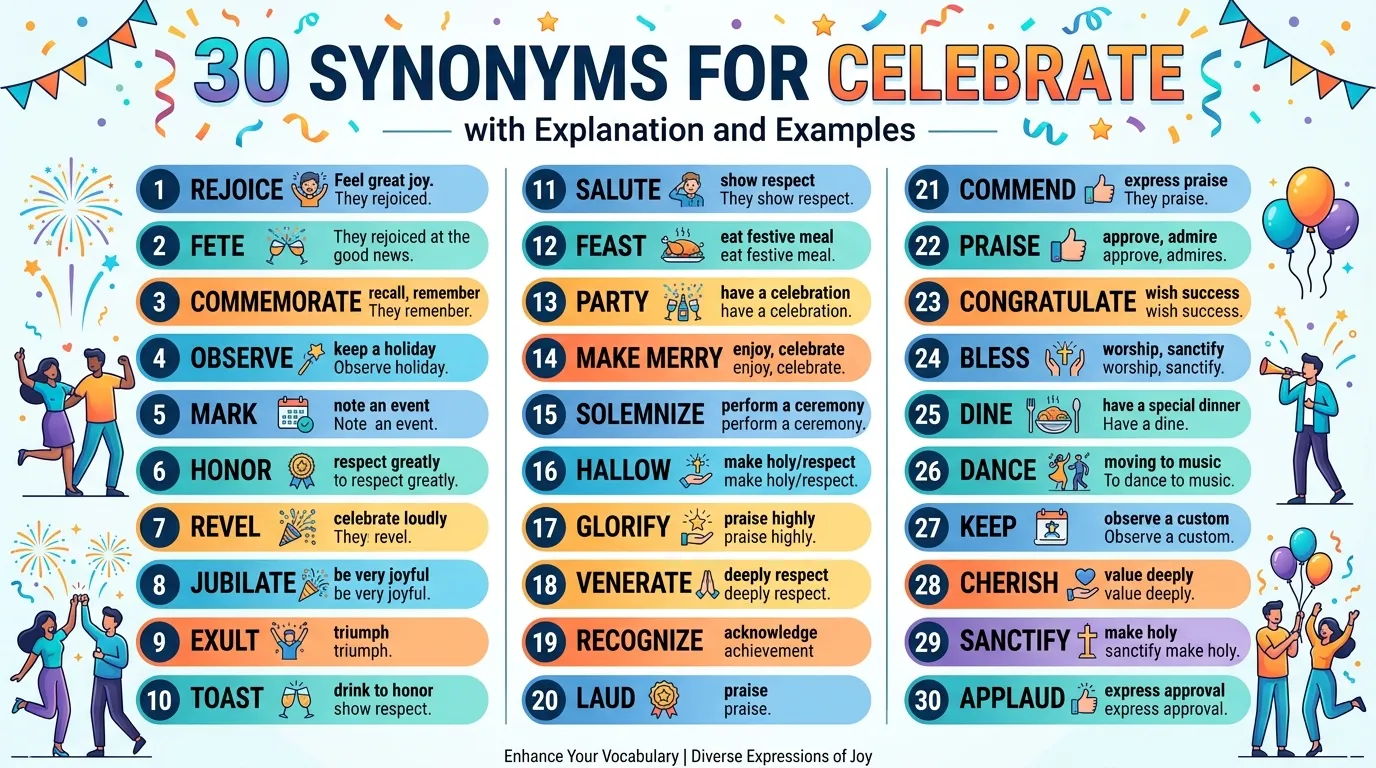
The word celebrate means to do something enjoyable. Because of a special occasion, victory, or happy event. Imagine blowing out candles on a big birthday cake while your friends sing, clap, and cheer. When you gather with others to share joy and have fun, you are celebrating!
We use synonyms for celebrate to describe birthdays, holidays, winning sports matches, or earning good grades in school. Learning new ways to say celebrate helps learners make their story writing descriptive.
This guide gives you 30 simple synonyms for celebrate. Along with easy sentences, word origins, pronunciation guides, and clear categories.
Meaning of Celebrate
Definition
Celebrate (Verb): To mark a special day or event with festive and joyful activities.
Examples
- We will celebrate my birthday with cake and games.
- The whole town gathered to celebrate the big festival.
Connotative Meaning
- Positive tone: Expresses high joy, excitement, togetherness, and happiness.
- Negative tone: Rarely used negatively, though wild celebrations can sometimes get loud or chaotic.
- Neutral tone: Simply marks an official date or holiday on the calendar.
Etymology
- Source language: Came from Latin roots long ago.
- Latin Root: Celeber (means frequented, famous, or honored by many).
- Modern English: Literally means coming together in a big group to honor a special moment!
Pronunciation
- US: /ˈsɛlɪˌbreɪt/
- UK: /ˈselɪbreɪt/
Syllables
cel-e-brate (3 parts)
Affixation Pattern of Celebrate
- Root: Celebr (means honor or gather)
- Suffix: -ate (makes a verb)
- Word Formation:
- Noun: Celebration
- Adjective: Celebrated / Celebratory
- Verb: Celebrate
Also read more about https://synonymhunting.com/synonyms-for-independent/
Synonyms for Celebrate
1. Party (Verb) — US: /ˈpɑːrti/ | UK: /ˈpɑːti/
Meaning: To have fun together with food, games, and music.
Examples:
We plan to party all evening after the final exam.
The team liked to party whenever they won a trophy.
2. Cheer (Verb) — US: /tʃɪr/ | UK: /tʃɪə/
Meaning: To shout with joy and happiness to show support.
Examples:
The crowd began to cheer when our team scored a goal.
We cheered loudly as the parade marched by.
3. Honor (Verb) — US: /ˈɑːnər/ | UK: /ˈɒnə/
Meaning: To show deep respect and admiration for someone or something.
Examples:
We gathered to honor our teacher on Teachers’ Day.
The country holds a parade to honor brave heroes.
4. Enjoy (Verb) — US: /ɪnˈdʒɔɪ/ | UK: /ɪnˈdʒɔɪ/
Meaning: To take pleasure and delight in a special moment.
Examples:
We enjoyed the festive fireworks show at night.
She sat down to enjoy her birthday ice cream.
5. Praise (Verb) — US: /preɪz/ | UK: /preɪz/
Meaning: To express approval and admiration for a good job.
Examples:
The principal praised the students for their hard work.
Everyone praised her beautiful art project.
6. Observe (Verb) — US: /əbˈzɜːrv/ | UK: /əbˈzɜːv/
Meaning: To mark or pay attention to an official holiday.
Examples:
Our school will observe Earth Day by planting trees.
They observe a moment of quiet respect each year.
7. Commemorate (Verb) — US: /kəˈmɛməˌreɪt/ | UK: /kəˈmeməreɪt/
Meaning: To remember and honor an important past event.
Examples:
The town built a statue to commemorate the historical victory.
We bake special cookies to commemorate the holiday.
8. Rejoice (Verb) — US: /rɪˈdʒɔɪs/ | UK: /rɪˈdʒɔɪs/
Meaning: To feel or show great joy and delight.
Examples:
The farmers rejoiced when the cool rain began to fall.
We rejoiced at the wonderful news of a new baby.
9. Welcome (Verb) — US: /ˈwɛlkəm/ | UK: /ˈwelkəm/
Meaning: To greet a person or new event with open arms and happiness.
Examples:
We happily welcomed the new year with confetti.
The children welcomed their grandparents with warm hugs.
10. Toast (Verb) — US: /toʊst/ | UK: /təʊst/
Meaning: To raise a drink and wish someone happiness or success.
Examples:
They raised juice glasses to toast the birthday girl.
The family gathered to toast the happy couple.
11. Hail (Verb) — US: /heɪl/ | UK: /heɪl/
Meaning: To greet or applaud someone with excitement.
Examples:
The fans hailed the winning player as a hero.
They hailed the arrival of spring after a long winter.
12. Applaud (Verb) — US: /əˈplɔːd/ | UK: /əˈplɔːd/
Meaning: To clap your hands to show praise and approval.
Examples:
The parents applauded after the children finished the play.
Everyone applauded the magician’s impressive trick.
13. Revel (Verb) — US: /ˈrɛvəl/ | UK: /ˈrevəl/
Meaning: To take great delight and have noisy, joyful fun.
Examples:
The children reveled in playing under the warm sun.
They reveled in their team’s big championship victory.
14. Keep (Verb) — US: /kiːp/ | UK: /kiːp/
Meaning: To observe or perform the tradition of a holiday.
Examples:
Our family loves to keep the tradition of Sunday dinner.
They keep the festival with songs and bright lanterns.
15. Salute (Verb) — US: /səˈluːt/ | UK: /səˈluːt/
Meaning: To show sign of respect or praise for an achievement.
Examples:
We salute the brave firefighters for their dedication.
The captain saluted the hard work of his entire team.
16. Glorify (Verb) — US: /ˈɡlɔːrɪˌfaɪ/ | UK: /ˈɡlɔːrɪfaɪ/
Meaning: To make something seem wonderful and worthy of praise.
Examples:
The festival songs glorify the beauty of nature.
Stories in books often glorify brave knights.
17. Carouse (Verb) — US: /kəˈraʊz/ | UK: /kəˈraʊz/
Meaning: To enjoy loud, cheerful partying with friends.
Examples:
The happy group caroused late into the evening.
Villagers caroused in the square during the fair.
18. Extol (Verb) — US: /ɪkˈstoʊl/ | UK: /ɪkˈstɒl/
Meaning: To praise highly and enthusiastically.
Examples:
The coach extolled the runner’s speed and effort.
Teachers extol the power of reading good books.
19. Magnify (Verb) — US: /ˈmæɡnɪˌfaɪ/ | UK: /ˈmæɡnɪfaɪ/
Meaning: To praise and highlight the greatness of an event.
Examples:
The special music served to magnify the holiday joy.
Their generous acts magnify the spirit of giving.
20. Exalt (Verb) — US: /ɪɡˈzɔːlt/ | UK: /ɪɡˈzɔːlt/
Meaning: To raise someone in rank or praise them greatly.
Examples:
The crowd exalted the winner of the race.
Poems often exalt the wonders of the natural world.
21. Make merry (Verb Phrase) — US: /meɪk ˈmɛri/ | UK: /meɪk ˈmeri/
Meaning: To laugh, sing, and have a cheerful time together.
Examples:
We gathered around the campfire to make merry.
The guests made merry with food and dancing.
22. Have fun (Verb Phrase) — US: /hæv fʌn/ | UK: /hæv fʌn/
Meaning: To enjoy yourself in a lighthearted way.
Examples:
The kids had fun playing tag at the park.
Go to the party and have fun with your classmates!
23. Pay tribute (Verb Phrase) — US: /peɪ ˈtrɪbjuːt/ | UK: /peɪ ˈtrɪbjuːt/
Meaning: To do or say something to show respect to a person.
Examples:
The speech was written to pay tribute to our principal.
We planted a tree to pay tribute to our school founder.
24. Mark (Verb) — US: /mɑːrk/ | UK: /mɑːk/
Meaning: To show that an important date or event is happening.
Examples:
A big cake helped us mark our tenth wedding anniversary.
The ringing bell marked the start of the summer break.
25. Acclaim (Verb) — US: /əˈkleɪm/ | UK: /əˈkleɪm/
Meaning: To welcome someone with enthusiastic praise.
Examples:
Critics acclaimed the young author’s new storybook.
The audience acclaimed the singer with a standing ovation.
26. Lionize (Verb) — US: /ˈlaɪəˌnaɪz/ | UK: /ˈlaɪənaɪz/
Meaning: To treat someone like a famous and important person.
Examples:
The school lionized the student who won the science fair.
Fans lionized the athlete after the world championship.
27. Bless (Verb) — US: /blɛs/ | UK: /bles/
Meaning: To wish happiness, luck, or good fortune upon someone.
Examples:
Elders bless young children during the festive holiday.
May good health bless your family this new year.
28. Feast (Verb) — US: /fiːst/ | UK: /fiːst/
Meaning: To eat a large and delicious meal to celebrate.
Examples:
We feasted on tasty dishes during the holiday dinner.
The kingdom feasted for three days after the victory.
29. Paint the town red (Idiom) — US: /peɪnt ðə taʊn rɛd/ | UK: /peɪnt ðə taʊn red/
Meaning: To go out and have a very fun, bright, and lively time.
Examples:
After winning the cup, the team went out to paint the town red.
Let’s celebrate your graduation and paint the town red!
30. Blow off steam (Idiom) — US: /bloʊ ɒf stiːm/ | UK: /bləʊ ɒf stiːm/
Meaning: To celebrate and relax by letting out energy after hard work.
Examples:
The kids blew off steam at the playground after testing week.
After finishing the big project, they blew off steam at the party.
Prototype Meaning
When children hear celebrate, they picture colorful balloons, sweet birthday cake, clapping hands, party hats, and friends cheering “Hooray!” together in a bright room.
Prototype Categorization
- Everyday Parties & Fun: Party, Enjoy, Welcome, Make merry, Have fun, Feast.
- Cheering & Loud Joy: Cheer, Rejoice, Toast, Applaud, Revel, Carouse, Paint the town red, Blow off steam.
- Respect & Memory: Honor, Observe, Commemorate, Keep, Pay tribute, Mark, Salute, Bless.
- High Praise & Admiration: Praise, Hail, Glorify, Extol, Magnify, Exalt, Acclaim, Lionize.
Antonyms of Celebrate
- Ignore
- Overlook
- Mourn
- Disregard
- Forget
- Neglect
Short Questions and Answers
- What does celebrate mean?
- It means doing something fun and happy to mark a special event, holiday, or victory.
- When should I use celebrate?
- Use it when writing about birthday parties, festivals, winning games, or honoring someone special.
- Is celebrate a action word?
- Yes! It is a verb because it describes an action you do with others.
- How is celebrate different from party?
- Party focuses specifically on games, music, and food, while celebrate can also mean showing quiet respect or honoring a special date.
Conclusion
Synonyms for celebrate can help you talk about happy events in many different ways. Words such as enjoy, honor, praise, rejoice, cheer, observe, and commemorate can make your English interesting. Each synonym has a slightly different use, so learning them helps you choose the right word. For English learners, synonyms for celebrate can improve speaking, writing, reading, and everyday communication. Synonyms for celebrate also help you avoid repeating the word celebrate too often. Try using synonyms for celebrate in sentences about birthdays, festivals, achievements, and special events. With regular practice, you can build a stronger vocabulary. Express your feelings clearly, and speak English with greater confidence.

I’m Zahid Abbas, an educator, researcher, and digital publishing strategist with a passion for linguistics, grammar, and clear communication. As a content creator and SEO specialist, I craft research-driven, reader-focused content that empowers learners and makes knowledge accessible worldwide.