The word introspective means looking inside your own mind to think about your own thoughts, feelings, and actions. Imagine sitting in a quiet corner of your room writing in a diary after school. Instead of focusing on noisy games outside, you sit quietly and think about your day. That calm habit of thinking about your inner feelings is what we call introspective.
We use synonyms for introspective to describe quiet thinkers, thoughtful book characters, or moments when you pause to understand your own heart. Learning new ways to say introspective and synonyms for introspective helps learners make their writing expressive.
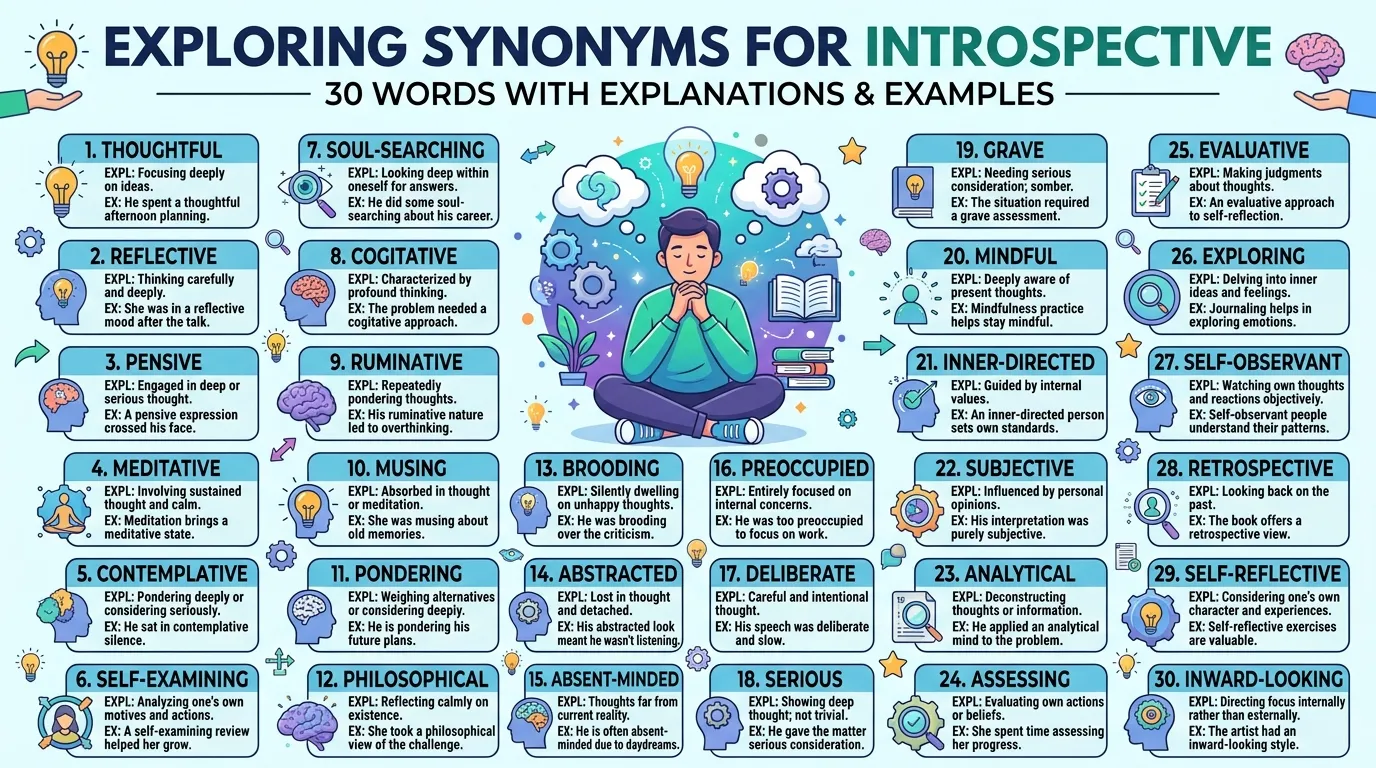
English learners and content writers need synonyms for introspective too. This guide gives you 30 simple synonyms for introspective. Along with easy sentences, word origins, pronunciation guides, and clear categories.
Meaning of Introspective
Definition
Introspective (Adjective): Thinking deeply about your own thoughts, feelings, and choices.
Examples
- She wrote an introspective story in her notebook.
- The introspective boy liked reading books in a quiet room.
Connotative Meaning
- Positive tone: Shows self-awareness, wisdom, kindness, and deep thinking.
- Negative tone: Can mean being too quiet or worrying too much inside your head.
- Neutral tone: Describes sitting quietly and examining your own thoughts.
Etymology
- Source language: Came from Latin roots long ago.
- Latin Prefix: Intro- (means inside or inward).
- Latin Root: Specere (means to look or see).
- Modern English (1600–Present): Means looking inside your own mind to understand your feelings.
Also read more about https://synonymhunting.com/synonyms-for-desperate/
Pronunciation
- US: /ˌɪntrəˈspɛktɪv/
- UK: /ˌɪntrəˈspektɪv/
Syllables
in-tro-spec-tive (4 parts)
Affixation Pattern of Introspective
- Root: Spect (means to look)
- Prefix: Intro- (means inside)
- Suffix: -ive (makes an adjective)
- Word Formation:
- Noun: Introspection
- Verb: Introspect
- Adjective: Introspective
- Adverb: Introspectively
Synonyms for Introspective
1. Thoughtful (Adjective) — US: /ˈθɔːtfl/ | UK: /ˈθɔːtfl/
Meaning: Thinking deeply about things in a quiet way.
Examples:
The thoughtful girl sat near the window.
He gave a thoughtful answer to his teacher.
2. Reflective (Adjective) — US: /rɪˈflɛktɪv/ | UK: /rɪˈflektɪv/
Meaning: Thinking carefully about what happened in the past.
Examples:
She was in a reflective mood after reading the book.
His reflective notes helped him learn from his mistake.
3. Pensive (Adjective) — US: /ˈpɛnsɪv/ | UK: /ˈpensɪv/
Meaning: Thinking quietly, sometimes with a serious face.
Examples:
The boy looked pensive as he watched the rain fall.
She sat with a pensive look on her face.
4. Meditative (Adjective) — US: /ˈmɛdɪteɪtɪv/ | UK: /ˈmedɪtətɪv/
Meaning: Very calm and focused on quiet inner thoughts.
Examples:
Soft music put him in a meditative mood.
We took a meditative walk through the quiet garden.
5. Contemplative (Adjective) — US: /kənˈtɛmplətɪv/ | UK: /kənˈtemplətɪv/
Meaning: Spending time thinking carefully and quietly.
Examples:
The painter spent a contemplative hour at his desk.
It was a contemplative and calm evening at home.
6. Self-aware (Adjective) — US: /ˌsɛlf əˈwɛr/ | UK: /ˌself əˈweə/
Meaning: Understanding your own feelings and actions well.
Examples:
A self-aware student knows when to ask for help.
Being self-aware helps you make good choices.
7. Inward-looking (Adjective Phrase) — US: /ˈɪnwərd ˈlʊkɪŋ/ | UK: /ˈɪnwəd ˈlʊkɪŋ/
Meaning: Paying attention to your own thoughts instead of outside things.
Examples:
Writing a diary is an inward-looking activity.
He took an inward-looking moment to calm down.
8. Self-examining (Adjective Phrase) — US: /ˌsɛlf ɪɡˈzæmɪnɪŋ/ | UK: /ˌself ɪɡˈzæmɪnɪŋ/
Meaning: Checking your own behavior to see if you did the right thing.
Examples:
She wrote a self-examining essay about her work.
A self-examining habit helps you become a better friend.
9. Quiet (Adjective) — US: /ˈkwaɪət/ | UK: /ˈkwaɪət/
Meaning: Making little noise and enjoying peace.
Examples:
He spent a quiet hour reading in his bedroom.
She has a quiet personality and likes deep talks.
10. Reserved (Adjective) — US: /rɪˈzɜːrvd/ | UK: /rɪˈzɜːvd/
Meaning: Keeping your thoughts and feelings to yourself.
Examples:
The reserved girl smiled politely but said very little.
He is usually reserved when meeting new people.
11. Solitary (Adjective) — US: /ˈsɑːlətɛri/ | UK: /ˈsɒlɪtri/
Meaning: Liking to spend time alone.
Examples:
He enjoyed a solitary walk in the park.
The bird flew on a solitary path in the sky.
12. Mindful (Adjective) — US: /ˈmaɪndfl/ | UK: /ˈmaɪndfl/
Meaning: Paying clear attention to your feelings and actions.
Examples:
Be mindful of how your words make others feel.
She took three mindful breaths to relax.
13. Deep-thinking (Adjective Phrase) — US: /diːp ˈθɪŋkɪŋ/ | UK: /diːp ˈθɪŋkɪŋ/
Meaning: Thinking about big ideas instead of simple things.
Examples:
The deep-thinking child solved the hard puzzle.
She is a deep-thinking reader who loves story mysteries.
14. Observant (Adjective) — US: /əbˈzɜːrvənt/ | UK: /əbˈzɜːvənt/
Meaning: Quick to notice details around you and inside yourself.
Examples:
The observant student saw the small bird in the tree.
He was very observant of his own feelings today.
15. Analytical (Adjective) — US: /ˌænəˈlɪtɪkl/ | UK: /ˌænəˈlɪtɪkl/
Meaning: Thinking about things step-by-step to understand them.
Examples:
She used an analytical mind to finish the math problem.
He gave an analytical review of the science test.
16. Self-reflecting (Adjective Phrase) — US: /ˌsɛlf rɪˈflɛktɪŋ/ | UK: /ˌself rɪˈflektɪŋ/
Meaning: Looking deeply into your own choices and life.
Examples:
He gave a self-reflecting talk about his year at school.
Keeping a journal builds self-reflecting habits.
17. Introverted (Adjective) — US: /ˈɪntrəvɜːrtɪd/ | UK: /ˈɪntrəvɜːtɪd/
Meaning: Preferring quiet time alone over loud crowds.
Examples:
The introverted child liked drawing quietly at home.
An introverted person enjoys reading on weekends.
18. Self-observant (Adjective Phrase) — US: /ˌsɛlf əbˈzɜːrvənt/ | UK: /ˌself əbˈzɜːvənt/
Meaning: Watching your own actions closely to learn from them.
Examples:
Being self-observant helps you fix small mistakes early.
She stayed self-observant during her practice test.
19. Subdued (Adjective) — US: /səbˈdjuːd/ | UK: /səbˈdjuːd/
Meaning: Quiet, soft, and not showing loud emotions.
Examples:
The classroom was subdued while the teacher read a book.
He felt subdued after a long day at school.
20. Brooding (Adjective) — US: /ˈbruːdɪŋ/ | UK: /ˈbruːdɪŋ/
Meaning: Thinking quietly about something that makes you worried.
Examples:
The character sat in brooding silence by the window.
Try to avoid brooding over small mistakes.
21. Dreamy (Adjective) — US: /ˈdriːmi/ | UK: /ˈdriːmi/
Meaning: Having gentle thoughts like you are daydreaming.
Examples:
She had a dreamy look while looking at the clouds.
The music had a soft and dreamy sound.
22. Self-searching (Adjective Phrase) — US: /ˌsɛlf ˈsɜːrtʃɪŋ/ | UK: /ˌself ˈsɜːtʃɪŋ/
Meaning: Thinking deeply to find out what you truly believe.
Examples:
After the hard game, he did some self-searching.
A self-searching character makes a story exciting.
23. Serious (Adjective) — US: /ˈsɪriəs/ | UK: /ˈsɪəriəs/
Meaning: Quiet and focused, not playing or joking around.
Examples:
He had a serious conversation with his mom about his work.
The doctor gave a serious and kind explanation.
24. Soft-spoken (Adjective Phrase) — US: /sɔːft ˈspoʊkən/ | UK: /sɒft ˈspəʊkən/
Meaning: Speaking gently and quietly from a calm mind.
Examples:
Our teacher is soft-spoken and very helpful.
She answered in a soft-spoken voice.
25. Inner-focused (Adjective Phrase) — US: /ˈɪnər ˈfoʊkəst/ | UK: /ˈɪnə ˈfəʊkəst/
Meaning: Directing your attention to your inner thoughts.
Examples:
Deep breathing helps you become more inner-focused.
She stayed inner-focused during her art project.
26. Self-centered (Inward Focus) (Adjective) — US: /ˌsɛlf ˈsɛntərd/ | UK: /ˌself ˈsentəd/
Meaning: Focused on your own inner world (can also mean selfish in other uses).
Examples:
His self-centered focus kept him lost in his thoughts.
Try not to be too self-centered when working with friends.
27. Absorbed (Adjective) — US: /əbˈzɔːrbd/ | UK: /əbˈzɔːbd/
Meaning: So busy thinking or reading that you do not notice other things.
Examples:
He was completely absorbed in his storybook.
She sat absorbed in thought for ten minutes.
28. Philosophical (Adjective) — US: /ˌfɪləˈsɑːfɪkl/ | UK: /ˌfɪləˈsɒfɪkl/
Meaning: Thinking deeply about life, truth, and feelings.
Examples:
Grandpa shared a philosophical thought about friendship.
They had a philosophical talk about helping others.
29. Self-studying (Adjective Phrase) — US: /ˌsɛlf ˈstʌdiɪŋ/ | UK: /ˌself ˈstʌdiɪŋ/
Meaning: Looking closely at your own mind and habits.
Examples:
He spent a self-studying moment thinking about his day.
She took a self-studying approach to fix her schedule.
30. Subjective (Adjective) — US: /səbˈdʒɛktɪv/ | UK: /səbˈdʒektɪv/
Meaning: Based on personal feelings and thoughts instead of outside facts.
Examples:
Choosing a favorite color is subjective.
Her subjective view came from her own personal experiences.
Prototype Meaning
When children hear introspective, they picture a quiet student. Sitting near a window with a journal thinking about their day and understanding their own feelings.
Prototype Categorization
- Everyday Deep Thinking: Thoughtful, Reflective, Pensive, Deep-thinking, Philosophical, Analytical.
- Inner Awareness & Reflection: Self-aware, Inward-looking, Self-examining, Self-reflecting, Self-searching, Inner-focused.
- Calm & Quiet Nature: Quiet, Reserved, Solitary, Subdued, Soft-spoken, Introverted.
- Focus & Meditation: Meditative, Contemplative, Mindful, Absorbed, Self-observant.
- Daydreaming & Moods: Brooding, Dreamy, Serious, Observant, Subjective.
Antonyms of Introspective
- Outgoing
- Loud
- Thoughtless
- Unreflective
- Unaware
- Surface-level
Short Questions and Answers
- What does introspective mean?
- It means thinking deeply about your own inner thoughts, feelings, and actions.
- When should I use introspective?
- Use it when writing about quiet moments, self-awareness, or thoughtful book characters.
- Is introspective a good or bad word?
- It is mostly a positive word that shows self-awareness and wisdom.
- How is it different from similar words?
- Introspective means looking at your own mind, thoughtful means thinking carefully about anything, and introverted describes a quiet person who likes being alone.
Conclusion
Synonyms for introspective can help you describe people who think deeply. About their feelings, thoughts, and actions. Words such as thoughtful, reflective, self-aware, contemplative, and meditative can add variety to your English. Each word has a slightly different meaning and works best in certain situations. Knowing these alternatives helps English learners avoid repeating the same word. Synonyms for introspective also improves writing, speaking, and reading skills. Try using synonyms for introspective in simple sentences about feelings, choices, or personal thoughts. With regular practice, you can build a stronger vocabulary. Write with more variety, and speak with greater confidence. Learning a few new words each day is a simple way to make your English better.

I’m Zahid Abbas, an educator, researcher, and digital publishing strategist with a passion for linguistics, grammar, and clear communication. As a content creator and SEO specialist, I craft research-driven, reader-focused content that empowers learners and makes knowledge accessible worldwide.