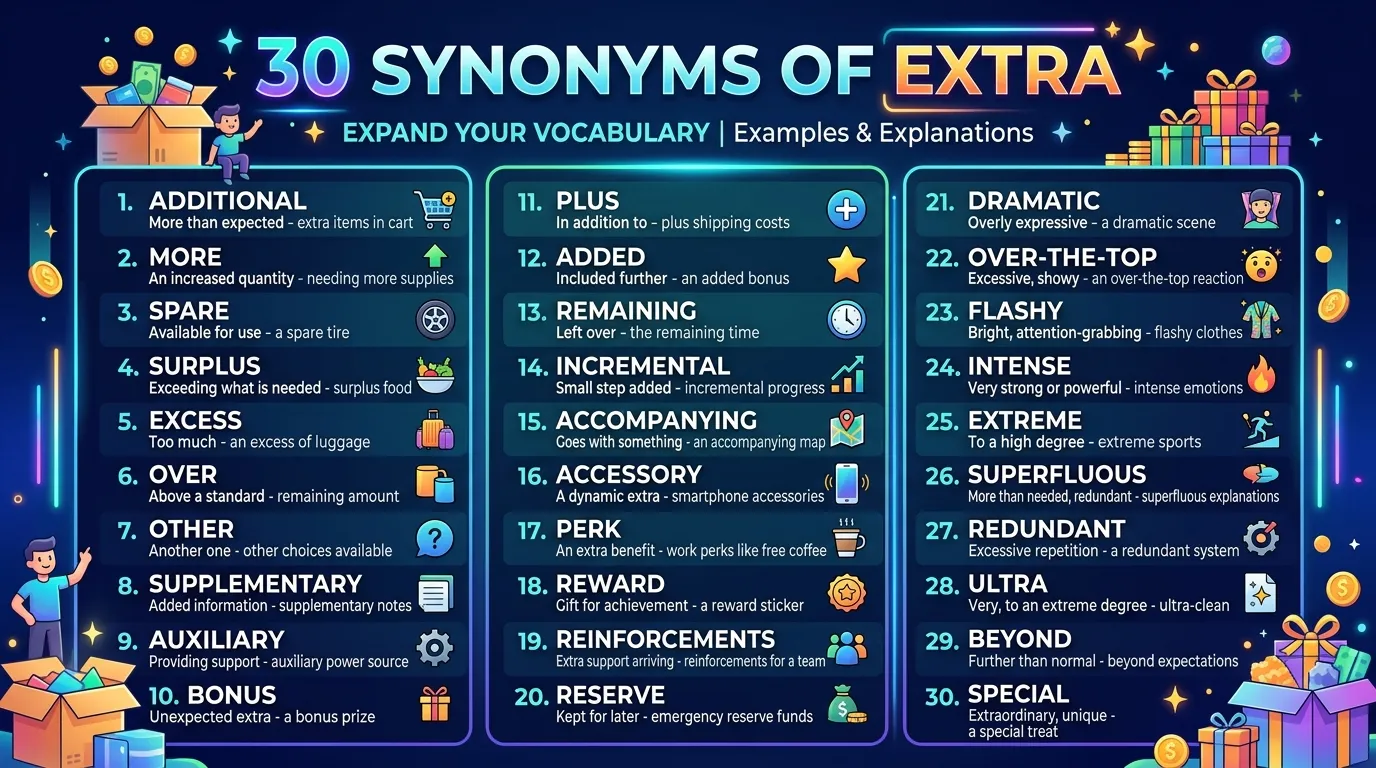
The word extra means more than what is normal, standard, or expected. Imagine ordering a slice of cake at a birthday party, and the host gives you an extra cherry on top! That means you received more than just the usual amount.
We use synonyms for extra every day when talking about additional items, leftover food, or even someone doing more work than expected. Learning new ways to say extra helps learners make their speaking and writing clear.
This guide provides 30 simple synonyms for extra. Complete with easy sentences, word origins, pronunciation guides, and clear categories.
Meaning of Extra
Definition
Extra (Adjective): Added to what is usual; more than needed or expected.
Examples
- She brought an extra pencil to school today.
- We ordered an extra pizza for the party.
Connotative Meaning
- Positive tone: Means generous, special, helpful, or giving more than enough.
- Negative tone: Can mean wasteful, unneeded, or doing too much dramatic behavior.
- Neutral tone: Simply describes having more items than the basic count.
Etymology
- Source language: Came from Latin roots long ago.
- Latin Word: Extra (means outside, beyond, or in addition to).
- Modern English Usage: Means something extra added beyond the usual limit!
Pronunciation
- US: /ˈɛkstrə/
- UK: /ˈekstrə/
Syllables
ex-tra (2 parts)
Affixation Pattern of Extra
- Root: Extra (means beyond or outside)
- Word Formation:
- Noun: Extra (an added person or thing)
- Adjective: Extra
- Adverb: Extra (meaning exceptionally or very)
Synonyms of Extra
1. Additional (Adjective) — US: /əˈdɪʃənl/ | UK: /əˈdɪʃənl/
Meaning: Added to what is already there.
Examples:
She asked for an additional piece of paper.
The teacher gave us additional time to finish our test.
2. Spare (Adjective) — US: /spɛr/ | UK: /speə/
Meaning: Kept in reserve to use when needed.
Examples:
My dad keeps a spare tire in the trunk of his car.
Do you have a spare eraser I can borrow?
3. Added (Adjective) — US: /ˈædɪd/ | UK: /ˈædɪd/
Meaning: Put together with something else to make it bigger.
Examples:
The warm milk gave an added taste to the cereal.
We enjoyed the added bonus of a free game.
4. Leftover (Adjective) — US: /ˈlɛftoʊvər/ | UK: /ˈleftəʊvə/
Meaning: Remaining after the rest has been used or eaten.
Examples:
We ate leftover rice for lunch today.
She used leftover paper to make a fun craft.
5. More (Adjective) — US: /mɔːr/ | UK: /mɔː/
Meaning: A larger amount or number of things.
Examples:
I would like more water, please.
There are more books on the teacher’s desk.
6. Plus (Adjective) — US: /plʌs/ | UK: /plʌs/
Meaning: Added or extra beyond the basic amount.
Examples:
You get a free toy plus a juice box with your meal.
The trip was fun plus very educational.
7. Excess (Adjective) — US: /ˈɛksɛs/ | UK: /ˈekses/
Meaning: More than what is necessary or proper.
Examples:
Wipe away the excess water from the table.
We donated our excess clothes to charity.
8. Surplus (Adjective) — US: /ˈsɜːrplʌs/ | UK: /ˈsɜːpləs/
Meaning: An amount left over after all needs are met.
Examples:
The farm produced a surplus supply of apples.
The school shared its surplus books with the library.
9. Supplementary (Adjective) — US: /ˌsʌplɪˈmɛntri/ | UK: /ˌsʌplɪˈmentri/
Meaning: Added to complete or improve something.
Examples:
We read a supplementary story in our English class.
She bought supplementary colors for her painting.
10. Reserve (Adjective) — US: /rɪˈzɜːrv/ | UK: /rɪˈzɜːv/
Meaning: Kept back for future or special use.
Examples:
The player sat on the reserve bench during the game.
We keep a reserve bottle of water in our bags.
11. Further (Adjective) — US: /ˈfɜːrðər/ | UK: /ˈfɜːðə/
Meaning: More in quantity, time, or distance.
Examples:
Call me if you need further help with your homework.
We need no further proof to solve the puzzle.
12. Fresh (Adjective) — US: /frɛʃ/ | UK: /freʃ/
Meaning: Newly made or newly added items.
Examples:
The waiter brought a fresh plate of fruit.
We took a fresh sheet of paper to draw.
13. Other (Adjective) — US: /ˈʌðər/ | UK: /ˈʌðə/
Meaning: Different or additional to the main ones.
Examples:
Are there any other questions before we play?
She has two other cats at home.
14. Remaining (Adjective) — US: /rɪˈmeɪnɪŋ/ | UK: /rɪˈmeɪnɪŋ/
Meaning: Left behind after parts are gone.
Examples:
He finished the remaining slice of pie.
The remaining students walked quietly into class.
15. Unused (Adjective) — US: /ˌʌnˈjuːzd/ | UK: /ˌʌnˈjuːzd/
Meaning: Not put to use yet; kept whole.
Examples:
She gave me an unused notebook for class.
Pack all the unused crayons into the box.
16. Bonus (Adjective) — US: /ˈboʊnəs/ | UK: /ˈbəʊnəs/
Meaning: An unexpected extra good thing.
Examples:
We answered a bonus question on the math test.
He got a bonus sticker for completing his work early.
17. Secondary (Adjective) — US: /ˈsɛkəndɛri/ | UK: /ˈsekəndri/
Meaning: Coming second in importance after the primary thing.
Examples:
Cleaning the desk was a secondary job today.
Winning was nice, but playing fairly was our secondary goal.
18. New (Adjective) — US: /nuː/ | UK: /njuː/
Meaning: Added recently for the first time.
Examples:
Our teacher gave us a new assignment.
They added new chairs to our computer lab.
19. Backup (Adjective) — US: /ˈbækʌp/ | UK: /ˈbækʌp/
Meaning: Held ready to help if the main one fails.
Examples:
Always carry a backup flashlight on a camp trip.
She has a backup plan for rainy days.
20. Auxiliary (Adjective) — US: /ɔːɡˈzɪliəri/ | UK: /ɔːɡˈzɪliəri/
Meaning: Giving extra help and support.
Examples:
The boat used an auxiliary engine during the storm.
They opened an auxiliary room for the big crowd.
21. Extreme (Over-the-top) (Adjective) — US: /ɪkˈstriːm/ | UK: /ɪkˈstriːm/
Meaning: Doing way too much; dramatic.
Examples:
Her extreme reaction surprised all of us.
He put an extreme amount of sauce on his fries.
22. Fancy (Adjective) — US: /ˈfænsi/ | UK: /ˈfænsi/
Meaning: Having special decorations or features added.
Examples:
She wore a fancy dress to the family dinner.
He loves using fancy pens for his projects.
23. Special (Adjective) — US: /ˈspɛʃl/ | UK: /ˈspeʃl/
Meaning: Better or different from the usual.
Examples:
We got a special treat after finishing our chores.
He was given a special task in school.
24. Excessive (Adjective) — US: /ɪkˈsɛsɪv/ | UK: /ɪkˈsesɪv/
Meaning: Way more than what is safe or necessary.
Examples:
Too much noise causes excessive worry for pets.
Using excessive salt is bad for your health.
25. Overabundant (Adjective) — US: /ˌoʊvərəˈbʌndənt/ | UK: /ˌəʊvərəˈbʌndənt/
Meaning: Existing in very large, extra amounts.
Examples:
The garden had an overabundant growth of berries.
We had an overabundant supply of school folders.
26. Superfluous (Adjective) — US: /suːˈpɜːrfluəs/ | UK: /suːˈpɜːfluəs/
Meaning: More than needed; completely unnecessary.
Examples:
He removed the superfluous words from his story.
Buying two toys was superfluous since he only played with one.
27. Unnecessary (Adjective) — US: /ʌnˈnɛsəsɛri/ | UK: /ʌnˈnesəsəri/
Meaning: Not needed; extra and easy to leave out.
Examples:
Avoid making unnecessary sounds during quiet reading.
She packed unnecessary items in her heavy bag.
28. Over-the-top (Adjective Phrase) — US: /ˈoʊvər ðə ˈtɑːp/ | UK: /ˈəʊvə ðə ˈtɒp/
Meaning: Exaggerated or way more dramatic than needed.
Examples:
His over-the-top party decorations looked wild!
She gave an over-the-top bow after singing.
29. Increased (Adjective) — US: /ɪnˈkriːst/ | UK: /ɪnˈkriːst/
Meaning: Made greater in size, amount, or number.
Examples:
We noticed an increased number of birds in the yard.
He worked with increased speed to finish early.
30. Expanded (Adjective) — US: /ɪkˈspændɪd/ | UK: /ɪkˈspændɪd/
Meaning: Made larger to include extra parts.
Examples:
The library opened an expanded section for kids’ books.
She showed us an expanded view of her map.
Also learn more about https://synonymhunting.com/synonyms-for-vast/
Prototype Meaning
When children hear extra, they picture getting a bonus scoop of ice cream on a cone. Also pulling a spare pencil out of their pencil case when a lead breaks.
Prototype Categorization
- Everyday More & Added: Additional, Added, More, Plus, Fresh, Other, Increased, Expanded.
- Backup & Spare Items: Spare, Leftover, Reserve, Unused, Backup, Auxiliary, Secondary.
- Special & Bonus Things: Bonus, Special, Fancy, Supplementary, Further, New.
- Leftovers & Too Much: Excess, Surplus, Remaining, Overabundant.
- Dramatic & Unnecessary: Extreme, Excessive, Superfluous, Unnecessary, Over-the-top.
Antonyms of Extra
- Main
- Basic
- Essential
- Primary
- Necessary
- Missing
Short Questions and Answers
- What does extra mean?
- It means having more than the normal amount, or having something added beyond what is expected.
- When should I use extra?
- Use it when writing about spare supplies, extra food, bonus points, or doing additional practice work.
- Is extra a good or bad word?
- It is mostly a positive or neutral word, though it can sometimes mean unnecessary if there is too much of something.
- How is extra different from spare?
- Extra means anything added beyond the usual count, while spare specifically means an extra item kept ready in case of emergency.
Conclusion
Synonyms for extra can help you make your English more clear and varied. Words such as additional, more, spare, added, and excess can describe something that is beyond what is needed or expected. Each synonym has a slightly different use, so learning them helps you choose the right word.. For English learners, these words can improve writing, speaking, reading, and everyday communication. Synonyms for extra also help you avoid using the same word again and again. Try using a few synonyms for extra in your own sentences each day. With regular practice, you can build a stronger vocabulary. Express your ideas more clearly, and speak English with greater confidence.

I’m Zahid Abbas, an educator, researcher, and digital publishing strategist with a passion for linguistics, grammar, and clear communication. As a content creator and SEO specialist, I craft research-driven, reader-focused content that empowers learners and makes knowledge accessible worldwide.