The word desperate means feeling like you are in a very difficult situation where you need help right away. Imagine a young boy named Sam who drops his favorite pencil down a deep crack in the floor right before his big spelling test. He reaches as far as he can, trying anything to pull it out. That urgent feeling of needing a quick fix when things look hard is what we call desperate.
People use synonyms for desperate in school stories, sports games, adventures, and daily conversations. Because feeling stuck or needing urgent help happens in books and real life.
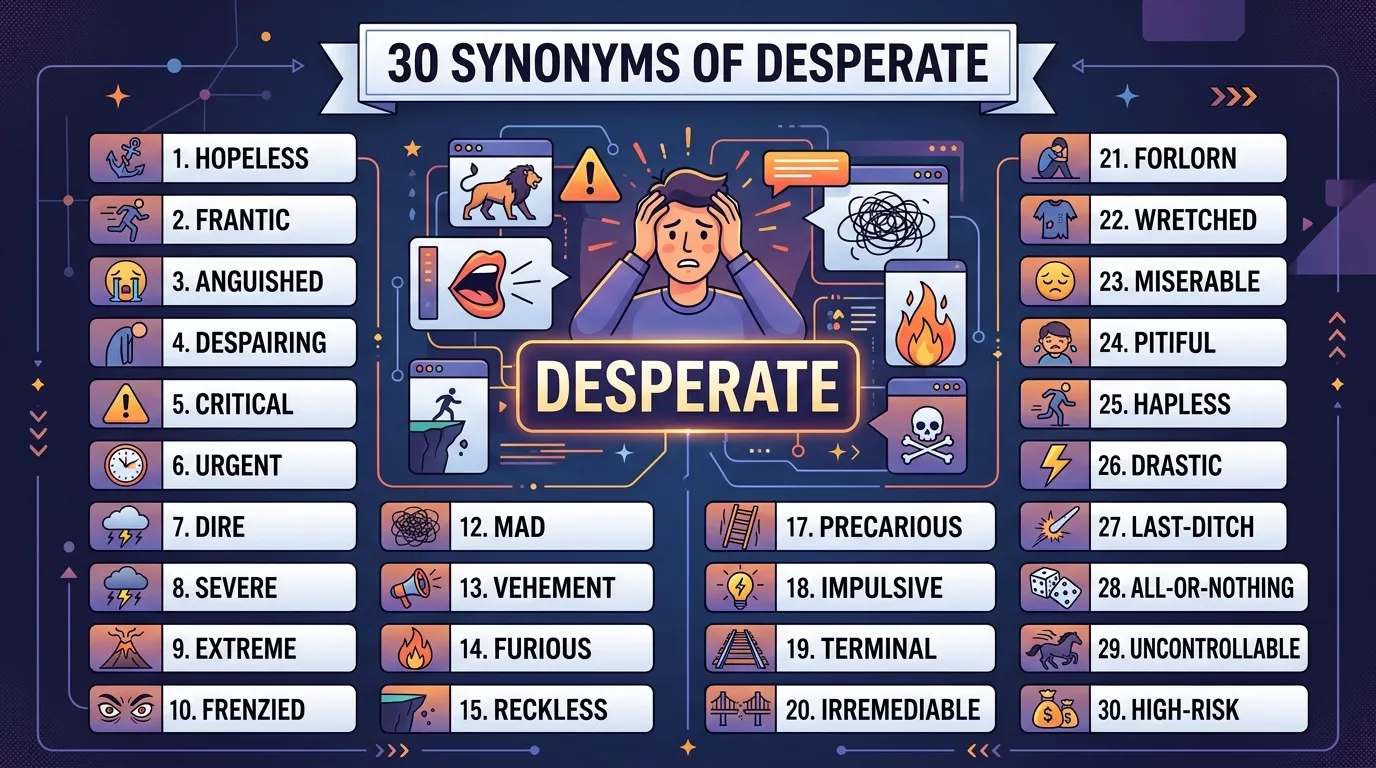
Learning synonyms for desperate helps young writers express feelings clearly. Synonyms for desperate lets you describe a hero in trouble, a team trying to win in the final second. This article covers the meaning of desperate. Along with 30 simple synonyms, clear examples, word history, pronunciation guides, and categories written in short.
Meaning of Desperate
Definition
Desperate (Adjective): Feeling hopeless, needing help very quickly, or ready to try anything because of a tough situation.
Examples
- The lost puppy gave a desperate bark for help in the dark woods.
- They made a desperate rush to catch the school bus before it drove away.
Connotative Meaning
- Positive tone: Shows strong effort, never giving up, and trying hard in a tough spot.
- Negative tone: Points to deep worry, fear, panic, or feeling completely hopeless.
- Neutral tone: Used in news and stories to describe urgent needs or hard choices.
Etymology
- Source language: Came from the Latin word desperatus, which meant “given up” or “having no hope.”
- Old English (450–1100): Early speakers used words like hopelēas (hopeless) to describe bad situations.
- Middle English (1100–1500): Borrowed from French désespéré to describe extreme danger or fear.
- Modern English (1500–Present): Became a standard storybook word for urgent needs and brave last tries!
Pronunciation
- US: /ˈdɛspərət/
- UK: /ˈdespərət/
Syllables
des-per-ate (3 parts)
Affixation Pattern of Desperate
- Root: Desperate
- Prefix: None
- Suffix: -ly (in desperately), -ion (in desperation)
- Word Formation:
- Noun: Desperation
- Verb: Despair
- Adjective: Desperate
- Adverb: Desperately
Synonyms of Desperate
1. Hopeless (Adjective) — US: /ˈhoʊpləs/ | UK: /ˈhəʊpləs/
Meaning: Feeling like things will not get better.
Examples:
He felt hopeless when he lost his house key.
It looked like a hopeless game, but they kept playing.
2. Urgent (Adjective) — US: /ˈɜːrdʒənt/ | UK: /ˈɜːdʒənt/
Meaning: Needing action or help right away.
Examples:
The doctor received an urgent phone call.
We made an urgent search for the missing notebook.
3. Wild (Adjective) — US: /waɪld/ | UK: /waɪld/
Meaning: Done in an excited, confused, or uncontrolled way.
Examples:
He made a wild jump across the deep puddle.
She had a wild look in her eyes during the tag game.
4. Frantic (Adjective) — US: /ˈfræntɪk/ | UK: /ˈfræntɪk/
Meaning: Extremely worried, hurried, and wild with fear.
Examples:
Mom made a frantic search for her car keys.
The birds made frantic noises when the cat came near.
5. Fearful (Adjective) — US: /ˈfɪrfəl/ | UK: /ˈfɪəfl/
Meaning: Full of fear and bad thoughts about what might happen.
Examples:
The fearful child held his mother’s hand tightly.
She felt fearful during the loud thunderstorm.
6. Upset (Adjective) — US: /ʌpˈsɛt/ | UK: /ʌpˈset/
Meaning: Unhappy, worried, or bothered by bad news.
Examples:
Maya was upset when her ice cream fell on the ground.
He felt upset after losing his favorite pencil.
7. Worried (Adjective) — US: /ˈwɜːrid/ | UK: /ˈwʌrid/
Meaning: Thinking a lot about unpleasant things that could happen.
Examples:
The worried teacher checked the playground twice.
He felt worried before speaking in front of the class.
8. Eager (Adjective) — US: /ˈiːɡər/ | UK: /ˈiːɡə/
Meaning: Wanting to do or get something very much.
Examples:
The eager boy ran fast to reach the front line.
She was eager to try her new shiny skates.
9. Careless (Adjective) — US: /ˈkɛrləs/ | UK: /ˈkeələs/
Meaning: Acting without thinking carefully because of hurry or fear.
Examples:
His careless rush caused him to spill the water.
In a quick moment, he made a careless guess.
10. Reckless (Adjective) — US: /ˈrɛkləs/ | UK: /ˈrekləs/
Meaning: Doing dangerous things without caring about safety.
Examples:
Running down the wet stairs was reckless.
The reckless driver turned the corner too fast.
11. Needy (Adjective) — US: /ˈniːdi/ | UK: /ˈniːdi/
Meaning: Wanting or needing a lot of help and care.
Examples:
The needy puppy followed us around the yard.
Plants become needy during hot summer weeks.
12. Unstoppable (Adjective) — US: /ˌʌnˈstɑːpəbəl/ | UK: /ˌʌnˈstɒpəbl/
Meaning: Trying so hard that nothing can stop you.
Examples:
Her strong effort made her seem unstoppable.
The team made an unstoppable push to score a goal.
13. Heavy-hearted (Adjective) — US: /ˌhɛvi-ˈhɑːrtəd/ | UK: /ˌhevi-ˈhɑːtɪd/
Meaning: Feeling very sad, burdened, and troubled inside.
Examples:
He walked home with a heavy-hearted feeling after losing.
She gave a heavy-hearted sigh when recess ended.
14. Anxious (Adjective) — US: /ˈæŋkʃəs/ | UK: /ˈæŋkʃəs/
Meaning: Nervous and worried about what is going to happen.
Examples:
The students felt anxious before the pop quiz.
She was anxious while waiting for her turn on stage.
15. Panicky (Adjective) — US: /ˈpænɪki/ | UK: /ˈpænɪki/
Meaning: Feeling sudden great fear that makes it hard to think clearly.
Examples:
He felt panicky when he lost sight of his group.
The panicky horse ran across the green field.
16. Extreme (Adjective) — US: /ɪkˈstriːm/ | UK: /ɪkˈstriːm/
Meaning: Very great, strong, or beyond normal levels.
Examples:
They worked with extreme effort to fix the toy.
The cold weather was extreme this winter.
17. Bold (Adjective) — US: /boʊld/ | UK: /bəʊld/
Meaning: Brave and ready to take big risks to succeed.
Examples:
He took a bold step to save his pet from the mud.
She made a bold move in the chess game.
18. Drastic (Adjective) — US: /ˈdræstɪk/ | UK: /ˈdræstɪk/
Meaning: Strong, sudden, and severe action taken to solve a problem.
Examples:
They took drastic steps to stop the water leak.
Changing the whole plan was a drastic choice.
19. Serious (Adjective) — US: /ˈsɪriəs/ | UK: /ˈsɪəriəs/
Meaning: Important, dangerous, or needing deep care and thought.
Examples:
The broken fence was a serious problem for the farm.
He had a serious look on his face during the test.
20. Critical (Adjective) — US: /ˈkrɪtɪkəl/ | UK: /ˈkrɪtɪkl/
Meaning: So serious that it can lead to success or failure.
Examples:
This is a critical minute in the final match.
Finding water was critical for the hikers.
21. Pressed (Adjective) — US: /prɛst/ | UK: /prest/
Meaning: Short on time, money, or help.
Examples:
We were pressed for time before the bell rang.
He felt pressed to finish his artwork quickly.
22. Clinging (Adjective) — US: /ˈklɪŋɪŋ/ | UK: /ˈklɪŋɪŋ/
Meaning: Holding on tightly because of fear or a strong wish for help.
Examples:
The clinging child would not leave his mother’s side.
He kept a clinging grip on the rope.
23. Distressed (Adjective) — US: /dɪˈstrɛst/ | UK: /dɪˈstrest/
Meaning: In great pain, sadness, or trouble.
Examples:
The distressed bird could not fly with its hurt wing.
She felt distressed when her art drawing got wet.
24. Unhappy (Adjective) — US: /ʌnˈhæpi/ | UK: /ʌnˈhæpi/
Meaning: Not glad, sad, or disappointed.
Examples:
He was unhappy that rain canceled outdoor sports.
The unhappy child sat quietly on the bench.
25. Hurried (Adjective) — US: /ˈhɜːrid/ | UK: /ˈhʌrɪd/
Meaning: Done very quickly because there is not enough time.
Examples:
She ate a hurried breakfast to catch the bus.
He wrote a hurried note to his teacher.
26. Driven (Adjective) — US: /ˈdrɪvən/ | UK: /ˈdrɪvn/
Meaning: Forced or moved by a strong feeling to get something done.
Examples:
He was driven by a strong wish to win the prize.
Her driven spirit helped her finish the long race.
27. Strained (Adjective) — US: /streɪnd/ | UK: /streɪnd/
Meaning: Showing signs of worry, tired effort, or hard pressure.
Examples:
He spoke in a strained voice after running fast.
The long day created a strained mood in class.
28. Desolate (Adjective) — US: /ˈdɛsələt/ | UK: /ˈdesələt/
Meaning: Feeling empty, lonely, and without comfort.
Examples:
The small lost dog looked desolate in the rain.
He felt desolate when his best friend moved away.
29. Last-ditch (Adjective) — US: /læst-dɪtʃ/ | UK: /lɑːst-dɪtʃ/
Meaning: Done as a final, desperate try when everything else fails.
Examples:
He made a last-ditch attempt to block the goal.
Their last-ditch plan helped them win the game.
30. Grieving (Adjective) — US: /ˈɡriːvɪŋ/ | UK: /ˈɡriːvɪŋ/
Meaning: Feeling deep sadness over a big loss.
Examples:
The grieving child missed her old pet rabbit.
He sat with his grieving friend to make him smile.
Prototype Meaning
When children hear the word desperate, they usually picture someone reaching out for help at the last second. Searching wildly for a lost item, or making a final big effort right before time runs out.
Also read more about https://synonymhunting.com/synonyms-of-experienced/
Prototype Categorization
- Hopeless & Sad Feelings: Hopeless, Heavy-hearted, Distressed, Unhappy, Desolate, Grieving.
- Panic, Fear & Worry: Frantic, Fearful, Worried, Anxious, Panicky, Strained.
- Urgent Times & Actions: Urgent, Critical, Pressed, Hurried, Last-ditch, Drastic, Serious.
- Wild & Risky Efforts: Wild, Careless, Reckless, Extreme, Eager, Bold, Driven, Needy, Clinging, Unstoppable.
Antonyms of Desperate
- Calm
- Peaceful
- Hopeful
- Safe
- Happy
- Patient
Short Questions and Answers
- What does desperate mean?
- Desperate means needing urgent help, feeling hopeless, or trying anything in a tough situation.
- When should desperate be used?
- Use desperate when writing about adventure stories, urgent hero rescues, or last-second sports plays.
- Is desperate positive or negative?
- Desperate is mostly negative because it involves fear or worry, but it can show strong effort when trying hard to succeed.
- How is it different from similar words?
- Desperate means being ready to try anything because of a bad spot, while worried just means feeling nervous, and urgent means needing fast action.
Conclusion
Synonyms for desperate strengthens your overall English vocabulary. Relying on basic words like “sad” or “scared” every day can make class stories sound plain. Using exact synonyms for desperate like frantic for searches, urgent for help, or last-ditch for big tries makes your sentences clear. Synonyms for desperate expand your vocabulary sharpens your writing. Builds speaking confidence, and helps you score well. Try using two or three of synonyms for desperate in your reading and writing today.

I’m Zahid Abbas, an educator, researcher, and digital publishing strategist with a passion for linguistics, grammar, and clear communication. As a content creator and SEO specialist, I craft research-driven, reader-focused content that empowers learners and makes knowledge accessible worldwide.