The word flexible describes something or someone that can bend, adapt, or change easily without breaking. Imagine a rubber band stretching when you pull it. A teacher changing the homework schedule to give students time. Both examples show the meaning of flexible. Learning synonyms for flexible helps English learners and writers talk clearly. About people, materials, schedules, and plans that can change or adjust easily. Synonyms for flexible also helps avoid repeating the same word in speaking and writing. You will learn 30 useful synonyms for flexible. With simple meanings, etymology, syllables, pronunciations, semantic categories, and clear example sentences. By the end, you will know how to choose the right synonym for different situations.
Meaning of Flexible
Definition
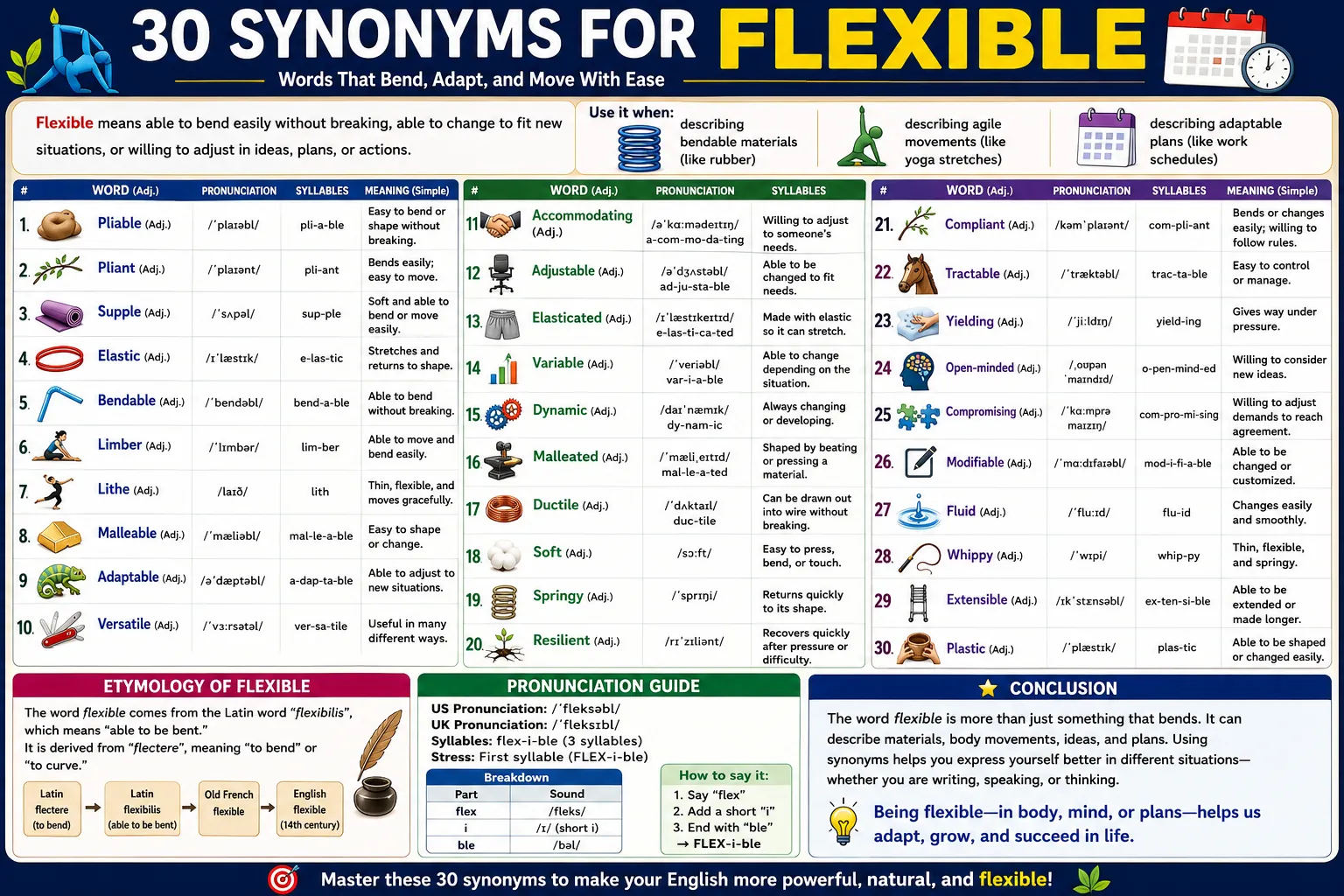
Flexible (Adjective): Capable of bending easily without breaking; able to adapt or be modified to respond to changing circumstances.
Examples
- Rubber is a flexible material used to make garden hoses.
- Our manager offers flexible work hours so employees can care for their families.
Connotative Meaning
- Positive tone: Represents adaptability, open-mindedness, agility, willingness to compromise, and resilience.
- Negative tone: Can occasionally imply lack of firmness, spinelessness, or inconsistent boundaries if overused.
- Neutral tone: Simply describes physical elasticity, bendable material, or adjustable arrangements.
Etymology
- Source language: Comes from Latin flexibilis (meaning easily bent or pliant).
- Old English (450–1100): People used Germanic words for things that could bend or give way, such as bēagsam and hnah.
- Middle English (1100–1500): The word flexible came into English from Middle French. It was first used mainly for things that could bend without breaking.
- Modern English (1500–Present): The meaning became wider. Today, flexible can describees.
Pronunciation
- US: /ˈflɛksəbl/
- UK: /ˈfleksəbl/
Syllables
flex-i-ble (3 parts)
Affixation Pattern of Flexible
- Root: Flex
- Prefix: In- (Inflexible)
- Suffix: -ible (Flexible), -ity (Flexibility)
- Word Formation:
- Noun: Flexibility / Flex
- Verb: Flex
- Adjective: Flexible / Inflexible
- Adverb: Flexibly
Learn More About Related Topics https://synonymhunting.com/synonyms-for-approach/
Synonyms for Flexible
1. Pliable (Adjective) — US: /ˈplaɪəbl/ | UK: /ˈplaɪəbl/
Meaning: Easily bent, shaped, or twisted without breaking.
Examples:
Warm clay is soft and pliable.
Leather becomes more pliable after regular conditioning.
2. Pliant (Adjective) — US: /ˈplaɪənt/ | UK: /ˈplaɪənt/
Meaning: Bending readily; easily influenced or yielding.
Examples:
Young willow twigs are remarkably pliant.
The young trees remained pliant during the strong storm.
3. Supple (Adjective) — US: /ˈsʌpəl/ | UK: /ˈsʌpl/
Meaning: Bending and moving easily and gracefully; flexible.
Examples:
Gymnasts train every morning to keep their muscles supple.
Good leather shoes feel soft and supple.
4. Elastic (Adjective) — US: /ɪˈlæstɪk/ | UK: /ɪˈlæstɪk/
Meaning: Able to resume normal shape after being stretched or compressed.
Examples:
An elastic band holds the stack of papers together.
Skin is elastic and stretches as our bodies move.
5. Bendable (Adjective) — US: /ˈbɛndəbl/ | UK: /ˈbendəbl/
Meaning: Capable of being bent easily.
Examples:
Children enjoy playing with bendable toy figures.
Use a bendable plastic straw for cold drinks.
6. Limber (Adjective) — US: /ˈlɪmbər/ | UK: /ˈlɪmbə/
Meaning: Warm, flexible, and lithe in physical movement.
Examples:
Runners do gentle stretches to keep their legs limber.
Dancers stay limber by practicing daily at the bar.
7. Lithe (Adjective) — US: /laɪð/ | UK: /laɪð/
Meaning: Thin, supple, and graceful in physical motion.
Examples:
The lithe cat leaped onto the fence effortlessly.
Her lithe movements made the dance look effortless.
8. Malleable (Adjective) — US: /ˈmæliəbl/ | UK: /ˈmæliəbl/
Meaning: Able to be hammered or pressed into shape without cracking; easily influenced.
Examples:
Gold is a malleable metal that craftsmen shape easily.
Young minds are highly malleable in early childhood.
9. Adaptable (Adjective) — US: /əˈdæptəbl/ | UK: /əˈdæptəbl/
Meaning: Able to adjust quickly to new conditions or changes.
Examples:
Successful employees are adaptable when workplace plans shift.
Chameleons are adaptable creatures that thrive in changing environments.
10. Versatile (Adjective) — US: /ˈvɜːrsətəl/ | UK: /ˈvɜːsətaɪl/
Meaning: Able to adapt to many different functions or activities.
Examples:
A pocket knife is a versatile tool for camping trips.
She is a versatile performer who sings, dances, and acts.
11. Accommodating (Adjective) — US: /əˈkɑːmədeɪtɪŋ/ | UK: /əˈkɒmədeɪtɪŋ/
Meaning: Willing to fit in with someone’s wishes or needs.
Examples:
The hotel staff was very accommodating to our large group.
My manager agreed to an accommodating work schedule.
12. Adjustable (Adjective) — US: /əˈdʒʌstəbl/ | UK: /əˈdʒʌstəbl/
Meaning: Able to be altered to fit changing conditions or sizes.
Examples:
This desk chair features an adjustable seat height.
The belt has an adjustable strap for a comfortable fit.
13. Elasticated (Adjective) — US: /ɪˈlæstɪkeɪtɪd/ | UK: /ɪˈlæstɪkeɪtɪd/
Meaning: Made with elastic threads or bands to allow stretching.
Examples:
The pants feature an elasticated waistband for easy wear.
She wore elasticated gloves to protect her hands.
14. Variable (Adjective) — US: /ˈvɛriəbl/ | UK: /ˈveəriəbl/
Meaning: Able to be changed or adapted according to circumstances.
Examples:
The store charges variable rates based on the season.
The project relies on variable working hours.
15. Dynamic (Adjective) — US: /daɪˈnæmɪk/ | UK: /daɪˈnæmɪk/
Meaning: Characterized by constant change, activity, or progress.
Examples:
Our team uses a dynamic strategy that changes weekly.
The modern market demands dynamic solutions.
16. Malleated (Adjective) — US: /ˈmælieɪtɪd/ | UK: /ˈmælieɪtɪd/
Meaning: Beaten into shape; physically pliable under pressure.
Examples:
Blacksmiths worked with malleated iron bars.
The soft foil remained easily malleated.
17. Ductile (Adjective) — US: /ˈdʌktaɪl/ | UK: /ˈdʌktaɪl/
Meaning: Able to be drawn out into a thin wire or deformed without breaking.
Examples:
Copper is a ductile metal widely used in electric wiring.
The heated glass became ductile under high heat.
18. Soft (Adjective) — US: /sɔːft/ | UK: /sɒft/
Meaning: Yielding readily to touch or pressure; easily bent.
Examples:
The child squeezed the soft rubber ball.
Fresh bread has a soft crust that cuts easily.
19. Springy (Adjective) — US: /ˈsprɪŋi/ | UK: /ˈsprɪŋi/
Meaning: Returning quickly to its original shape after being bent or compressed.
Examples:
The mattress has a springy foam layer.
Fresh green moss felt springy underfoot.
20. Resilient (Adjective) — US: /rɪˈzɪliənt/ | UK: /rɪˈzɪliənt/
Meaning: Able to withstand or recover quickly from difficult conditions or bending.
Examples:
Rubber tires are built from resilient compound materials.
She showed a resilient spirit after facing set-backs.
21. Compliance (Noun/Adj Context) — US: /kəmˈplaɪəns/ | UK: /kəmˈplaɪəns/
Meaning: Yielding, flexile, or responding smoothly to applied pressure.
Examples:
The compliant branches bent harmlessly beneath heavy snow.
Air cushions offer a compliant surface for landing.
22. Tractable (Adjective) — US: /ˈtræktəbl/ | UK: /ˈtræktəbl/
Meaning: Easy to control, influence, shape, or guide.
Examples:
The horse was quiet and tractable on the trail.
Warm wax is a tractable medium for sculpting.
23. Yielding (Adjective) — US: /ˈjiːldɪŋ/ | UK: /ˈjiːldɪŋ/
Meaning: Giving way under pressure; soft and pliable.
Examples:
The hiker sat down on the yielding turf.
A yielding pillow supports your neck comfortably.
24. Open-minded (Adjective) — US: /ˈoʊpən ˈmaɪndɪd/ | UK: /ˈəʊpən ˈmaɪndɪd/
Meaning: Willing to consider new ideas or alternative opinions.
Examples:
An open-minded leader listens to every team member.
Stay open-minded when trying new learning methods.
25. Compromising (Adjective) — US: /ˈkɑːmprəmaɪzɪŋ/ | UK: /ˈkɒmprəmaɪzɪŋ/
Meaning: Willing to adjust demands to reach mutual agreement.
Examples:
Both parties took a compromising approach to settle the deal.
Being compromising helps resolve disagreements quickly.
26. Modifiable (Adjective) — US: /ˈmɑːdɪfaɪəbl/ | UK: /ˈmɒdɪfaɪəbl/
Meaning: Capable of being altered or customized easily.
Examples:
The program offers modifiable templates for students.
The plan is fully modifiable to suit your needs.
27. Fluid (Adjective) — US: /ˈfluːɪd/ | UK: /ˈfluːɪd/
Meaning: Smooth and continuous; capable of flowing or adapting easily.
Examples:
The schedule remains fluid while weather conditions clear up.
Dancers executed fluid movements across the floor.
28. Whippy (Adjective) — US: /ˈwɪpi/ | UK: /ˈwɪpi/
Meaning: Flexible and springy like a whip.
Examples:
The angler used a whippy fishing rod for lightweight lures.
Thin, whippy bamboo shoots swayed in the breeze.
29. Extensible (Adjective) — US: /ɪkˈstɛnsəbl/ | UK: /ɪkˈstensəbl/
Meaning: Capable of being stretched or extended.
Examples:
The camera uses an extensible mounting cord.
An extensible ladder helps reach high windows.
30. Plastic (Adjective) — US: /ˈplæstɪk/ | UK: /ˈplæstɪk/
Meaning: Easily shaped, molded, or altered; displaying high physical flexibility.
Examples:
Warm clay remains plastic in the artist’s hands.
Brain structure shows plastic qualities during learning.
Prototype Meaning
When people hear flexible, they often think of things like an elastic band, a bendable straw, or a flexible ruler. These objects can bend easily without breaking.
Prototype Categorization
- Bending & Physical Flexibility: Pliable, Pliant, Supple, Elastic, Bendable, Springy, Ductile, Extensible, Whippy, Soft, Yielding, Plastic.
- Body Movement: Limber, Lithe, Resilient.
- Flexible Plans & Minds: Adaptable, Versatile, Accommodating, Adjustable, Open-minded, Compromising, Modifiable, Fluid, Variable, Dynamic, Tractable, Compliant.
- Shaping Materials: Malleable, Malleated.
Antonyms of Flexible
- Rigid
- Stiff
- Inflexible
- Stubborn
- Unyielding
- Firm
Short Questions and Answers
- What does flexible mean?
- It means able to bend easily without breaking, or able to adapt to changing plans.
- When should flexible be used?
- Use it for things that can bend, such as rubber, body movements. Like yoga stretches, or plans that can change, such as work schedules.
- Is flexible positive or negative?
- It is usually positive, as it reflects strength, open-mindedness, and adaptability.
- How is flexible different from adaptable?
- Flexible can describe something that bends or changes easily. While adaptable describes a person or thing that can adjust to a new situation.
Conclusion
Synonyms for flexible will enrich your writing and conversation. Relying solely on basic words like “soft” or “bendable” makes descriptions repetitive. Using precise synonyms like malleable for metals, supple for leather, or adaptable for team schedules makes your prose clear, or engaging. Try incorporating a few of these synonyms into your next English assignment. English learners and content writers can improve their vocabulary, writing, and speaking skills by learning synonyms for flexible.

I’m Zahid Abbas, an educator, researcher, and digital publishing strategist with a passion for linguistics, grammar, and clear communication. As a content creator and SEO specialist, I craft research-driven, reader-focused content that empowers learners and makes knowledge accessible worldwide.