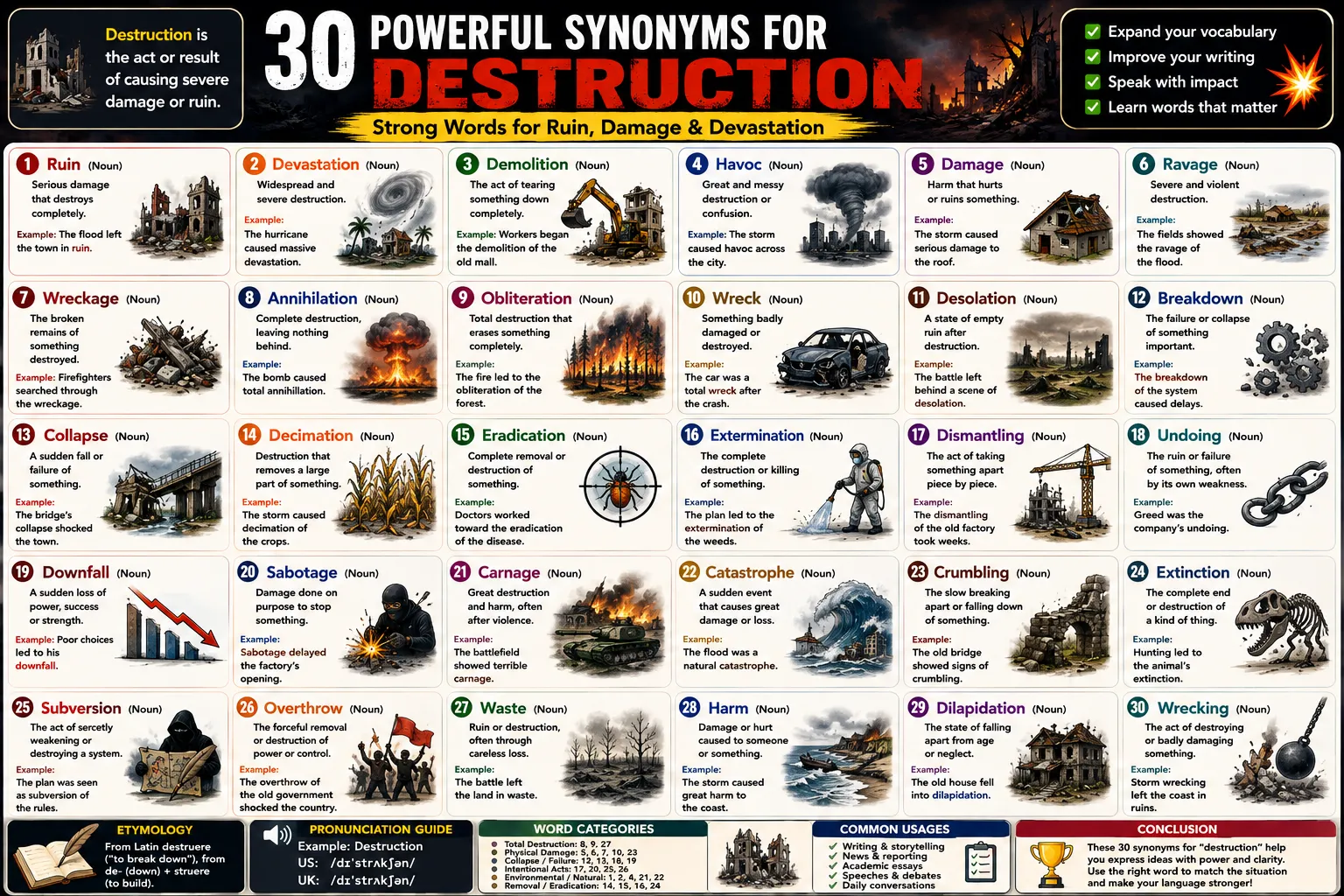
Destruction means the act of destroying something, or serious damage that ruins it. Think about a big storm that hits a town. Trees fall. Roofs break. Streets flood. People say, “The storm caused a lot of destruction.” This word helps show how badly something has been broken or ruined. People use synonyms for destruction a lot in news, stories, and history. Learning new words like this helps English learners and writers. Synonyms for destruction helps you say the same idea in fresh ways. It also makes your writing sound more clear. This article will teach you the meaning of destruction. You will learn its history, how to say it, and 30 words that mean the same thing.
Meaning of Destruction
Definition
Destruction (Noun): The act of destroying something, or serious damage that ruins it completely.
Examples
- The earthquake left a path of destruction.
- The war caused great destruction in the city.
Connotative Meaning
- Positive tone: This word almost never feels good. It is rarely used in a happy way.
- Negative tone: This word often feels sad or scary, showing loss, damage, or ruin.
- Neutral tone: In science or history writing, this word can be used in a plain way to describe facts, like the destruction of old buildings.
Etymology
- This word comes from Latin “destructio.”
- That word came from “destruere,” meaning “to destroy.”
- The Latin word joined “de-” (meaning “down” or “undo”) and “struere” (meaning “to build”).
Short History
- Old English (450–1100): This word did not exist yet. People used other native words to describe ruin or damage.
- Middle English (1100–1500): The word “destruccioun” came into English from Old French, which took it from Latin.
- Modern English (1500–Present): The spelling became “destruction.” The word is now used for wars, storms, and any event that causes great harm or ruin.
Pronunciation (US & UK – IPA)
- US: /dɪˈstrʌkʃən/
- UK: /dɪˈstrʌkʃən/
Syllables
de-struc-tion (3 syllables)
Affixation Pattern of Destruction
- Root: struct (from Latin “struere,” meaning “to build”)
- Prefix: de- (meaning “down” or “undo”)
- Suffix: -ion (turns the word into a noun)
Word Formation:
- Destroy (action word)
- Destructive (describing word)
- Destructively (tells how)
- Destruction (naming word)
Discover more about https://synonymhunting.com/synonyms-for-suddenly/
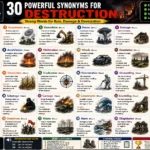
Synonyms for Destruction
1. Ruin (Noun) — US: /ˈruːɪn/ | UK: /ˈruːɪn/
Meaning: Serious damage that destroys something completely. Examples:
- The flood left the town in ruin.
- The fire brought total ruin to the barn.
2. Devastation (Noun) — US: /ˌdɛvəˈsteɪʃən/ | UK: /ˌdɛvəˈsteɪʃən/
Meaning: Widespread and severe destruction. Examples:
- The hurricane caused massive devastation.
- Photos showed the devastation after the war.
3. Demolition (Noun) — US: /ˌdɛməˈlɪʃən/ | UK: /ˌdɛməˈlɪʃən/
Meaning: The act of tearing something down completely. Examples:
- Workers began the demolition of the old mall.
- The demolition took only a few hours.
4. Havoc (Noun) — US: /ˈhævək/ | UK: /ˈhævək/
Meaning: Great and messy destruction or confusion. Examples:
- The storm caused havoc across the city.
- The prank caused havoc in the classroom.
5. Damage (Noun) — US: /ˈdæmɪdʒ/ | UK: /ˈdæmɪdʒ/
Meaning: Harm that hurts or ruins something. Examples:
- The storm caused serious damage to the roof.
- Water damage ruined the old books.
6. Ravage (Noun) — US: /ˈrævɪdʒ/ | UK: /ˈrævɪdʒ/
Meaning: Severe and violent destruction. Examples:
- The fields showed the ravage of the flood.
- The disease left ravage across the crops.
7. Wreckage (Noun) — US: /ˈrɛkɪdʒ/ | UK: /ˈrɛkɪdʒ/
Meaning: The broken remains of something destroyed. Examples:
- Firefighters searched through the wreckage.
- The plane’s wreckage was found in the forest.
8. Annihilation (Noun) — US: /əˌnaɪəˈleɪʃən/ | UK: /əˌnaɪəˈleɪʃən/
Meaning: Complete destruction, leaving nothing behind. Examples:
- The bomb caused total annihilation.
- The village faced complete annihilation.
9. Obliteration (Noun) — US: /əˌblɪtəˈreɪʃən/ | UK: /əˌblɪtəˈreɪʃən/
Meaning: Total destruction that erases something completely. Examples:
- The fire led to the obliteration of the forest.
- The old map showed the town’s obliteration.
10. Wreck (Noun) — US: /rɛk/ | UK: /rɛk/
Meaning: Something badly damaged or destroyed. Examples:
- The car was a total wreck after the crash.
- Divers found the ship’s wreck at sea.
11. Desolation (Noun) — US: /ˌdɛsəˈleɪʃən/ | UK: /ˌdɛsəˈleɪʃən/
Meaning: A state of empty ruin after destruction. Examples:
- The battle left behind a scene of desolation.
- The desert showed miles of desolation.
12. Breakdown (Noun) — US: /ˈbreɪkˌdaʊn/ | UK: /ˈbreɪkˌdaʊn/
Meaning: The failure or collapse of something important. Examples:
- The breakdown of the system caused delays.
- A breakdown in talks stopped the deal.
13. Collapse (Noun) — US: /kəˈlæps/ | UK: /kəˈlæps/
Meaning: A sudden fall or failure of something. Examples:
- The bridge’s collapse shocked the town.
- The building’s collapse trapped several workers.
14. Decimation (Noun) — US: /ˌdɛsɪˈmeɪʃən/ | UK: /ˌdɛsɪˈmeɪʃən/
Meaning: Destruction that removes a large part of something. Examples:
- The storm caused decimation of the crops.
- The disease led to the decimation of the herd.
15. Eradication (Noun) — US: /ɪˌrædɪˈkeɪʃən/ | UK: /ɪˌrædɪˈkeɪʃən/
Meaning: Complete removal or destruction of something. Examples:
- Doctors worked toward the eradication of the disease.
- The program aimed at eradication of pests.
16. Extermination (Noun) — US: /ɪkˌstɜːrməˈneɪʃən/ | UK: /ɪkˌstɜːməˈneɪʃən/
Meaning: The complete destruction or killing of something, often pests or harmful things. Examples:
- The company handled insect extermination.
- The plan led to the extermination of the weeds.
17. Dismantling (Noun) — US: /dɪsˈmæntlɪŋ/ | UK: /dɪsˈmæntlɪŋ/
Meaning: The act of taking something apart piece by piece. Examples:
- The dismantling of the old factory took weeks.
- Workers began dismantling the broken machine.
18. Undoing (Noun) — US: /ʌnˈduːɪŋ/ | UK: /ʌnˈduːɪŋ/
Meaning: The ruin or failure of something, often caused by its own weakness. Examples:
- Greed was the company’s undoing.
- Pride became his own undoing.
19. Downfall (Noun) — US: /ˈdaʊnˌfɔːl/ | UK: /ˈdaʊnˌfɔːl/
Meaning: A sudden loss of power, success, or strength. Examples:
- Poor choices led to his downfall.
- The empire’s downfall took many years.
20. Sabotage (Noun) — US: /ˈsæbəˌtɑːʒ/ | UK: /ˈsæbətɑːʒ/
Meaning: Damage done on purpose to stop something from working. Examples:
- The fire was later blamed on sabotage.
- Sabotage delayed the factory’s opening.
21. Carnage (Noun) — US: /ˈkɑːrnɪdʒ/ | UK: /ˈkɑːnɪdʒ/
Meaning: Great destruction and harm, often after violence. Examples:
- The battlefield showed terrible carnage.
- News reports described the carnage after the crash.
22. Catastrophe (Noun) — US: /kəˈtæstrəfi/ | UK: /kəˈtæstrəfi/
Meaning: A sudden event that causes great damage or loss. Examples:
- The flood was a natural catastrophe.
- The fire turned into a major catastrophe.
23. Crumbling (Noun) — US: /ˈkrʌmblɪŋ/ | UK: /ˈkrʌmblɪŋ/
Meaning: The slow breaking apart or falling down of something. Examples:
- Years of crumbling left the wall unsafe.
- The old bridge showed signs of crumbling.
24. Extinction (Noun) — US: /ɪkˈstɪŋkʃən/ | UK: /ɪkˈstɪŋkʃən/
Meaning: The complete end or destruction of a group or kind of thing. Examples:
- Hunting led to the animal’s extinction.
- Scientists study causes of extinction.
25. Subversion (Noun) — US: /səbˈvɜːrʒən/ | UK: /səbˈvɜːʃən/
Meaning: The act of secretly weakening or destroying a system. Examples:
- The plan was seen as subversion of the rules.
- Their actions led to the subversion of trust.
26. Overthrow (Noun) — US: /ˈoʊvərˌθroʊ/ | UK: /ˈəʊvəˌθrəʊ/
Meaning: The forceful removal or destruction of power or control. Examples:
- The overthrow of the old government shocked the country.
- Rebels planned the leader’s overthrow.
27. Waste (Noun) — US: /weɪst/ | UK: /weɪst/
Meaning: Ruin or destruction, often through careless loss. Examples:
- The battle left the land in waste.
- War brought waste to the countryside.
28. Harm (Noun) — US: /hɑːrm/ | UK: /hɑːm/
Meaning: Damage or hurt caused to someone or something. Examples:
- The storm caused great harm to the coast.
- No harm came to the old building.
29. Dilapidation (Noun) — US: /dɪˌlæpɪˈdeɪʃən/ | UK: /dɪˌlæpɪˈdeɪʃən/
Meaning: The state of falling apart from age or neglect. Examples:
- The old house fell into dilapidation.
- Years of dilapidation ruined the barn.
30. Wrecking (Noun) — US: /ˈrɛkɪŋ/ | UK: /ˈrɛkɪŋ/
Meaning: The act of destroying or badly damaging something. Examples:
- The wrecking of the old building began Monday.
- Storm wrecking left the coast in ruins.
Prototype Meaning
When people hear the word destruction, they think of something being broken, ruined, or completely wiped out. This often brings to mind storms, wars, or accidents that leave behind damage and loss. The word carries a strong, serious feeling of harm and loss.
Prototype Categorization
- Total or complete ruin: annihilation, obliteration, extermination, eradication, extinction
- Physical damage: damage, wreckage, wreck, ruin, harm
- Sudden collapse or failure: collapse, breakdown, downfall, catastrophe
- Slow or ongoing decay: crumbling, dilapidation, decimation
- Caused on purpose: sabotage, subversion, overthrow, dismantling, wrecking
- Widespread destruction: devastation, havoc, ravage, carnage, desolation, waste, demolition, undoing
Antonyms of Destruction
- Creation
- Construction
- Preservation
- Restoration
- Repair
Short Questions and Answers
- What does destruction mean?
- It means the act of destroying something, or serious damage that ruins it.
- When should destruction be used?
- Use it when describing severe damage, ruin, or the loss caused by an event like a storm or war.
- Is destruction positive or negative?
- It is almost always negative. It shows loss, harm, or ruin.
- How is it different from similar words?
- “Damage” often means harm that can still be fixed. “Destruction” usually means the harm is complete or very severe.
Conclusion
Synonyms for destruction helps you grow your word bank. It makes your writing and talking more clear and powerful. Synonyms for destruction helps you use different words instead of the same one again and again. It also helps you feel more sure when you speak English. Try to learn one new word from this list each day. Small steps like this help you grow a lot over time. English learners and content writers can improve their vocabulary, writing, and speaking skills by learning synonyms for destruction.

I’m Zahid Abbas, an educator, researcher, and digital publishing strategist with a passion for linguistics, grammar, and clear communication. As a content creator and SEO specialist, I craft research-driven, reader-focused content that empowers learners and makes knowledge accessible worldwide.