Importance means how much something matters or has value. Think about a mother telling her kids, “Brushing your teeth every day is very important for your health.” That word “importance” shows why something matters a lot. People use synonyms for importance a lot at home, school, and work. It helps show what should be cared about most. Learning new words like this helps English learners and writers. Synonyms for importance helps you say the same idea in fresh ways. Synonyms for importance also makes your writing sound more clear. This article will teach you the meaning of importance. You will learn its history, how to say it, and 30 words that mean the same thing.
Meaning of Importance
Definition
Importance (Noun): The quality of being important, valuable, or worth caring about.
Examples
- She understands the importance of hard work.
- The teacher explained the importance of sleep.
Connotative Meaning
- Positive tone: This word often feels helpful, like showing something is worth caring about.
- Negative tone: This word rarely feels bad. It can feel serious when linked to danger or risk.
- Neutral tone: In reports and school work, this word is often used in a plain, factual way to show value or priority.
Etymology
- This word comes from the word “important.”
- “Important” came from Latin “importare,” meaning “to bring in” or “to matter.”
- The Latin word joined “in-” (meaning “into”) and “portare” (meaning “to carry”).
Short History
- Old English (450–1100): This word did not exist yet. People used simpler words to show that something mattered.
- Middle English (1100–1500): The root idea of “carrying meaning” existed in Latin, but the English word “important” had not yet fully formed.
- Modern English (1500–Present): The word “important” entered English from Latin and French. Soon after, “importance” was formed and became common in daily talk and writing.
Pronunciation (US & UK – IPA)
- US: /ɪmˈpɔːrtəns/
- UK: /ɪmˈpɔːtəns/
Syllables
im-por-tance (3 syllables)
Affixation Pattern of Importance
- Root: port (from Latin “portare,” meaning “to carry”)
- Prefix: im- (a form of “in-,” meaning “into”)
- Suffix: -ance (turns the word into a noun)
Word Formation:
- Import (naming word/action word)
- Important (describing word)
- Importantly (tells how)
- Importance (naming word)
Learn More About Related Topics https://synonymhunting.com/synonyms-for-motivated/
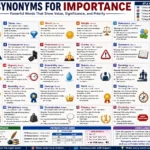
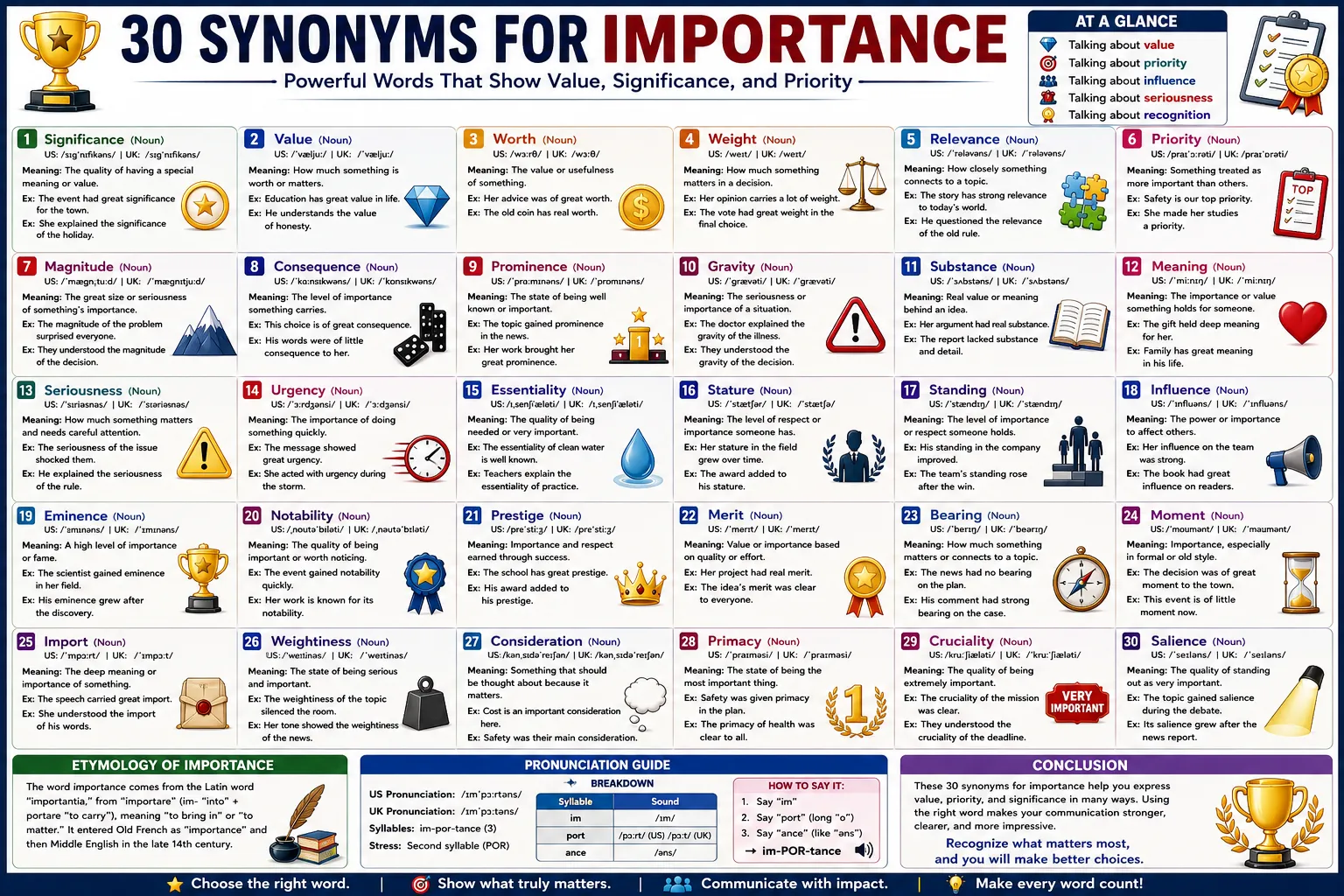
Synonyms for Importance
1. Significance (Noun) — US: /sɪɡˈnɪfɪkəns/ | UK: /sɪɡˈnɪfɪkəns/
Meaning: The quality of having a special meaning or value. Examples:
- The event had great significance for the town.
- She explained the significance of the holiday.
2. Value (Noun) — US: /ˈvæljuː/ | UK: /ˈvæljuː/
Meaning: How much something is worth or matters. Examples:
- Education has great value in life.
- He understands the value of honesty.
3. Worth (Noun) — US: /wɜːrθ/ | UK: /wɜːθ/
Meaning: The value or usefulness of something. Examples:
- Her advice was of great worth.
- The old coin has real worth.
4. Weight (Noun) — US: /weɪt/ | UK: /weɪt/
Meaning: How much something matters in a decision or discussion. Examples:
- Her opinion carries a lot of weight.
- The vote had great weight in the final choice.
5. Relevance (Noun) — US: /ˈrɛləvəns/ | UK: /ˈrɛləvəns/
Meaning: How closely something connects to a topic and matters to it. Examples:
- The story has strong relevance to today’s world.
- He questioned the relevance of the old rule.
6. Priority (Noun) — US: /praɪˈɔːrəti/ | UK: /praɪˈɒrəti/
Meaning: Something that is treated as more important than other things. Examples:
- Safety is our top priority.
- She made her studies a priority.
7. Magnitude (Noun) — US: /ˈmæɡnɪˌtuːd/ | UK: /ˈmæɡnɪtjuːd/
Meaning: The great size or seriousness of something’s importance. Examples:
- The magnitude of the problem surprised everyone.
- They understood the magnitude of the decision.
8. Consequence (Noun) — US: /ˈkɑːnsɪkwəns/ | UK: /ˈkɒnsɪkwəns/
Meaning: The level of importance something carries. Examples:
- This choice is of great consequence.
- His words were of little consequence to her.
9. Prominence (Noun) — US: /ˈprɑːmɪnəns/ | UK: /ˈprɒmɪnəns/
Meaning: The state of being well known or important. Examples:
- The topic gained prominence in the news.
- Her work brought her great prominence.
10. Gravity (Noun) — US: /ˈɡrævəti/ | UK: /ˈɡrævəti/
Meaning: The seriousness or importance of a situation. Examples:
- The doctor explained the gravity of the illness.
- They understood the gravity of the decision.
11. Substance (Noun) — US: /ˈsʌbstəns/ | UK: /ˈsʌbstəns/
Meaning: Real value or meaning behind an idea. Examples:
- Her argument had real substance.
- The report lacked substance and detail.
12. Meaning (Noun) — US: /ˈmiːnɪŋ/ | UK: /ˈmiːnɪŋ/
Meaning: The importance or value something holds for someone. Examples:
- The gift held deep meaning for her.
- Family has great meaning in his life.
13. Seriousness (Noun) — US: /ˈsɪriəsnəs/ | UK: /ˈsɪəriəsnəs/
Meaning: How much something matters and needs careful attention. Examples:
- The seriousness of the issue shocked them.
- He explained the seriousness of the rule.
14. Urgency (Noun) — US: /ˈɜːrdʒənsi/ | UK: /ˈɜːdʒənsi/
Meaning: The importance of doing something quickly. Examples:
- The message showed great urgency.
- She acted with urgency during the storm.
15. Essentiality (Noun) — US: /ɪˌsɛnʃiˈæləti/ | UK: /ɪˌsɛnʃiˈæləti/
Meaning: The quality of being needed or very important. Examples:
- The essentiality of clean water is well known.
- Teachers explain the essentiality of practice.
16. Stature (Noun) — US: /ˈstætʃər/ | UK: /ˈstætʃə/
Meaning: The level of respect or importance someone has. Examples:
- Her stature in the field grew over time.
- The award added to his stature.
17. Standing (Noun) — US: /ˈstændɪŋ/ | UK: /ˈstændɪŋ/
Meaning: The level of importance or respect someone holds. Examples:
- His standing in the company improved.
- The team’s standing rose after the win.
18. Influence (Noun) — US: /ˈɪnfluəns/ | UK: /ˈɪnfluəns/
Meaning: The power or importance to affect others. Examples:
- Her influence on the team was strong.
- The book had great influence on readers.
19. Eminence (Noun) — US: /ˈɛmɪnəns/ | UK: /ˈɛmɪnəns/
Meaning: A high level of importance or fame. Examples:
- The scientist gained eminence in her field.
- His eminence grew after the discovery.
20. Notability (Noun) — US: /ˌnoʊtəˈbɪləti/ | UK: /ˌnəʊtəˈbɪləti/
Meaning: The quality of being important or worth noticing. Examples:
- The event gained notability quickly.
- Her work is known for its notability.
21. Prestige (Noun) — US: /prɛˈstiːʒ/ | UK: /prɛˈstiːʒ/
Meaning: Importance and respect earned through success. Examples:
- The school has great prestige.
- His award added to his prestige.
22. Merit (Noun) — US: /ˈmɛrɪt/ | UK: /ˈmɛrɪt/
Meaning: Value or importance based on quality or effort. Examples:
- Her project had real merit.
- The idea’s merit was clear to everyone.
23. Bearing (Noun) — US: /ˈbɛrɪŋ/ | UK: /ˈbeərɪŋ/
Meaning: How much something matters or connects to a topic. Examples:
- The news had no bearing on the plan.
- His comment had strong bearing on the case.
24. Moment (Noun) — US: /ˈmoʊmənt/ | UK: /ˈməʊmənt/
Meaning: Importance, especially in a formal or old style. Examples:
- The decision was of great moment to the town.
- This event is of little moment now.
25. Import (Noun) — US: /ˈɪmpɔːrt/ | UK: /ˈɪmpɔːt/
Meaning: The deep meaning or importance of something. Examples:
- The speech carried great import.
- She understood the import of his words.
26. Weightiness (Noun) — US: /ˈweɪtinəs/ | UK: /ˈweɪtinəs/
Meaning: The state of being serious and important. Examples:
- The weightiness of the topic silenced the room.
- Her tone showed the weightiness of the news.
27. Consideration (Noun) — US: /kənˌsɪdəˈreɪʃən/ | UK: /kənˌsɪdəˈreɪʃən/
Meaning: Something that should be thought about because it matters. Examples:
- Cost is an important consideration here.
- Safety was their main consideration.
28. Primacy (Noun) — US: /ˈpraɪməsi/ | UK: /ˈpraɪməsi/
Meaning: The state of being the most important thing. Examples:
- Safety was given primacy in the plan.
- The primacy of health was clear to all.
29. Cruciality (Noun) — US: /kruːˈʃiæləti/ | UK: /kruːˈʃiæləti/
Meaning: The quality of being extremely important. Examples:
- The cruciality of the mission was clear.
- They understood the cruciality of the deadline.
30. Salience (Noun) — US: /ˈseɪliəns/ | UK: /ˈseɪliəns/
Meaning: The quality of standing out as very important. Examples:
- The topic gained salience during the debate.
- Its salience grew after the news report.
Prototype Meaning
When people hear the word importance, they think of something that truly matters and deserves attention. It could be a rule, a person, an idea, or an event. This word often carries a feeling of value, seriousness, and the need to pay close attention.
Prototype Categorization
- Simple everyday value: value, worth, meaning, weight
- Formal or serious importance: gravity, seriousness, urgency, cruciality
- Rank or respect-based importance: stature, standing, eminence, prestige, prominence
- Connection or relevance: relevance, bearing, consideration, substance
- Priority and focus: priority, primacy, essentiality, magnitude
- Notice and influence: significance, notability, salience, influence, merit, consequence, import, weightiness
Antonyms of Importance
- Insignificance
- Triviality
- Irrelevance
- Unimportance
- Worthlessness
Short Questions and Answers
- What does importance mean? It means the quality of being important, valuable, or worth caring about.
- When should importance be used? Use it when explaining why something matters or deserves attention.
- Is importance positive or negative? It is usually positive or neutral. It shows value, though the topic itself can be serious.
- How is it different from similar words? “Value” often focuses on worth in a practical or money-related sense. “Importance” is broader and can apply to ideas, people, feelings, and events.
Conclusion
Synonyms for importance helps you grow your word bank. It makes your writing and talking more clear and thoughtful. Synonyms for importance helps you use different words instead of the same one again and again. It also helps you feel more sure when you speak English. Try to learn one new word from this list each day. Small steps like this help you grow a lot over time.

I’m Zahid Abbas, an educator, researcher, and digital publishing strategist with a passion for linguistics, grammar, and clear communication. As a content creator and SEO specialist, I craft research-driven, reader-focused content that empowers learners and makes knowledge accessible worldwide.