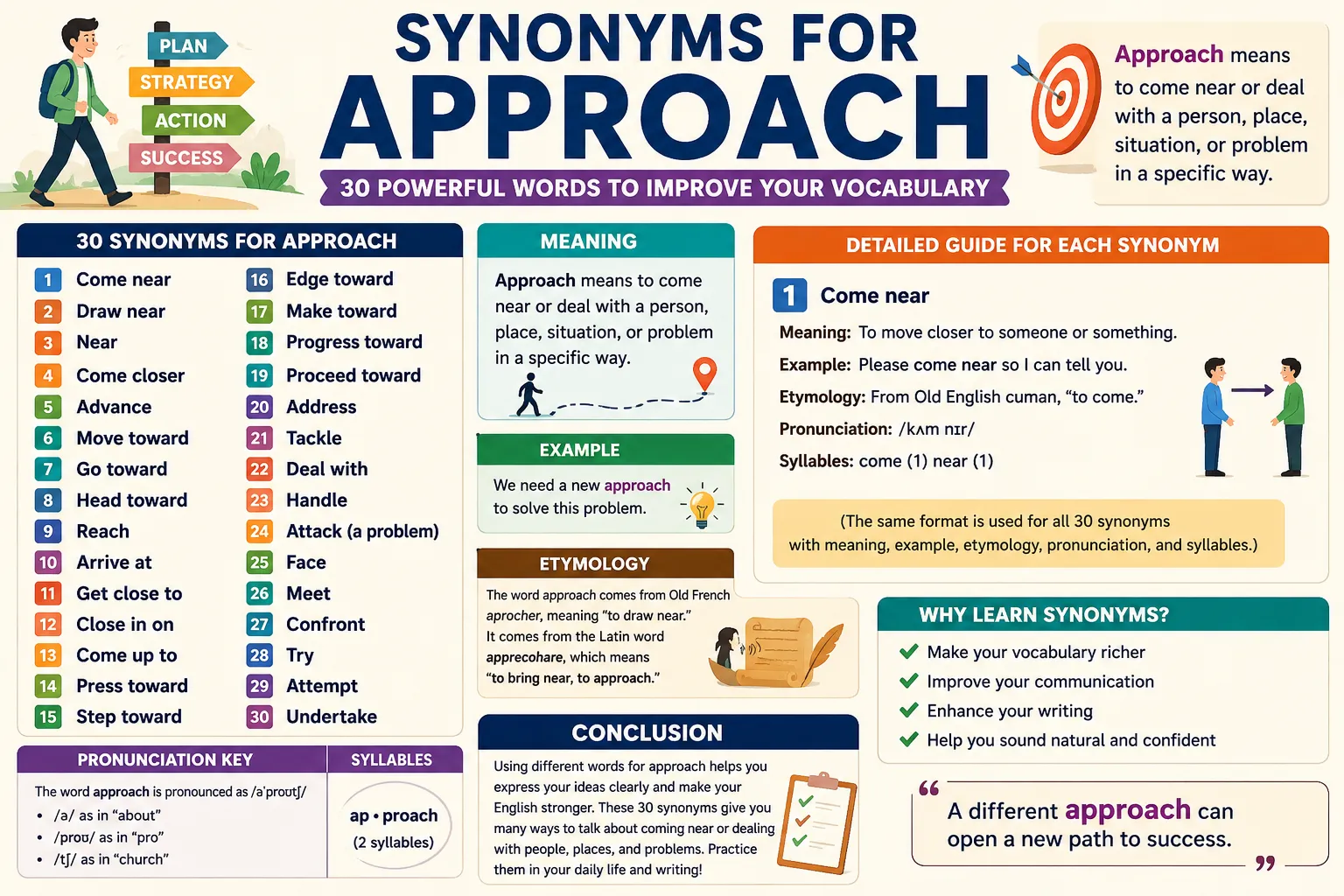
Approach means a way of doing something or dealing with a problem or situation. Picture a teacher who tries one way to explain a math problem, but the students still look confused. She changes her approach, uses a simple drawing instead, and suddenly everyone understands. That change in method is exactly what “approach” means. People use synonyms for approach often because it describes how someone chooses to handle a task. For English learners and content writers, learning synonyms for approach is important. Synonyms for approach helps you avoid repeating the same word again and again. Also makes your writing sound more natural, and keeps readers engaged. This article explains the meaning of approach. Its synonyms, examples, grammar, history, pronunciation, and word categories.
Meaning of Approach
Definition
Approach (Noun): A way of doing something or dealing with a problem, task, or situation.
Examples
- Her approach to teaching made the lesson easy to follow.
- The company tried a new approach to solve the sales problem.
Connotative Meaning
- Positive tone: Approach often sounds thoughtful and planned, suggesting careful thinking before action.
- Negative tone: In some cases, approach can sound negative if the chosen method is wrong or poorly planned, such as “a careless approach.”
- Neutral tone: In business or academic writing, approach is often used in a plain, factual way, such as “a scientific approach” or “a step-by-step approach.”
Etymology
- The word approach comes from Old French “aprochier.”
- It traces back to Late Latin “appropiare,” meaning “to come near.”
- This word was formed from Latin “ad-” (meaning “to”) and “propius” (meaning “nearer”).
Short History
- Old English (450–1100): The word did not exist. Old English speakers used words like “nēalǣcan,” meaning “to draw near.”
- Middle English (1100–1500): After the Norman Conquest, French words entered English. “Approach” appeared, borrowed from French “aprochier,” first meaning “to come closer physically.”
- Modern English (1500–Present): The meaning widened beyond physical closeness to include a way of dealing with tasks, problems, or ideas, as used in business, science, and daily life today.
Pronunciation (US & UK – IPA)
- US: /əˈproʊtʃ/
- UK: /əˈprəʊtʃ/
Syllables
ap-proach (2 syllables)
Affixation Pattern of Approach
- Root: proach (from Latin “propius,” meaning “near”)
- Prefix: ap- (a form of “ad-,” meaning “to” or “toward”)
- Suffix: none
Word Formation:
- Approach (noun/verb)
- Approachable (adjective)
- Approachability (noun)
- Unapproachable (adjective)
Explore more about https://synonymhunting.com/synonyms-for-suggests/
Synonyms for Approach
1. Method (Noun) — US: /ˈmɛθəd/ | UK: /ˈmɛθəd/
Meaning: A planned way of doing something. Examples:
- She used a simple method to teach the lesson.
- The new method saved a lot of time.
2. Technique (Noun) — US: /tɛkˈniːk/ | UK: /tɛkˈniːk/
Meaning: A specific skillful way of doing a task. Examples:
- His painting technique took years to master.
- The coach taught a new running technique.
3. Strategy (Noun) — US: /ˈstrætədʒi/ | UK: /ˈstrætədʒi/
Meaning: A careful plan made to reach a goal. Examples:
- The team built a strategy to win the game.
- Her marketing strategy increased sales.
4. Tactic (Noun) — US: /ˈtæktɪk/ | UK: /ˈtæktɪk/
Meaning: A specific action used to achieve a short-term goal. Examples:
- Their tactic worked well in the negotiation.
- He tried a new tactic to calm the child.
5. Procedure (Noun) — US: /prəˈsiːdʒər/ | UK: /prəˈsiːdʒə/
Meaning: A fixed series of steps used to complete a task. Examples:
- The nurse followed the correct procedure.
- The safety procedure must be followed carefully.
6. Way (Noun) — US: /weɪ/ | UK: /weɪ/
Meaning: A manner or method of doing something. Examples:
- There is an easier way to solve this.
- Her way of explaining things is very clear.
7. Manner (Noun) — US: /ˈmænər/ | UK: /ˈmænə/
Meaning: The way in which something is done. Examples:
- He spoke in a calm manner.
- The task was done in a professional manner.
8. Style (Noun) — US: /staɪl/ | UK: /staɪl/
Meaning: A particular way of doing or presenting something. Examples:
- Her writing style is simple and clear.
- The coach has a unique training style.
9. Process (Noun) — US: /ˈprɑːsɛs/ | UK: /ˈprəʊsɛs/
Meaning: A series of actions taken to reach a result. Examples:
- The hiring process took three weeks.
- Learning a language is a slow process.
10. System (Noun) — US: /ˈsɪstəm/ | UK: /ˈsɪstəm/
Meaning: An organized method or set of steps used to complete tasks. Examples:
- The company uses a new filing system.
- Her study system helped her pass the exam.
11. Plan (Noun) — US: /plæn/ | UK: /plæn/
Meaning: A detailed idea for achieving a goal. Examples:
- They created a plan to finish the project early.
- His plan worked better than expected.
12. Scheme (Noun) — US: /skiːm/ | UK: /skiːm/
Meaning: A structured plan or system for doing something. Examples:
- The city introduced a new recycling scheme.
- Her color scheme made the room look bright.
13. Framework (Noun) — US: /ˈfreɪmwɜːrk/ | UK: /ˈfreɪmwɜːk/
Meaning: A basic structure used to guide a plan or method. Examples:
- The report followed a clear framework.
- They built a framework for future projects.
14. Course (Noun) — US: /kɔːrs/ | UK: /kɔːs/
Meaning: A planned direction of action. Examples:
- She chose a different course of action.
- The company changed its course after the loss.
15. Angle (Noun) — US: /ˈæŋɡəl/ | UK: /ˈæŋɡəl/
Meaning: A particular way of looking at or handling a problem. Examples:
- He looked at the issue from a new angle.
- Her angle on the story was unique.
16. Perspective (Noun) — US: /pərˈspɛktɪv/ | UK: /pəˈspɛktɪv/
Meaning: A particular way of viewing or thinking about something. Examples:
- Her perspective changed the whole discussion.
- Try to see it from his perspective.
17. Viewpoint (Noun) — US: /ˈvjuːpɔɪnt/ | UK: /ˈvjuːpɔɪnt/
Meaning: A way of thinking about or judging something. Examples:
- His viewpoint was different from the others.
- The article shared a fresh viewpoint.
18. Attitude (Noun) — US: /ˈætɪtuːd/ | UK: /ˈætɪtjuːd/
Meaning: A way of thinking or feeling that shapes how someone handles something. Examples:
- Her positive attitude helped the team stay calm.
- His attitude toward work changed after the promotion.
19. Means (Noun) — US: /miːnz/ | UK: /miːnz/
Meaning: A method or way used to achieve something. Examples:
- They found a means to reduce costs.
- Education is a means to a better future.
20. Mode (Noun) — US: /moʊd/ | UK: /məʊd/
Meaning: A particular way or style of doing something. Examples:
- The teacher used a new mode of instruction.
- Working from home became a common mode of work.
21. Avenue (Noun) — US: /ˈævəˌnuː/ | UK: /ˈævənjuː/
Meaning: A possible way of achieving or dealing with something. Examples:
- They explored a new avenue for growth.
- This idea opened an avenue for research.
22. Tack (Noun) — US: /tæk/ | UK: /tæk/
Meaning: A particular way of dealing with a situation, often a change in method. Examples:
- She took a different tack to solve the issue.
- His new tack in the argument surprised everyone.
23. Gambit (Noun) — US: /ˈɡæmbɪt/ | UK: /ˈɡæmbɪt/
Meaning: A calculated action or method meant to gain an advantage. Examples:
- His opening gambit impressed the investors.
- The marketing gambit paid off quickly.
24. Methodology (Noun) — US: /ˌmɛθəˈdɑːlədʒi/ | UK: /ˌmɛθəˈdɒlədʒi/
Meaning: A structured system of methods used in a particular field. Examples:
- The study followed a clear methodology.
- Their research methodology was well organized.
25. Formula (Noun) — US: /ˈfɔːrmjələ/ | UK: /ˈfɔːmjʊlə/
Meaning: A fixed method or set of steps used to solve a problem. Examples:
- He found the winning formula for success.
- The recipe follows a simple formula.
26. Route (Noun) — US: /ruːt/ | UK: /ruːt/
Meaning: A chosen path or method used to reach a goal. Examples:
- She took a different route to solve the case.
- Their business took the safest route to growth.
27. Practice (Noun) — US: /ˈpræktɪs/ | UK: /ˈpræktɪs/
Meaning: A usual way of doing something, often followed regularly. Examples:
- It is common practice to check emails daily.
- Their teaching practice focuses on group work.
28. Treatment (Noun) — US: /ˈtriːtmənt/ | UK: /ˈtriːtmənt/
Meaning: A particular way of handling or dealing with a subject or issue. Examples:
- The film’s treatment of the topic was thoughtful.
- His treatment of the customer’s complaint was fair.
29. Policy (Noun) — US: /ˈpɑːləsi/ | UK: /ˈpɒləsi/
Meaning: A planned course of action followed by a person or organization. Examples:
- The company adopted a new refund policy.
- Their policy on remote work changed this year.
30. Design (Noun) — US: /dɪˈzaɪn/ | UK: /dɪˈzaɪn/
Meaning: A planned method or structure created to achieve a purpose. Examples:
- The course design made learning easier.
- Her design for the project impressed the team.
Prototype Meaning
When people hear the word approach, they usually imagine a chosen way of handling a task, often after some thought or planning. This typical image connects approach with method, direction, and decision-making. It suggests that someone has thought about the best way to move forward.
Prototype Categorization
- Planned methods: method, technique, procedure, system, methodology
- Strategic thinking: strategy, tactic, gambit, plan, scheme
- Ways of viewing something: perspective, viewpoint, angle, attitude
- General manner of doing things: way, manner, style, mode, practice
- Structured paths or directions: course, route, avenue, tack, framework
- Formal or organizational methods: policy, formula, design, treatment, means
Antonyms of Approach
- Avoidance
- Departure
- Retreat
- Neglect
- Disregard
Short Questions and Answers
- What does approach mean?
- Approach means a way of doing something or dealing with a problem or situation.
- When should approach be used?
- Use approach when describing a method, plan, or way someone chooses to handle a task or challenge.
- Is approach positive or negative?
- Approach is usually neutral or positive. It becomes negative only if paired with a weak method, such as “a careless approach.”
- How is it different from similar words?
- Unlike “method,” which focuses on the exact steps, approach often includes the overall attitude or direction behind those steps. Unlike “strategy,” which suggests long-term planning, approach can apply to smaller, everyday choices too.
Conclusion
Synonyms for approach helps you build a stronger, more flexible vocabulary. Synonyms for approach improves your writing and speaking by giving you more ways to describe methods. synonyms for approach also helps you avoid repeating the same words, which makes your writing interesting. Most importantly, learning new words like this builds your confidence in English. Try using one new synonym from this list every day. Small daily practice adds up to big improvement over time.

I’m Zahid Abbas, an educator, researcher, and digital publishing strategist with a passion for linguistics, grammar, and clear communication. As a content creator and SEO specialist, I craft research-driven, reader-focused content that empowers learners and makes knowledge accessible worldwide.