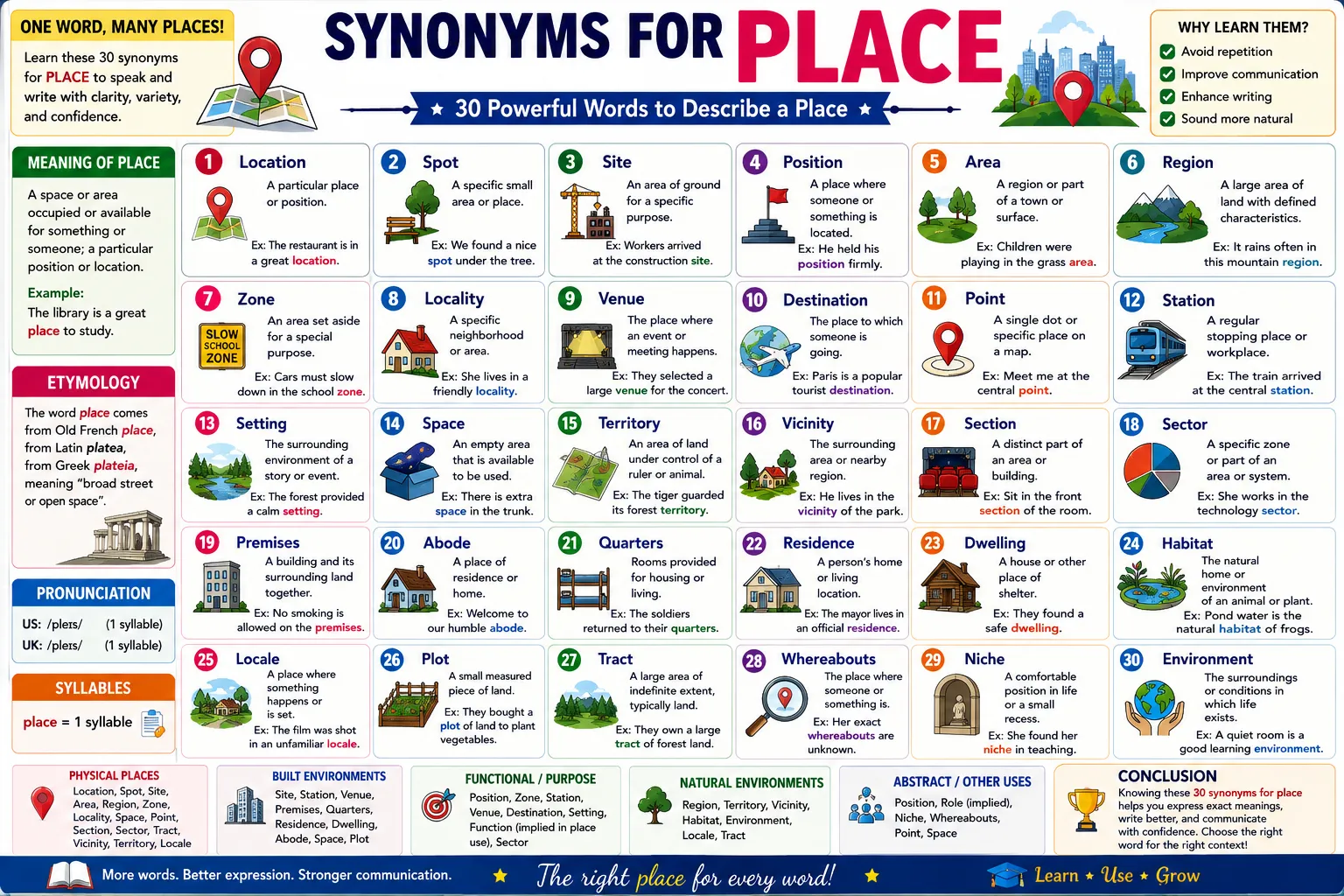
The word place refers to a specific spot, area, position, or building. Imagine pointing your finger at a pin on a map to show where you live that exact spot is a place. We synonyms for place every day because locations, homes, roles, and spaces are everywhere around us. Learning new synonyms for place helps English learners and writers describe locations clearly. Also avoid using the same word again and again. This guide explains the meaning, history, pronunciation, grammar, and thirty useful synonyms for place, with simple examples and helpful categories.
Meaning of Place
Definition
Place (Noun / Verb): A particular position, point, spot, building, or area in space; as a verb, to put something in a specific position.
Examples
- We found a quiet place in the park to read.
- Please place your book on the wooden desk.
Connotative Meaning
- Positive tone: Implies comfort, safety, home, belonging, or achievement (such as “first place”).
- Negative tone: Can suggest feeling trapped, restricted to a spot, or out of position.
- Neutral tone: Simply points out a physical location, geographical point, or order in a list.
Etymology
- Source language: The word place comes from Old French place. It can be traced back to Latin and Greek words meaning a broad street or open space.
- Old English (450–1100): People used words such as stow and stede to talk about a spot or location.
- Middle English (1100–1500): The word place became common for an open area, square, or position.
- Modern English (1500–Present): The meaning of place grew. Today, it can mean a physical spot, a home, a job or role, a position in a competition. The act of putting something somewhere.
Pronunciation
- US: /pleɪs/
- UK: /pleɪs/
Syllables
place (1 part)
Affixation Pattern of Place
- Root: Place
- Prefix: Dis- (Displace), Re- (Replace), Mis- (Misplace)
- Suffix: -ment (Placement), -less (Placeless)
- Word Formation:
- Noun: Place / Placement
- Verb: Place / Displace / Replace / Misplace
- Adjective: Placeless / Placed
- Adverb: In-place
Discover more about https://synonymhunting.com/synonyms-for-approach/
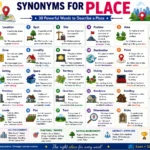
Synonyms for Place
1. Location (Noun) — US: /loʊˈkeɪʃən/ | UK: /ləʊˈkeɪʃn/
Meaning: A particular place or position.
Examples:
The restaurant is in a great location.
Pin your exact location on the map.
2. Spot (Noun) — US: /spɑːt/ | UK: /spɒt/
Meaning: A specific small area or place.
Examples:
This is my favorite spot for lunch.
We found a nice spot under the tree.
3. Site (Noun) — US: /saɪt/ | UK: /saɪt/
Meaning: An area of ground set aside for a specific purpose or building.
Examples:
Workers arrived at the construction site.
They visited the historical site yesterday.
4. Position (Noun) — US: /pəˈzɪʃən/ | UK: /pəˈzɪʃn/
Meaning: A place where someone or something is located or put.
Examples:
The guard stayed in his position all night.
She adjusted the position of the chair.
5. Area (Noun) — US: /ˈɛriə/ | UK: /ˈeəriə/
Meaning: A region or part of a town, country, or surface.
Examples:
Children were playing in the grass area.
This area is known for great food.
6. Region (Noun) — US: /ˈriːdʒən/ | UK: /ˈriːdʒən/
Meaning: A large area of land with defined characteristics.
Examples:
It rains often in this mountain region.
The region produces fresh fruits every summer.
7. Zone (Noun) — US: /zoʊn/ | UK: /zəʊn/
Meaning: An area set aside for a special purpose.
Examples:
Cars must slow down in the school zone.
This quiet zone is for reading only.
8. Locality (Noun) — US: /loʊˈkæləti/ | UK: /ləʊˈkæləti/
Meaning: A specific neighborhood or area.
Examples:
Many trees grow in this locality.
She lives in a friendly locality.
9. Venue (Noun) — US: /ˈvɛnjuː/ | UK: /ˈvenjuː/
Meaning: The place where an event or meeting happens.
Examples:
The hall is a wonderful venue for weddings.
They selected a large venue for the concert.
10. Destination (Noun) — US: /ˌdɛstəˈneɪʃən/ | UK: /ˌdestɪˈneɪʃn/
Meaning: The place to which someone or something is going.
Examples:
We reached our beach destination at noon.
Paris is a popular tourist destination.
11. Point (Noun) — US: /pɔɪnt/ | UK: /pɔɪnt/
Meaning: A single dot or specific place on a surface or map.
Examples:
Meet me at the central point of the park.
X marks the point on the map.
12. Station (Noun) — US: /ˈsteɪʃən/ | UK: /ˈsteɪʃn/
Meaning: A regular stopping place or assigned workplace.
Examples:
The train arrived at the central station.
The firefighter rushed back to the station.
13. Setting (Noun) — US: /ˈsɛtɪŋ/ | UK: /ˈsetɪŋ/
Meaning: The surrounding environment or location of a story or event.
Examples:
The forest provided a calm setting for the cabin.
The novel has a historical setting.
14. Space (Noun) — US: /speɪs/ | UK: /speɪs/
Meaning: An empty area that is available to be used.
Examples:
There is extra space in the trunk.
We need a large space for the party.
15. Territory (Noun) — US: /ˈtɛrəˌtɔːri/ | UK: /ˈterətri/
Meaning: An area of land under the control of a ruler or animal.
Examples:
The tiger guarded its forest territory.
Explorers mapped out the unknown territory.
16. Vicinity (Noun) — US: /vəˈsɪnəti/ | UK: /vəˈsɪnəti/
Meaning: The surrounding area or nearby region.
Examples:
There are no stores in the immediate vicinity.
He lives in the vicinity of the park.
17. Section (Noun) — US: /ˈsɛkʃən/ | UK: /ˈsekʃn/
Meaning: A distinct part of an area or building.
Examples:
Sit in the front section of the room.
The produce section has fresh apples.
18. Sector (Noun) — US: /ˈsɛktər/ | UK: /ˈsektə/
Meaning: A specific zone or part of an area or system.
Examples:
Patrol boats searched the northern sector.
She works in the technology sector.
19. Premises (Noun) — US: /ˈprɛməsəz/ | UK: /ˈpremɪsɪz/
Meaning: A building and its surrounding land together.
Examples:
No smoking is allowed on the premises.
Guards patrol the factory premises.
20. Abode (Noun) — US: /əˈboʊd/ | UK: /əˈbəʊd/
Meaning: A place of residence or home.
Examples:
Welcome to our humble abode.
He built a cozy abode in the woods.
21. Quarters (Noun) — US: /ˈkwɔːrtərz/ | UK: /ˈkwɔːtəz/
Meaning: Rooms provided for housing or living.
Examples:
The soldiers returned to their quarters.
She stayed in the guest quarters.
22. Residence (Noun) — US: /ˈrɛzədəns/ | UK: /ˈrezɪdəns/
Meaning: A person’s home or living location.
Examples:
The mayor lives in an official residence.
This building is a private residence.
23. Dwelling (Noun) — US: /ˈdwɛlɪŋ/ | UK: /ˈdwelɪŋ/
Meaning: A house, flat, or other place of shelter.
Examples:
The ancient dwelling was built of stone.
They found a safe dwelling for the night.
24. Habitat (Noun) — US: /ˈhæbəˌtæt/ | UK: /ˈhæbɪtæt/
Meaning: The natural home or environment of an animal or plant.
Examples:
Pond water is the natural habitat of frogs.
Forest destruction threatens wild animal habitats.
25. Locale (Noun) — US: /loʊˈkæl/ | UK: /ləʊˈkɑːl/
Meaning: A place where something happens or is set.
Examples:
The film was shot in an unfamiliar locale.
This quiet village is a peaceful locale.
26. Plot (Noun) — US: /plɑːt/ | UK: /plɒt/
Meaning: A small measured piece of land.
Examples:
They bought a plot of land to plant vegetables.
The house sits on a large plot.
27. Tract (Noun) — US: /trækt/ | UK: /trækt/
Meaning: An area of indefinite extent, typically a large stretch of land.
Examples:
They own a large tract of forest land.
The desert tract stretched for miles.
28. Whereabouts (Noun) — US: /ˈwɛrəˌbaʊts/ | UK: /ˈweərəbaʊts/
Meaning: The place where someone or something is.
Examples:
The police questioned his current whereabouts.
Her exact whereabouts remain unknown.
29. Niche (Noun) — US: /nɪtʃ/ | UK: /niːʃ/
Meaning: A comfortable or suitable position in life or employment; a small recess spot.
Examples:
She found her niche in teaching young children.
He placed a statue in the wall niche.
30. Environment (Noun) — US: /ɪnˈvaɪrənmənt/ | UK: /ɪnˈvaɪrənmənt/
Meaning: The surroundings or conditions in which a person, animal, or plant lives.
Examples:
Clean water creates a healthy environment.
A quiet room is a good learning environment.
Prototype Meaning
When people hear the word place, they usually think of a spot where someone or something can be. It could be a cozy room, a spot on a map, or a seat at a table. In simple words, place means a particular spot, area, or location.
Prototype Categorization
- Exact Points & Locations: Location, Spot, Site, Position, Point, Station, Destination, Whereabouts.
- General Areas & Regions: Area, Region, Zone, Locality, Sector, Section, Territory, Vicinity, Tract, Plot.
- Homes & Living Spaces: Abode, Quarters, Residence, Dwelling, Habitat, Premises.
- Surroundings & Event Settings: Venue, Setting, Locale, Space, Environment, Niche.
Antonyms of Place
- Nowhere
- Nonexistence
- Void
- Space (outer space)
- Displacement
- Absence
Short Questions and Answers
- What does place mean?
- It means a particular spot, position, location, area, or home.
- When should place be used?
- Use place when talking about a spot, area, home, city, or where something is put.
- Is place positive or negative?
- Place is usually neutral. It can sound positive when talking about a happy home, a safe place, or a good position.
- How is place different from location?
- Place is a common word for where something or someone is. Location is more specific and usually means the exact position of something.
Conclusion
Synonyms for place helps you grow your word bank. It makes your writing and talking more clear and interesting. Synonyms for place helps you use different words instead of the same one again and again. It also helps you feel more sure when you speak English. Try to learn one new word from this list each day. Small steps like this help you grow a lot over time.

I’m Zahid Abbas, an educator, researcher, and digital publishing strategist with a passion for linguistics, grammar, and clear communication. As a content creator and SEO specialist, I craft research-driven, reader-focused content that empowers learners and makes knowledge accessible worldwide.