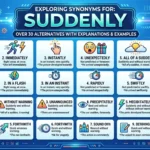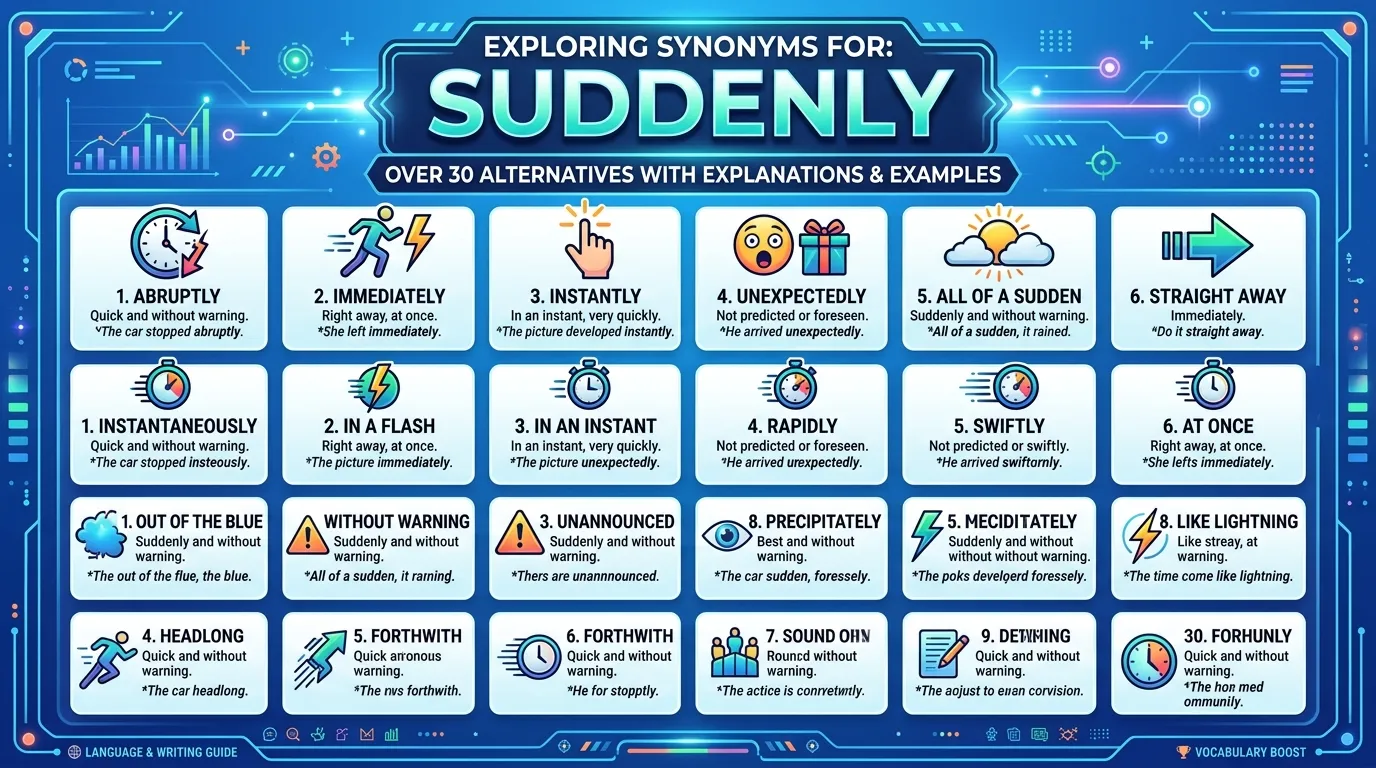
The word suddenly means that something happens quickly and without warning. Imagine walking under a clear blue sky when lightning suddenly flashes. The quick and unexpected event happens suddenly. We use synonyms for suddenly when something surprises us or happens very quickly. Learning synonyms for suddenly helps learners and writers describe events in different ways. And also avoid using the same word again and again. This guide explains the meaning, history, pronunciation, grammar, and thirty useful synonyms for suddenly with examples and easy categories.
Meaning of Suddenly
Definition
Suddenly (Adverb): Quickly and unexpectedly; taking place without warning or preparation.
Examples
- The lights went out suddenly during the storm.
- She suddenly remembered where she left her keys.
Connotative Meaning
- Positive tone: Represents exciting surprises, instant brilliant ideas, or quick relief.
- Negative tone: Implies alarming shocks, abrupt disruptions, or sudden dangers.
- Neutral tone: Simply describes an action happening fast without advance notice.
Etymology
- Source language: Suddenly comes from Old French and Latin words meaning sudden, quick, or unexpected.
- Old English (450–1100): Early English used words such as færlice to mean suddenly or unexpectedly.
- Middle English (1100–1500): The word developed into forms such as sodenly, meaning without warning.
- Modern English (1500–Present): Suddenly became a common English word used in stories, news, science, and everyday speech to describe something that happens quickly and without warning.
Pronunciation
- US: /ˈsʌdənli/
- UK: /ˈsʌdnli/
Syllables
sud-den-ly (3 parts)
Affixation Pattern of Suddenly
- Root: Sudden (adjective)
- Prefix: None
- Suffix: -ly (adverb maker meaning “in a specified manner”)
- Word Formation:
- Noun: Suddenness
- Adjective: Sudden
- Adverb: Suddenly
Explore more about https://synonymhunting.com/synonyms-for-suggests/
Synonyms for Suddenly
1. Abruptly (Adverb) — US: /əˈbrʌptli/ | UK: /əˈbrʌptli/
Meaning: In a sudden, unexpected, or brief manner.
Examples:
The car stopped abruptly at the red light.
He ended the phone call abruptly.
2. Unexpectedly (Adverb) — US: /ˌʌnɪkˈspɛktɪdli/ | UK: /ˌʌnɪkˈspektɪdli/
Meaning: In a way that was not anticipated or planned.
Examples:
Old friends arrived unexpectedly at our door.
The weather turned cold unexpectedly.
3. All at once (Adverbial Phrase) — US: /ɔːl æt wʌns/ | UK: /ɔːl æt wʌns/
Meaning: Happening suddenly and completely in a single moment.
Examples:
All at once, the crowd started cheering.
The rain came down all at once.
4. Out of nowhere (Adverbial Phrase) — US: /aʊt ʌv ˈnoʊˌwɛr/ | UK: /aʊt əv ˈnəʊweə/
Meaning: Appearing suddenly without any prior warning.
Examples:
A stray dog ran out out of nowhere.
The idea popped into her head out of nowhere.
5. Instantly (Adverb) — US: /ˈɪnstəntli/ | UK: /ˈɪnstəntli/
Meaning: At once; immediately.
Examples:
The water boiled instantly on the hot burner.
They became best friends instantly.
6. Immediately (Adverb) — US: /ɪˈmiːdiətli/ | UK: /ɪˈmiːdiətli/
Meaning: Without any delay or intervening time.
Examples:
Please respond to the message immediately.
She answered the door immediately.
7. Out of the blue (Adverbial Phrase) — US: /aʊt ʌv ðə bluː/ | UK: /aʊt əv ðə bluː/
Meaning: Completely unexpectedly and without warning.
Examples:
She called me out of the blue after five years.
The storm hit out of the blue.
8. In an instant (Adverbial Phrase) — US: /ɪn æn ˈɪnstənt/ | UK: /ɪn æn ˈɪnstənt/
Meaning: In a very short time; right away.
Examples:
Everything changed in an instant.
He solved the problem in an instant.
9. In a flash (Adverbial Phrase) — US: /ɪn ə flæʃ/ | UK: /ɪn ə flæʃ/
Meaning: Extremely quickly; as fast as a spark of light.
Examples:
The cat dashed up the tree in a flash.
Summer passed by in a flash.
10. Promptly (Adverb) — US: /ˈprɑːmptli/ | UK: /ˈprɒmptli/
Meaning: Without delay; quickly at the right time.
Examples:
The bus arrived promptly at eight o’clock.
She paid the bill promptly.
11. Swiftly (Adverb) — US: /ˈswɪftli/ | UK: /ˈswɪftli/
Meaning: Moving with great speed and smooth action.
Examples:
The bird flew swiftly across the sky.
He swiftly packed his bag and left.
12. Rapidly (Adverb) — US: /ˈræpɪdli/ | UK: /ˈræpɪdli/
Meaning: Fast or at a high rate of speed.
Examples:
The river was flowing rapidly after the rain.
Technology is growing rapidly.
13. Sharply (Adverb) — US: /ˈʃɑːrpli/ | UK: /ˈʃɑːpli/
Meaning: With a sudden and clear change in direction or level.
Examples:
The road turned sharply to the left.
Prices rose sharply last month.
14. Precipitously (Adverb) — US: /prɪˈsɪpɪtəsli/ | UK: /prɪˈsɪpɪtəsli/
Meaning: Very suddenly and steeply.
Examples:
The trail dropped off precipitously at the cliff edge.
Temperatures fell precipitously overnight.
15. Unawares (Adverb) — US: /ˌʌnəˈwɛrz/ | UK: /ˌʌnəˈweəz/
Meaning: Without warning; by surprise.
Examples:
The sudden question caught him unawares.
The loud noise took us unawares.
16. Without warning (Adverbial Phrase) — US: /wɪˈðaʊt ˈwɔːrnɪŋ/ | UK: /wɪˈðaʊt ˈwɔːnɪŋ/
Meaning: With no previous sign or caution given.
Examples:
The branch snapped without warning.
The alarm rang without warning.
17. On the spur of the moment (Adverbial Phrase) — US: /ɑːn ðə spɜːr ʌv ðə ˈmoʊmənt/ | UK: /ɒn ðə spɜːr əv ðə ˈməʊmənt/
Meaning: On a sudden impulse without planning ahead.
Examples:
We decided to travel on the spur of the moment.
He bought the ticket on the spur of the moment.
18. At short notice (Adverbial Phrase) — US: /æt ʃɔːrt ˈnoʊtɪs/ | UK: /æt ʃɔːt ˈnəʊtɪs/
Meaning: With little time given for preparation.
Examples:
She organized the meeting at short notice.
They left town at short notice.
19. Overnight (Adverb) — US: /ˌoʊvərˈnaɪt/ | UK: /ˌəʊvəˈnaɪt/
Meaning: Happening during the night or very quickly in a single day.
Examples:
The town became famous almost overnight.
Snow covered the ground overnight.
20. Offhand (Adverb) — US: /ˌɔːfˈhænd/ | UK: /ˌɒfˈhænd/
Meaning: Without previous thought or preparation.
Examples:
I cannot give you the exact number offhand.
He answered the question offhand.
21. Straightaway (Adverb) — US: /ˌstreɪtəˈweɪ/ | UK: /ˌstreɪtəˈweɪ/
Meaning: Immediately; right now.
Examples:
You should start your work straightaway.
He left the office straightaway.
22. Impulsively (Adverb) — US: /ɪmˈpʌlsɪvli/ | UK: /ɪmˈpʌlsɪvli/
Meaning: Acting on a sudden wish or impulse without thinking carefully.
Examples:
She bought the dress impulsively.
He spoke impulsively and regretted it later.
23. Headlong (Adverb) — US: /ˈhɛdˌlɔːŋ/ | UK: /ˈhedlɒŋ/
Meaning: With great speed and without deliberation.
Examples:
They rushed headlong into the game.
The child ran headlong down the hill.
24. Unpreparedly (Adverb) — US: /ˌʌnprɪˈpɛrədli/ | UK: /ˌʌnprɪˈpeədli/
Meaning: In a manner that lacks advance readiness.
Examples:
The team was caught unpreparedly by the sudden strategy change.
He entered the room unpreparedly for the news.
25. Spontaneously (Adverb) — US: /spɑːnˈteɪniəsli/ | UK: /spɒnˈteɪniəsli/
Meaning: Performed or occurring as a result of a sudden inner impulse.
Examples:
The audience broke into applause spontaneously.
We took a spontaneously planned road trip.
26. In the twinkling of an eye (Adverbial Phrase) — US: /ɪn ðə ˈtwɪŋklɪŋ ʌv æn aɪ/ | UK: /ɪn ðə ˈtwɪŋklɪŋ əv æn aɪ/
Meaning: In an extremely short space of time.
Examples:
The magic trick was finished in the twinkling of an eye.
He disappeared in the twinkling of an eye.
27. Summary-like (Adverbial) — US: /ˈsʌməri laɪk/ | UK: /ˈsʌməri laɪk/
Meaning: Done quickly and without formal procedure.
Examples:
The judgment was delivered in a summary-like fashion.
They made a summary-like dismissal of the complaint.
28. Peremptorily (Adverb) — US: /pəˈrɛmptərəli/ | UK: /pəˈremptərəli/
Meaning: Leaving no opportunity for denial or refusal; commandingly sudden.
Examples:
The officer ordered them out peremptorily.
She closed the debate peremptorily.
29. Extemporaneously (Adverb) — US: /ɪkˌstɛmpəˈreɪniəsli/ | UK: /ɪkˌstempəˈreɪniəsli/
Meaning: Spoken or done without preparation.
Examples:
He gave his speech extemporaneously when called upon.
She answered the questions extemporaneously.
30. Unforeseenly (Adverb) — US: /ˌʌnfɔːrˈsiːnli/ | UK: /ˌʌnfɔːˈsiːnli/
Meaning: In a way that was not predicted or seen in advance.
Examples:
Costs increased unforeseenly during the project.
Events developed unforeseenly that afternoon.
Prototype Meaning
When people hear suddenly, they often think of something happening very quickly and without warning. For example, a balloon may pop, a door may suddenly close, or a light may flash in a dark room.
Prototype Categorization
- Very Fast: Instantly, Immediately, In an instant, In a flash, Straightaway, Rapidly, Swiftly.
- Without Warning: Unexpectedly, Out of nowhere, Out of the blue, Unawares, Without warning, Unforeseenly.
- Quick and Abrupt: Abruptly, All at once, Sharply, Precipitously, Peremptorily.
- Without Planning: On the spur of the moment, Impulsively, Spontaneously, Offhand, Headlong, At short notice, Overnight, Promptly.
Antonyms of Suddenly
- Gradually
- Slowly
- Eventually
- Deliberately
- Predictably
- Step-by-step
Short Questions and Answers
- What does suddenly mean?
- It means quickly and unexpectedly, taking place without prior warning.
- When should suddenly be used? Use suddenly when something happens quickly and without warning.
- Is suddenly positive or negative? It can be positive, negative, or neutral, depending on the situation. It can describe a happy surprise, a sudden problem, or a quick action.
- How is suddenly different from gradually?
- Suddenly happens all at once in a quick moment, while gradually happens slowly over a long period.
Conclusion
Synonyms for suddenly helps you describe unexpected events in a clear way. Words like unexpectedly, abruptly, instantly, and all at once can make your writing more natural and expressive. Choosing the synonyms for suddenly helps English learners build stronger vocabulary. And also helps content writers make their sentences more engaging. By using synonyms for suddenly correctly, you can improve both your writing and speaking skills. English learners and content writers can improve their vocabulary, writing, and speaking skills by learning synonyms for suddenly.

I’m Zahid Abbas, an educator, researcher, and digital publishing strategist with a passion for linguistics, grammar, and clear communication. As a content creator and SEO specialist, I craft research-driven, reader-focused content that empowers learners and makes knowledge accessible worldwide.