The word resilient means being strong enough to bounce back after a tough time or hard challenge. Imagine bending a plastic ruler down with your fingers. When you let go, it pops right back up to its straight shape. That ability to bend without breaking and bounce back strong is what we call resilient.
We use synonyms for resilient to describe brave sports teams, strong plants. Also children who keep trying even after making mistakes. Learning new ways to say resilient helps learners make their story writing descriptive.
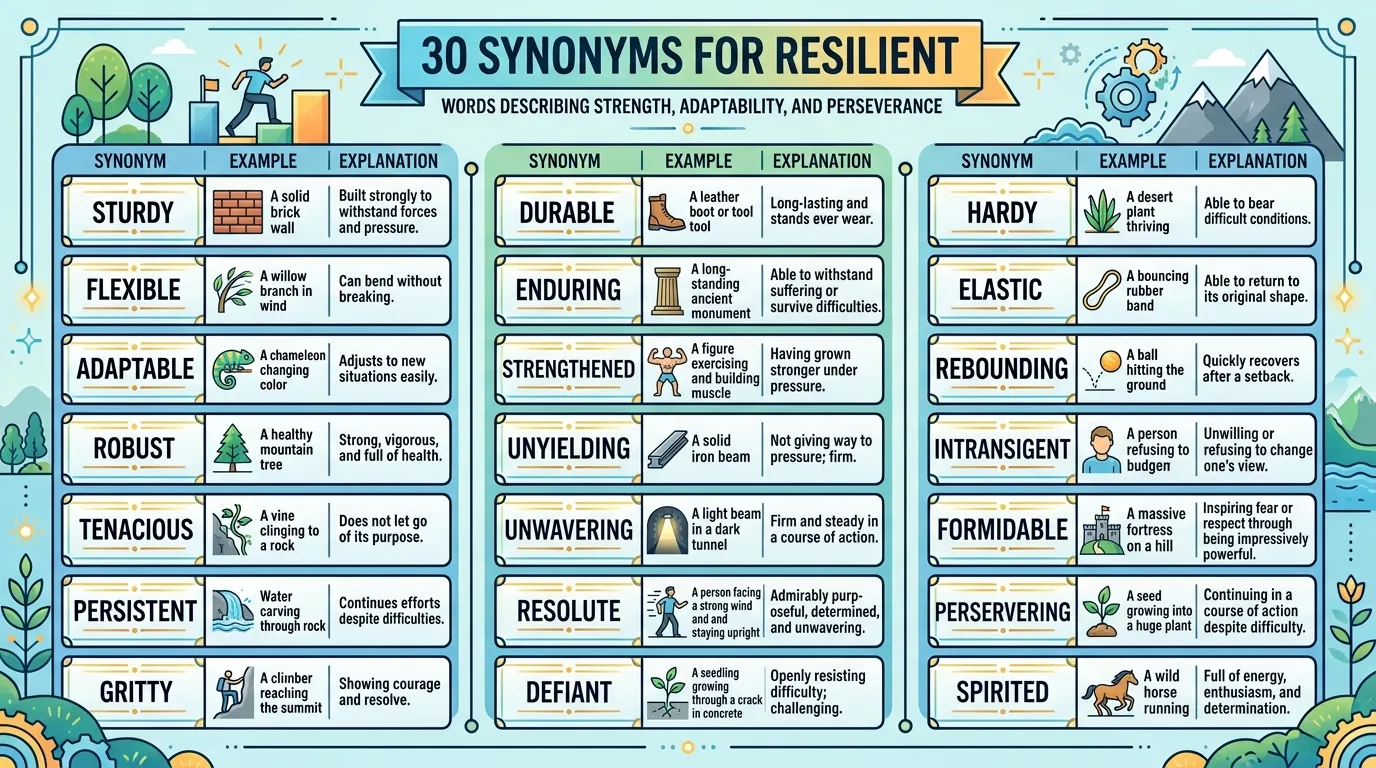
This guide gives you 30 simple synonyms for resilient. Along with easy sentences, word origins, pronunciation guides, and clear categories.
Meaning of Resilient
Definition
Resilient (Adjective): Able to withstand or recover quickly from difficult conditions.
Examples
- The resilient team won the match after losing early in the game.
- Plants in the desert are resilient against hot weather.
Connotative Meaning
- Positive tone: Shows strength, bravery, perseverance, and high energy.
- Negative tone: Can sometimes mean feeling stiff or refusal to change plans.
- Neutral tone: Describes an object returning to its normal state after pressure.
Etymology
- Source language: Came from Latin roots long ago.
- Latin Prefix: Re- (means back or again).
- Latin Root: Salire (means to leap or jump).
- Modern English: Literally means leaping back up after falling down!
Pronunciation
- US: /rɪˈzɪliənt/
- UK: /rɪˈzɪliənt/
Syllables
re-sil-i-ent (4 parts)
Affixation Pattern of Resilient
- Root: Sili (means to jump or bounce)
- Prefix: Re- (means back)
- Suffix: -ent (makes an adjective)
- Word Formation:
- Noun: Resilience / Resiliency
- Adjective: Resilient
- Adverb: Resiliently
Also read more about https://synonymhunting.com/synonyms-for-simultaneously/
Synonyms for Resilient
1. Strong (Adjective) — US: /strɔːŋ/ | UK: /strɒŋ/
Meaning: Having power and toughness to face hard things.
Examples:
She is a strong girl who never gives up easily.
The strong tower stood during the storm.
2. Tough (Adjective) — US: /tʌf/ | UK: /tʌf/
Meaning: Able to endure hard work, pain, or difficulties.
Examples:
The tough boots stayed clean in the deep mud.
He showed a tough spirit during the long race.
3. Adaptable (Adjective) — US: /əˈdæptəbl/ | UK: /əˈdæptəbl/
Meaning: Able to change easily to fit new conditions.
Examples:
An adaptable student feels comfortable in a new class.
Animals in the woods are very adaptable.
4. Flexible (Adjective) — US: /ˈflɛksəbl/ | UK: /ˈflekəbl/
Meaning: Able to bend easily without snapping or breaking.
Examples:
The flexible branch did not snap in high winds.
She stayed flexible when our game plan changed.
5. Hardy (Adjective) — US: /ˈhɑːrdi/ | UK: /ˈhɑːdi/
Meaning: Strong enough to live through cold, heat, or hard times.
Examples:
These hardy flowers bloom even in winter cold.
The hardy hikers reached the top of the mountain.
6. Durable (Adjective) — US: /ˈdʊrəbl/ | UK: /ˈdjʊərəbl/
Meaning: Staying strong and in good condition for a long time.
Examples:
My backpack is made of durable cloth.
These durable toys do not break when dropped.
7. Bouncy (Adjective) — US: /ˈbaʊnsi/ | UK: /ˈbaʊnsi/
Meaning: Jumping back quickly after hitting a surface.
Examples:
We played with a bouncy rubber ball.
He has a cheerful and bouncy walk today.
8. Sturdy (Adjective) — US: /ˈstɜːrdi/ | UK: /ˈstɜːdi/
Meaning: Firmly built and not easily damaged.
Examples:
We sat at a sturdy wooden dining table.
The sturdy bridge held all the heavy cars safely.
9. Unstoppable (Adjective) — US: /ˌʌnˈstɑːpəbl/ | UK: /ˌʌnˈstɒpəbl/
Meaning: Not able to be stopped or turned back.
Examples:
The runner showed unstoppable speed near the finish line.
Her positive attitude made her unstoppable.
10. Springy (Adjective) — US: /ˈsprɪŋi/ | UK: /ˈsprɪŋi/
Meaning: Returning quickly to shape after being pushed down.
Examples:
The bed had a comfortable, springy mattress.
We walked on green, springy grass in the park.
11. Persistent (Adjective) — US: /pərˈsɪstənt/ | UK: /pəˈsɪstənt/
Meaning: Continuing to try hard even when things get difficult.
Examples:
The persistent boy kept trying until he solved the math puzzle.
Her persistent efforts earned her an award.
12. Brave (Adjective) — US: /breɪv/ | UK: /breɪv/
Meaning: Ready to face danger or hardship without showing fear.
Examples:
The brave firefighter saved the scared cat.
Be brave when trying something brand new!
13. Elastic (Adjective) — US: /ɪˈlæstɪk/ | UK: /ɪˈlæstɪk/
Meaning: Able to stretch out and snap right back into place.
Examples:
The elastic band snapped back onto the paper stack.
His muscles were elastic and ready to jump.
14. Unshakable (Adjective) — US: /ˌʌnˈʃeɪkəbl/ | UK: /ˌʌnˈʃeɪkəbl/
Meaning: So strong that nothing can destroy your confidence.
Examples:
She has an unshakable smile even on hard days.
Their team showed unshakable trust in each other.
15. Indomitable (Adjective) — US: /ɪnˈdɑːmɪtəbl/ | UK: /ɪnˈdɒmɪtəbl/
Meaning: Having a brave spirit that cannot be defeated.
Examples:
The team won thanks to their indomitable spirit.
He showed an indomitable desire to learn.
16. Rugged (Adjective) — US: /ˈrʌɡɪd/ | UK: /ˈrʌɡɪd/
Meaning: Strong, rough, and built to survive wild places.
Examples:
We drove a rugged jeep up the stony path.
The mountain goat is a rugged animal.
17. Determined (Adjective) — US: /dɪˈtɜːrmɪnd/ | UK: /dɪˈtɜːmɪnd/
Meaning: Making a firm choice to finish something no matter what.
Examples:
She was determined to read every book on the shelf.
A determined student practices spelling daily.
18. Solid (Adjective) — US: /ˈsɑːlɪd/ | UK: /ˈsɒlɪd/
Meaning: Hard, reliable, and strong all the way through.
Examples:
The wall was made of solid red bricks.
He gave a solid performance during the music recital.
19. Firm (Adjective) — US: /fɜːrm/ | UK: /fɜːm/
Meaning: Strong, steady, and not easily moved.
Examples:
He kept a firm grip on his dog’s leash.
She gave a firm handshake to her new classmate.
20. Tireless (Adjective) — US: /ˈtaɪərləs/ | UK: /ˈtaɪələs/
Meaning: Working hard without getting worn out or quitting.
Examples:
Our teacher gave tireless help during art class.
The tireless ants collected food for winter.
21. Tenacious (Adjective) — US: /təˈneɪʃəs/ | UK: /təˈneɪʃəs/
Meaning: Holding on tight to a goal without letting go.
Examples:
The puppy gave a tenacious pull on the rope toy.
She is a tenacious reader who finishes long books.
22. Unyielding (Adjective) — US: /ʌnˈjiːldɪŋ/ | UK: /ʌnˈjiːldɪŋ/
Meaning: Standing completely firm without giving up or bending.
Examples:
The unyielding shield protected the knight.
His unyielding focus helped him win the chess game.
23. Robust (Adjective) — US: /roʊˈbʌst/ | UK: /rəʊˈbʌst/
Meaning: Full of health, strength, and power.
Examples:
Eating vegetables keeps your body robust and healthy.
The tree had a robust trunk that held high branches.
24. Steadfast (Adjective) — US: /ˈstɛdfæst/ | UK: /ˈstedfɑːst/
Meaning: Staying loyal, steady, and constant in hard times.
Examples:
A steadfast friend stays by your side when you are sad.
He remained steadfast in doing his chores.
25. Undaunted (Adjective) — US: /ˌʌnˈdɔːntɪd/ | UK: /ˌʌnˈdɔːntɪd/
Meaning: Not discouraged or scared by a big challenge.
Examples:
Undaunted by the rain, the kids kept playing soccer.
She stood undaunted before the big crowd.
26. Persistent (Steady) (Adjective) — US: /pərˈsɪstənt/ | UK: /pəˈsɪstənt/
Meaning: Keeping up steady action without stopping.
Examples:
The persistent sound of rain helped me fall asleep.
With persistent training, he ran faster every day.
27. Iron-willed (Adjective Phrase) — US: /ˈaɪərn ˈwɪld/ | UK: /ˈaɪən ˈwɪld/
Meaning: Having a mind as strong as metal that won’t give in.
Examples:
An iron-willed leader guided the ship through the storm.
She showed an iron-willed focus during spelling bee practice.
28. Irrepressible (Adjective) — US: /ˌɪrɪˈprɛsəbl/ | UK: /ˌɪrɪˈpresəbl/
Meaning: So full of energy and cheer that nothing can keep you down.
Examples:
His irrepressible cheer brightened up our gloomy day.
She brought an irrepressible smile to the stage.
29. Unwavering (Adjective) — US: /ʌnˈweɪvərɪŋ/ | UK: /ʌnˈweɪvərɪŋ/
Meaning: Staying completely steady without shaking or changing.
Examples:
Thanks to her family’s unwavering support, she felt brave.
He kept an unwavering glare on the goal post.
30. Unfazed (Adjective) — US: /ˌʌnˈfeɪzd/ | UK: /ˌʌnˈfeɪzd/
Meaning: Not worried, nervous, or bothered by surprises.
Examples:
The cat sat unfazed when the loud dog barked.
She looked unfazed by the difficult test question.
Prototype Meaning
When children hear resilient, they picture a strong rubber ball bouncing right back up off the ground. A tiny green sprout pushing up through hard concrete to grow in the sun.
Prototype Categorization
- Everyday Toughness & Strength: Strong, Tough, Hardy, Durable, Sturdy, Solid, Robust.
- Bouncing Back & Stretching: Adaptable, Flexible, Bouncy, Springy, Elastic.
- Courage & Bravery: Brave, Unstoppable, Unshakable, Indomitable, Undaunted, Irrepressible, Unfazed.
- Never Giving Up: Persistent, Determined, Tireless, Tenacious, Unyielding, Steadfast, Iron-willed, Unwavering.
- Rough & Outdoor Power: Rugged, Firm, Persistent (Steady).
Antonyms of Resilient
- Fragile
- Weak
- Delicate
- Easily broken
- Sensitive
- Vulnerable
Short Questions and Answers
- What does resilient mean?
- It means being able to bounce back quickly after facing a hard time, mistake, or pressure.
- When should I use resilient?
- Use it when writing about brave heroes, sturdy nature, bounce-back materials, or people who try again after failing.
- Is resilient a positive word?
- Yes! It is a wonderful positive word that praises strength, power, and courage.
- How is resilient different from strong?
- Strong means having power right now, while resilient specifically means having the power to bounce back after getting hurt or knocked down.
Conclusion
Synonyms for resilient can help you describe people, things, and situations that can recover from problems and keep going. Words such as strong, tough, durable, adaptable, flexible, persistent, and hardy can add variety to your English. Each synonym has a slightly different meaning, so learning them helps you choose the best word for each situation. For English learners, synonyms for resilient can improve writing, speaking, reading, and everyday communication. They also help you avoid repeating the same word. Try using a few synonyms for resilient in simple sentences each day. With regular practice, you can build a stronger vocabulary. Express your ideas more clearly, and speak English with greater confidence.

I’m Zahid Abbas, an educator, researcher, and digital publishing strategist with a passion for linguistics, grammar, and clear communication. As a content creator and SEO specialist, I craft research-driven, reader-focused content that empowers learners and makes knowledge accessible worldwide.