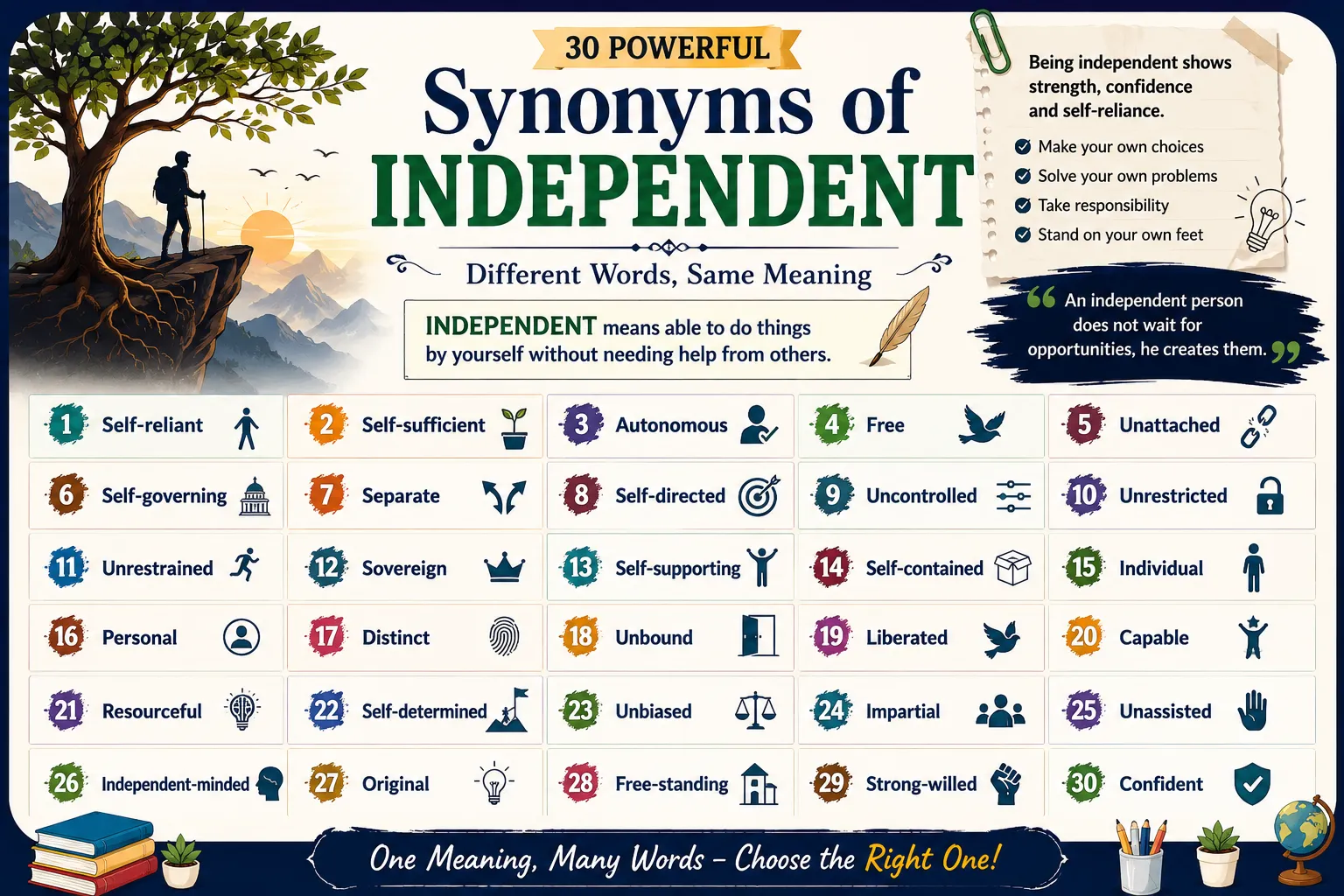
Independent means being able to do things by yourself without needing help from others. For example, a child who packs a school bag, finishes homework, and gets ready for school alone is becoming independent. We often use this word when talking about people, countries, ideas, and actions. Learning synonyms for independent helps English learners use different words and avoid repeating the same word. It also helps students and content writers make their sentences clearer and more interesting. In this article, you will learn 30 useful synonyms for independent. Each word includes a simple meaning, US and UK pronunciation, and easy examples. You will also learn about the word’s tone, history, word formation, meaning groups, antonyms, and common usage. All explanations and examples are written in simple English.
Meaning of Independent
Definition
Independent (Adjective): Able to do things by yourself without needing help from others.
Examples
- Ali is independent and can pack his school bag.
- She became more independent as she grew older.
Connotative Meaning
- Positive tone: Strong, confident, responsible, and able to help yourself.
- Negative tone: It can sometimes suggest that someone does not want help from others.
- Neutral tone: Simply able to work or act without depending on someone else.
Etymology
- Independent comes from Latin roots through French.
- It is made from in-, meaning “not,” and dependent, meaning “relying on someone or something.”
- So, independent means “not depending on others.”
Short History
- Old English (450–1100): The modern word independent was not commonly used in Old English.
- Middle English (1100–1500): French and Latin words became more common in English.
- Modern English (1500–Present): Independent became widely used for people, countries, ideas, and groups that can act on their own.
Pronunciation
US: /ˌɪndɪˈpendənt/ UK: /ˌɪndɪˈpendənt/
Syllables
in-de-pend-ent
Affixation Pattern of Independent
- Root: depend
- Prefix: in- — means “not”
- Suffix: -ent — helps form an adjective
- Word formation: depend → dependent → independent
- Grammatical categories: depend (verb), dependent (adjective/noun), independence (noun), independently (adverb), independent (adjective/noun).
Synonyms of Independent
1. Self-Reliant (Adjective) — US /ˌself rɪˈlaɪənt/ | UK /ˌself rɪˈlaɪənt/
Meaning: Able to take care of yourself without much help.
Examples:
- Maya is self-reliant and does her homework alone.
- He is becoming more self-reliant every day.
2. Self-Sufficient (Adjective) — US /ˌself səˈfɪʃənt/ | UK /ˌself səˈfɪʃənt/
Meaning: Able to provide what you need by yourself.
Examples:
- The family grows food and is quite self-sufficient.
- The small farm is almost self-sufficient.
3. Autonomous (Adjective) — US /ɔːˈtɑːnəməs/ | UK /ɔːˈtɒnəməs/
Meaning: Able to make your own choices and decisions.
Examples:
- The group is autonomous and makes its own rules.
- The children were given an autonomous role in the project.
4. Free (Adjective) — US /friː/ | UK /friː/
Meaning: Able to choose what you want to do.
Examples:
- You are free to choose your own book.
- The students were free to play outside.
5. Uncontrolled (Adjective) — US /ˌʌnkənˈtroʊld/ | UK /ˌʌnkənˈtrəʊld/
Meaning: Not controlled by another person.
Examples:
- The bird flew uncontrolled across the open field.
- The machine became uncontrolled after the power stopped.
6. Self-Governing (Adjective) — US /ˌself ˈɡʌvərnɪŋ/ | UK /ˌself ˈɡʌvənɪŋ/
Meaning: Able to make and follow its own rules.
Examples:
- The club is self-governing.
- The group became self-governing after making its own rules.
7. Unattached (Adjective) — US /ˌʌnəˈtætʃt/ | UK /ˌʌnəˈtætʃt/
Meaning: Not connected to another person or group.
Examples:
- The small boat was unattached to the dock.
- She joined the trip as an unattached member.
8. Separate (Adjective) — US /ˈsepərət/ | UK /ˈseprət/
Meaning: Not joined or connected to something else.
Examples:
- We have separate rooms.
- The two teams work in separate areas.
9. Free-Standing (Adjective) — US /ˌfriː ˈstændɪŋ/ | UK /ˌfriː ˈstændɪŋ/
Meaning: Able to stand or work by itself.
Examples:
- We bought a free-standing shelf.
- The sign is free-standing and does not need a wall.
10. Self-Directed (Adjective) — US /ˌself dəˈrektɪd/ | UK /ˌself daɪˈrektɪd/
Meaning: Able to choose what to do and how to do it.
Examples:
- She is a self-directed learner.
- He enjoys self-directed reading.
11. Unrestricted (Adjective) — US /ˌʌnrɪˈstrɪktɪd/ | UK /ˌʌnrɪˈstrɪktɪd/
Meaning: Not limited by rules or controls.
Examples:
- The children had unrestricted time to play.
- The park gives visitors unrestricted access during the day.
12. Unrestrained (Adjective) — US /ˌʌnrɪˈstreɪnd/ | UK /ˌʌnrɪˈstreɪnd/
Meaning: Not held back or controlled.
Examples:
- The children showed unrestrained joy.
- He gave an unrestrained laugh.
13. Sovereign (Adjective) — US /ˈsɑːvrən/ | UK /ˈsɒvrɪn/
Meaning: Having the power to govern itself.
Examples:
- The country is a sovereign nation.
- A sovereign state makes its own laws.
14. Self-Supporting (Adjective) — US /ˌself səˈpɔːrtɪŋ/ | UK /ˌself səˈpɔːtɪŋ/
Meaning: Able to support yourself without help.
Examples:
- She has a job and is self-supporting.
- The small business is now self-supporting.
15. Self-Contained (Adjective) — US /ˌself kənˈteɪnd/ | UK /ˌself kənˈteɪnd/
Meaning: Complete and able to work on its own.
Examples:
- The lesson is self-contained.
- The small unit is self-contained and easy to use.
16. Unrelated (Adjective) — US /ˌʌnrɪˈleɪtɪd/ | UK /ˌʌnrɪˈleɪtɪd/
Meaning: Not connected with another thing.
Examples:
- These two stories are unrelated.
- The questions are unrelated to each other.
17. Distinct (Adjective) — US /dɪˈstɪŋkt/ | UK /dɪˈstɪŋkt/
Meaning: Clearly different or separate.
Examples:
- The two colors are distinct.
- Each group has a distinct name.
18. Individual (Adjective) — US /ˌɪndəˈvɪdʒuəl/ | UK /ˌɪndɪˈvɪdʒuəl/
Meaning: Belonging to one person rather than a group.
Examples:
- Each child has an individual locker.
- She has her own individual style.
19. Personal (Adjective) — US /ˈpɜːrsənəl/ | UK /ˈpɜːsənəl/
Meaning: Belonging to one person.
Examples:
- Everyone has a personal choice.
- He keeps a personal notebook.
20. Own (Adjective) — US /oʊn/ | UK /əʊn/
Meaning: Belonging to a particular person.
Examples:
- She has her own room.
- He made his own lunch.
21. Self-Sufficient (Adjective) — US /ˌself səˈfɪʃənt/ | UK /ˌself səˈfɪʃənt/
Meaning: Able to manage without help.
Examples:
- The family is self-sufficient.
- The garden helps them become self-sufficient.
22. Unbound (Adjective) — US /ʌnˈbaʊnd/ | UK /ʌnˈbaʊnd/
Meaning: Free from limits or control.
Examples:
- The bird was unbound and flew away.
- Her imagination felt unbound.
23. Liberated (Adjective) — US /ˈlɪbəreɪtɪd/ | UK /ˈlɪbəreɪtɪd/
Meaning: Set free from control.
Examples:
- The bird was liberated from the cage.
- He felt liberated after finishing the difficult task.
Also read more about https://synonymhunting.com/synonyms-for-comfort/
24. Unbiased (Adjective) — US /ʌnˈbaɪəst/ | UK /ʌnˈbaɪəst/
Meaning: Fair and not controlled by personal feelings.
Examples:
- The judge gave an unbiased answer.
- We need an unbiased person to choose the winner.
25. Impartial (Adjective) — US /ɪmˈpɑːrʃəl/ | UK /ɪmˈpɑːʃəl/
Meaning: Fair and not choosing one side.
Examples:
- The teacher was impartial during the game.
- We need an impartial judge.
26. Self-Determined (Adjective) — US /ˌself dɪˈtɜːrmɪnd/ | UK /ˌself dɪˈtɜːmɪnd/
Meaning: Able to choose your own goals and actions.
Examples:
- She is self-determined and works hard.
- His self-determined attitude helped him learn.
27. Unassisted (Adjective) — US /ˌʌnəˈsɪstɪd/ | UK /ˌʌnəˈsɪstɪd/
Meaning: Done without help from another person.
Examples:
- The child finished the puzzle unassisted.
- She walked home unassisted.
28. Capable (Adjective) — US /ˈkeɪpəbəl/ | UK /ˈkeɪpəbl/
Meaning: Able to do something well.
Examples:
- She is capable of doing her homework alone.
- He is a capable young student.
29. Resourceful (Adjective) — US /rɪˈsɔːrsfəl/ | UK /rɪˈsɔːsfəl/
Meaning: Good at finding ways to solve problems.
Examples:
- The resourceful boy fixed his broken toy.
- She was resourceful when she lost her pencil.
30. Self-Reliant (Adjective) — US /ˌself rɪˈlaɪənt/ | UK /ˌself rɪˈlaɪənt/
Meaning: Able to solve problems and take care of yourself.
Examples:
- Tom is self-reliant and packs his own bag.
- Being self-reliant helps children learn new skills.
Prototype Meaning
The most common meaning of independent is able to do things by yourself. When people hear this word, they often imagine someone who can make choices. Solve simple problems, and take care of their own needs without always asking others for help.
Prototype Categorization
- Able to work alone: self-reliant, self-sufficient, self-supporting, unassisted.
- Free from control: free, autonomous, unrestricted, unbound.
- Separate from others: separate, distinct, individual, unattached.
- Able to make choices: self-directed, self-determined, sovereign.
- Able to solve problems: capable, resourceful, self-reliant.
- Fair and neutral: unbiased, impartial.
Antonyms of Independent
- Dependent — needing help from someone else.
- Reliant — depending on another person or thing.
- Controlled — directed by someone else.
- Connected — joined to another person or thing.
- Restricted — limited by rules or control.
- Dependent-minded — needing others to make decisions.
Short Questions and Answers
- What does independent mean? Independent means able to do things or make choices without needing help from others.
- When should independent be used? Use independent when talking about a person, group, country, or idea that can act or work on its own.
- Is independent positive or negative? It is usually positive because it can show confidence, strength, and responsibility. However, the meaning can change with context.
- How is independent different from similar words? Independent is a broad word. Self-reliant focuses on taking care of yourself. Autonomous focuses on making your own decisions, and capable means being able to do something well.
Conclusion
Synonyms for independent can make your English vocabulary stronger. Words such as self-reliant, self-sufficient, capable, autonomous, free, separate, and self-directed can help you express different ideas clearly. Each word has its own small difference, so choosing the right synonym makes your writing natural. Synonyms for independent words are useful for school writing, everyday conversations, stories, and English practice. Learning synonyms for independent also helps you avoid repeating independent many times. Start with a few easy words, such as self-reliant, capable, free, and separate. Then learn more words as your vocabulary grows. Practice by writing one simple sentence with each new word. With daily practice, you can become a more confident English speaker and writer.

I’m Zahid Abbas, an educator, researcher, and digital publishing strategist with a passion for linguistics, grammar, and clear communication. As a content creator and SEO specialist, I craft research-driven, reader-focused content that empowers learners and makes knowledge accessible worldwide.