The word consider means to think carefully about something before making a choice or decision. Imagine that you want to buy a new mobile phone. You compare prices, check features, and think about your needs before buying one. In this situation, you consider your options.
People use the word consider in daily conversations, schoolwork, business, and professional writing. It helps us talk about ideas, choices, opinions, and plans. However, using the same word again and again can make writing sound boring.
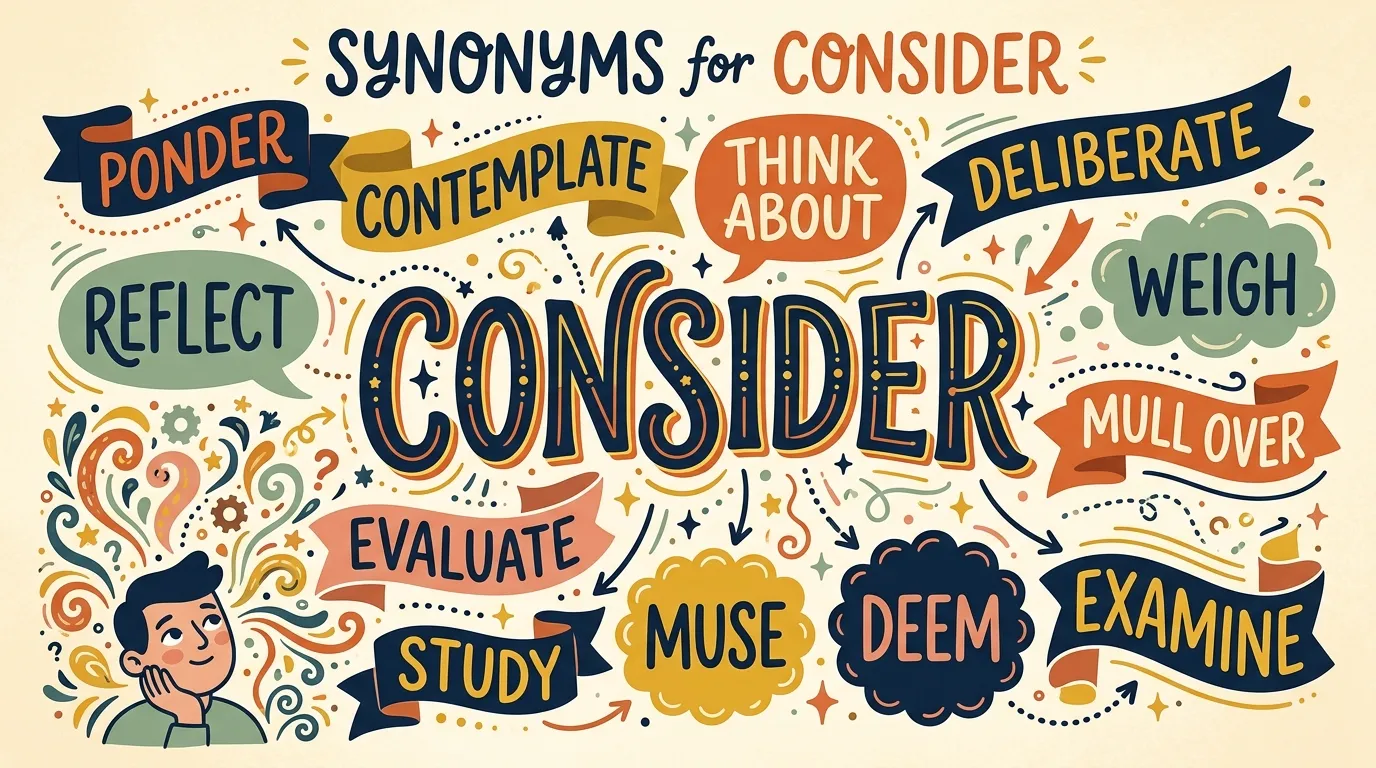
In this article, you will learn the meaning of consider, 30 useful synonyms, their pronunciations, and simple examples. You will also explore its grammar, history, emotional tone, word formation, antonyms, and common uses.
Meaning of Consider
Consider (verb)
Definition: To think carefully about something before making a decision, forming an opinion, or taking action.
Examples
- I will consider your suggestion before making a decision.
- Please consider all the options before choosing a school.
Connotative Meaning
Connotation is the feeling or idea that a word suggests beyond its basic meaning.
- Positive tone: Consider can suggest care, respect, thoughtfulness, and wisdom. Example: She considered everyone’s ideas before making a plan.
- Negative tone: In some situations, consider can suggest doubt, worry, or hesitation. Example: He is considering leaving his job because he feels unhappy.
- Neutral tone: It can simply mean thinking about an idea or choice. Example: We will consider the proposal tomorrow.
Etymology of Consider
The word consider comes from Latin through French.
- Source language: Latin considerare, which means to examine, observe, or think about carefully.
- Root: The word entered English through Old French considerer.
- Original meaning: To examine or look at something carefully.
Read more about:https://synonymhunting.com/synonyms-of-personality/
Short History of Consider
Old English (450–1100)
The modern English word consider was not a common established word in Old English. People used other words to express ideas such as thinking, examining, and observing.
Middle English (1100–1500)
The word entered English through Anglo-French and Old French influences. It was used for thinking about, examining, or judging something.
Modern English (1500–Present)
The word became common in everyday speech and formal writing. Today, it can mean thinking carefully, regarding someone or something in a particular way, or taking facts into account.
Pronunciation of Consider
- US: /kənˈsɪdər/
- UK: /kənˈsɪdə/
- Syllables: con-sid-er
- Number of syllables: 3
- Stress: The second syllable, sid, receives the main stress.
Affixation Pattern of Consider
- Root: consider
- Prefix: None in the base word.
- Suffix: None in the base word consider.
- Word class: Verb.
Word Formation of Consider
Several words can be formed from or closely related to consider.
Word
Grammatical category
Meaning
Consider
Verb
Think about something
Considers
Verb
Thinks about something
Considered
Verb/adjective
Thought about; regarded as
Considering
Verb/preposition
Thinking about; taking into account
Consideration
Noun
Careful thought
Considerate
Adjective
Thoughtful toward others
Considerately
Adverb
In a thoughtful way
Considerateness
Noun
The quality of being thoughtful
Considerable
Adjective
Large or important enough to notice
Considerably
Adverb
By a large amount
Considerationless
Adjective
Lacking thought for others; uncommon
These words are related to the same word family, but they do not all have the same meaning or grammatical function.
30 Synonyms of Consider
The best synonym depends on what you want to express. Some words focus on careful thought, while others focus on examining facts, respecting someone, or making a decision.
1. Think (Verb) — US /θɪŋk/ | UK /θɪŋk/
Meaning: To use your mind to form ideas or make decisions.
Examples:
- I need to think about your offer.
- Think carefully before you answer the question.
2. Contemplate (Verb) — US /ˈkɑːntəmˌpleɪt/ | UK /ˈkɒntəmpleɪt/
Meaning: To think deeply about something for some time.
Examples:
- She contemplated changing her career.
- He sat quietly and contemplated his future.
3. Ponder (Verb) — US /ˈpɑːndər/ | UK /ˈpɒndə/
Meaning: To think carefully about a question or idea.
Examples:
- I pondered his words for a long time.
- She pondered the best way to solve the problem.
4. Reflect (Verb) — US /rɪˈflekt/ | UK /rɪˈflekt/
Meaning: To think carefully about something that happened or an idea.
Examples:
- I reflected on my past mistakes.
- She reflected on what her teacher had said.
5. Examine (Verb) — US /ɪɡˈzæmɪn/ | UK /ɪɡˈzæmɪn/
Meaning: To look at something carefully to understand it.
Examples:
- The teacher examined the student’s work.
- We must examine the facts before deciding.
6. Evaluate (Verb) — US /ɪˈvæljuˌeɪt/ | UK /ɪˈvæljueɪt/
Meaning: To judge the value, quality, or importance of something.
Examples:
- We need to evaluate the results.
- The manager evaluated each application.
7. Assess (Verb) — US /əˈses/ | UK /əˈses/
Meaning: To judge something after studying its condition or quality.
Examples:
- The doctor assessed the patient’s condition.
- We should assess the risks before starting.
8. Review (Verb) — US /rɪˈvjuː/ | UK /rɪˈvjuː/
Meaning: To look at something again to check or understand it.
Examples:
- Please review the report before sending it.
- She reviewed her notes before the exam.
9. Study (Verb) — US /ˈstʌdi/ | UK /ˈstʌdi/
Meaning: To examine or learn about something carefully.
Examples:
- Scientists study the effects of pollution.
- We studied the proposal before giving an answer.
10. Analyze (Verb) — US /ˈænəˌlaɪz/ | UK /ˈænəlaɪz/
Meaning: To examine the parts of something to understand it better.
Examples:
- The team analyzed the survey results.
- We must analyze the problem before finding a solution.
11. Weigh (Verb) — US /weɪ/ | UK /weɪ/
Meaning: To compare the advantages and disadvantages of different choices.
Examples:
- She weighed the risks before accepting the job.
- We should weigh both options carefully.
12. Deliberate (Verb) — US /dɪˈlɪbəˌreɪt/ | UK /dɪˈlɪbəreɪt/
Meaning: To think carefully or discuss something before making a decision.
Examples:
- The committee deliberated before voting.
- We deliberated over the best plan.
13. Judge (Verb) — US /dʒʌdʒ/ | UK /dʒʌdʒ/
Meaning: To form an opinion about someone or something.
Examples:
- Do not judge people by their appearance.
- The panel will judge each entry fairly.
14. Regard (Verb) — US /rɪˈɡɑːrd/ | UK /rɪˈɡɑːd/
Meaning: To think of someone or something in a particular way.
Examples:
- I regard her as a good teacher.
- Many people regard honesty as an important value.
15. View (Verb) — US /vjuː/ | UK /vjuː/
Meaning: To think about or see something in a particular way.
Examples:
- I view this change as a good opportunity.
- She views education as a basic need.
16. Regard as (Verb phrase) — US /rɪˈɡɑːrd æz/ | UK /rɪˈɡɑːd æz/
Meaning: To see or think of someone or something as having a certain quality.
Examples:
- They regard him as a skilled leader.
- We regard this plan as useful.
17. Envision (Verb) — US /ɪnˈvɪʒən/ | UK /ɪnˈvɪʒən/
Meaning: To imagine something that may happen or exist in the future.
Examples:
- She envisions a better future for her students.
- I envision a small home near the sea.
18. Imagine (Verb) — US /ɪˈmædʒɪn/ | UK /ɪˈmædʒɪn/
Meaning: To form a picture or idea in your mind.
Examples:
- Imagine how different life could be.
- He imagined starting his own business.
19. Entertain (Verb) — US /ˌentərˈteɪn/ | UK /ˌentəˈteɪn/
Meaning: To be willing to think about an idea or possibility.
Examples:
- The manager agreed to entertain our proposal.
- She would not entertain the idea of giving up.
20. Explore (Verb) — US /ɪkˈsplɔːr/ | UK /ɪkˈsplɔː/
Meaning: To examine an idea or possibility to learn more about it.
Examples:
- We explored several ways to reduce costs.
- The students explored different career options.
21. Investigate (Verb) — US /ɪnˈvestɪˌɡeɪt/ | UK /ɪnˈvestɪɡeɪt/
Meaning: To examine something closely to discover facts.
Examples:
- The police investigated the incident.
- We investigated the cause of the problem.
22. Inspect (Verb) — US /ɪnˈspekt/ | UK /ɪnˈspekt/
Meaning: To look at something closely to check its condition.
Examples:
- The engineer inspected the building.
- Please inspect the goods before signing.
23. Scrutinize (Verb) — US /ˈskruːtəˌnaɪz/ | UK /ˈskruːtɪnaɪz/
Meaning: To examine something very carefully and critically.
Examples:
- The editor scrutinized every sentence.
- Investigators scrutinized the available evidence.
24. Research (Verb) — US /ˈriːsɜːrtʃ/ | UK /rɪˈsɜːtʃ/
Meaning: To study a subject to discover information.
Examples:
- I researched several schools before choosing one.
- Writers research facts before publishing articles.
25. Question (Verb) — US /ˈkwestʃən/ | UK /ˈkwestʃən/
Meaning: To ask whether something is true, correct, or reasonable.
Examples:
- We should question information that seems false.
- She questioned the decision because it seemed unfair.
26. Account for (Verb phrase) — US /əˈkaʊnt fɔːr/ | UK /əˈkaʊnt fɔː/
Meaning: To take something into account or explain its effect.
Examples:
- We must account for travel costs when planning the trip.
- The study accounted for differences in age.
27. Take into Account (Verb phrase) — US /teɪk ˈɪntuː əˈkaʊnt/ | UK /teɪk ˈɪntuː əˈkaʊnt/
Meaning: To include a fact or factor when making a decision.
Examples:
- Take the weather into account before leaving.
- We must take students’ needs into account.
28. Factor In (Verb phrase) — US /ˈfæktər ɪn/ | UK /ˈfæktər ɪn/
Meaning: To include something when calculating or planning.
Examples:
- Factor in the cost of transport.
- We factored in extra time for the journey.
29. Mind (Verb) — US /maɪnd/ | UK /maɪnd/
Meaning: To pay attention to or take something into account.
Examples:
- Keep the children’s safety in mind.
- Bear in mind that the rules may change.
30. Decide (Verb) — US /dɪˈsaɪd/ | UK /dɪˈsaɪd/
Meaning: To make a choice after thinking about different options.
Examples:
- We will decide after considering all the facts.
- She decided to accept the offer.
Prototype Meaning of Consider
The most typical meaning of consider is to think carefully about an idea, choice, or situation before making a decision. When people hear this word, they often imagine someone looking at different options, weighing the pros and cons, and deciding what to do next. For example, a student may consider which subject to study, or a family may consider where to spend a holiday. The word often suggests that a person is taking time to think rather than acting immediately.
Prototype Categorization
Synonyms of consider can be grouped by the type of thinking they describe. These groups help writers choose words that match their exact meaning and tone.
- Careful thought: Think, ponder, contemplate, reflect, deliberate. Use these when someone is thinking deeply or taking time to make a choice.
- Examination and analysis: Examine, analyze, inspect, scrutinize, investigate, study. Use these when someone checks details or looks for facts.
- Judgment and evaluation: Assess, evaluate, judge, review. Use these when someone measures quality, value, or performance.
- Opinions and viewpoints: Regard, view, regard as. Use these when describing how a person sees someone or something.
- Possibilities and imagination: Imagine, envision, entertain, explore. Use these when thinking about ideas or future events.
- Planning and decision-making: Weigh, take into account, factor in, account for, decide. Use these when comparing choices or including important facts in a plan.
- Critical thinking: Question, research. Use these when checking claims, seeking information, or testing whether something is true.
Choosing synonyms by category helps avoid mistakes. For example, scrutinize suggests close examination, while envision suggests imagining the future. Both relate to thinking, but they are not interchangeable in every sentence.
Antonyms of Consider
Antonyms are words with opposite or contrasting meanings. The best antonym depends on how consider is used.
Antonym
Meaning
Example
Ignore
Pay no attention to something
He ignored my suggestion.
Disregard
Treat something as unimportant
She disregarded the warning.
Neglect
Fail to give proper attention
Do not neglect your duties.
Overlook
Fail to notice or consider something
We overlooked an important detail.
Dismiss
Reject an idea without serious thought
He dismissed the proposal too quickly.
Reject
Refuse to accept something
They rejected the offer.
Overlook mentally
Fail to take a fact into account
The planner overlooked the extra cost.
Rush
Act too quickly without enough thought
Do not rush your decision.
Some of these words are opposites only in certain contexts. For example, reject is an opposite of considering an offer when it means refusing it, but it is not the opposite of thinking carefully in general.
Short Questions and Answers
– What does consider mean? Consider means to think carefully about something before making a decision or forming an opinion.
– When should consider be used? Use consider when discussing choices, ideas, suggestions, plans, or facts that need attention before a decision.
– Is consider positive or negative? It is usually neutral. The sentence and situation determine whether it sounds positive or negative.
– How is consider different from similar words? Consider is a broad word for thinking about something. Evaluate focuses on judging value, ponder suggests deep thought, and examine focuses on close inspection.
– What is the most common synonym of consider? Think about is one of the most common alternatives in everyday English.
– Can consider be used in formal writing? Yes. It is common in academic writing, business communication, reports, and professional discussions.
– What preposition is used after consider? Consider usually takes a direct object: Consider this idea. Do not normally write consider about this idea. You can say think about this idea instead.
– What is the noun form of consider? The most common noun form is consideration. Example: Thank you for your consideration.
Conclusion
Learning the meaning of consider and its synonyms can improve your English vocabulary and help you express ideas more clearly. Words such as think, ponder, examine, and evaluate allow you to describe different kinds of thought without repeating the same word. Each synonym has its own meaning, tone, and purpose, so choosing the right one makes your writing more accurate and natural.
These words can help students write better essays, teachers explain ideas, and content writers create useful articles. They can also make everyday speaking easier and more confident. Start by learning three synonyms each day. Write a simple sentence for each word and use it in a real conversation. With regular practice, you will build a stronger vocabulary, avoid repetition, and feel more confident when speaking and writing English.

I’m Zahid Abbas, an educator, researcher, and digital publishing strategist with a passion for linguistics, grammar, and clear communication. As a content creator and SEO specialist, I craft research-driven, reader-focused content that empowers learners and makes knowledge accessible worldwide.