Imagine you push a small red block on a wooden table. The first block falls over and hits the next block, and soon a whole line of blocks tumbles down. That falling line shows a real effect. An effect is a change or result that happens because of an action. People use synonyms for effect every day because actions always cause new things to happen.
Learning synonyms for effect is very important for English learners and content writers. Using different synonyms for effect makes your writing interesting and keeps you from repeating the same term. This article discusses the meaning of effect. Along with 30 simple synonyms for effect by giving easy definitions, clear examples, grammar points, word history, pronunciations, and useful word groups written in simple, flowing sentences.
Meaning of Effect
Definition
Effect (Noun): A change or result that happens because of an action or cause.
Examples
- The bright morning sun had a happy effect on her mood.
- Eating healthy food produces a good effect on your body.
Connotative Meaning
- Positive tone:
- Shows good outcomes like winning a prize, staying healthy, or solving a hard problem.
- Negative tone:
- Points to bad results like pain, damage, or loss after making a mistake.
- Neutral tone:
- Connects a cause to a result in a plain, factual way for school reports.
Etymology
- Source:
- Comes from the Latin word effectus, which means a completion, performance, or outcome.
- Old English (450–1100):
- Early speakers used native words like geworc, but Latin words entered later through books.
- Middle English (1100–1500):
- Middle English took the word effect from Old French to mean an outcome or result.
- Modern English (1500–Present):
- Today, effect is used as a standard noun for a result and a formal verb meaning to bring something about.
Pronunciation
- US: /əˈfɛkt/
- UK: /ɪˈfɛkt/
Syllables
ef-fect
Affixation Pattern
- Root: Fect (from Latin facere, meaning to make or do)
- Prefix: Ef- (a form of ex-, meaning out of)
- Suffix: None
Word Formation:
- Effect (Noun / Verb)
- Effective (Adjective)
- Effectively (Adverb)
- Effectiveness (Noun)
- Ineffective (Adjective)
- Effectuate (Verb)
You also get more information https://synonymhunting.com/synonyms-for-useful/
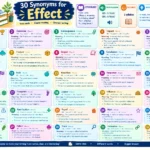
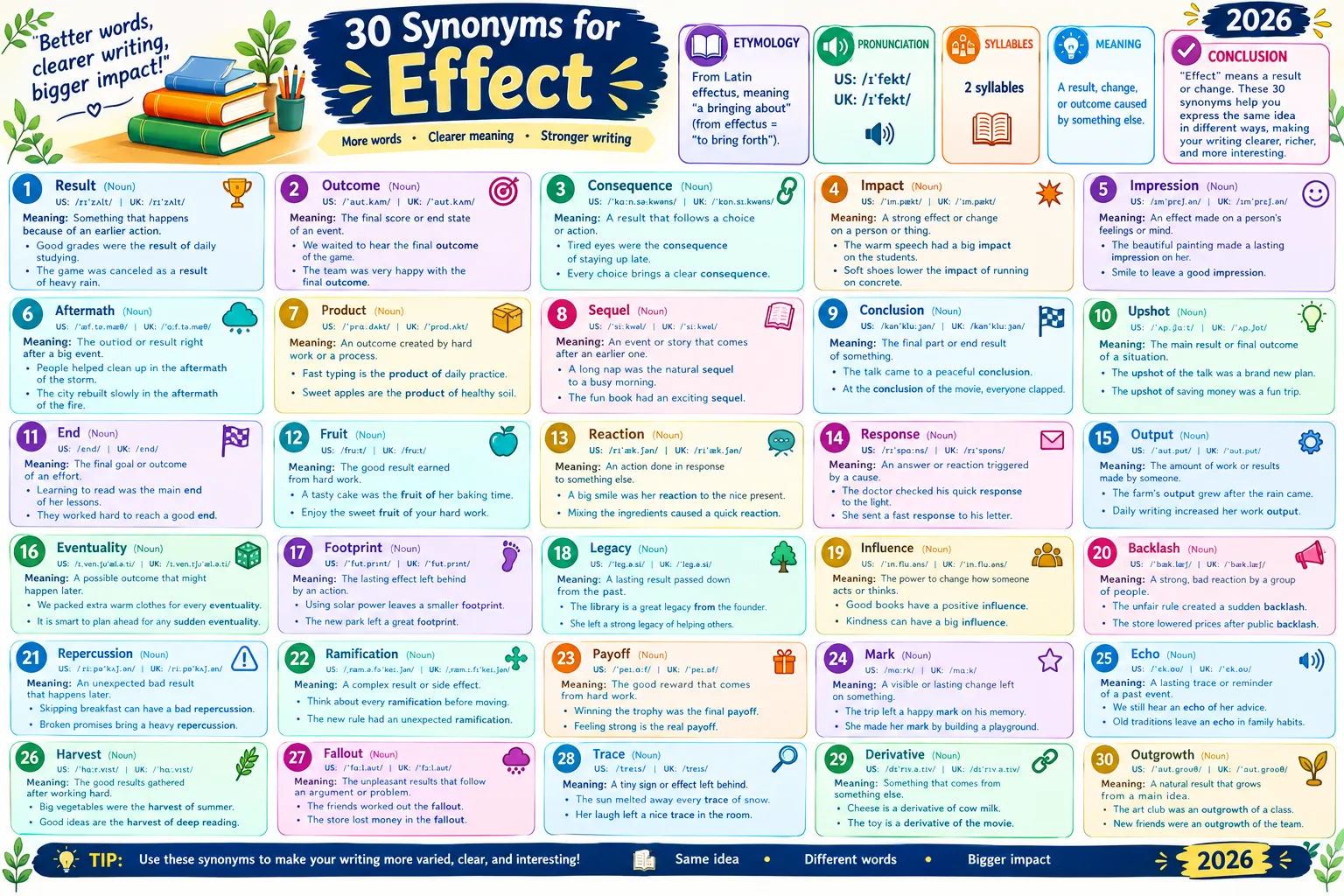
30 Synonyms for Effect
1. Result (Noun) — US: /rɪˈzʌlt/ | UK: /rɪˈzʌlt/
Meaning: Something that happens because of an earlier action.
- Example 1: Good grades were the result of daily studying.
- Example 2: The game was canceled as a result of heavy rain.
2. Outcome (Noun) — US: /ˈaʊt.kʌm/ | UK: /ˈaʊt.kʌm/
Meaning: The final score or end state of an event.
- Example 1: We waited to hear the final outcome of the game.
- Example 2: The team was very happy with the final outcome.
3. Consequence (Noun) — US: /ˈkɑːn.sə.kwəns/ | UK: /ˈkɒn.sɪ.kwəns/
Meaning: A result that follows a choice or action.
- Example 1: Tired eyes were the consequence of staying up late.
- Example 2: Every choice brings a clear consequence.
4. Impact (Noun) — US: /ˈɪm.pækt/ | UK: /ˈɪm.pækt/
Meaning: A strong effect or change on a person or thing.
- Example 1: The warm speech had a big impact on the students.
- Example 2: Soft shoes lower the impact of running on concrete.
5. Impression (Noun) — US: /ɪmˈprɛʃ.ən/ | UK: /ɪmˈprɛʃ.ən/
Meaning: An effect made on a person’s feelings or mind.
- Example 1: The beautiful painting made a lasting impression on her.
- Example 2: Smile to leave a good impression on your new teacher.
6. Aftermath (Noun) — US: /ˈæf.tɚ.mæθ/ | UK: /ˈɑːf.tə.mæθ/
Meaning: The period or result right after a big event.
- Example 1: People helped clean up in the aftermath of the storm.
- Example 2: The city rebuilt slowly in the aftermath of the fire.
7. Product (Noun) — US: /ˈprɑː.dʌkt/ | UK: /ˈprɒd.ʌkt/
Meaning: An outcome created by hard work or a process.
- Example 1: Fast typing is the product of daily practice.
- Example 2: Sweet apples are the product of healthy soil.
8. Sequel (Noun) — US: /ˈsiː.kwəl/ | UK: /ˈsiː.kwəl/
Meaning: An event or story that comes after an earlier one.
- Example 1: A long nap was the natural sequel to a busy morning.
- Example 2: The fun book had an exciting sequel.
9. Conclusion (Noun) — US: /kənˈkluː.ʒən/ | UK: /kənˈkluː.ʒən/
Meaning: The final part or end result of something.
- Example 1: The talk came to a peaceful conclusion.
- Example 2: At the conclusion of the movie, everyone clapped.
10. Upshot (Noun) — US: /ˈʌp.ʃɑːt/ | UK: /ˈʌp.ʃɒt/
Meaning: The main result or final outcome of a situation.
- Example 1: The upshot of the talk was a brand new plan.
- Example 2: The upshot of saving money was a fun weekend trip.
11. End (Noun) — US: /ɛnd/ | UK: /ɛnd/
Meaning: The final goal or outcome of an effort.
- Example 1: Learning to read was the main end of her lessons.
- Example 2: They worked hard together to reach a good end.
12. Fruit (Noun) — US: /fruːt/ | UK: /fruːt/
Meaning: The good result earned from hard work.
- Example 1: A tasty cake was the fruit of her baking time.
- Example 2: Enjoy the sweet fruit of your hard work.
13. Reaction (Noun) — US: /riˈæk.ʃən/ | UK: /riˈæk.ʃən/
Meaning: An action done in response to something else.
- Example 1: A big smile was her reaction to the nice present.
- Example 2: Mixing the ingredients caused a quick reaction.
14. Response (Noun) — US: /rɪˈspɑːns/ | UK: /rɪˈspɒns/
Meaning: An answer or reaction triggered by a cause.
- Example 1: The doctor checked his quick response to the light.
- Example 2: She sent a fast response to his letter.
15. Output (Noun) — US: /ˈaʊt.pʊt/ | UK: /ˈaʊt.pʊt/
Meaning: The amount of work or results made by someone.
- Example 1: The farm’s output grew after the rain came.
- Example 2: Daily writing increased her total work output.
16. Eventuality (Noun) — US: /ɪˌvɛn.tʃuˈæl.ə.ti/ | UK: /ɪˌvɛn.tʃuˈæl.ə.ti/
Meaning: A possible outcome that might happen later.
- Example 1: We packed extra warm clothes for every eventuality.
- Example 2: It is smart to plan ahead for any sudden eventuality.
17. Footprint (Noun) — US: /ˈfʊt.prɪnt/ | UK: /ˈfʊt.prɪnt/
Meaning: The lasting effect left behind by an action.
- Example 1: Using solar power leaves a smaller carbon footprint.
- Example 2: The new park left a great footprint in the town.
18. Legacy (Noun) — US: /ˈlɛɡ.ə.si/ | UK: /ˈlɛɡ.ə.si/
Meaning: A lasting result passed down from the past.
- Example 1: The library is a great legacy from the town founder.
- Example 2: She left a strong legacy of helping others.
19. Influence (Noun) — US: /ˈɪn.flu.əns/ | UK: /ˈɪn.flu.əns/
Meaning: The power to change how someone acts or thinks.
- Example 1: Good books have a positive influence on young minds.
- Example 2: Kindness can have a big influence on your friends.
20. Backlash (Noun) — US: /ˈbæk.læʃ/ | UK: /ˈbæk.læʃ/
Meaning: A strong, bad reaction by a group of people.
- Example 1: The unfair rule created a sudden backlash.
- Example 2: The store lowered prices after public backlash.
21. Repercussion (Noun) — US: /ˌriː.pɚˈkʌʃ.ən/ | UK: /ˌriː.pəˈkʌʃ.ən/
Meaning: An unexpected bad result that happens later.
- Example 1: Skipping breakfast can have a bad repercussion at lunch.
- Example 2: Broken promises usually carry a heavy repercussion.
22. Ramification (Noun) — US: /ˌræm.ə.fəˈkeɪ.ʃən/ | UK: /ˌræm.ɪ.fɪˈkeɪ.ʃən/
Meaning: A complex result or side effect of a choice.
- Example 1: Think about every ramification before moving to a new city.
- Example 2: The new rule had an unexpected ramification for sports teams.
23. Payoff (Noun) — US: /ˈpeɪ.ɑːf/ | UK: /ˈpeɪ.ɒf/
Meaning: The good reward that comes from hard work.
- Example 1: Winning the trophy was the final payoff for practice.
- Example 2: Feeling strong is the real payoff of exercising.
24. Mark (Noun) — US: /mɑːrk/ | UK: /mɑːk/
Meaning: A visible or lasting change left on something.
- Example 1: The great trip left a happy mark on his memory.
- Example 2: She made her mark by building a new playground.
25. Echo (Noun) — US: /ˈɛk.oʊ/ | UK: /ˈɛk.əʊ/
Meaning: A lasting trace or reminder of a past event.
- Example 1: We still hear an echo of her wise advice today.
- Example 2: Old traditions leave a clear echo in family habits.
26. Harvest (Noun) — US: /ˈhɑːr.vɪst/ | UK: /ˈhɑː.vɪst/
Meaning: The good results gathered after working hard.
- Example 1: Big vegetables were the harvest of summer gardening.
- Example 2: Good ideas are the rich harvest of deep reading.
27. Fallout (Noun) — US: /ˈfɑːl.aʊt/ | UK: /ˈfɔːl.aʊt/
Meaning: The unpleasant results that follow an argument or problem.
- Example 1: The friends worked out the bad fallout from their fight.
- Example 2: The store lost money in the fallout from the storm.
28. Trace (Noun) — US: /treɪs/ | UK: /treɪs/
Meaning: A tiny sign or effect left by something.
- Example 1: The warm sun melted away every trace of snow.
- Example 2: Her happy laugh left a nice trace in the room.
29. Derivative (Noun) — US: /dɪˈrɪv.ə.tɪv/ | UK: /dɪˈrɪv.ə.tɪv/
Meaning: Something that comes directly from something else.
- Example 1: Cheese is a yummy derivative of cow milk.
- Example 2: The toy is a fun derivative of the original movie.
30. Outgrowth (Noun) — US: /ˈaʊt.ɡroʊθ/ | UK: /ˈaʊt.ɡrəʊθ/
Meaning: A natural result that grows out of a main idea.
- Example 1: The art club was an outgrowth of their fun painting class.
- Example 2: New friends were a happy outgrowth of joining the team.
Prototype Meaning
The main job of effect is to show an outcome produced by a cause. When people hear this word, they picture a simple chain one action happens first, and the effect follows right after as a result.
Prototype Categorization
- Direct Results: Result, outcome, product, output, end, conclusion, upshot. Use these simple terms for clear results of tasks or choices.
- Strong Changes: Impact, impression, influence, mark, footprint, legacy. Best when an action leaves a lasting change on a person or place.
- Reactions & Side Effects: Reaction, response, backlash, repercussion, ramification, fallout. Great for describing how people react or what bad side effects happen.
- Rewards & Benefits: Fruit, payoff, harvest, outgrowth, sequel. Use these words to show good rewards earned through effort.
Antonyms of Effect
- Cause
- Origin
- Source
- Root
- Start
- Reason
Short Questions and Answers
- What does effect mean?
- It means a change or result caused by an earlier event.
- When should effect be used?
- Use it when you talk about what happens after a specific action.
- Is effect positive or negative?
- It is neutral on its own and can be good or bad depending on your sentence.
- How is it different from similar words?
- Effect is a noun that means the result, while affect is a verb that means to change something.
Conclusion
Synonyms for effect helps you talk about causes and results with ease. Building a bigger vocabulary makes your writing better. Synonyms for effect also improves your speaking skills, and stops you from using the same words again and again. Choosing different words gives you confidence to express your ideas. Try using a few synonyms for effect in your writing.

I’m Zahid Abbas, an educator, researcher, and digital publishing strategist with a passion for linguistics, grammar, and clear communication. As a content creator and SEO specialist, I craft research-driven, reader-focused content that empowers learners and makes knowledge accessible worldwide.