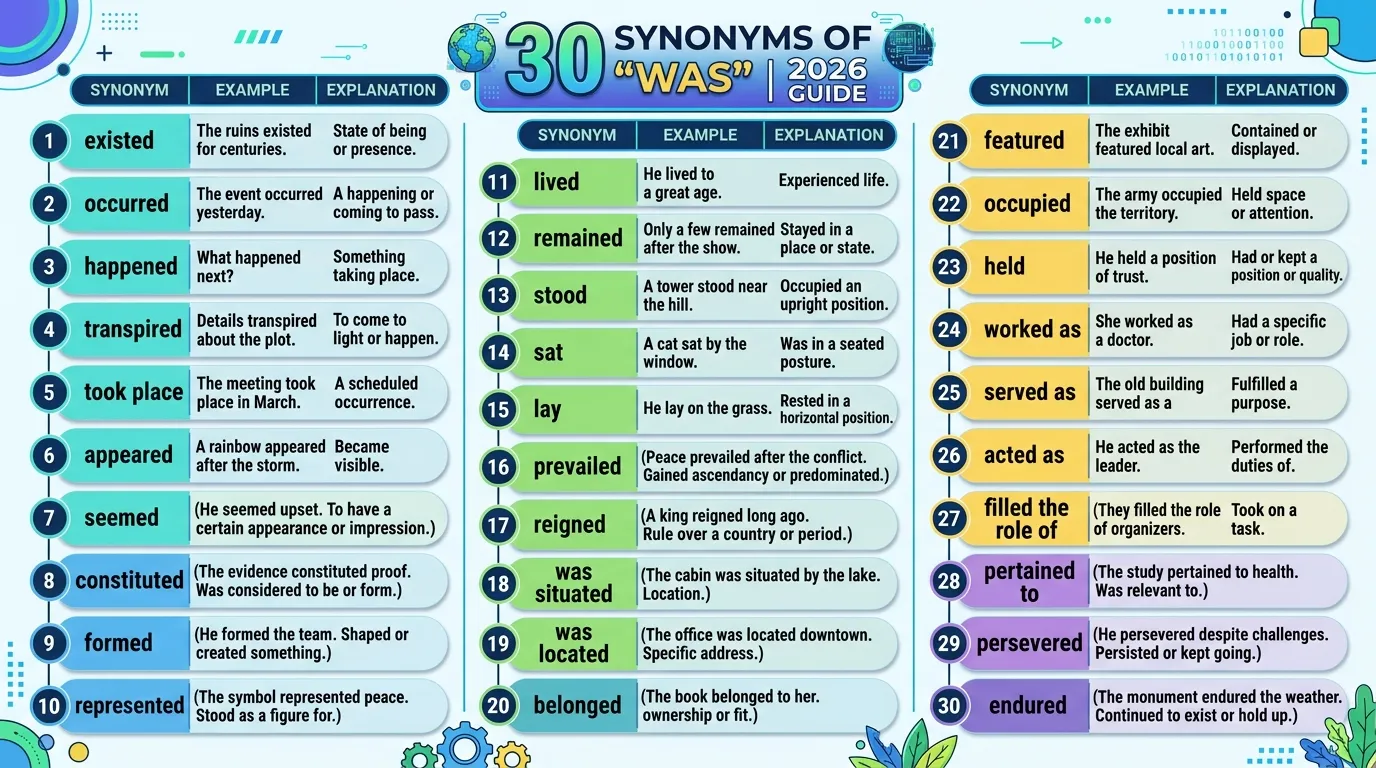
Was is one of the most common words in English. It is the past tense form of the verb be and is used to describe a state, condition, identity, or situation that existed in the past. For example, you might say, “She was happy yesterday,” or “The weather was cold last week.”
People use was every day in conversations, stories, essays, and business writing. Because it appears so often, writers can easily repeat it many times in the same paragraph. Learning synonyms and related alternatives helps English learners, students, bloggers, and content writers make their language more interesting and varied.
In this article, you will learn the meaning of was, its pronunciation, history, grammar, connotation, and thirty useful synonyms or alternatives with examples. You will also discover categories of synonyms, antonyms, and practical usage tips that can improve both writing and speaking skills.
Meaning of Was
Was (Verb)
Definition:
The singular past tense form of the verb be, used to describe a person, thing, condition, identity, or situation that existed in the past.
Examples
- She was very excited about the trip.
- The meeting was successful.
Connotative Meaning
- Positive tone: Used when describing pleasant past situations, such as “The event was wonderful.”
- Negative tone: Used when describing unpleasant past situations, such as “The journey was difficult.”
- Neutral tone: Most commonly neutral, simply stating a past fact, such as “The book was on the table.”
Etymology
- Source Language: Old English
- Original Form: wæs
- Original Meaning: Past tense form of “be”
Short History of the Keyword
- Old English (450–1100): Appeared as wæs, meaning “existed” or “occurred.”
- Middle English (1100–1500): Spelling gradually changed toward modern forms.
- Modern English (1500–Present): Became the standard singular past tense form of the verb be.
Pronunciation (US & UK – IPA)
US: /wʌz/
UK: /wɒz/
Syllables
was
Affixation Pattern of Was
Root: be
Prefix: None
Suffix: None
Word Formation of the Keyword
- Be (Verb)
- Am (Verb)
- Is (Verb)
- Are (Verb)
- Was (Verb)
- Were (Verb)
- Being (Verb/Gerund)
- Been (Verb/Participle)
30 Synonyms of Was
1. Existed (Verb)
US /ɪɡˈzɪstɪd/ | UK /ɪɡˈzɪstɪd/
Meaning: Lived or had reality in the past.
Examples:
- The village existed for hundreds of years.
- A solution existed before the problem grew.
2. Remained (Verb)
US /rɪˈmeɪnd/ | UK /rɪˈmeɪnd/
Meaning: Continued to be in the same state.
Examples:
- She remained calm during the storm.
- The door remained open all night.
3. Stayed (Verb)
US /steɪd/ | UK /steɪd/
Meaning: Continued in a place or condition.
Examples:
- He stayed silent.
- The weather stayed warm.
4. Lived (Verb)
US /lɪvd/ | UK /lɪvd/
Meaning: Existed as a living person.
Examples:
- She lived in London.
- They lived happily together.
5. Occurred (Verb)
US /əˈkɝːd/ | UK /əˈkɜːd/
Meaning: Happened at a particular time.
Examples:
- The accident occurred yesterday.
- The event occurred suddenly.
6. Happened (Verb)
US /ˈhæpənd/ | UK /ˈhæpənd/
Meaning: Took place.
Examples:
- What happened yesterday?
- The meeting happened online.
7. Appeared (Verb)
US /əˈpɪrd/ | UK /əˈpɪəd/
Meaning: Came into view or seemed.
Examples:
- She appeared nervous.
- A rainbow appeared after the rain.
8. Became (Verb)
US /bɪˈkeɪm/ | UK /bɪˈkeɪm/
Meaning: Changed into a different state.
Examples:
- He became famous.
- The sky became dark.
9. Seemed (Verb)
US /siːmd/ | UK /siːmd/
Meaning: Gave an impression.
Examples:
- She seemed happy.
- The task seemed easy.
10. Functioned (Verb)
US /ˈfʌŋkʃənd/ | UK /ˈfʌŋkʃənd/
Meaning: Worked or operated.
Examples:
- The machine functioned well.
- Everything functioned normally.
11. Persisted (Verb)
US /pərˈsɪstɪd/ | UK /pəˈsɪstɪd/
Meaning: Continued despite difficulties.
Examples:
- The problem persisted.
- Rain persisted throughout the day.
12. Endured (Verb)
US /ɪnˈdʊrd/ | UK /ɪnˈdjʊəd/
Meaning: Continued for a long time.
Examples:
- The friendship endured.
- Their success endured for decades.
13. Survived (Verb)
US /sərˈvaɪvd/ | UK /səˈvaɪvd/
Meaning: Continued to live or exist.
Examples:
- The tree survived the storm.
- The tradition survived many years.
14. Lasted (Verb)
US /ˈlæstɪd/ | UK /ˈlɑːstɪd/
Meaning: Continued for a period.
Examples:
- The show lasted two hours.
- Their friendship lasted years.
15. Continued (Verb)
US /kənˈtɪnjuːd/ | UK /kənˈtɪnjuːd/
Meaning: Kept going without stopping.
Examples:
- The discussion continued.
- The rain continued all night.
16. Resided (Verb)
US /rɪˈzaɪdɪd/ | UK /rɪˈzaɪdɪd/
Meaning: Lived in a place.
Examples:
- He resided in Paris.
- They resided near the river.
17. Dwelled (Verb)
US /dweld/ | UK /dweld/
Meaning: Lived somewhere.
Examples:
- Ancient people dwelled there.
- She dwelled in the countryside.
18. Occupied (Verb)
US /ˈɑːkjupaɪd/ | UK /ˈɒkjʊpaɪd/
Meaning: Filled or used a space.
Examples:
- The office occupied the building.
- He occupied the chair.
19. Stood (Verb)
US /stʊd/ | UK /stʊd/
Meaning: Was located in a position.
Examples:
- A castle stood there.
- The monument stood proudly.
20. Lay (Verb)
US /leɪ/ | UK /leɪ/
Meaning: Was positioned flat.
Examples:
- The book lay on the desk.
- The town lay near the coast.
21. Sat (Verb)
US /sæt/ | UK /sæt/
Meaning: Was positioned in a seated place.
Examples:
- The cat sat quietly.
- The house sat on a hill.
22. Represented (Verb)
US /ˌreprɪˈzentɪd/ | UK /ˌreprɪˈzentɪd/
Meaning: Served as a symbol.
Examples:
- The flag represented freedom.
- The award represented achievement.
23. Constituted (Verb)
US /ˈkɑːnstətuːtɪd/ | UK /ˈkɒnstɪtjuːtɪd/
Meaning: Formed or made up.
Examples:
- The team constituted ten members.
- This action constituted a violation.
24. Equaled (Verb)
US /ˈiːkwəld/ | UK /ˈiːkwəld/
Meaning: Was the same as.
Examples:
- Two plus two equaled four.
- His score equaled hers.
25. Signified (Verb)
US /ˈsɪɡnɪfaɪd/ | UK /ˈsɪɡnɪfaɪd/
Meaning: Meant or indicated.
Examples:
- The symbol signified peace.
- The smile signified approval.
26. Characterized (Verb)
US /ˈkærəktəraɪzd/ | UK /ˈkærəktəraɪzd/
Meaning: Described a quality.
Examples:
- The era was characterized by growth.
- His work was characterized by creativity.
27. Manifested (Verb)
US /ˈmænəfestɪd/ | UK /ˈmænɪfestɪd/
Meaning: Became visible.
Examples:
- Success manifested over time.
- The problem manifested clearly.
28. Emerged (Verb)
US /ɪˈmɜːrdʒd/ | UK /ɪˈmɜːdʒd/
Meaning: Came into existence.
Examples:
- A new leader emerged.
- Opportunities emerged quickly.
29. Developed (Verb)
US /dɪˈveləpt/ | UK /dɪˈveləpt/
Meaning: Grew or progressed.
Examples:
- The city developed rapidly.
- The idea developed over time.
30. Transformed (Verb)
US /trænsˈfɔːrmd/ | UK /trænsˈfɔːmd/
Meaning: Changed completely.
Examples:
- The town transformed dramatically.
- Technology transformed society.
Prototype Meaning
The prototype meaning of was is simply “existed or was in a certain state in the past.” When people hear the word, they usually think of someone or something being a certain way before the present time. For example, “She was tired” or “The house was old.”
Prototype Categorization
- Existence: existed, survived, endured, persisted
- Location: stood, sat, lay, occupied, resided, dwelled
- Continuation: remained, stayed, continued, lasted
- Events: happened, occurred, emerged
- Change of State: became, developed, transformed, manifested
- Representation: represented, signified, constituted, equaled
- Appearance: appeared, seemed, characterized
Antonyms of Was
- Am (Verb) — First-person present form of be.
- Is (Verb) — Present singular form of be.
- Are (Verb) — Present plural form of be.
- Become (Verb) — To begin to be.
- Will be (Verb Phrase) — Indicates future existence or state.
- Exist not (Verb Phrase) — To have no existence.
Short Questions and Answers
- What does was mean?
It is the singular past tense form of the verb be. - When should was be used?
Use it when talking about a person, thing, or situation in the past. - Is was positive or negative?
It is usually neutral. The surrounding context determines whether it sounds positive or negative. - How is it different from similar words?
Was is a general past-tense linking verb, while words like became, remained, and seemed express more specific meanings.
Conclusion
The Synonyms of Was is one of the most important verbs in English because it helps describe past situations, conditions, identities, and events. Learning Synonyms of Was expands your vocabulary and allows you to express ideas more precisely. Instead of repeating was, you can use alternatives such as remained, existed, occurred, became, or appeared when the context fits. This improves writing quality, strengthens speaking skills, and makes communication more engaging. A rich vocabulary also helps students, professionals, and content writers create clearer and more effective sentences. Make vocabulary learning a daily habit, and practice using these synonyms in your conversations and writing to build greater confidence in English.

I’m Zahid Abbas, an educator, researcher, and digital publishing strategist with a passion for linguistics, grammar, and clear communication. As a content creator and SEO specialist, I craft research-driven, reader-focused content that empowers learners and makes knowledge accessible worldwide.