Conclusion is a common English word that means the final part, result, judgment, or ending of something. Imagine you have finished reading a mystery novel. After looking at all the clues, you finally know who committed the crime. That final understanding is the conclusion.
People use this word every day in school, business, writing, research, and conversations. It helps us express the end of a discussion, an opinion formed after thinking, or the result of an event.
Learning synonyms of conclusion is important for English learners and content writers because it improves vocabulary, makes writing more interesting, and helps avoid repeating the same word. In this article, you will learn the meaning of conclusion, its pronunciation, history, grammar, connotations, word formation, and 30 useful synonyms with examples. You will also discover categories of synonyms, antonyms, and practical questions and answers.
Meaning of Conclusion
Conclusion (Noun):
A conclusion is the final part, decision, opinion, or result that comes after thinking, discussing, or examining something.
Examples
- The teacher gave a short conclusion at the end of the lesson.
- After studying the evidence, the scientist reached a conclusion.
Connotative Meaning
- Positive tone: A wise decision, clear understanding, successful ending.
- Negative tone: A wrong judgment, premature decision, mistaken result.
- Neutral tone: The final part or outcome of something.
Etymology
- Origin: Latin
- Source word: conclusio
- Original meaning: “A closing, ending, or shutting up”
Short History of the Keyword
- Old English (450–1100): The exact word was not commonly used; native words for endings were preferred.
- Middle English (1100–1500): The word entered English through Old French and Latin influences.
- Modern English (1500–Present): Conclusion became widely used in education, logic, science, and everyday communication.
Pronunciation (US & UK – IPA)
- US: /kənˈkluːʒən/
- UK: /kənˈkluːʒən/
Syllables
con-clu-sion
Affixation Pattern of Conclusion
- Root: conclude
- Prefix: con- (“together”)
- Suffix: -sion (“state, action, result”)
Word Formation of the Keyword
- Conclude (Verb)
- Conclusion (Noun)
- Conclusive (Adjective)
- Conclusively (Adverb)
- Inconclusive (Adjective)
- Inconclusively (Adverb)
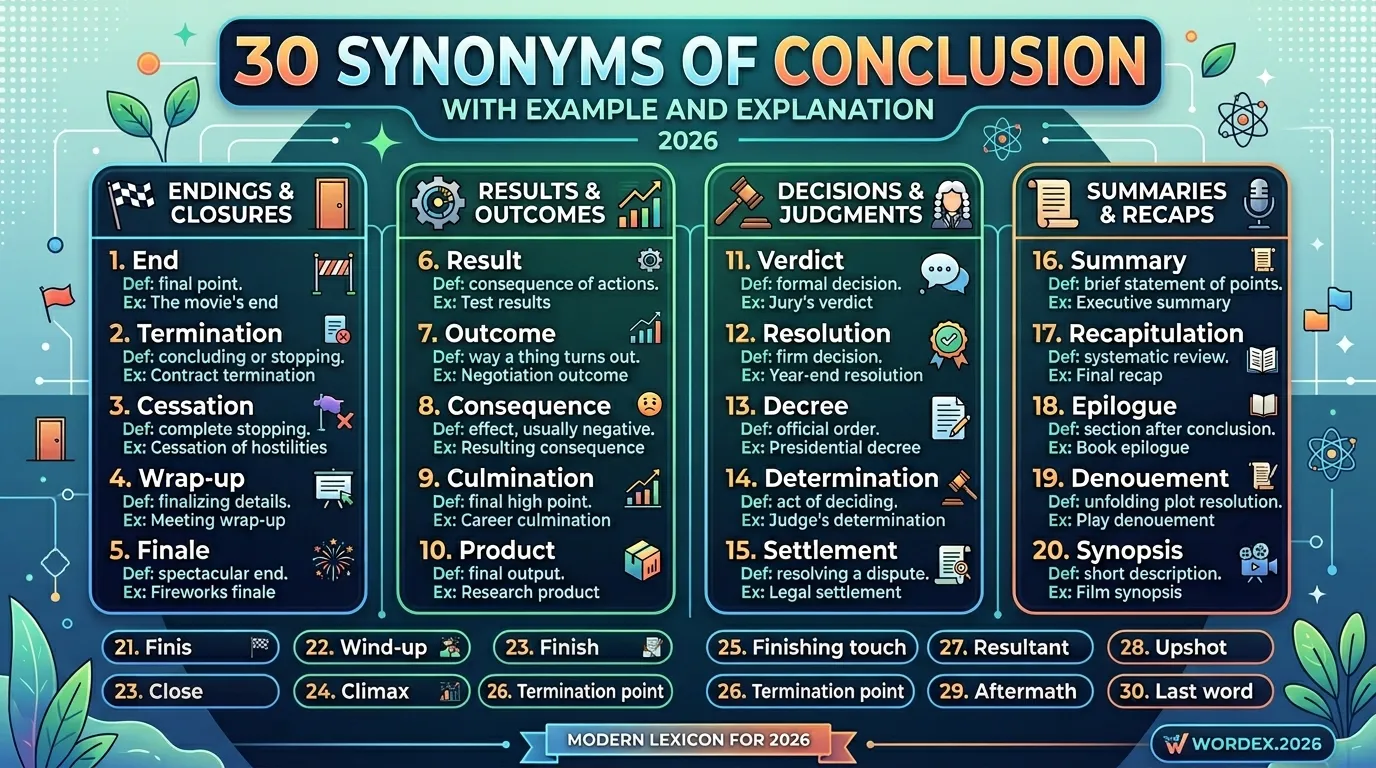
30 Synonyms of Conclusion
1. Ending (Noun)
US: /ˈen.dɪŋ/ | UK: /ˈen.dɪŋ/
Meaning: The final part of something.
Examples:
- The movie had a happy ending.
- Everyone enjoyed the ending of the story.
2. Result (Noun)
US: /rɪˈzʌlt/ | UK: /rɪˈzʌlt/
Meaning: The outcome of an action or event.
Examples:
- Hard work brought good results.
- The test result surprised her.
3. Outcome (Noun)
US: /ˈaʊt.kʌm/ | UK: /ˈaʊt.kʌm/
Meaning: The final effect of a process.
Examples:
- The outcome was better than expected.
- Nobody knew the outcome beforehand.
4. Decision (Noun)
US: /dɪˈsɪʒ.ən/ | UK: /dɪˈsɪʒ.ən/
Meaning: A choice made after consideration.
Examples:
- The manager made the final decision.
- It was a difficult decision.
5. Judgment (Noun)
US: /ˈdʒʌdʒ.mənt/ | UK: /ˈdʒʌdʒ.mənt/
Meaning: An opinion formed after careful thought.
Examples:
- Use your judgment wisely.
- The court delivered its judgment.
6. Inference (Noun)
US: /ˈɪn.fɚ.əns/ | UK: /ˈɪn.fər.əns/
Meaning: A conclusion based on evidence.
Examples:
- Her inference was correct.
- We made an inference from the data.
7. Deduction (Noun)
US: /dɪˈdʌk.ʃən/ | UK: /dɪˈdʌk.ʃən/
Meaning: A logical conclusion.
Examples:
- The detective reached a deduction.
- His deduction was accurate.
8. Determination (Noun)
US: /dɪˌtɝː.məˈneɪ.ʃən/ | UK: /dɪˌtɜː.mɪˈneɪ.ʃən/
Meaning: A final decision or finding.
Examples:
- The committee announced its determination.
- The determination ended the dispute.
9. Resolution (Noun)
US: /ˌrez.əˈluː.ʃən/ | UK: /ˌrez.əˈluː.ʃən/
Meaning: A solution or final decision.
Examples:
- The conflict reached a resolution.
- Everyone welcomed the resolution.
10. Finding (Noun)
US: /ˈfaɪn.dɪŋ/ | UK: /ˈfaɪn.dɪŋ/
Meaning: Information discovered after investigation.
Examples:
- The report included important findings.
- Scientists shared their findings.
11. Verdict (Noun)
US: /ˈvɝː.dɪkt/ | UK: /ˈvɜː.dɪkt/
Meaning: An official decision or judgment.
Examples:
- The jury announced its verdict.
- The verdict ended the trial.
12. End (Noun)
US: /end/ | UK: /end/
Meaning: The final point of something.
Examples:
- We reached the end of the road.
- The speech came to an end.
13. Close (Noun)
US: /kloʊz/ | UK: /kləʊz/
Meaning: The ending part of an event.
Examples:
- The close of the meeting was brief.
- Everyone applauded at the close.
14. Finale (Noun)
US: /fɪˈnæl.i/ | UK: /fɪˈnɑː.li/
Meaning: The last and often exciting part.
Examples:
- The concert ended with a grand finale.
- The finale impressed the audience.
15. Wrap-up (Noun)
US: /ˈræp.ʌp/ | UK: /ˈræp.ʌp/
Meaning: A summary at the end.
Examples:
- The teacher gave a wrap-up.
- Let’s do a quick wrap-up.
16. Summary (Noun)
US: /ˈsʌm.ər.i/ | UK: /ˈsʌm.ər.i/
Meaning: A short statement of main points.
Examples:
- The summary was clear.
- Read the summary first.
17. Recap (Noun)
US: /ˈriː.kæp/ | UK: /ˈriː.kæp/
Meaning: A brief review of important points.
Examples:
- He gave a recap of the meeting.
- The recap helped everyone remember.
18. Interpretation (Noun)
US: /ɪnˌtɝː.prəˈteɪ.ʃən/ | UK: /ɪnˌtɜː.prɪˈteɪ.ʃən/
Meaning: An explanation or understanding.
Examples:
- That is one interpretation of the text.
- Her interpretation differed from mine.
19. Opinion (Noun)
US: /əˈpɪn.jən/ | UK: /əˈpɪn.jən/
Meaning: A personal conclusion or belief.
Examples:
- In my opinion, it is useful.
- Everyone shared an opinion.
20. Assessment (Noun)
US: /əˈses.mənt/ | UK: /əˈses.mənt/
Meaning: A judgment after evaluation.
Examples:
- The assessment was positive.
- Teachers completed the assessment.
21. Evaluation (Noun)
US: /ɪˌvæl.juˈeɪ.ʃən/ | UK: /ɪˌvæl.juˈeɪ.ʃən/
Meaning: Careful examination and judgment.
Examples:
- The evaluation took two weeks.
- The evaluation showed improvement.
22. Consequence (Noun)
US: /ˈkɑːn.sə.kwens/ | UK: /ˈkɒn.sɪ.kwəns/
Meaning: A result of an action.
Examples:
- Actions have consequences.
- This was a direct consequence.
23. Product (Noun)
US: /ˈprɑː.dʌkt/ | UK: /ˈprɒd.ʌkt/
Meaning: Something produced as a result.
Examples:
- Success is the product of effort.
- The report was the product of research.
24. End Point (Noun)
US: /ˈend pɔɪnt/ | UK: /ˈend pɔɪnt/
Meaning: The final stage or destination.
Examples:
- We finally reached the end point.
- The project has a clear end point.
25. Settlement (Noun)
US: /ˈset.əl.mənt/ | UK: /ˈset.əl.mənt/
Meaning: An agreement that ends a dispute.
Examples:
- The companies reached a settlement.
- The settlement avoided a trial.
26. Solution (Noun)
US: /səˈluː.ʃən/ | UK: /səˈluː.ʃən/
Meaning: An answer to a problem.
Examples:
- We found a solution.
- The solution worked well.
27. Consequent (Noun)
US: /ˈkɑːn.sə.kwənt/ | UK: /ˈkɒn.sɪ.kwənt/
Meaning: Something that follows as a result.
Examples:
- The consequent was predictable.
- Every action has a consequent.
28. Culmination (Noun)
US: /ˌkʌl.məˈneɪ.ʃən/ | UK: /ˌkʌl.mɪˈneɪ.ʃən/
Meaning: The highest or final point.
Examples:
- Graduation was the culmination of years of study.
- The event marked the culmination of the project.
29. Termination (Noun)
US: /ˌtɝː.məˈneɪ.ʃən/ | UK: /ˌtɜː.mɪˈneɪ.ʃən/
Meaning: The act of ending something.
Examples:
- The contract reached termination.
- Termination occurred last month.
30. Finishing Point (Noun)
US: /ˈfɪn.ɪ.ʃɪŋ pɔɪnt/ | UK: /ˈfɪn.ɪ.ʃɪŋ pɔɪnt/
Meaning: The place or stage where something ends.
Examples:
- The runners crossed the finishing point.
- The project has reached its finishing point.
Prototype Meaning
The most typical meaning of conclusion is the final idea, judgment, or ending reached after thinking about facts, evidence, or events. When people hear the word, they often imagine the last part of an essay, speech, report, discussion, or investigation where everything is brought together and a final point is made.
Prototype Categorization
- Endings: ending, end, close, finale, termination, finishing point
- Results and Outcomes: result, outcome, consequence, product, consequent
- Decisions and Judgments: decision, judgment, determination, verdict, assessment
- Logical Thinking: inference, deduction, interpretation
- Problem Solving: resolution, settlement, solution
- Summaries: summary, wrap-up, recap
- Research Findings: finding, evaluation
- Final Stages: culmination, end point
Antonyms of Conclusion
- Beginning (Noun) — the start of something.
- Introduction (Noun) — the opening section of a text or speech.
- Opening (Noun) — the first part of an event or work.
- Commencement (Noun) — the act of starting.
- Initiation (Noun) — the process of beginning.
- Origin (Noun) — the source or starting point.
- Launch (Noun) — the beginning of a project or activity.
- Start (Noun) — the point where something begins.
- Question (Noun) — uncertainty rather than a final answer.
- Doubt (Noun) — lack of certainty about a result.
Short Questions and Answers
- What does conclusion mean?
A conclusion is the final result, judgment, opinion, or ending reached after thinking or discussing something. - When should conclusion be used?
Use it when talking about a final decision, result, summary, or ending. - Is conclusion positive or negative?
It can be positive, negative, or neutral depending on the situation and result. - How is it different from similar words?
Conclusion is a general term. Words like verdict are legal, inference is logical, and summary focuses on reviewing key points.
Conclusion
Learning the Synonyms of Conclusion and Synonyms of Conclusion is a valuable way to improve your English vocabulary. These words help you express endings, results, judgments, and final ideas more accurately. By using different synonyms, you can make your writing and speaking more interesting while avoiding unnecessary repetition. Understanding pronunciation, history, connotations, and semantic categories also helps you choose the right word for the right context. Whether you are a student, writer, teacher, or English learner, expanding your vocabulary with words related to conclusion can build confidence and improve communication skills. Practice using a few new synonyms each day, and over time your English will become stronger, clearer, and more natural using Synonyms of Conclusion.

I’m Zahid Abbas, an educator, researcher, and digital publishing strategist with a passion for linguistics, grammar, and clear communication. As a content creator and SEO specialist, I craft research-driven, reader-focused content that empowers learners and makes knowledge accessible worldwide.