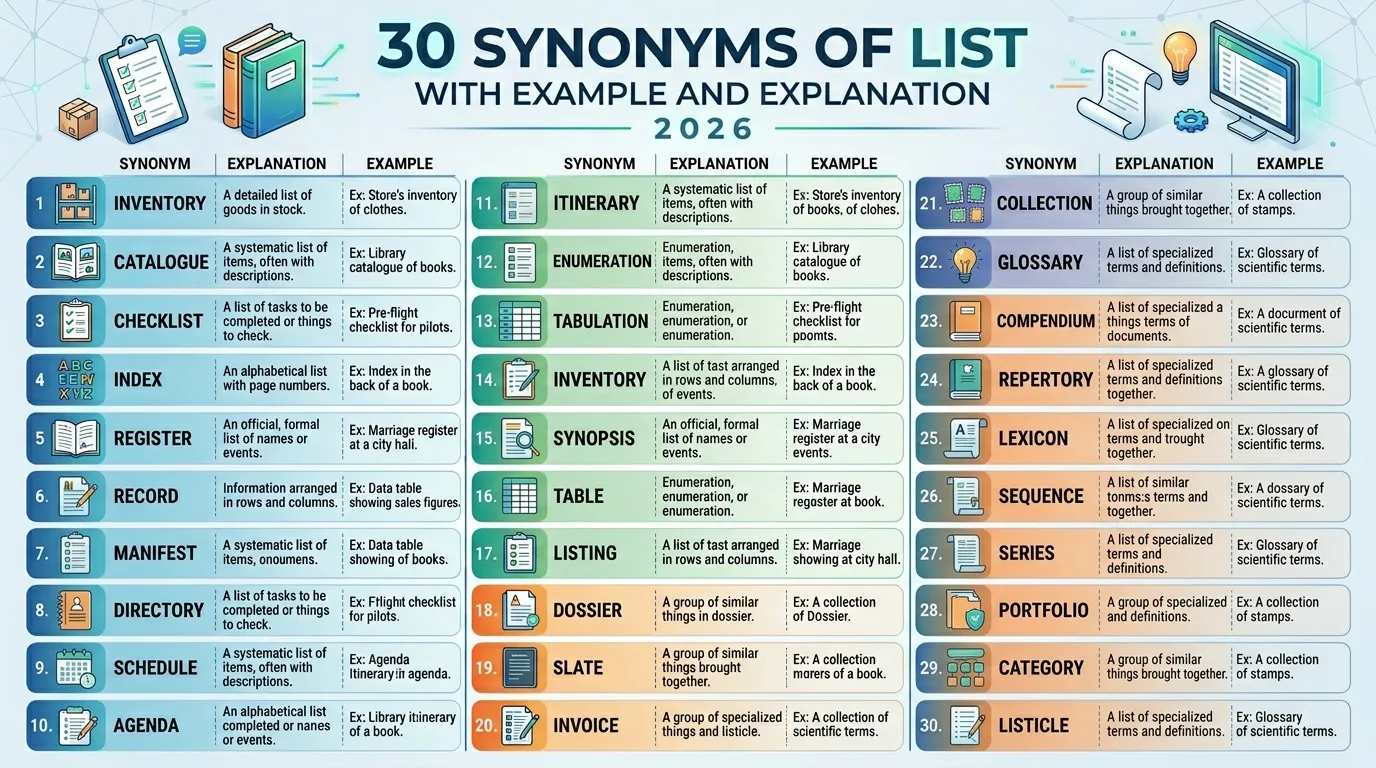
The word list is one of the most common words in English. A list is a collection of items, names, tasks, or pieces of information arranged in a particular order. Imagine you are going shopping. Before leaving home, you write down milk, bread, eggs, and fruit. That written collection is a list.
People use the word list every day in school, business, writing, planning, and daily life. Because it appears so often, learning its synonyms can help English learners express ideas more clearly and avoid repeating the same word.
For content writers, students, and professionals, knowing different words for list improves vocabulary, writing quality, and communication skills. In this article, you will learn the meaning of list, its pronunciation, grammar, history, connotation, word formation, and 30 useful synonyms with examples. You will also discover categories of synonyms, antonyms, and practical questions and answers to strengthen your English skills using Synonyms of List.
Meaning of List
Definition
List (Noun/Verb): A set of names, items, facts, or tasks written or presented one after another.
Examples
- I made a list of things to buy from the market.
- The teacher gave us a list of books to read during summer.
Connotative Meaning
- Positive tone: Organization, planning, preparation, efficiency.
- Negative tone: Restriction, bureaucracy, excessive categorization.
- Neutral tone: A simple collection of items or information.
Etymology
- Origin: Old English liste
- Source Language: Germanic languages
- Original Meaning: Border, edge, strip, or catalog of items
Short History of the Keyword
- Old English (450–1100): Used to describe borders, strips, or edges.
- Middle English (1100–1500): Began referring to recorded items and inventories.
- Modern English (1500–Present): Widely used for catalogs, records, schedules, and collections of information.
Pronunciation (US & UK – IPA)
US: /lɪst/
UK: /lɪst/
Syllables
list
Affixation Pattern of List
Root: list
Prefix: None
Suffix: None
Word Formation of the Keyword
- list (noun)
- list (verb)
- listed (adjective/verb)
- listing (noun/verb)
- listless (adjective)
- listlessly (adverb)
- listlessness (noun)
30 Synonyms of List
1. Catalog (Noun)
US: /ˈkætəlɔːɡ/ | UK: /ˈkætəlɒɡ/
Meaning: An organized list of items.
Examples:
- The company published a new catalog of products.
- I checked the catalog before ordering.
2. Inventory (Noun)
US: /ˈɪnvənˌtɔːri/ | UK: /ˈɪnvəntri/
Meaning: A detailed list of goods or items.
Examples:
- The store updated its inventory.
- We counted every item on the inventory.
3. Register (Noun)
US: /ˈredʒɪstər/ | UK: /ˈredʒɪstə/
Meaning: An official record of names or details.
Examples:
- The school keeps a student register.
- Her name appeared in the register.
4. Record (Noun)
US: /ˈrekərd/ | UK: /ˈrekɔːd/
Meaning: Written information kept for future reference.
Examples:
- The hospital maintains medical records.
- Keep a record of your expenses.
5. Index (Noun)
US: /ˈɪndeks/ | UK: /ˈɪndeks/
Meaning: An alphabetical list used for reference.
Examples:
- Use the index to find topics quickly.
- The index appears at the end of the book.
6. Directory (Noun)
US: /dəˈrektəri/ | UK: /daɪˈrektəri/
Meaning: A list containing names and information.
Examples:
- The phone directory is online now.
- Check the directory for contact details.
7. Schedule (Noun)
US: /ˈskedʒuːl/ | UK: /ˈʃedjuːl/
Meaning: A planned list of activities or events.
Examples:
- My schedule is very busy today.
- The schedule changed suddenly.
8. Roster (Noun)
US: /ˈrɑːstər/ | UK: /ˈrɒstə/
Meaning: A list of people or team members.
Examples:
- His name is on the roster.
- The coach updated the roster.
9. Roll (Noun)
US: /roʊl/ | UK: /rəʊl/
Meaning: A list of names.
Examples:
- The teacher called the roll.
- Everyone answered during roll call.
10. Enumeration (Noun)
US: /ɪˌnuːməˈreɪʃən/ | UK: /ɪˌnjuːməˈreɪʃən/
Meaning: A complete listing of items.
Examples:
- The report included an enumeration of facts.
- She gave a careful enumeration of expenses.
11. Checklist (Noun)
US: /ˈtʃeklɪst/ | UK: /ˈtʃeklɪst/
Meaning: A list used to verify tasks.
Examples:
- Use a checklist before traveling.
- The pilot reviewed the checklist.
12. Table (Noun)
US: /ˈteɪbəl/ | UK: /ˈteɪbəl/
Meaning: Information arranged in rows and columns.
Examples:
- The data appears in a table.
- Review the table carefully.
13. Register Book (Noun)
US: /ˈredʒɪstər bʊk/ | UK: /ˈredʒɪstə bʊk/
Meaning: A book containing records or names.
Examples:
- Sign the register book.
- The register book was updated.
14. Ledger (Noun)
US: /ˈledʒər/ | UK: /ˈledʒə/
Meaning: A book of financial records.
Examples:
- The accountant checked the ledger.
- All transactions were in the ledger.
15. Archive (Noun)
US: /ˈɑːrkaɪv/ | UK: /ˈɑːkaɪv/
Meaning: A collection of stored records.
Examples:
- The documents went into the archive.
- Researchers searched the archive.
16. Docket (Noun)
US: /ˈdɑːkɪt/ | UK: /ˈdɒkɪt/
Meaning: A list of scheduled matters.
Examples:
- The case appeared on today’s docket.
- Check the court docket.
17. Agenda (Noun)
US: /əˈdʒendə/ | UK: /əˈdʒendə/
Meaning: A list of topics to discuss.
Examples:
- The agenda contains five items.
- We followed the agenda closely.
18. Program (Noun)
US: /ˈproʊɡræm/ | UK: /ˈprəʊɡræm/
Meaning: A list of planned events.
Examples:
- The event program was printed.
- Read the program before the show.
19. Register Sheet (Noun)
US: /ˈredʒɪstər ʃiːt/ | UK: /ˈredʒɪstə ʃiːt/
Meaning: A sheet containing names or records.
Examples:
- Sign the register sheet.
- The register sheet was full.
20. Compilation (Noun)
US: /ˌkɑːmpəˈleɪʃən/ | UK: /ˌkɒmpɪˈleɪʃən/
Meaning: A collection gathered from various sources.
Examples:
- The book is a compilation of articles.
- She prepared a compilation of data.
21. Summary (Noun)
US: /ˈsʌməri/ | UK: /ˈsʌməri/
Meaning: A brief listing of key points.
Examples:
- Read the summary first.
- The summary highlighted major findings.
22. Outline (Noun)
US: /ˈaʊtlaɪn/ | UK: /ˈaʊtlaɪn/
Meaning: A structured list of main ideas.
Examples:
- Create an outline before writing.
- The outline improved organization.
23. Menu (Noun)
US: /ˈmenjuː/ | UK: /ˈmenjuː/
Meaning: A list of available choices.
Examples:
- The menu offers many dishes.
- I studied the menu carefully.
24. Register of Names (Noun)
US: /ˈredʒɪstər əv neɪmz/ | UK: /ˈredʒɪstə əv neɪmz/
Meaning: An official list of people.
Examples:
- The register of names was published.
- Check the register of names.
25. Itemization (Noun)
US: /ˌaɪtəmaɪˈzeɪʃən/ | UK: /ˌaɪtəmaɪˈzeɪʃən/
Meaning: A detailed listing of items.
Examples:
- The bill included itemization.
- Provide an itemization of costs.
26. Log (Noun)
US: /lɔːɡ/ | UK: /lɒɡ/
Meaning: A record of events or activities.
Examples:
- Keep a daily log.
- The captain reviewed the log.
27. Database (Noun)
US: /ˈdeɪtəbeɪs/ | UK: /ˈdeɪtəbeɪs/
Meaning: An organized collection of information.
Examples:
- The customer database grew quickly.
- Search the database for details.
28. Register Record (Noun)
US: /ˈredʒɪstər ˈrekərd/ | UK: /ˈredʒɪstə ˈrekɔːd/
Meaning: An official recorded entry.
Examples:
- The register record was verified.
- Every entry has a register record.
29. Enumeration Table (Noun)
US: /ɪˌnuːməˈreɪʃən ˈteɪbəl/ | UK: /ɪˌnjuːməˈreɪʃən ˈteɪbəl/
Meaning: A table showing listed items.
Examples:
- Review the enumeration table.
- The report included an enumeration table.
30. Listing (Noun)
US: /ˈlɪstɪŋ/ | UK: /ˈlɪstɪŋ/
Meaning: A written collection of items or information.
Examples:
- The property listing attracted buyers.
- Check the online listing.
Prototype Meaning
When people hear the word list, they usually imagine a written collection of items arranged one after another. It may be a shopping list, task list, guest list, or a list of names. The central idea is organization and easy reference using Synonyms of List.
Prototype Categorization
- Official Records: register, record, roster, roll, ledger.
- Business and Data: inventory, database, catalog, log.
- Planning and Organization: checklist, schedule, agenda, outline.
- Reference Materials: index, directory, archive.
- Collections and Summaries: compilation, summary, listing.
- Events and Activities: program, docket, menu.
Antonyms of List
- Disorder (Noun): Lack of organization.
- Chaos (Noun): Complete confusion.
- Mess (Noun): Untidy arrangement.
- Confusion (Noun): Unclear organization.
- Randomness (Noun): Absence of order.
- Disorganization (Noun): Poor arrangement of items.
- Scatter (Verb): To spread things without order.
- Mix-up (Noun): A confused arrangement.
Short Questions and Answers
- What does list mean?
A list is a collection of names, items, facts, or tasks arranged in order. - When should list be used?
Use it when presenting information, tasks, names, or items in an organized way. - Is list positive or negative?
It is generally neutral, though it may have a positive sense of organization. - How is it different from similar words?
A list is a general collection of items, while words like catalog, inventory, and register are more specialized types of lists.
Conclusion
The Synonyms of List is a simple but powerful English word used in everyday communication. Learning Synonyms of List helps expand vocabulary and gives writers more options for expressing ideas clearly. Different synonyms such as catalog, inventory, register, and checklist allow you to match the exact context of your message. This improves writing quality, strengthens speaking skills, and prevents unnecessary repetition. Understanding pronunciation, history, connotation, and related vocabulary also deepens language knowledge. By practicing one new synonym each day, English learners can build confidence, improve communication, and become more effective writers and speakers. Small vocabulary improvements create significant long-term language growth using Synonyms of List.

I’m Zahid Abbas, an educator, researcher, and digital publishing strategist with a passion for linguistics, grammar, and clear communication. As a content creator and SEO specialist, I craft research-driven, reader-focused content that empowers learners and makes knowledge accessible worldwide.