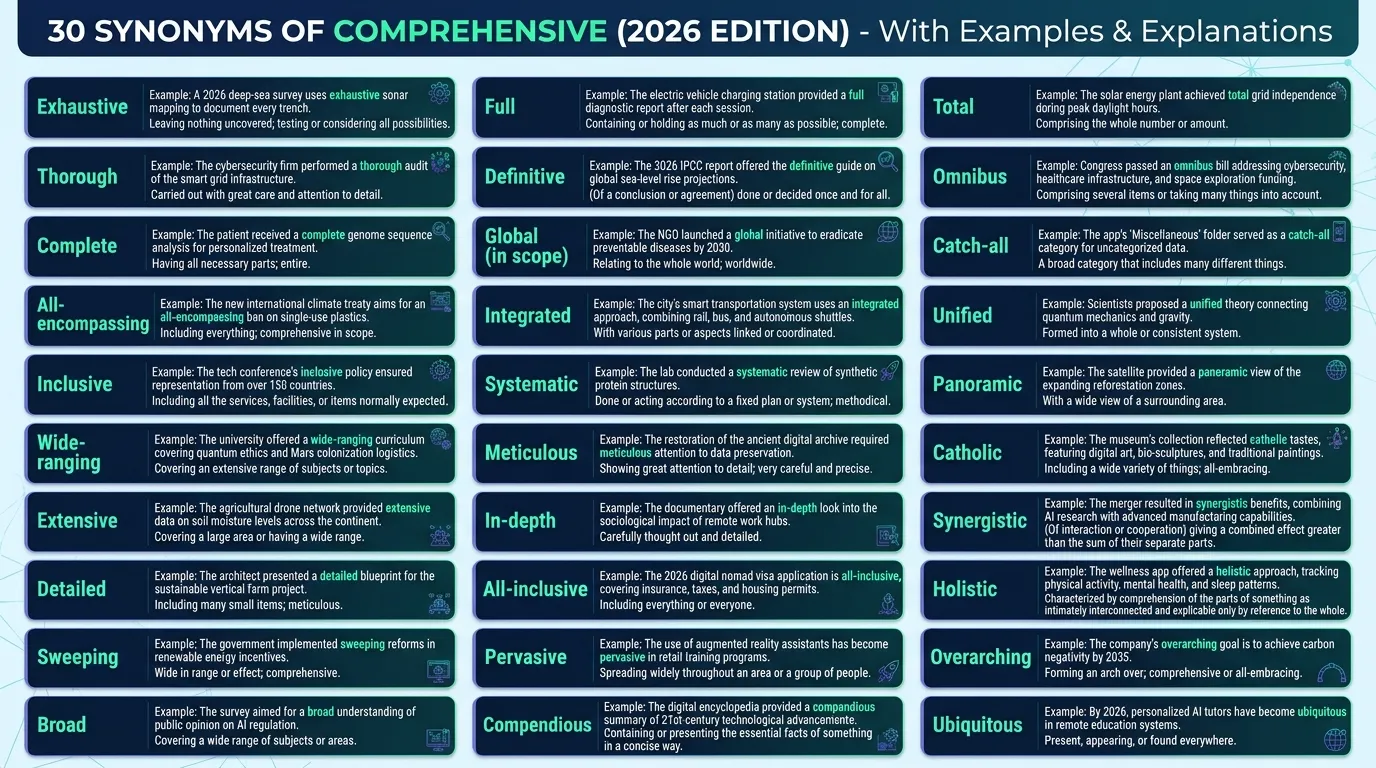
Comprehensive is a useful English word that means complete, thorough, and covering all important details. Imagine a student preparing for a final exam. Instead of reading only a few notes, the student studies a comprehensive guide that explains every topic. This helps the student understand the subject better and feel confident.
The word comprehensive is common in education, business, research, writing, and everyday communication. People use it when they want to describe something that includes all necessary information.
Learning synonyms of comprehensive is important for English learners and content writers because it improves vocabulary, makes writing more interesting, and helps avoid repeating the same word. In this article, you will learn the meaning of comprehensive, its pronunciation, history, grammar, semantic categories, and 30 powerful synonyms with simple examples.
Meaning of Comprehensive
Comprehensive (Adjective):
A complete and detailed thing that includes all important parts or information.
Examples
- The report provides a comprehensive review of the project.
- She created a comprehensive study plan for her exams.
Connotative Meaning
- Positive tone: Complete, reliable, informative, well-organized.
- Negative tone: Sometimes suggests something is very long or complex.
- Neutral tone: Simply means covering many details or areas.
Etymology
- Origin: Latin
- Source word: comprehendere
- Original meaning: “to grasp, seize, or include”
Short History of the Keyword
- Old English (450–1100): The word did not exist in Old English.
- Middle English (1100–1500): Ideas related to understanding and including appeared through Latin influence.
- Modern English (1500–Present): Comprehensive became widely used to describe something complete and inclusive.
Pronunciation (US & UK – IPA)
US: /ˌkɑːmprɪˈhensɪv/
UK: /ˌkɒmprɪˈhensɪv/
Syllables
com-pre-hen-sive
Affixation Pattern of Comprehensive
Root: comprehens
Prefix: com-
Suffix: -ive
Word Formation of Comprehensive
- Comprehensive (Adjective)
- Comprehensively (Adverb)
- Comprehensiveness (Noun)
- Comprehend (Verb)
- Comprehension (Noun)
- Comprehensible (Adjective)
- Incomprehensible (Adjective)
30 Synonyms of Comprehensive
1. Thorough (Adjective)
US: /ˈθɝːoʊ/ | UK: /ˈθʌrə/
Meaning: Done with great care and attention to detail.
Examples:
- He conducted a thorough investigation.
- The teacher gave a thorough explanation.
2. Complete (Adjective)
US: /kəmˈpliːt/ | UK: /kəmˈpliːt/
Meaning: Having all parts included.
Examples:
- The project is complete now.
- We need a complete record.
3. Extensive (Adjective)
US: /ɪkˈstensɪv/ | UK: /ɪkˈstensɪv/
Meaning: Covering a large area or amount.
Examples:
- The library has extensive resources.
- She has extensive experience.
4. Detailed (Adjective)
US: /ˈdiːteɪld/ | UK: /ˈdiːteɪld/
Meaning: Including many specific facts.
Examples:
- The report was detailed.
- We received detailed instructions.
5. Exhaustive (Adjective)
US: /ɪɡˈzɔːstɪv/ | UK: /ɪɡˈzɔːstɪv/
Meaning: Including every possible detail.
Examples:
- Researchers conducted an exhaustive study.
- The guide offers exhaustive information.
6. Inclusive (Adjective)
US: /ɪnˈkluːsɪv/ | UK: /ɪnˈkluːsɪv/
Meaning: Including all relevant people or things.
Examples:
- The policy is inclusive.
- The event welcomed everyone.
7. Broad (Adjective)
US: /brɔːd/ | UK: /brɔːd/
Meaning: Covering many subjects or areas.
Examples:
- He has broad knowledge.
- The discussion was broad.
8. All-inclusive (Adjective)
US: /ˌɔːl ɪnˈkluːsɪv/ | UK: /ˌɔːl ɪnˈkluːsɪv/
Meaning: Including everything.
Examples:
- The package was all-inclusive.
- The service covers all costs.
9. In-depth (Adjective)
US: /ˌɪnˈdepθ/ | UK: /ˌɪnˈdepθ/
Meaning: Very detailed and careful.
Examples:
- The article gives in-depth analysis.
- We had an in-depth discussion.
10. Sweeping (Adjective)
US: /ˈswiːpɪŋ/ | UK: /ˈswiːpɪŋ/
Meaning: Affecting many areas.
Examples:
- The reforms were sweeping.
- The changes were sweeping.
11. Encyclopedic (Adjective)
US: /ɛnˌsaɪkləˈpiːdɪk/ | UK: /ɛnˌsaɪkləˈpiːdɪk/
Meaning: Containing a vast amount of knowledge.
Examples:
- She has encyclopedic knowledge.
- The book is encyclopedic.
12. Full (Adjective)
US: /fʊl/ | UK: /fʊl/
Meaning: Containing everything needed.
Examples:
- Give the full details.
- We received a full report.
13. Wide-ranging (Adjective)
US: /ˌwaɪd ˈreɪndʒɪŋ/ | UK: /ˌwaɪd ˈreɪndʒɪŋ/
Meaning: Covering many topics.
Examples:
- The survey was wide-ranging.
- They discussed wide-ranging issues.
14. All-embracing (Adjective)
US: /ˌɔːl ɪmˈbreɪsɪŋ/ | UK: /ˌɔːl ɪmˈbreɪsɪŋ/
Meaning: Including everything.
Examples:
- The plan was all-embracing.
- The policy was all-embracing.
15. Far-reaching (Adjective)
US: /ˌfɑːr ˈriːtʃɪŋ/ | UK: /ˌfɑː ˈriːtʃɪŋ/
Meaning: Having a wide effect.
Examples:
- The decision had far-reaching consequences.
- The law brought far-reaching changes.
16. Complete-scale (Adjective)
US: /kəmˈpliːt skeɪl/ | UK: /kəmˈpliːt skeɪl/
Meaning: Covering all levels.
Examples:
- The review was complete-scale.
- The analysis covered every area.
17. Holistic (Adjective)
US: /hoʊˈlɪstɪk/ | UK: /həʊˈlɪstɪk/
Meaning: Considering the whole rather than parts.
Examples:
- The school uses a holistic approach.
- We need a holistic solution.
18. Integrated (Adjective)
US: /ˈɪntɪɡreɪtɪd/ | UK: /ˈɪntɪɡreɪtɪd/
Meaning: Combined into a complete whole.
Examples:
- The system is integrated.
- They developed an integrated plan.
19. Elaborate (Adjective)
US: /ɪˈlæbərət/ | UK: /ɪˈlæbərət/
Meaning: Rich in details.
Examples:
- She provided an elaborate explanation.
- The design is elaborate.
20. Minute (Adjective)
US: /maɪˈnuːt/ | UK: /maɪˈnjuːt/
Meaning: Very detailed.
Examples:
- The report examined minute details.
- He noticed minute differences.
21. Careful (Adjective)
US: /ˈkerfəl/ | UK: /ˈkeəfəl/
Meaning: Done with attention.
Examples:
- She made a careful review.
- The inspection was careful.
22. Meticulous (Adjective)
US: /məˈtɪkjələs/ | UK: /məˈtɪkjələs/
Meaning: Extremely careful and precise.
Examples:
- He is meticulous in his work.
- The records were meticulously prepared.
23. Systematic (Adjective)
US: /ˌsɪstəˈmætɪk/ | UK: /ˌsɪstəˈmætɪk/
Meaning: Organized and methodical.
Examples:
- The team used a systematic approach.
- Learning became systematic.
24. Rigorous (Adjective)
US: /ˈrɪɡərəs/ | UK: /ˈrɪɡərəs/
Meaning: Extremely thorough and strict.
Examples:
- The testing process was rigorous.
- Researchers followed rigorous methods.
25. Methodical (Adjective)
US: /məˈθɑːdɪkəl/ | UK: /məˈθɒdɪkəl/
Meaning: Done in an organized way.
Examples:
- She is methodical in planning.
- The work followed a methodical process.
26. Multifaceted (Adjective)
US: /ˌmʌltiˈfæsɪtɪd/ | UK: /ˌmʌltiˈfæsɪtɪd/
Meaning: Having many aspects.
Examples:
- The issue is multifaceted.
- They proposed a multifaceted solution.
27. Universal (Adjective)
US: /ˌjuːnɪˈvɜːrsəl/ | UK: /ˌjuːnɪˈvɜːsəl/
Meaning: Applying to all.
Examples:
- The rule is universal.
- The idea has universal appeal.
28. Total (Adjective)
US: /ˈtoʊtəl/ | UK: /ˈtəʊtəl/
Meaning: Whole and complete.
Examples:
- The total cost was listed.
- They wanted total coverage.
29. Thoroughgoing (Adjective)
US: /ˈθɝːoʊɡoʊɪŋ/ | UK: /ˈθʌrəɡəʊɪŋ/
Meaning: Complete in every respect.
Examples:
- The review was thoroughgoing.
- He made a thoroughgoing study.
30. Comprehensive-minded (Adjective)
US: /ˌkɑːmprɪˈhensɪv maɪndɪd/ | UK: /ˌkɒmprɪˈhensɪv maɪndɪd/
Meaning: Thinking about all aspects of a subject.
Examples:
- She is a comprehensive-minded leader.
- The manager takes a comprehensive-minded approach.
Prototype Meaning
The typical meaning of comprehensive is something that covers all important information, parts, or aspects of a topic. People usually imagine a detailed report, guide, study, or plan that leaves nothing important out.
Prototype Categorization
- For completeness: Complete, Full, Total, All-inclusive, All-embracing.
- For detail: Detailed, Thorough, Exhaustive, Elaborate, Minute.
- For research and analysis: Rigorous, Meticulous, Systematic, Methodical, In-depth.
- For broad coverage: Extensive, Broad, Wide-ranging, Sweeping, Far-reaching.
- For whole-picture thinking: Holistic, Integrated, Multifaceted, Universal.
Antonyms of Comprehensive
- Limited (Adjective): Covering only a small part.
- Partial (Adjective): Not complete.
- Incomplete (Adjective): Missing important parts.
- Restricted (Adjective): Limited in scope.
- Narrow (Adjective): Covering few areas.
- Selective (Adjective): Including only certain parts.
- Fragmentary (Adjective): Existing in incomplete pieces.
- Superficial (Adjective): Not detailed or deep.
- Sketchy (Adjective): Lacking important details.
- Brief (Adjective): Short and not extensive.
Short Questions and Answers
- What does comprehensive mean?
A comprehensive thing is complete and includes all important details. - When should comprehensive be used?
Use it when something covers a topic fully and thoroughly. - Is comprehensive positive or negative?
It is usually positive because it suggests completeness and reliability, though it can sometimes imply a large amount of information. - How is it different from similar words?
Comprehensive focuses on complete coverage, while words like detailed focus mainly on depth and broad focuses mainly on range.
Conclusion
Learning the Synonyms of Comprehensive and Synonyms of Comprehensive can greatly improve your English vocabulary. These words help you express ideas more clearly in speaking and writing. Using different synonyms also makes your content more interesting and prevents repetition. Understanding pronunciation, meaning, connotation, and usage allows you to choose the right word for each situation. Whether you are a student, teacher, writer, or English learner, expanding your vocabulary builds confidence and communication skills. Make vocabulary learning a daily habit. Practice using one new synonym each day in conversations and writing. Over time, your English will become richer, stronger, and more natural.

I’m Zahid Abbas, an educator, researcher, and digital publishing strategist with a passion for linguistics, grammar, and clear communication. As a content creator and SEO specialist, I craft research-driven, reader-focused content that empowers learners and makes knowledge accessible worldwide.