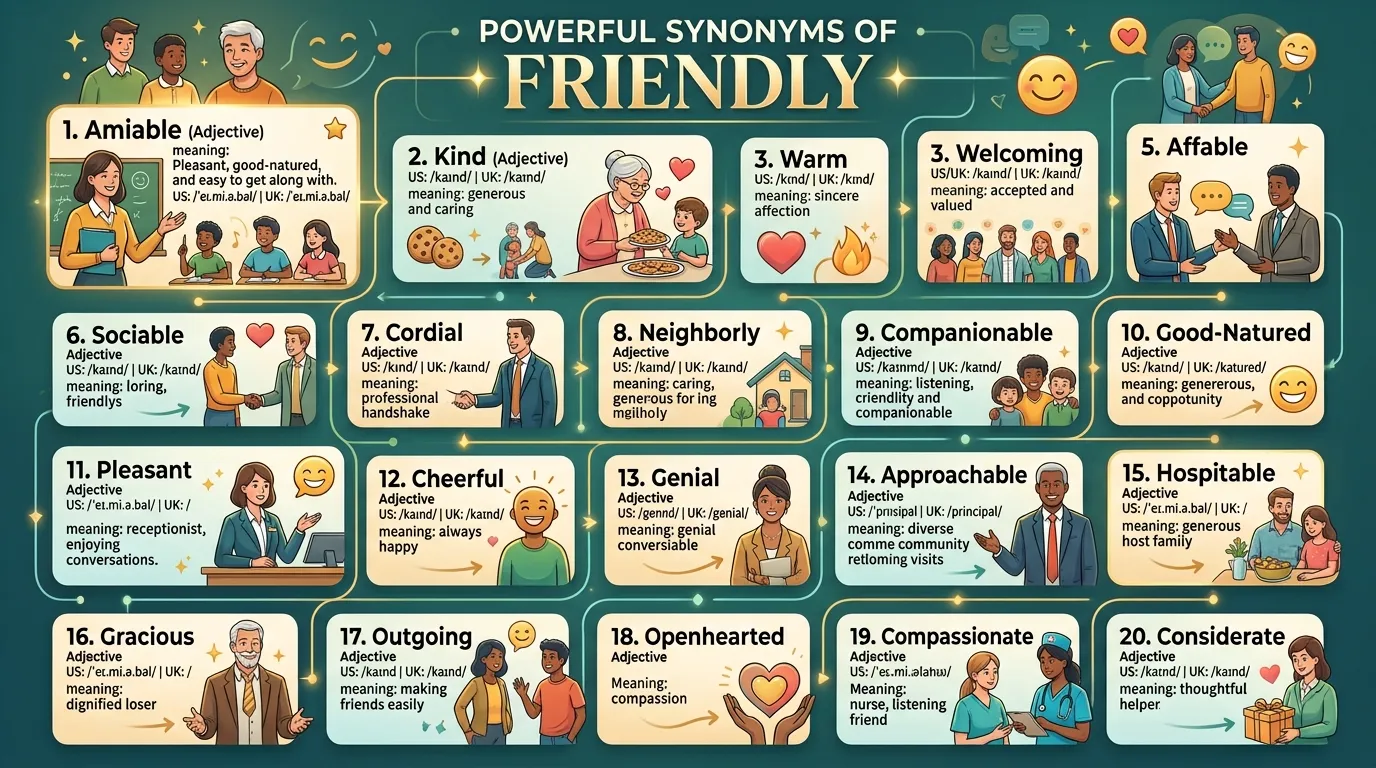
Think about the last time someone smiled at you, held the door open, or welcomed you into a new place. You probably described that person as friendly. It is one of the first English words many learners use because it expresses kindness, warmth, and a positive attitude in a simple way. Whether you are talking about a helpful neighbor, a cheerful teacher, excellent customer service, or even easy-to-use software, friendly is a word that appears in everyday English.
However, using the same word repeatedly can make your writing sound repetitive. Learning the synonyms of friendly helps students, teachers, writers, bloggers, and English learners communicate with greater variety and confidence. In this guide, you will discover the meaning of friendly, its pronunciation, grammar, history, word formation, emotional tone, and 30 carefully selected synonyms with easy definitions, natural examples, and pronunciation. By the end of this article, you will know which synonym works best in different situations and how to use each one naturally.
Friendly at a Glance
FeatureDetailsWordFriendlyPart of SpeechAdjectiveMeaningKind, pleasant, welcoming, and easy to get along withCommon TonePositiveCommon SynonymsAmiable, Kind, Affable, Cordial, ApproachableCommon AntonymUnfriendlyUsed ForPeople, animals, workplaces, communities, technology, customer service
Meaning of Friendly
Friendly describes someone or something that is kind, welcoming, pleasant, and easy to approach. A friendly person makes others feel comfortable, respected, and accepted. The word can also describe places, businesses, services, animals, and even technology that is simple and enjoyable to use.
Definition
Friendly (Adjective)
A person, place, or thing that shows kindness, warmth, goodwill, and a welcoming attitude toward others.
Examples of Friendly
- Sarah is always friendly to new students and helps them settle into class.
- The hotel staff were extremely friendly, making every guest feel welcome.
Connotative Meaning
- Positive Tone: Kind, welcoming, warm, approachable, caring, supportive, cheerful.
- Negative Tone: In rare situations, friendly may suggest someone is overly familiar or too trusting.
- Neutral Tone: It simply describes pleasant or polite behavior without expressing strong emotion.
Etymology
- It comes from the Old English word frēondlīc.
- It is formed from friend + the adjective-forming suffix -ly.
- The original meaning was “like a friend” or “having the qualities of a friend.”
A Brief History of the Word
Old English (450–1100)
The word appeared as frēondlīc, describing someone who behaved like a loyal and trustworthy friend.
Middle English (1100–1500)
Its spelling gradually changed to friendly, and its meaning expanded to include kindness, warmth, and pleasant behavior.
Modern English (1500–Present)
Today, friendly is used to describe not only people but also animals, communities, businesses, customer service, workplaces, technology, and environments that are welcoming or easy to use.
Pronunciation (US & UK IPA)
US: /ˈfrɛnd.li/
UK: /ˈfrend.li/
Syllables
friend·ly
Affixation Pattern
Root: friend
Prefix: None
Suffix: -ly
Word Family (Word Formation)
- Friend (Noun) — A person you know, like, and trust.
- Friendly (Adjective) — Kind, warm, and welcoming.
- Friendliness (Noun) — The quality of being friendly.
- Friendship (Noun) — A close relationship between friends.
- Befriend (Verb) — To become someone’s friend.
- Friendless (Adjective) — Having no friends.
- Unfriendly (Adjective) — Not welcoming or kind.
- Unfriend (Verb) — To remove someone from a social media friends list.
Synonyms of Friendly
1. Amiable (Adjective)
US: /ˈeɪ.mi.ə.bəl/ | UK: /ˈeɪ.mi.ə.bəl/
Meaning: Pleasant, good-natured, and easy to get along with.
Best used when: Describing someone with a naturally pleasant personality.
Examples
- The new teacher is very amiable, so students enjoy her classes.
- His amiable personality helped him make friends quickly.
2. Kind (Adjective)
US: /kaɪnd/ | UK: /kaɪnd/
Meaning: Caring, generous, and willing to help others.
Best used when: Talking about thoughtful actions or genuine concern for people.
Examples
- My grandmother is always kind to everyone she meets.
- A kind word can make someone’s day much better.
3. Warm (Adjective)
US: /wɔːrm/ | UK: /wɔːm/
Meaning: Showing affection, sincerity, and kindness.
Best used when: Describing someone’s personality or the way they welcome others.
Examples
- She gave us a warm welcome at the door.
- His warm smile made everyone feel comfortable.
4. Welcoming (Adjective)
US: /ˈwel.kəm.ɪŋ/ | UK: /ˈwel.kə.mɪŋ/
Meaning: Making people feel accepted, valued, and comfortable.
Best used when: Talking about places, homes, organizations, or communities.
Examples
- The village was very welcoming to visitors.
- They created a welcoming workplace for new employees.
5. Affable (Adjective)
US: /ˈæf.ə.bəl/ | UK: /ˈæf.ə.bəl/
Meaning: Easy to talk to, polite, and pleasant.
Best used when: Describing someone who enjoys conversations and treats people kindly.
Examples
- The manager was both professional and affable.
- His affable manner impressed every customer.
6. Sociable (Adjective)
US: /ˈsoʊ.ʃə.bəl/ | UK: /ˈsəʊ.ʃə.bəl/
Meaning: Enjoying meeting people and spending time with others.
Best used when: Talking about outgoing people who like social activities.
Examples
- Emma is very sociable and enjoys meeting new people.
- A sociable personality makes teamwork easier.
7. Cordial (Adjective)
US: /ˈkɔːr.dʒəl/ | UK: /ˈkɔː.di.əl/
Meaning: Warm, polite, and respectful.
Best used when: Describing formal friendliness in business or professional settings.
Examples
- The meeting ended with a cordial handshake.
- We received a cordial welcome from the organizers.
8. Neighborly (Adjective)
US: /ˈneɪ.bɚ.li/ | UK: /ˈneɪ.bəli/
Meaning: Friendly, generous, and helpful toward neighbors.
Best used when: Talking about communities or neighborhood relationships.
Examples
- The community has a strong neighborly spirit.
- Our neighborly neighbors often help during emergencies.
9. Companionable (Adjective)
US: /kəmˈpæn.jə.nə.bəl/ | UK: /kəmˈpæn.jə.nə.bəl/
Meaning: Pleasant and enjoyable to spend time with.
Best used when: Describing someone whose company is relaxing and enjoyable.
Examples
- He is a companionable travel partner.
- We spent a companionable evening chatting together.
10. Good-Natured (Adjective)
US: /ˌɡʊd ˈneɪ.tʃɚd/ | UK: /ˌɡʊd ˈneɪ.tʃəd/
Meaning: Naturally cheerful, patient, and pleasant.
Best used when: Describing someone who stays calm and positive even in difficult situations.
Examples
- Tom remained good-natured despite the long delay.
- Her good-natured attitude made the whole team feel relaxed.
11. Pleasant (Adjective)
US: /ˈplez.ənt/ | UK: /ˈplez.ənt/
Meaning: Kind, enjoyable, and agreeable in behavior or attitude.
Best used when: Describing someone, a conversation, an experience, or an environment that feels enjoyable and comfortable.
Examples
- The receptionist was pleasant and answered every question with a smile.
- We had a pleasant conversation during lunch.
Quick Tip: Pleasant can describe both people and experiences, while friendly is more commonly used for people and behavior.
12. Cheerful (Adjective)
US: /ˈtʃɪr.fəl/ | UK: /ˈtʃɪə.fəl/
Meaning: Happy, optimistic, and full of positive energy.
Best used when: Describing someone who spreads happiness through their attitude.
Examples
- She is always cheerful, even on busy mornings.
- His cheerful greeting brightened everyone’s day.
Quick Tip: Cheerful emphasizes happiness, while friendly emphasizes kindness.
13. Genial (Adjective)
US: /ˈdʒiː.ni.əl/ | UK: /ˈdʒiː.ni.əl/
Meaning: Warm, welcoming, and naturally pleasant.
Best used when: Referring to someone with an easy-going and likable personality.
Examples
- The host remained genial throughout the dinner party.
- Everyone appreciated his genial sense of humor.
Quick Tip: Genial often suggests a mature, naturally warm personality.
14. Approachable (Adjective)
US: /əˈproʊ.tʃə.bəl/ | UK: /əˈprəʊ.tʃə.bəl/
Meaning: Easy to speak to or ask for help.
Best used when: Describing teachers, managers, leaders, or anyone who makes others feel comfortable asking questions.
Examples
- Our principal is very approachable.
- She looks approachable, so people often ask her for directions.
Quick Tip: Someone can be approachable without being highly sociable.
15. Hospitable (Adjective)
US: /hɑːˈspɪt̬ə.bəl/ | UK: /hɒˈspɪt.ə.bəl/
Meaning: Warm and generous toward guests and visitors.
Best used when: Talking about families, homes, hotels, or cultures that welcome visitors.
Examples
- The family was incredibly hospitable during our visit.
- Their hospitable nature made us feel completely at home.
Quick Tip: Hospitable is mainly used when people receive or entertain guests.
16. Gracious (Adjective)
US: /ˈɡreɪ.ʃəs/ | UK: /ˈɡreɪ.ʃəs/
Meaning: Kind, polite, respectful, and generous.
Best used when: Describing someone who remains courteous, even in difficult situations.
Examples
- She was gracious even after losing the competition.
- Our host remained gracious throughout the evening.
Quick Tip: Gracious often suggests dignity and elegance in behavior.
17. Outgoing (Adjective)
US: /ˈaʊtˌɡoʊ.ɪŋ/ | UK: /ˈaʊtˌɡəʊ.ɪŋ/
Meaning: Enjoying meeting new people and making friends easily.
Best used when: Describing people who are confident in social situations.
Examples
- Jake is an outgoing student who enjoys group activities.
- Her outgoing personality helped her build friendships quickly.
Quick Tip: Outgoing focuses on being social, while friendly focuses on being kind.
18. Openhearted (Adjective)
US: /ˌoʊ.pənˈhɑːr.tɪd/ | UK: /ˌəʊ.pənˈhɑː.tɪd/
Meaning: Honest, generous, sincere, and warm toward others.
Best used when: Describing people who openly express kindness and compassion.
Examples
- Everyone admired her openhearted nature.
- He gave us an openhearted welcome.
Quick Tip: Openhearted suggests emotional warmth and generosity.
19. Compassionate (Adjective)
US: /kəmˈpæʃ.ən.ət/ | UK: /kəmˈpæʃ.ən.ət/
Meaning: Showing deep care and understanding for people who are suffering.
Best used when: Talking about healthcare workers, volunteers, teachers, or supportive friends.
Examples
- The nurse was compassionate with every patient.
- A compassionate friend listens without judging.
20. Considerate (Adjective)
US: /kənˈsɪd.ɚ.ət/ | UK: /kənˈsɪd.ər.ət/
Meaning: Thoughtful and careful about other people’s feelings and needs.
Best used when: Describing respectful actions that show concern for others.
Examples
- Please be considerate when others are speaking.
Quick Tip: A considerate person thinks about how their actions affect other people.
21. Kindhearted (Adjective)
US: /ˌkaɪndˈhɑːr.t̬ɪd/ | UK: /ˌkaɪndˈhɑː.tɪd/
Meaning: Naturally caring, generous, and thoughtful toward others.
Best used when: Describing someone who genuinely enjoys helping people.
Examples
- My aunt is kindhearted and never refuses to help someone in need.
- Everyone appreciates her kindhearted nature.
Quick Tip: Kindhearted emphasizes a person’s naturally caring character rather than a single kind action.
22. Caring (Adjective)
US: /ˈker.ɪŋ/ | UK: /ˈkeə.rɪŋ/
Meaning: Showing concern, kindness, and support for others.
Best used when: Talking about parents, teachers, doctors, nurses, or close friends.
Examples
- She is a caring mother who always puts her family first.
- Our teacher is patient, caring, and encouraging.
Quick Tip: Caring focuses more on emotional support than general friendliness.
23. Helpful (Adjective)
US: /ˈhelp.fəl/ | UK: /ˈhelp.fəl/
Meaning: Ready and willing to provide assistance.
Best used when: Describing people, customer service, advice, or useful information.
Examples
- The shop assistant was extremely helpful.
- Thank you for your helpful advice.
Quick Tip: Someone can be helpful without being particularly sociable.
24. Polite (Adjective)
US: /pəˈlaɪt/ | UK: /pəˈlaɪt/
Meaning: Showing good manners, respect, and courtesy.
Best used when: Talking about respectful speech and behavior.
Examples
- The children were polite to their guests.
- Always be polite when speaking to strangers.
Quick Tip: Polite describes good manners, while friendly adds warmth and kindness.
25. Courteous (Adjective)
US: /ˈkɝː.t̬i.əs/ | UK: /ˈkɜː.ti.əs/
Meaning: Very polite, respectful, and considerate.
Best used when: Describing formal communication or professional customer service.
Examples
- The flight attendants were courteous throughout the journey.
- He gave a courteous reply to every customer.
Quick Tip: Courteous sounds more formal than polite.
26. Nice (Adjective)
US: /naɪs/ | UK: /naɪs/
Meaning: Pleasant, kind, and enjoyable.
Best used when: Casual conversations and everyday English.
Examples
- She is a nice neighbor who always says hello.
- It was nice to meet your family.
Quick Tip: Nice is common in everyday speech, but using more specific synonyms makes your vocabulary richer.
27. Gentle (Adjective)
US: /ˈdʒen.t̬əl/ | UK: /ˈdʒen.təl/
Meaning: Calm, kind, and not rough in words or actions.
Best used when: Describing a person’s voice, behavior, or touch.
Examples
- The doctor spoke in a gentle voice.
- Be gentle with the puppy.
Quick Tip: Gentle highlights softness and patience rather than sociability.
28. Sweet (Adjective)
US: /swiːt/ | UK: /swiːt/
Meaning: Kind, thoughtful, and lovable.
Best used when: Describing thoughtful actions or someone’s lovable personality.
Examples
- That was a sweet thing to say.
- She has a sweet personality that everyone admires.
Quick Tip: Sweet often expresses affection and emotional warmth.
29. Easygoing (Adjective)
US: /ˌiː.ziˈɡoʊ.ɪŋ/ | UK: /ˌiː.ziˈɡəʊ.ɪŋ/
Meaning: Relaxed, calm, and pleasant to spend time with.
Best used when: Talking about people who rarely become stressed or angry.
Examples
- My uncle is easygoing and enjoys every situation.
- An easygoing manager creates a positive workplace.
Quick Tip: Easygoing describes a relaxed personality more than friendliness itself.
30. Charitable (Adjective)
US: /ˈtʃer.ə.t̬ə.bəl/ | UK: /ˈtʃær.ɪ.tə.bəl/
Meaning: Generous and willing to help people in need.
Best used when: Referring to donations, volunteer work, or acts of generosity.
Examples
- The community is charitable toward families in need.
- Her charitable work inspired many young volunteers.
What Do People Usually Mean by “Friendly”?
When people hear the word friendly, they usually imagine someone who smiles often, speaks politely, listens with interest, and makes others feel welcome. A friendly person is approachable, respectful, and easy to spend time with. The word also describes places, workplaces, communities, and services that create a comfortable and positive experience. In everyday English, friendly is strongly associated with kindness, trust, warmth, and good relationships.
Final Thoughts
Learning Synonyms of Friendly and Synonyms of Friendly is a simple but effective way to expand your English vocabulary. Each synonym adds a different shade of meaning, allowing you to describe people, personalities, relationships, and situations more accurately. Instead of repeating the same word, you can choose alternatives like amiable, cordial, approachable, kindhearted, or compassionate to make your writing richer and more engaging.
Whether you are a student, English learner, teacher, blogger, or professional writer, using a wider range of vocabulary improves both speaking and writing. It also makes your communication sound more natural and confident. The best way to master these words is to practice using one or two new synonyms every day in conversations, emails, essays, or social media posts. Over time, these small improvements will strengthen your vocabulary and help you communicate with greater clarity and confidence.

I’m Zahid Abbas, an educator, researcher, and digital publishing strategist with a passion for linguistics, grammar, and clear communication. As a content creator and SEO specialist, I craft research-driven, reader-focused content that empowers learners and makes knowledge accessible worldwide.