The word ambiguous means something that has more than one possible meaning or is not clear. Imagine you receive a text message that simply says, “We’ll see.” You may not know if the person means yes, no, or maybe. The message is ambiguous because it can be understood in different ways.
People often use the word ambiguous in daily conversations, business writing, legal documents, literature, and academic English. Learning synonyms of ambiguous helps English learners understand different shades of meaning and avoid repeating the same word. It also helps writers create more interesting and accurate content. In this article, you will learn the meaning of ambiguous, its definition, pronunciation, history, grammar, word formation, and semantic categories. You will also discover useful synonyms with simple meanings and examples to improve your English vocabulary.
Meaning of Ambiguous
Definition
Ambiguous (Adjective):
Something is ambiguous when it has two or more possible meanings or when its meaning is not clear.
Examples
Example sentence using ambiguous:
The teacher gave an ambiguous answer that confused the students.
Another natural sentence:
His message was ambiguous, so nobody knew what he really wanted.
Connotative Meaning
- Positive tone: Can describe creative writing, poetry, or art that invites different interpretations.
- Negative tone: Can describe unclear instructions, confusing messages, or misleading information.
- Neutral tone: Often used simply to describe language or situations that have more than one possible meaning.
Etymology
- Source language: Latin
- Original word: ambiguus
- Original meaning: “Moving from side to side,” “uncertain,” or “having more than one meaning.”
Short History of the Keyword
- Old English (450–1100): The exact word ambiguous was not used. English speakers used native words that meant “uncertain” or “doubtful.”
- Middle English (1100–1500): The idea entered English through French and Latin influence after the Norman Conquest.
- Modern English (1500–Present): Ambiguous became a common adjective in literature, education, law, science, and everyday communication to describe unclear or double meanings.
Pronunciation (US & UK – IPA)
US: /æmˈbɪɡ.ju.əs/
UK: /æmˈbɪɡ.ju.əs/
Syllables
am-big-u-ous
Affixation Pattern of Ambiguous
Root:
- ambi (both, around)
- ag (to move)
Prefix:
- ambi- (both)
Suffix:
- -ous (forming an adjective)
Word Formation of the Keyword
- Ambiguous — adjective
- Ambiguity — noun
- Ambiguously — adverb
- Unambiguous — adjective
- Unambiguously — adverb
- Unambiguity — noun (rare)
Synonyms of Ambiguous
1. Unclear (Adjective)
US: /ʌnˈklɪr/ | UK: /ʌnˈklɪə/
Meaning: Not easy to understand or not expressed clearly.
Examples:
- The directions were unclear, so we got lost.
- His explanation was unclear to the new students.
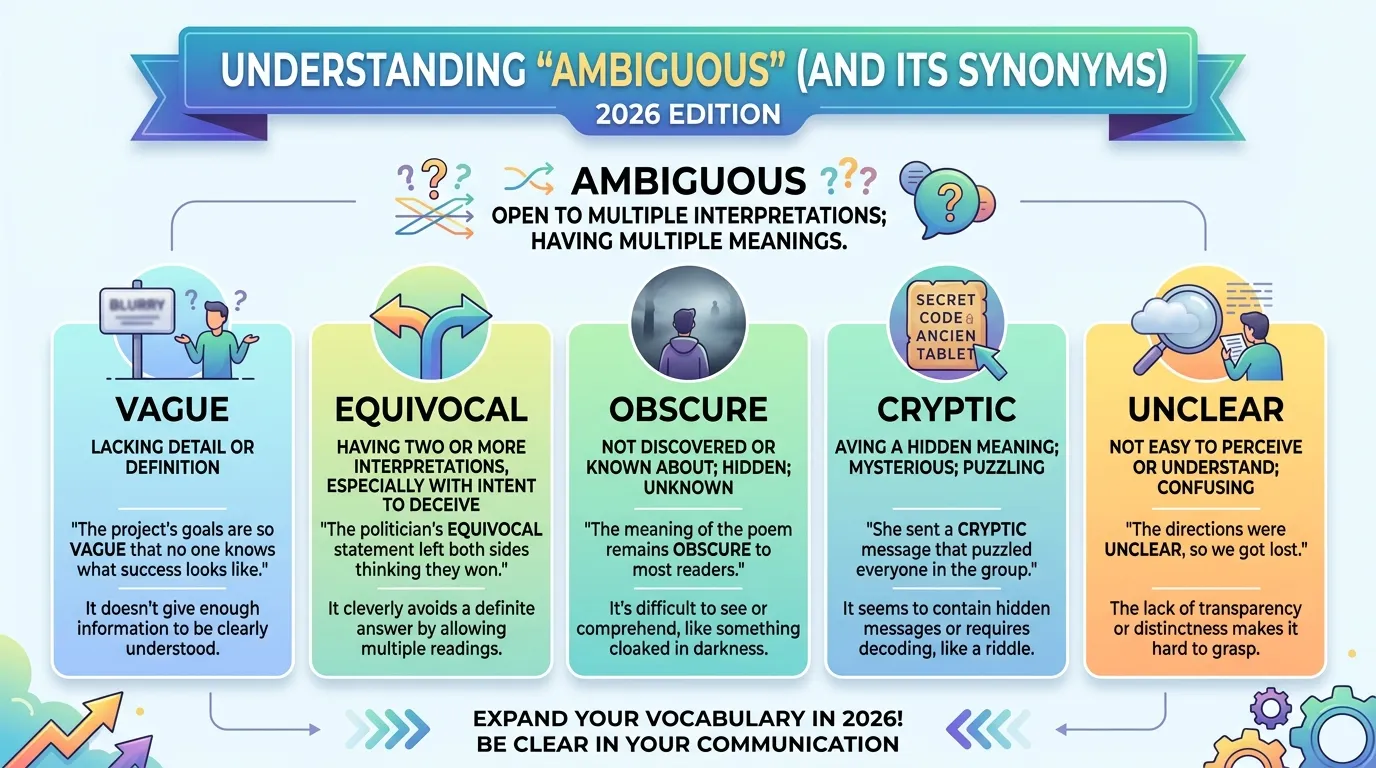
2. Vague (Adjective)
US: /veɪɡ/ | UK: /veɪɡ/
Meaning: Not expressed in enough detail or not specific.
Examples:
- She gave a vague answer about her plans.
- The report was too vague to be useful.
3. Equivocal (Adjective)
US: /ɪˈkwɪvəkəl/ | UK: /ɪˈkwɪvəkəl/
Meaning: Open to more than one interpretation or intentionally unclear.
Examples:
- The witness gave an equivocal response.
- His statement remained equivocal throughout the interview.
4. Indefinite (Adjective)
US: /ɪnˈdefənət/ | UK: /ɪnˈdefɪnət/
Meaning: Not exact, fixed, or clearly defined.
Examples:
- The meeting was delayed for an indefinite time.
- She gave an indefinite reply.
5. Obscure (Adjective)
US: /əbˈskjʊr/ | UK: /əbˈskjʊə/
Meaning: Difficult to understand because it is not clear.
Examples:
- The poem uses obscure language.
- Some historical records are obscure.
6. Uncertain (Adjective)
US: /ʌnˈsɝːtn/ | UK: /ʌnˈsɜːtən/
Meaning: Not known for sure or lacking certainty.
Examples:
- The future remains uncertain.
- We are uncertain about the final result.
7. Doubtful (Adjective)
US: /ˈdaʊtfəl/ | UK: /ˈdaʊtfəl/
Meaning: Not likely to be true or certain.
Examples:
- It is doubtful that he will arrive today.
- She looked doubtful after hearing the news.
8. Indistinct (Adjective)
US: /ˌɪndɪˈstɪŋkt/ | UK: /ˌɪndɪˈstɪŋkt/
Meaning: Not clear enough to be seen, heard, or understood.
Examples:
- The voice on the phone was indistinct.
- The image became indistinct in the fog.
9. Confusing (Adjective)
US: /kənˈfjuːzɪŋ/ | UK: /kənˈfjuːzɪŋ/
Meaning: Difficult to understand because it lacks clarity.
Examples:
- The instructions were confusing.
- The new rules seemed confusing at first.
10. Puzzling (Adjective)
US: /ˈpʌzəlɪŋ/ | UK: /ˈpʌzəlɪŋ/
Meaning: Causing confusion because the meaning is not obvious.
Examples:
- The detective found the letter puzzling.
- Her behavior was puzzling to everyone.
11. Uncertain (Adjective)
US: /ʌnˈsɝːtn/ | UK: /ʌnˈsɜːtən/
Meaning: Not completely known, decided, or clear.
Examples:
- The company’s future is uncertain.
- We are uncertain about the weather tomorrow.
12. Dubious (Adjective)
US: /ˈduːbiəs/ | UK: /ˈdjuːbiəs/
Meaning: Not certain, trustworthy, or easy to believe.
Examples:
- She looked dubious about the plan.
- The story sounded dubious from the beginning.
13. Cryptic (Adjective)
US: /ˈkrɪptɪk/ | UK: /ˈkrɪptɪk/
Meaning: Having a hidden or mysterious meaning that is difficult to understand.
Examples:
- He posted a cryptic message online.
- Her smile seemed cryptic to everyone.
14. Enigmatic (Adjective)
US: /ˌenɪɡˈmætɪk/ | UK: /ˌenɪɡˈmætɪk/
Meaning: Difficult to understand because it is mysterious or puzzling.
Examples:
- The artist was known for his enigmatic paintings.
- She gave an enigmatic answer instead of a direct one.
15. Mysterious (Adjective)
US: /mɪˈstɪriəs/ | UK: /mɪˈstɪəriəs/
Meaning: Not explained or understood, making people curious.
Examples:
- A mysterious sound came from the forest.
- The stranger had a mysterious smile.
16. Inconclusive (Adjective)
US: /ˌɪnkənˈkluːsɪv/ | UK: /ˌɪnkənˈkluːsɪv/
Meaning: Not leading to a clear or final conclusion.
Examples:
- The investigation produced inconclusive results.
- The test was inconclusive, so another one was needed.
17. Indeterminate (Adjective)
US: /ˌɪndɪˈtɝːmɪnət/ | UK: /ˌɪndɪˈtɜːmɪnət/
Meaning: Not exactly known or clearly defined.
Examples:
- The ending of the story is indeterminate.
- The exact cause remains indeterminate.
18. Imprecise (Adjective)
US: /ˌɪmprɪˈsaɪs/ | UK: /ˌɪmprɪˈsaɪs/
Meaning: Not exact or accurate.
Examples:
- The measurements were imprecise.
- His language was too imprecise for a legal document.
19. Foggy (Adjective)
US: /ˈfɔːɡi/ | UK: /ˈfɒɡi/
Meaning: Not mentally or verbally clear.
Examples:
- My memory of that day is foggy.
- His explanation remained foggy after several questions.
20. Open-ended (Adjective)
US: /ˌoʊpən ˈendɪd/ | UK: /ˌəʊpən ˈendɪd/
Meaning: Allowing more than one answer, interpretation, or outcome.
Examples:
- The teacher asked an open-ended question.
- The discussion remained open-ended until everyone agreed.
Prototype Meaning
When people hear the word ambiguous, they usually think of something that is not clear and can be understood in more than one way. It often refers to words, sentences, messages, instructions, or situations that leave people unsure about the intended meaning. An ambiguous statement does not provide enough information for only one clear interpretation.
Prototype Categorization
- General lack of clarity: unclear, vague, obscure, indistinct, inexplicit
- Multiple meanings: equivocal, polysemous, interpretive, double-edged
- Uncertainty or doubt: uncertain, doubtful, dubious, indeterminate, unresolved
- Mystery or hidden meaning: cryptic, enigmatic, mysterious, shadowy
- Lack of precision: imprecise, indefinite, inconclusive
- Flexible interpretation: elastic, multifaceted, open-ended
- Unclear decisions or responses: indecisive, noncommittal, confusing, puzzling
Antonyms of Ambiguous
- Clear (Adjective): Easy to understand.
- Definite (Adjective): Exact and certain.
- Certain (Adjective): Known without doubt.
- Obvious (Adjective): Easy to notice or understand.
- Explicit (Adjective): Fully and clearly expressed.
- Precise (Adjective): Exact and accurate.
- Unambiguous (Adjective): Having only one clear meaning.
- Specific (Adjective): Clearly identified or stated.
- Plain (Adjective): Simple and easy to understand.
- Direct (Adjective): Straightforward without hidden meaning.
Short Questions and Answers
- What does ambiguous mean? It means something has more than one possible meaning or is not clear.
- When should ambiguous be used? Use ambiguous when a statement, word, instruction, situation, or message can be understood in different ways or lacks clarity.
- Is ambiguous positive or negative? It depends on the context. It can be positive in literature, poetry, and art because it allows different interpretations. It is often negative when describing instructions, rules, contracts, or communication because it may cause confusion.
- How is it different from similar words? Ambiguous means having more than one possible meaning. Vague means lacking enough detail. Obscure means difficult to understand, while cryptic usually suggests a hidden or mysterious meaning.
Conclusion
Learning the Synonyms of Ambiguous and Synonyms of Ambiguous is an excellent way to expand your English vocabulary. Understanding words such as vague, obscure, equivocal, cryptic, and indefinite helps you express ideas with greater accuracy and variety. It also improves your reading, writing, speaking, and listening skills by helping you recognize different shades of meaning. Using the right synonym makes your communication clearer, more natural, and more engaging while reducing unnecessary repetition. As you practice these words in daily conversations, writing tasks, and reading activities, your confidence in English will continue to grow. Make vocabulary learning a daily habit, and you will steadily become a stronger and more effective English communicator.

I’m Zahid Abbas, an educator, researcher, and digital publishing strategist with a passion for linguistics, grammar, and clear communication. As a content creator and SEO specialist, I craft research-driven, reader-focused content that empowers learners and makes knowledge accessible worldwide.