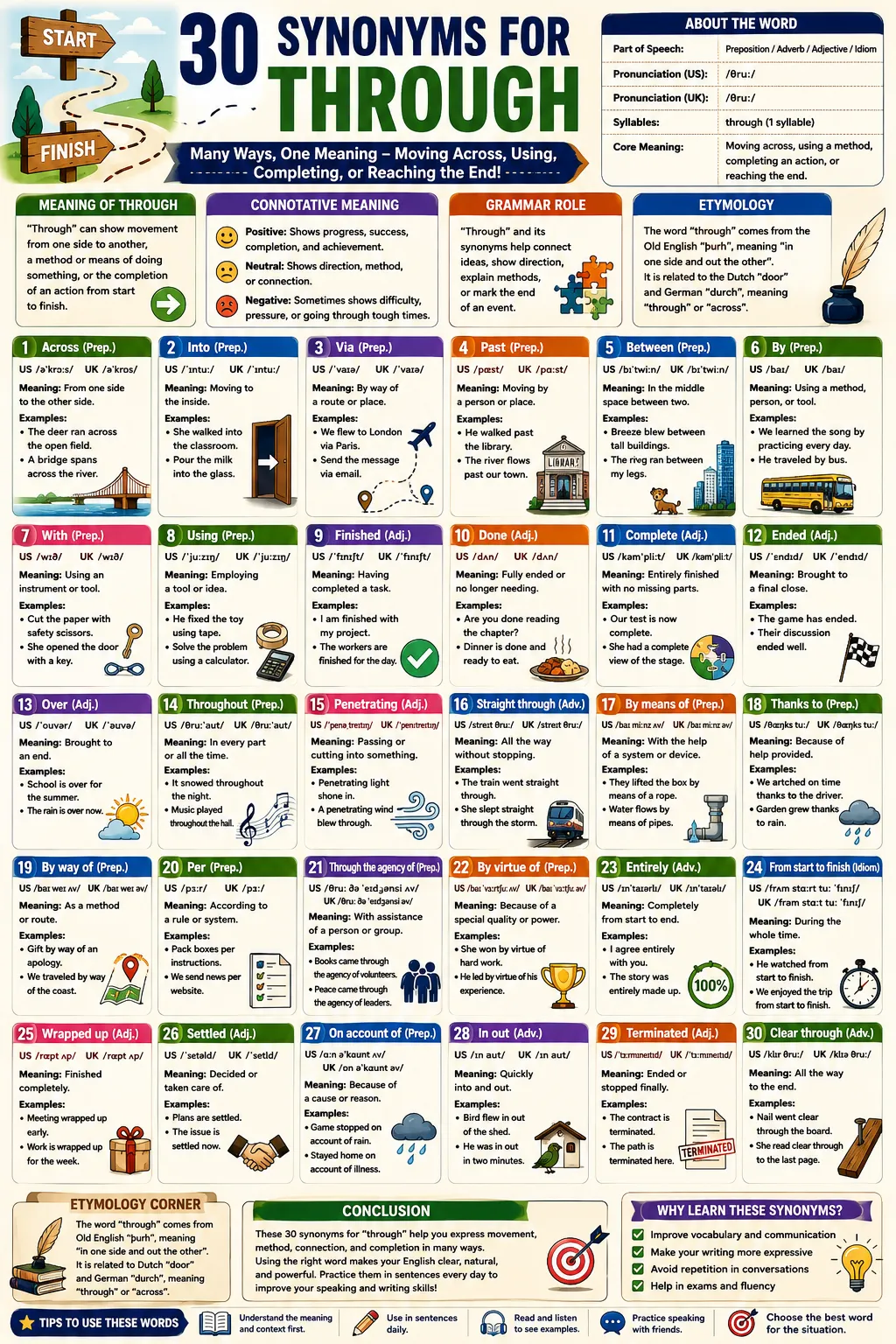
The word through describes passing into one side of a space and popping out the other side. Imagine riding your bicycle into a long dark tunnel and coming out into the bright sunshine. That exciting ride took you right through the mountain. People use this word every day because movement, finishing jobs, and using helpers happen all the time. Learning synonyms for through helps English learners and writers describe motion, completion, and methods. This complete guide explores the meaning of through alongside thirty useful synonyms. You will discover clear example sentences. Also simple grammar explanations, word history, pronunciations, and helpful categories.
Meaning of Through
Definition
Through (Preposition / Adverb / Adjective): Moving in one side and out the other side of an opening or space; by means of a process or helper; finished or completed.
Examples
- The train sped through the dark forest.
- We solved the difficult puzzle through teamwork.
Connotative Meaning
- Positive tone: Implies success, completing tasks, overcoming obstacles, or making clear progress.
- Negative tone: Can suggest enduring hardship, feeling worn out, or being completely done with a bad situation.
- Neutral tone: Simply points out physical movement, direction, passage of time, or a tool used to do a job.
Etymology
- Source language: Comes from Proto-Germanic thurx, which means passing from one end to the other.
- Old English (450–1100): Written as ðurh or thurh, meaning across, by reason of, or from end to end.
- Middle English (1100–1500): Changed to thurgh or throuch as spelling rules developed.
- Modern English (1500–Present): Became spelled as through, covering movement, methods, completion, and time.
Pronunciation
- US: /θruː/
- UK: /θruː/
Syllables
through (1 part)
Affixation Pattern of Through
- Root: Through
- Prefix: None
- Suffix: -out (Throughout)
- Word Formation:
- Preposition: Through
- Adverb: Through
- Adjective: Through
- Noun: Throughput / Throughway
- Compound Words: Breakthrough / Walkthrough / Drive-through
learn more about https://synonymhunting.com/synonyms-for-approach/
Synonyms for Through
1. Across (Preposition) — US: /əˈkrɔːs/ | UK: /əˈkrɒs/
Meaning: From one side to the other side of a place.
Examples:
The deer ran across the open field.
A new bridge spans across the wide river.
2. Into (Preposition) — US: /ˈɪntuː/ | UK: /ˈɪntuː/
Meaning: Moving to the inside of a space or container.
Examples:
She walked into the warm classroom.
Pour the fresh milk into the glass.
3. Via (Preposition) — US: /ˈvaɪə/ | UK: /ˈvaɪə/
Meaning: Traveling by way of a specific location or route.
Examples:
We flew to London via Paris.
Send the message via email.
4. Past (Preposition) — US: /pæst/ | UK: /pɑːst/
Meaning: Moving by a person or place on the way to somewhere else.
Examples:
He walked right past the library.
The river flows past our quiet town.
5. Between (Preposition) — US: /bɪˈtwiːn/ | UK: /bɪˈtwiːn/
Meaning: Moving in the middle space that separates two objects.
Examples:
The breeze blew between the tall buildings.
The small dog ran between my legs.
6. By (Preposition) — US: /baɪ/ | UK: /baɪ/
Meaning: Using a specific method, person, or tool to achieve a goal.
Examples:
We learned the song by practicing every day.
He traveled by bus to reach the museum.
7. With (Preposition) — US: /wɪð/ | UK: /wɪð/
Meaning: Using an instrument, tool, or feature to do something.
Examples:
Cut the paper with dull safety scissors.
She opened the door with a small key.
8. Using (Preposition) — US: /ˈjuːzɪŋ/ | UK: /ˈjuːzɪŋ/
Meaning: Employing a tool or idea to complete an action.
Examples:
He fixed the toy using strong tape.
Solve the math problem using a calculator.
9. Finished (Adjective) — US: /ˈfɪnɪʃt/ | UK: /ˈfɪnɪʃt/
Meaning: Having completed a task or reached the end.
Examples:
I am finished with my art project.
The workers are finished for the day.
10. Done (Adjective) — US: /dʌn/ | UK: /dʌn/
Meaning: Fully ended or no longer needing attention.
Examples:
Are you done reading the chapter?
Dinner is done and ready to eat.
11. Complete (Adjective) — US: /kəmˈpliːt/ | UK: /kəmˈpliːt/
Meaning: Entirely finished with no missing parts.
Examples:
Our science test is now complete.
She had a complete view of the stage.
12. Ended (Adjective) — US: /ˈɛndɪd/ | UK: /ˈendɪd/
Meaning: Brought to a final close or stop.
Examples:
The long game has finally ended.
Their discussion ended on a friendly note.
13. Over (Adjective) — US: /ˈoʊvər/ | UK: /ˈəʊvə/
Meaning: Brought to an end or conclusion.
Examples:
School is over for the summer break.
The rain shower is over now.
14. Throughout (Preposition) — US: /θruːˈaʊt/ | UK: /θruːˈaʊt/
Meaning: In every part or during the whole time of an event.
Examples:
It snowed throughout the cold night.
Music played throughout the entire building.
15. Penetrating (Adjective) — US: /ˈpɛnəˌtreɪtɪŋ/ | UK: /ˈpenɪtreɪtɪŋ/
Meaning: Passing or cutting right into an object or space.
Examples:
The penetrating light shone into the cave.
A penetrating wind blew through the woods.
16. Straight through (Adverb) — US: /streɪt θruː/ | UK: /streɪt θruː/
Meaning: Passing all the way from start to finish without stopping.
Examples:
The train went straight through to Chicago.
She slept straight through the noisy storm.
17. By means of (Preposition) — US: /baɪ miːnz ʌv/ | UK: /baɪ miːnz əv/
Meaning: With the help or use of a specific system or device.
Examples:
They lifted the box by means of a rope.
Water travels by means of long pipes.
18. Thanks to (Preposition) — US: /θæŋks tuː/ | UK: /θæŋks tuː/
Meaning: Because of the help provided by someone or something.
Examples:
We arrived on time thanks to the fast driver.
The garden grew thanks to daily rain.
19. By way of (Preposition) — US: /baɪ weɪ ʌv/ | UK: /baɪ weɪ əv/
Meaning: Serving as a method or route to do something.
Examples:
He offered a gift by way of an apology.
We traveled south by way of the coast.
20. Per (Preposition) — US: /pɜːr/ | UK: /pɜː/
Meaning: According to a rule, channel, or system.
Examples:
Please pack the boxes per the instructions.
We send news per the official website.
21. Through the agency of (Preposition) — US: /θruː ðə ˈeɪdʒənsi ʌv/ | UK: /θruː ðə ˈeɪdʒənsi əv/
Meaning: Produced or completed with the assistance of a person or group.
Examples:
The library got books through the agency of volunteers.
Peace was restored through the agency of leaders.
22. By virtue of (Preposition) — US: /baɪ ˈvɜːrtʃuː ʌv/ | UK: /baɪ ˈvɜːtʃuː əv/
Meaning: Because of a special power, position, or quality.
Examples:
She won by virtue of hard work.
He led the group by virtue of his experience.
23. Entirely (Adverb) — US: /ɪnˈtaɪərli/ | UK: /ɪnˈtaɪəli/
Meaning: Completely from the beginning to the end.
Examples:
I agree entirely with your plan.
The story was entirely made up.
24. From start to finish (Idiom) — US: /frʌm stɑːrt tuː ˈfɪnɪʃ/ | UK: /frəm stɑːt tuː ˈfɪnɪʃ/
Meaning: During the complete duration of an event.
Examples:
He watched the race from start to finish.
We enjoyed the trip from start to finish.
25. Wrapped up (Adjective) — US: /ræpt ʌp/ | UK: /ræpt ʌp/
Meaning: Finished completely and successfully.
Examples:
We have the meeting wrapped up early.
Her work is wrapped up for the week.
26. Settled (Adjective) — US: /ˈsɛtəld/ | UK: /ˈsetld/
Meaning: Decided or taken care of fully.
Examples:
Our holiday plans are fully settled.
The argument is settled now.
27. On account of (Preposition) — US: /ɑːn əˈkaʊnt ʌv/ | UK: /ɒn əˈkaʊnt əv/
Meaning: Because of a specific event or cause.
Examples:
Game play stopped on account of rain.
They stayed home on account of illness.
28. In out (Adverb) — US: /ɪn aʊt/ | UK: /ɪn aʊt/
Meaning: Passing quickly into and out of a space.
Examples:
The bird flew in out of the shed.
He was in out of the store in two minutes.
29. Terminated (Adjective) — US: /ˈtɜːrmɪneɪtɪd/ | UK: /ˈtɜːmɪneɪtɪd/
Meaning: Ended or stopped at a final boundary.
Examples:
The contract is terminated today.
The path is terminated by a stone wall.
30. Clear through (Adverb) — US: /klɪr θruː/ | UK: /klɪə θruː/
Meaning: All the way to the very end or back.
Examples:
The nail went clear through the wooden board.
She read clear through to the last page.
Prototype Meaning
When people hear through, they picture something passing in one side of an enclosed space and exiting out the other side. A car driving into a mountain tunnel and coming out into the sunlight is the most typical mental image of this word.
Prototype Categorization
- Physical Movement & Direction: Across, Into, Via, Past, Between, Penetrating, Straight through, In out, Clear through.
- Methods, Means & Helpers: By, With, Using, By means of, Thanks to, By way of, Per, Through the agency of, By virtue of, On account of.
- Completion & Finished Tasks: Finished, Done, Complete, Ended, Over, Entirely, From start to finish, Wrapped up, Settled, Terminated.
- Time & Coverage: Throughout.
Antonyms of Through
- Around
- Outside
- Incomplete
- Unfinished
- Blocked
- Stopped
Short Questions and Answers
- What does through mean?
- It means moving in one side and out the other side, using a tool or helper, or finishing a task completely.
- When should through be used?
- Use it when talking about traveling inside a tunnel, finishing homework, or doing a job with help.
- Is through positive or negative?
- It is usually neutral, but it becomes positive when finishing tasks. And also negative when enduring hard times.
- How is through different from across?
- Through means moving inside a 3D space like a tunnel. While across means moving over a flat surface like a street.
Conclusion
synonyms for through will improve your English vocabulary. Using the same word over and over can make your writing feel repetitive. Choosing precise synonyms like via for routes, thanks to for helpers, or complete for finished projects makes your writing clear and interesting. Practicing synonyms for through every day builds your confidence.Synonyms for through also improves your reading skills, and strengthens your speaking ability. Try using two or three of these synonyms in your next writing task

I’m Zahid Abbas, an educator, researcher, and digital publishing strategist with a passion for linguistics, grammar, and clear communication. As a content creator and SEO specialist, I craft research-driven, reader-focused content that empowers learners and makes knowledge accessible worldwide.