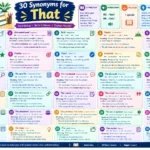
That is a small but important word used to point to something already known, seen, or mentioned. Think about a mom pointing across the yard and saying, “Can you bring me that ball?” The word “that” tells her son exactly which ball she means, without repeating a long description. This word is used constantly in speech and writing to point to people, things, or ideas. Because “that” is a grammar word rather than a describing word, it does not have many direct synonyms. However, several synonyms for that can perform similar functions depending on the sentence. Understanding these synonyms for that can help English learners and writers choose precise wording. This article explains the meaning, history, pronunciation, and 30 alternatives to “that,” with simple examples.
Meaning of That
Definition
That (Demonstrative Pronoun/Determiner):
Used to point to a specific person, thing, or idea already known, seen, or mentioned.
Examples
- Please pass me that book on the table.
- That was the best movie I have seen this year.
Connotative Meaning
- Positive tone:
- It can sound clear when talking about something familiar or pleasant, such as “that lovely day we had.”
- Negative tone:
- It can sometimes sound distant or direct, especially in a firm statement like “That is not my problem.”
- Neutral tone:
- Most of the time, “that” is used in factual way to point to a specific person, thing, or idea without showing emotion.
Etymology
- Comes from the Old English word “þæt,” used to point to something or someone.
- It is related to similar words in other old Germanic languages, all used for pointing to specific things.
- The spelling and pronunciation slowly changed over time into the modern word “that.”
Short History
- Old English (450–1100): “Þæt” was already a common pointing word, used much like “that” is today.
- Middle English (1100–1500):
- The word gradually changed into “that,” and people began using it more often as a pointing word, pronoun, and connecting word.
- Modern English (1500–Present): “That” became a common and important word in English. It is used in many ways in both everyday speech and writing.
Pronunciation (US & UK – IPA)
- US: /ðæt/
- UK: /ðæt/
Syllables
that (1 syllable)
Affixation Pattern of That
- Root: that (a base grammar word, not formed from smaller parts)
- Prefix: none
- Suffix: none
Explore related topics https://synonymhunting.com/synonyms-for-according/
Word Formation:
“That” does not form many other words. Related words include “those” (plural form) and “thus” (a distant relative in meaning, though not directly formed from “that”).
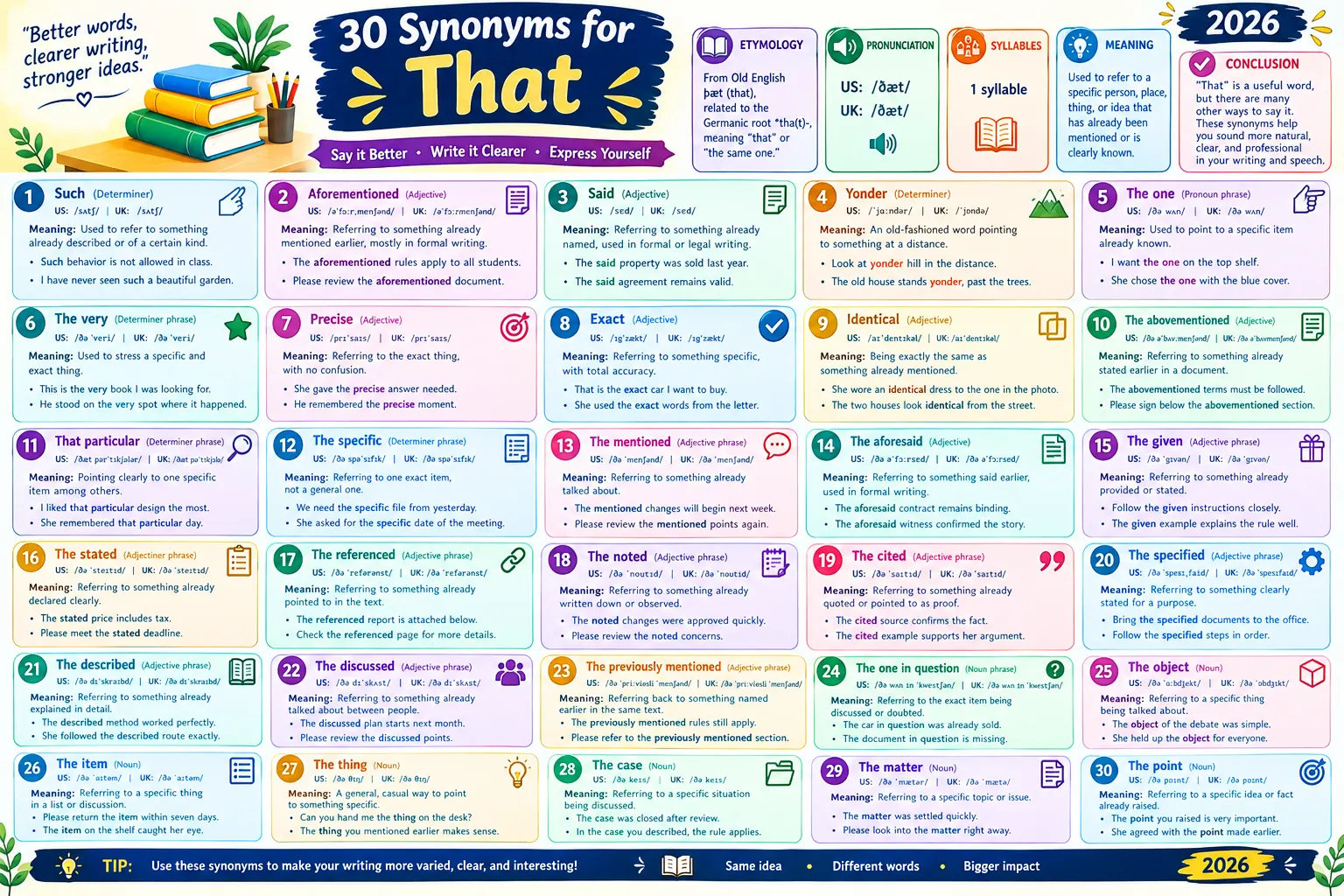
Synonyms for That
1. Such (Determiner) — US: /sʌtʃ/ | UK: /sʌtʃ/
Meaning: Used to refer to something already described or of a certain kind. Examples:
- Such behavior is not allowed in class.
- I have never seen such a beautiful garden.
2. Aforementioned (Adjective) — US: /əˈfɔːrˌmɛnʃənd/ | UK: /əˈfɔːmɛnʃənd/
Meaning: Referring to something already mentioned earlier, mostly in formal writing. Examples:
- The aforementioned rules apply to all students.
- Please review the aforementioned document.
3. Said (Adjective) — US: /sɛd/ | UK: /sɛd/
Meaning: Referring to something already named, used in formal or legal writing. Examples:
- The said property was sold last year.
- The said agreement remains valid.
4. Yonder (Determiner) — US: /ˈjɑːndər/ | UK: /ˈjɒndə/
Meaning: An old-fashioned word pointing to something at a distance. Examples:
- Look at yonder hill in the distance.
- The old house stands yonder, past the trees.
5. The one (Pronoun phrase) — US: /ðə wʌn/ | UK: /ðə wʌn/
Meaning: Used to point clearly to a specific item already known. Examples:
- I want the one on the top shelf.
- She chose the one with the blue cover.
6. The very (Determiner phrase) — US: /ðə ˈvɛri/ | UK: /ðə ˈvɛri/
Meaning: Used to stress a specific and exact thing. Examples:
- This is the very book I was looking for.
- He stood on the very spot where it happened.
7. Precise (Adjective) — US: /prɪˈsaɪs/ | UK: /prɪˈsaɪs/
Meaning: Referring to the exact thing, with no confusion. Examples:
- She gave the precise answer needed.
- He remembered the precise moment it happened.
8. Exact (Adjective) — US: /ɪɡˈzækt/ | UK: /ɪɡˈzækt/
Meaning: Referring to something specific, with total accuracy. Examples:
- That is the exact car I want to buy.
- She used the exact words from the letter.
9. Identical (Adjective) — US: /aɪˈdɛntɪkəl/ | UK: /aɪˈdɛntɪkəl/
Meaning: Being exactly the same as something already mentioned. Examples:
- She wore an identical dress to the one in the photo.
- The two houses look identical from the street.
10. The abovementioned (Adjective) — US: /ðə əˈbʌvˌmɛnʃənd/ | UK: /ðə əˈbʌvmɛnʃənd/
Meaning: Referring to something already stated earlier in a document. Examples:
- The abovementioned terms must be followed.
- Please sign below the abovementioned section.
11. That particular (Determiner phrase) — US: /ðæt pərˈtɪkjələr/ | UK: /ðæt pəˈtɪkjʊlə/
Meaning: Pointing clearly to one specific item among others. Examples:
- I liked that particular design the most.
- She remembered that particular day very well.
12. The specific (Determiner phrase) — US: /ðə spəˈsɪfɪk/ | UK: /ðə spəˈsɪfɪk/
Meaning: Referring to one exact item, not a general one. Examples:
- We need the specific file from yesterday.
- She asked for the specific date of the meeting.
13. The mentioned (Adjective phrase) — US: /ðə ˈmɛnʃənd/ | UK: /ðə ˈmɛnʃənd/
Meaning: Referring to something already talked about. Examples:
- The mentioned changes will begin next week.
- Please review the mentioned points again.
14. The aforesaid (Adjective) — US: /ðə əˈfɔːrsɛd/ | UK: /ðə əˈfɔːsɛd/
Meaning: Referring to something said earlier, used in formal writing. Examples:
- The aforesaid contract remains binding.
- The aforesaid witness confirmed the story.
15. The given (Adjective phrase) — US: /ðə ˈɡɪvən/ | UK: /ðə ˈɡɪvən/
Meaning: Referring to something already provided or stated. Examples:
- Follow the given instructions closely.
- The given example explains the rule well.
16. The stated (Adjective phrase) — US: /ðə ˈsteɪtɪd/ | UK: /ðə ˈsteɪtɪd/
Meaning: Referring to something already declared clearly. Examples:
- The stated price includes tax.
- Please meet the stated deadline.
17. The referenced (Adjective phrase) — US: /ðə ˈrɛfərənst/ | UK: /ðə ˈrɛfərənst/
Meaning: Referring to something already pointed out in the text. Examples:
- The referenced report is attached below.
- Check the referenced page for more details.
18. The noted (Adjective phrase) — US: /ðə ˈnoʊtɪd/ | UK: /ðə ˈnəʊtɪd/
Meaning: Referring to something already written down or observed. Examples:
- The noted changes were approved quickly.
- Please review the noted concerns before signing.
19. The cited (Adjective phrase) — US: /ðə ˈsaɪtɪd/ | UK: /ðə ˈsaɪtɪd/
Meaning: Referring to something already quoted or pointed to as proof. Examples:
- The cited source confirms the fact.
- The cited example supports her argument.
20. The specified (Adjective phrase) — US: /ðə ˈspɛsɪˌfaɪd/ | UK: /ðə ˈspɛsɪfaɪd/
Meaning: Referring to something clearly stated for a purpose. Examples:
- Bring the specified documents to the office.
- Follow the specified steps in order.
21. The described (Adjective phrase) — US: /ðə dɪˈskraɪbd/ | UK: /ðə dɪˈskraɪbd/
Meaning: Referring to something already explained in detail. Examples:
- The described method worked perfectly.
- She followed the described route exactly.
22. The discussed (Adjective phrase) — US: /ðə dɪˈskʌst/ | UK: /ðə dɪˈskʌst/
Meaning: Referring to something already talked about between people. Examples:
- The discussed plan starts next month.
- Please review the discussed points before the meeting.
23. The previously mentioned (Adjective phrase) — US: /ðə ˈpriːviəsli ˈmɛnʃənd/ | UK: /ðə ˈpriːviəsli ˈmɛnʃənd/
Meaning: Referring back to something named earlier in the same text. Examples:
- The previously mentioned rules still apply.
- Please refer to the previously mentioned section.
24. The one in question (Noun phrase) — US: /ðə wʌn ɪn ˈkwɛstʃən/ | UK: /ðə wʌn ɪn ˈkwɛstʃən/
Meaning: Referring to the exact item being discussed or doubted. Examples:
- The car in question was already sold.
- The document in question is missing a signature.
25. The object (Noun) — US: /ðə ˈɑːbdʒɛkt/ | UK: /ðə ˈɒbdʒɪkt/
Meaning: Referring to a specific thing being talked about. Examples:
- The object of the debate was quite simple.
- She held up the object for everyone to see.
26. The item (Noun) — US: /ðə ˈaɪtəm/ | UK: /ðə ˈaɪtəm/
Meaning: Referring to a specific thing in a list or discussion. Examples:
- Please return the item within seven days.
- The item on the shelf caught her eye.
27. The thing (Noun) — US: /ðə θɪŋ/ | UK: /ðə θɪŋ/
Meaning: A general, casual way to point to something specific. Examples:
- Can you hand me the thing on the desk?
- The thing you mentioned earlier makes sense now.
28. The case (Noun) — US: /ðə keɪs/ | UK: /ðə keɪs/
Meaning: Referring to a specific situation being discussed. Examples:
- The case was closed after review.
- In the case you described, the rule applies.
29. The matter (Noun) — US: /ðə ˈmætər/ | UK: /ðə ˈmætə/
Meaning: Referring to a specific topic or issue. Examples:
- The matter was settled quickly.
- Please look into the matter right away.
30. The point (Noun) — US: /ðə pɔɪnt/ | UK: /ðə pɔɪnt/
Meaning: Referring to a specific idea or fact already raised. Examples:
- The point you raised is very important.
- She agreed with the point made earlier.
Prototype Meaning
When people hear the word “that,” they imagine something specific being pointed out or identified. It may refer to a person, thing, or idea that is already known, seen, or mentioned. The word “that” adds directness, helping the listener understand exactly what is being referred to.
Prototype Categorization
- Simple pointing words:
- such, yonder, the one, the thing
- Formal or legal references:
- aforementioned, said, the aforesaid, the abovementioned, the previously mentioned
- Exact or precise references:
- precise, exact, identical, the specific, that particular
- Written or spoken references:
- the mentioned, the stated, the referenced, the noted, the cited, the specified, the described, the discussed
- Topic or issue references:
- the case, the matter, the point, the object, the item, the one in question
- Emphasis words: the very
Antonyms of That
- this
- these
- the other
- a different one
- another
Short Questions and Answers
- What does that mean? It means used to point to a specific person, thing, or idea already known, seen, or mentioned.
- When should that be used? Use it when pointing to something specific that is farther away or already discussed.
- Is that positive or negative? It is neutral. It simply points to something, with no strong feeling attached.
- How is it different from similar words? “This” points to something close by, while “that” points to something farther away.
Conclusion
Synonyms for that helps you build more precise vocabulary, especially in legal writing. It strengthens your writing by giving you different ways to point to specific or ideas. Synonyms for that helps you avoid repeating the same word. Its keeps your writing clearer and more professional. Most importantly, synonyms for that builds your confidence as an English speaker and writer. Try learning one new synonyms for that from this list, and notice how often “that” appears in your daily speech. English learners and content writers can improve their vocabulary, writing, and speaking skills by learning synonyms for that.

I’m Zahid Abbas, an educator, researcher, and digital publishing strategist with a passion for linguistics, grammar, and clear communication. As a content creator and SEO specialist, I craft research-driven, reader-focused content that empowers learners and makes knowledge accessible worldwide.