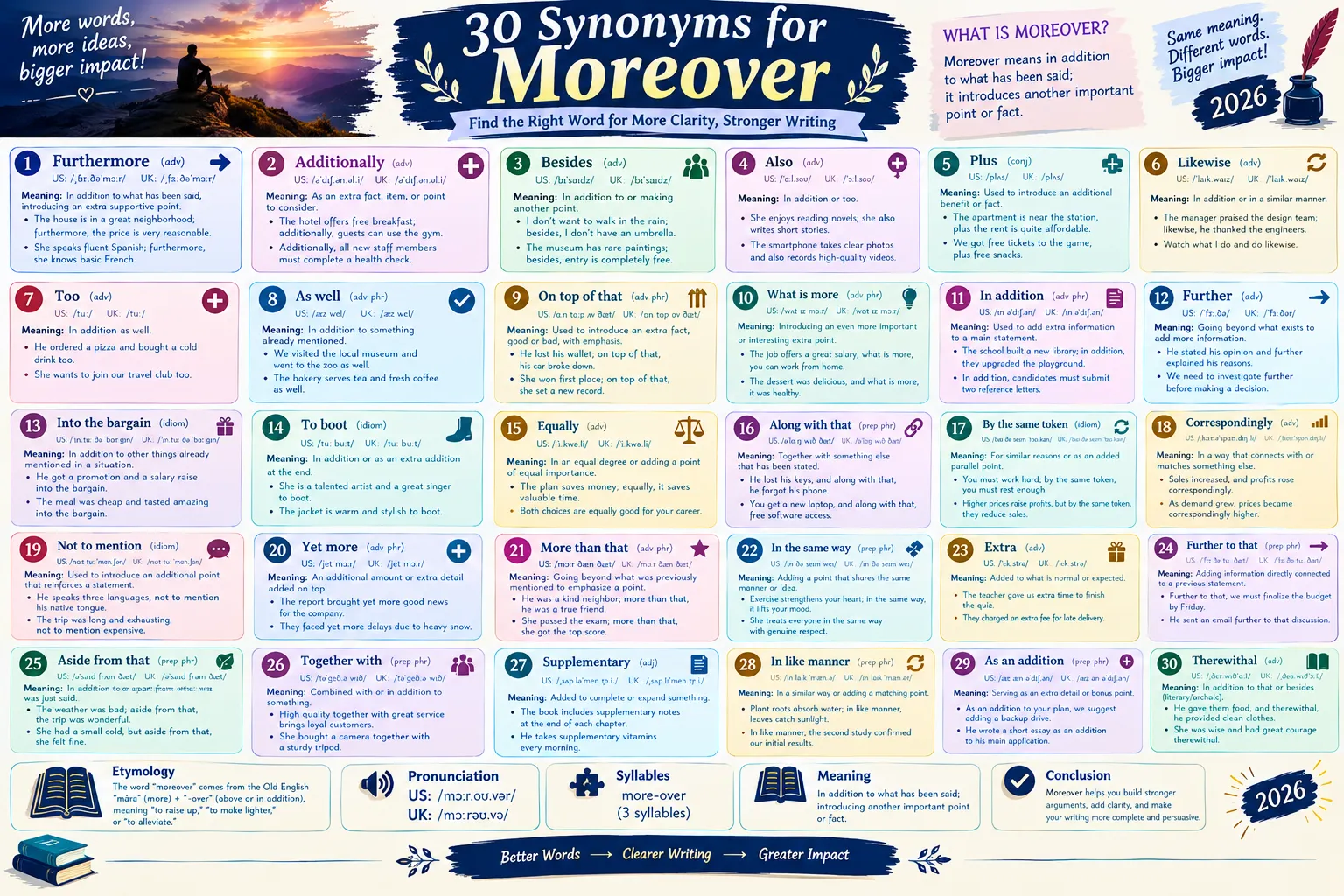
Imagine you are trying to convince your family to go on a weekend trip. You tell them that the hotel is affordable. Then you add that it sits right on a beautiful beach. To connect these two ideas smoothly, you say moreover. People frequently use synonyms for moreover because it acts like a bridge between related ideas, making arguments stronger.
However, repeating the exact same transition word over and over can make your writing feel unnatural. Learning varied synonyms for moreover helps English learners and content creators express additional thoughts with precision. This guide covers the essential meaning of moreover alongside 30 dynamic synonyms for moreover. You will discover their simple definitions, natural example sentences, grammar breakdown, origin history, pronunciation, and semantic categories.
Meaning of Moreover
Definition
Moreover (Adverb): In addition to what has already been said; also or furthermore.
Examples
- The new laptop is lightweight; moreover, its battery lasts for up to twenty hours.
- The team completed the project on time; moreover, they stayed well under budget.
Connotative Meaning
- Positive tone:
- Adds encouraging points, helpful benefits, or extra reasons to celebrate.
- Negative tone:
- Adds extra warnings, complaints, problems, or unpleasant facts to an argument.
- Neutral tone:
- In business reports, and news articles, moreover works as a professional transition word.
Explore more related topics https://synonymhunting.com/synonyms-for-according/
Etymology
- Source:
- The word comes from the Old English words māra, meaning “greater” or “more,” and ofer, meaning “above” or “beyond.”
- Old English (450–1100):
- The early forms of more (māra) and over (ofer) were separate words used to show a greater amount or a higher position..
- Middle English (1100–1500):
- Middle English speakers combined these terms into more-over to mean “besides” or “furthermore.”
- Modern English (1500–Present):
- Modern English uses moreover or synonyms for moreover as a formal transition word. It is common in essays, books, and formal speech.
Pronunciation
- US: /mɔːrˈoʊ.vɚ/
- UK: /mɔːrˈəʊ.vər/
Syllables
more-o-ver
Affixation Pattern
- Root: More (adverb/determiner) and Over (preposition/adverb)
- Prefix: None
- Suffix: None
Word Formation:
- Moreover (Conjunctive Adverb)
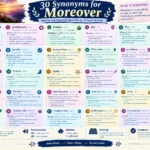
30 Synonyms for Moreover
1. Furthermore (Adverb) — US: /ˌfɝː.ðɚˈmɔːr/ | UK: /ˌfɜː.ðəˈmɔːr/
Meaning: In addition to what has been said, introducing an extra supportive point.
- Example 1: The house is in a great neighborhood; furthermore, the price is very reasonable.
- Example 2: She speaks fluent Spanish; furthermore, she knows basic French.
2. Additionally (Adverb) — US: /əˈdɪʃ.ən.əl.i/ | UK: /əˈdɪʃ.ən.əl.i/
Meaning: As an extra fact, item, or point to consider.
- Example 1: The hotel offers free breakfast; additionally, guests can use the gym.
- Example 2: Additionally, all new staff members must complete a health check.
3. Besides (Adverb) — US: /bɪˈsaɪdz/ | UK: /bɪˈsaɪdz/
Meaning: In addition to or making another point.
- Example 1: I don’t want to walk in the rain; besides, I don’t have an umbrella.
- Example 2: The museum has rare paintings; besides, entry is completely free.
4. Also (Adverb) — US: /ˈɑːl.soʊ/ | UK: /ˈɔːl.səʊ/
Meaning: In addition or too.
- Example 1: She enjoys reading novels; she also writes short stories.
- Example 2: The smartphone takes clear photos and also records high-quality videos.
5. Plus (Conjunction) — US: /plʌs/ | UK: /plʌs/
Meaning: Used to introduce an additional benefit or fact.
- Example 1: The apartment is near the station, plus the rent is quite affordable.
- Example 2: We got free tickets to the game, plus free snacks.
6. Likewise (Adverb) — US: /ˈlaɪk.waɪz/ | UK: /ˈlaɪk.waɪz/
Meaning: In addition or in a similar manner.
- Example 1: The manager praised the design team; likewise, he thanked the engineers.
- Example 2: Watch what I do and do likewise.
7. Too (Adverb) — US: /tuː/ | UK: /tuː/
Meaning: In addition as well.
- Example 1: He ordered a pizza and bought a cold drink too.
- Example 2: She wants to join our travel club too.
8. As well (Adverb phrase) — US: /æz wɛl/ | UK: /æz wɛl/
Meaning: In addition to something already mentioned.
- Example 1: We visited the local museum and went to the zoo as well.
- Example 2: The bakery serves tea and fresh coffee as well.
9. On top of that (Adverbial phrase) — US: /ɑːn tɑːp ʌv ðæt/ | UK: /ɒn tɒp ɒv ðæt/
Meaning: Used to introduce an extra fact, good or bad, with emphasis.
- Example 1: He lost his wallet; on top of that, his car broke down.
- Example 2: She won first place; on top of that, she set a new record.
10. What is more (Adverbial phrase) — US: /wʌt ɪz mɔːr/ | UK: /wɒt ɪz mɔːr/
Meaning: Introducing an even more important or interesting extra point.
- Example 1: The job offers a great salary; what is more, you can work from home.
- Example 2: The dessert was delicious, and what is more, it was healthy.
11. In addition (Adverbial phrase) — US: /ɪn əˈdɪʃ.ən/ | UK: /ɪn əˈdɪʃ.ən/
Meaning: Used to add extra information to a main statement.
- Example 1: The school built a new library; in addition, they upgraded the playground.
- Example 2: In addition, candidates must submit two reference letters.
12. Further (Adverb) — US: /ˈfɝː.ðɚ/ | UK: /ˈfɜː.ðər/
Meaning: Going beyond what exists to add more information.
- Example 1: He stated his opinion and further explained his reasons.
- Example 2: We need to investigate further before making a decision.
13. Into the bargain (Idiom) — US: /ˈɪn.tuː ðə ˈbɑːr.ɡɪn/ | UK: /ˈɪn.tuː ðə ˈbɑː.ɡɪn/
Meaning: In addition to other things already mentioned in a situation.
- Example 1: He got a promotion and a salary raise into the bargain.
- Example 2: The meal was cheap and tasted amazing into the bargain.
14. To boot (Idiom) — US: /tuː buːt/ | UK: /tuː buːt/
Meaning: In addition or as an extra addition at the end.
- Example 1: She is a talented artist and a great singer to boot.
- Example 2: The jacket is warm and stylish to boot.
15. Equally (Adverb) — US: /ˈiː.kwə.li/| UK: /ˈiː.kwə.li/
Meaning: In an equal degree or adding a point of equal importance.
- Example 1: The plan saves money; equally, it saves valuable time.
- Example 2: Both choices are equally good for your career.
16. Along with that (Prepositional phrase) — US: /əˈlɑːŋ wɪð ðæt/ | UK: /əˈlɒŋ wɪð ðæt/
Meaning: Together with something else that has been stated.
- Example 1: He lost his keys, and along with that, he forgot his phone.
- Example 2: You get a new laptop, and along with that, free software access.
17. By the same token (Idiom) — US: /baɪ ðə seɪm ˈtoʊ.kən/ | UK: /baɪ ðə seɪm ˈtəʊ.kən/
Meaning: For similar reasons or as an added parallel point.
- Example 1: You must work hard; by the same token, you must rest enough.
- Example 2: Higher prices raise profits, but by the same token, they reduce sales.
18. Correspondingly (Adverb) — US: /ˌkɔːr.əˈspɑːn.dɪŋ.li/| UK: /ˌkɒr.ɪˈspɒn.dɪŋ.li/
Meaning: In a way that connects with or matches something else.
- Example 1: Sales increased, and profits rose correspondingly.
- Example 2: As demand grew, prices became correspondingly higher.
19. Not to mention (Idiom) — US: /nɑːt tuː ˈmɛn.ʃən/ | UK: /nɒt tuː ˈmɛn.ʃən/
Meaning: Used to introduce an additional point that reinforces a statement.
- Example 1: He speaks three languages, not to mention his native tongue.
- Example 2: The trip was long and exhausting, not to mention expensive.
20. Yet more (Adverbial phrase) — US: /jɛt mɔːr/ | UK: /jɛt mɔːr/
Meaning: An additional amount or extra detail added on top.
- Example 1: The report brought yet more good news for the company.
- Example 2: They faced yet more delays due to heavy snowfall.
21. More than that (Adverbial phrase) — US: /mɔːr ðæn ðæt/ | UK: /mɔːr ðæn ðæt/
Meaning: Going beyond what was previously mentioned to emphasize a point.
- Example 1: He was a kind neighbor; more than that, he was a true friend.
- Example 2: She passed the exam; more than that, she got the top score.
22. In the same way (Prepositional phrase) — US: /ɪn ðə seɪm weɪ/ | UK: /ɪn ðə seɪm weɪ/
Meaning: Adding a point that shares the same manner or idea.
- Example 1: Exercise strengthens your heart; in the same way, it lifts your mood.
- Example 2: She treats everyone in the same way with genuine respect.
23. Extra (Adverb) — US: /ˈɛk.strə/ | UK: /ˈɛk.strə/
Meaning: Added to what is normal or expected.
- Example 1: The teacher gave us extra time to finish the quiz.
- Example 2: They charged an extra fee for late delivery.
24. Further to that (Prepositional phrase) — US: /ˈfɝː.ðɚ tuː ðæt/ | UK: /ˈfɜː.ðə tuː ðæt/
Meaning: Adding information directly connected to a previous statement.
- Example 1: Further to that, we must finalize the budget by Friday.
- Example 2: He sent an email further to that discussion.
25. Aside from that (Prepositional phrase) — US: /əˈsaɪd frʌm ðæt/ | UK: /əˈsaɪd frəm ðæt/
Meaning: In addition to or apart from what was just said.
- Example 1: The weather was bad; aside from that, the trip was wonderful.
- Example 2: She had a small cold, but aside from that, she felt fine.
26. Together with (Prepositional phrase) — US: /təˈɡɛð.ɚ wɪð/ | UK: /təˈɡɛð.ə wɪð/
Meaning: Combined with or in addition to something.
- Example 1: High quality together with great service brings loyal customers.
- Example 2: She bought a camera together with a sturdy tripod.
27. Supplementary (Adverbial adjective) — US: /ˌsʌp.ləˈmɛn.t̬ɚ.i/ | UK: /ˌsʌp.lɪˈmɛn.tr̩.i/
Meaning: Added to complete or expand something.
- Example 1: The book includes supplementary notes at the end of each chapter.
- Example 2: He takes supplementary vitamins every morning.
28. In like manner (Prepositional phrase) — US: /ɪn laɪk ˈmæn.ɚ/ | UK: /ɪn laɪk ˈmæn.ər/
Meaning: In a similar way or adding a matching point.
- Example 1: Plant roots absorb water; in like manner, leaves catch sunlight.
- Example 2: In like manner, the second study confirmed our initial results.
29. As an addition (Prepositional phrase) — US: /æz æn əˈdɪʃ.ən/ | UK: /æz ən əˈdɪʃ.ən/
Meaning: Serving as an extra detail or bonus point.
- Example 1: As an addition to your plan, we suggest adding a backup drive.
- Example 2: He wrote a short essay as an addition to his main application.
30. Therewithal (Adverb) — US: /ˌðɛr.wɪðˈɑːl/ | UK: /ˌðeə.wɪðˈɔːl/
Meaning: In addition to that or besides (literary/archaic).
- Example 1: He gave them food, and therewithal, he provided clean clothes.
- Example 2: She was wise and had great courage therewithal.
Prototype Meaning
The prototype meaning of moreover centers on adding a secondary, highly persuasive thought to reinforce a primary statement. When people hear or read this moreover or synonyms for moreover, they picture a writer stacking supportive evidence onto an argument to convince the reader.
Prototype Categorization
- Formal Academic transitions:
- Furthermore, additionally, in addition, moreover, further to that, supplementary. These work best for academic essays, research papers, formal letters, and professional reports.
- Conversational Additions:
- Plus, besides, also, on top of that, what is more, along with that. Best suited for casual emails, daily conversations, blog posts, and informal speeches.
- Emphasis & Bonus Point Markers:
- Not to mention, into the bargain, to boot, yet more, more than that. Use these phrases when you want to highlight a surprising additional point.
- Parallel & Comparative Transitions:
- Likewise, equally, in the same way, by the same token, correspondingly, in like manner. Ideal for adding facts that match, mirror, or equal the weight of your previous statement.
Antonyms of Moreover
- However
- Conversely
- Nevertheless
- On the other hand
- In contrast
- Despite this
Short Questions and Answers
- What does moreover mean?
- It is a transition word that means “in addition” or “furthermore.”
- When should moreover be used?
- Use it when you want to add a strong extra point that supports an idea you just mentioned.
- Is moreover positive or negative?
- It is neutral on its own, but it takes on a positive or negative tone depending on the context of your sentence.
- How is it different from similar words?
- Moreover is more formal than plus or also and adds extra persuasive weight to an argument.
Conclusion
Synonyms for moreover gives you a versatile tool kit for connecting ideas smoothly. Learning synonyms for moreover enhances your vocabulary. Strengthens your writing flow, and helps you avoid awkward repetition. Using exact synonyms for moreover lets you present facts logically and boosts your confidence in English speaking and writing. Try incorporating a few new synonyms for moreover into your daily writing practice to elevate your style.

I’m Zahid Abbas, an educator, researcher, and digital publishing strategist with a passion for linguistics, grammar, and clear communication. As a content creator and SEO specialist, I craft research-driven, reader-focused content that empowers learners and makes knowledge accessible worldwide.