The word navigate means to plan, direct, or steer a path from one place to another carefully. Imagine holding a map and compass while walking through a thick forest to find your camp. Choosing the right trail and steering your way safely is what it means to navigate.
We use synonyms for navigate to describe steering a ship, following GPS directions in a car, or even handling a tricky situation. Learning new ways to say navigate helps learners make their story writing adventurous. English learners and content writer need synonyms for navigate too.
This guide gives you 30 simple synonyms for navigate. Along with easy sentences, word origins, pronunciation guides, and clear categories.
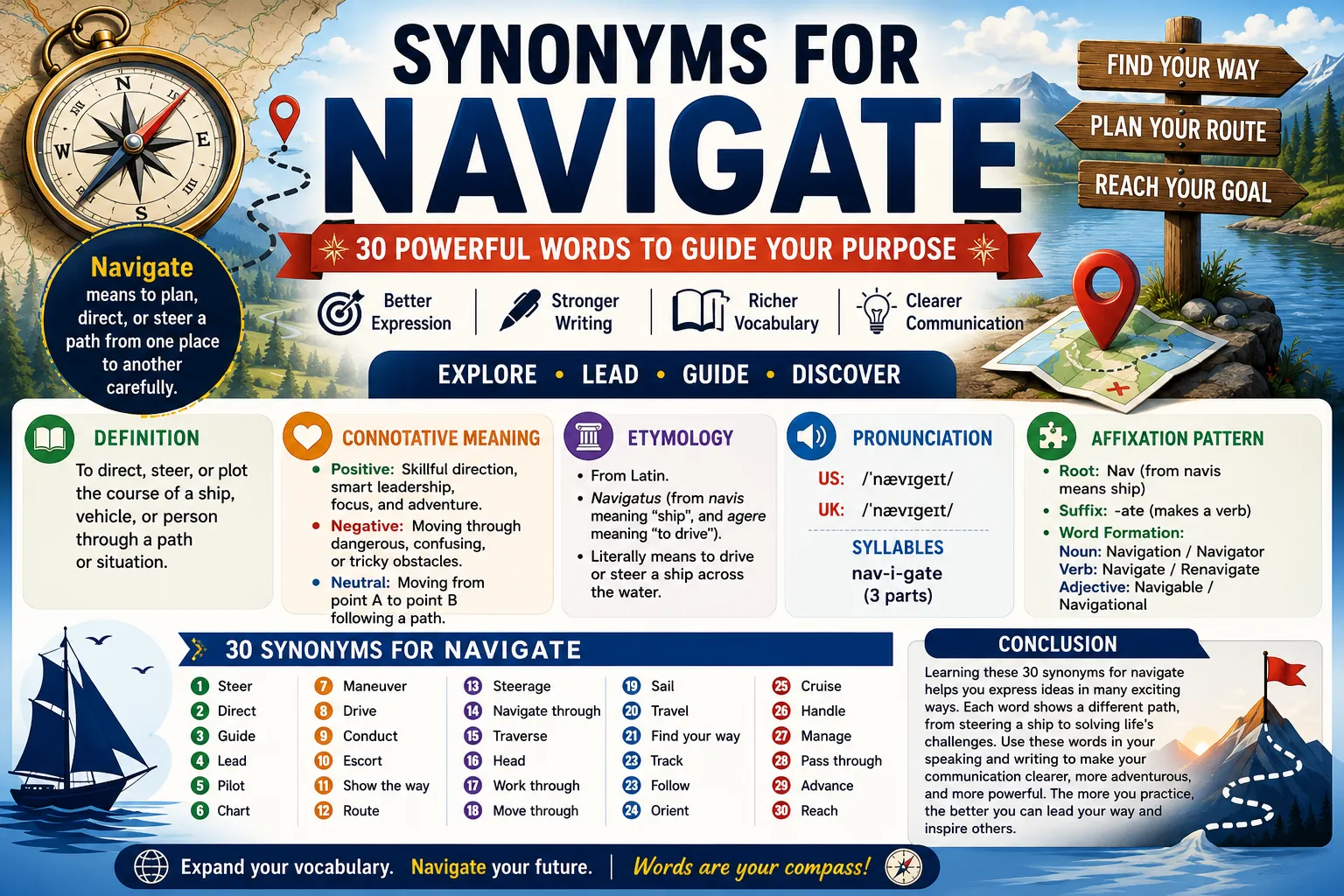
Meaning of Navigate
Definition
Navigate (Verb): To direct, steer, or plot the course of a ship, vehicle, or person through a path or situation.
Examples
- Sailors use bright stars to navigate their ships across the ocean.
- She used a map app on her phone to navigate through the busy city.
Connotative Meaning
- Positive tone: Represents skillful direction, smart leadership, focus, and adventure.
- Negative tone: Can imply moving through a dangerous, confusing, or tricky obstacle course.
- Neutral tone: Simply describes moving from point A to point B following a path.
Etymology
- Source language: Came from Latin.
- Latin: Navigatus (from navis, meaning “ship”, and agere, meaning “to drive” or “to lead”).
- Modern English: Literally means to drive or steer a ship across the water.
For further information, you can also visit our website https://synonymhunting.com/synonyms-for-simultaneously/
Pronunciation
- US: /ˈnævɪɡeɪt/
- UK: /ˈnævɪɡeɪt/
Syllables
nav-i-gate (3 parts)
Affixation Pattern of Navigate
- Root: Nav (from navis, means ship)
- Suffix: -ate (makes a verb meaning “to do or cause”)
- Word Formation:
- Noun: Navigation / Navigator
- Verb: Navigate / Renavigate
- Adjective: Navigable / Navigational
Synonyms for Navigate
1. Steer (Verb) — US: /stɪr/ | UK: /stɪə/
Meaning: To control the direction in which a vehicle or boat moves.
Examples:
He helped his captain steer the boat toward the harbor.
She used both hands to steer her bicycle around the sharp curve.
2. Direct (Verb) — US: /dəˈrɛkt/ | UK: /daɪˈrekt/
Meaning: To show or point out the proper path to someone.
Examples:
The police officer helped direct traffic safely past the school.
He will direct us to the nearest museum entrance.
3. Guide (Verb) — US: /ɡaɪd/ | UK: /ɡaɪd/
Meaning: To lead or show the way to a destination.
Examples:
A friendly park ranger will guide us along the hiking trail.
The bright lighthouse helped guide ships away from the sharp rocks.
4. Lead (Verb) — US: /liːd/ | UK: /liːd/
Meaning: To go ahead of others to show them the correct way.
Examples:
Our teacher will lead the line down to the auditorium.
The brave scout offered to lead the group back to camp.
5. Pilot (Verb) — US: /ˈpaɪlət/ | UK: /ˈpaɪlət/
Meaning: To fly or steer an aircraft or ship through a path.
Examples:
The captain learned to pilot the big airplane smoothly.
A local sailor came aboard to pilot the ship through the narrow river.
6. Chart (Verb) — US: /tʃɑːrt/ | UK: /tʃɑːt/
Meaning: To plan or draw out a course using a map.
Examples:
Explorers love to chart new routes across the ocean.
We sat together to chart our weekend road trip path.
7. Maneuver (Verb) — US: /məˈnuːvər/ | UK: /məˈnuːvə/
Meaning: To move or turn skillfully around tricky obstacles.
Examples:
The driver had to maneuver carefully into the tight parking space.
She can maneuver her skateboard through the obstacle cones.
8. Drive (Verb) — US: /draɪv/ | UK: /draɪv/
Meaning: To operate and control the direction of a motor vehicle.
Examples:
Dad will drive us home after soccer practice.
It takes focus and care to drive along winding mountain roads.
9. Conduct (Verb) — US: /kənˈdʌkt/ | UK: /kənˈdʌkt/
Meaning: To lead, guide, or manage a trip or process.
Examples:
The tour manager will conduct the visitors through the palace.
She helped conduct the class field trip smoothly.
10. Wayfind (Verb) — US: /ˈweɪfaɪnd/ | UK: /ˈweɪfaɪnd/
Meaning: To figure out your position and find your way through a place.
Examples:
Hikers use signs to wayfind through the dense national park.
It was easy to wayfind in the clear, well-marked airport.
11. Travel (Verb) — US: /ˈtrævl/ | UK: /ˈtrævl/
Meaning: To go from one place to another over a distance.
Examples:
They like to travel by train during the summer holidays.
Birds travel south every year before winter comes.
12. Cross (Verb) — US: /krɔːs/ | UK: /krɒs/
Meaning: To pass from one side of a road, river, or land to the other.
Examples:
Always look both ways before you cross the street.
The wooden bridge helped us cross the rushing stream.
13. Traverse (Verb) — US: /trəˈvɜːrs/ | UK: /trəˈvɜːs/
Meaning: To travel or pass across a wide piece of land or water.
Examples:
The brave climbers plan to traverse the snowy ridge.
Camels can traverse hot deserts for many days.
14. Course (Verb) — US: /kɔːrs/ | UK: /kɔːs/
Meaning: To move quickly along a specified path or channel.
Examples:
Water began to course through the garden pipe.
Ships course along established ocean routes every day.
15. Sail (Verb) — US: /seɪl/ | UK: /seɪl/
Meaning: To travel over water in a ship or sailboat.
Examples:
We watched the white boats sail across the bay.
They plan to sail to the nearby island this afternoon.
16. Fly (Verb) — US: /flaɪ/ | UK: /flaɪ/
Meaning: To move through the air under direction or power.
Examples:
Pilots know how to fly planes through cloudy skies.
Eagles fly high above the hills to spot their path.
17. Head (Verb) — US: /hɛd/ | UK: /hed/
Meaning: To move in a specific direction toward a place.
Examples:
We should head home before it begins to rain.
The geese head south when the autumn weather turns cool.
18. Route (Verb) — US: /ruːt/ | UK: /ruːt/
Meaning: To send or direct along a particular road or path.
Examples:
The app will route us around the heavy highway traffic.
Map signs will route travelers safely around the construction zone.
19. Negotiate (Verb) — US: /nəˈɡoʊʃieɪt/ | UK: /nəˈɡəʊʃieɪt/
Meaning: To move successfully through a difficult or twisting path.
Examples:
The mountain bike was able to negotiate the bumpy dirt track.
Hikers must negotiate slippery rocks near the waterfall.
20. Track (Verb) — US: /træk/ | UK: /træk/
Meaning: To follow a trail, path, or footprint toward a goal.
Examples:
The guide can track animal footprints in the snow.
We used GPS to track our journey on the map.
21. Plot (Verb) — US: /plɑːt/ | UK: /plɒt/
Meaning: To mark out a path or position on a map carefully.
Examples:
The captain sat down to plot the safest sea course.
We helped plot the treasure map for our party game.
22. Target (Verb) — US: /ˈtɑːrɡɪt/ | UK: /ˈtɑːɡɪt/
Meaning: To aim or direct movement toward a specific point.
Examples:
The runner aimed to target the finish line in record time.
Birds target cozy trees to rest after a long flight.
23. Handle (Verb) — US: /ˈhændl/ | UK: /ˈhændl/
Meaning: To manage, control, or steer a vehicle or situation.
Examples:
She knows how to handle her sled on icy slopes.
He learned to handle difficult problems with patience.
24. Shift (Verb) — US: /ʃɪft/ | UK: /ʃɪft/
Meaning: To change direction or position while moving along.
Examples:
The wind began to shift, changing our sailboat’s path.
You must shift directions quickly during a basketball game.
25. Control (Verb) — US: /kənˈtroʊl/ | UK: /kənˈtrəʊl/
Meaning: To command or direct the movement and speed of something.
Examples:
Use the remote to control the toy car’s direction.
The pilot worked to control the glider during the gust of wind.
26. Orient (Verb) — US: /ˈɔːriɛnt/ | UK: /ˈɔːriənt/
Meaning: To figure out your exact location relative to your surroundings.
Examples:
Look for the tall tower to orient yourself in the town.
Using a compass helps hikers orient their map to true north.
27. Circumvent (Verb) — US: /ˌsɜːrkəmˈvɛnt/ | UK: /ˌsɜːkəmˈvent/
Meaning: To go completely around an obstacle or path.
Examples:
We had to circumvent the fallen tree blocking the trail.
They found a side path to circumvent the deep puddle.
28. Walk (Verb) — US: /wɔːk/ | UK: /wɔːk/
Meaning: To move along on foot while choosing your path.
Examples:
We love to walk through the quiet forest trails.
She will walk to the neighborhood library this afternoon.
29. Path (Verb) — US: /pæθ/ | UK: /pɑːθ/
Meaning: To lay out or follow a clear walking line.
Examples:
The deer will path their way through the high grass.
We had to path our way around the muddy garden bed.
30. Explore (Verb) — US: /ɪkˈsplɔːr/ | UK: /ɪkˈsplɔː/
Meaning: To travel through an unfamiliar area to learn about it.
Examples:
The children love to explore the trails in the nature park.
Diving teams explore deep ocean reefs to study sea life.
Prototype Meaning
When children hear navigate, they picture a ship captain spinning a wooden wheel to steer through ocean waves. A hiker looking at a compass, or a driver following GPS arrows on a map.
Prototype Categorization
- Steering & Directing: Steer, Direct, Guide, Lead, Pilot, Drive, Conduct, Maneuver, Control, Handle.
- Maps & Route Planning: Chart, Wayfind, Plot, Route, Target, Orient, Track.
- Moving & Traveling Across: Travel, Cross, Traverse, Course, Sail, Fly, Head, Walk, Explore.
- Handling Obstacles & Curves: Negotiate, Shift, Circumvent, Path.
Antonyms of Navigate
- Get lost
- Stray
- Wander
- Misguide
- Stop
- Lose direction
Short Questions and Answers
- What does navigate mean?
- It means to plan, steer, or direct a path from one place to another safely.
- When should I use navigate?
- Use it when writing about maps, driving cars, sailing boats, hiking trails, or solving tricky problems.
- Is navigate a verb or a noun?
- It is a verb! (The related noun is navigation and a person who does it is a navigator).
- What is the difference between navigate and steer?
- Steer means physically turning the wheel or handlebars, while navigate includes planning the whole map route as well as steering.
Conclusion
Synonyms of navigate can help you talk about finding a way, moving through a place, or dealing with a difficult situation. Words such as guide, steer, direct, travel, explore, manage, and find your way can make your English flexible. Each word has a slightly different use, so understanding the meaning of each synonym helps you choose the best one. For English learners, practicing synonyms for navigate can improve speaking, writing, and everyday communication. Use synonyms for navigate in simple sentences about maps, roads, journeys, websites, and life situations. With regular practice, you can build a stronger vocabulary. And also use navigate and its alternatives with confidence.