The word music refers to vocal or instrumental sounds combined in a harmonious, rhythmic, and pleasing way. Imagine tapping your feet to a cheerful song, listening to a bird sing, or playing a piano tune. That wonderful combination of sounds is music!
We use music to describe songs on the radio, soothing sounds of nature, or written notes on a sheet. Learning new ways to say music helps make their story writing precise, and expressive.
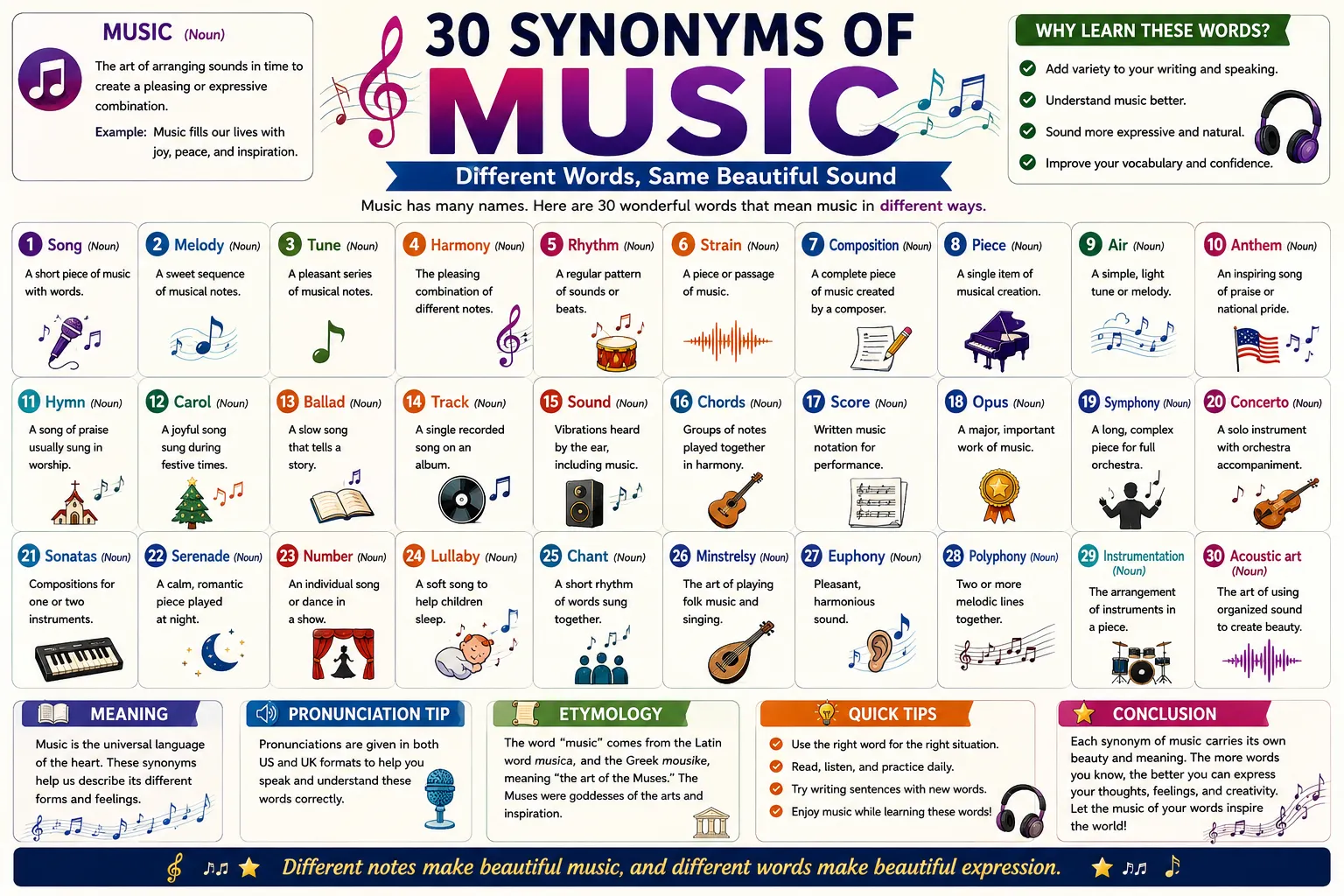
This guide gives you 30 simple synonyms for music. Along with easy sentences, word origins, pronunciation guides, and clear categories.
Meaning of Music
Definition
Music (Noun): An art form consisting of sounds combined in a pleasing or meaningful way using rhythm, melody, and harmony.
Examples
- We listened to soft music while painting in art class.
- She loves to play cheerful music on her violin.
Connotative Meaning
- Positive tone: Represents joy, creativity, peace, harmony, and celebration.
- Negative tone: Can mean noise or chaos when sounds clash unpleasant light.
- Neutral tone: Simply describes acoustic patterns or sound compositions.
Etymology
- Source language: Came from Greek (mousike), meaning “art of the Muses.”
- Old French: Passed through Old French as musique.
- Modern English: Refers to the universal language of melody and sound!
Pronunciation
- US: /ˈmjuːzɪk/
- UK: /ˈmjuːzɪk/
Syllables
mu-sic (2 parts)
Affixation Pattern of Music
- Root: Music (noun)
- Suffix: -al (relating to), -ian (person who plays)
- Word Formation:
- Noun: Music / Musician / Musicologist
- Verb: Musicalize
- Adjective: Musical
- Adverb: Musically
You can also get more information https://synonymhunting.com/synonyms-for-celebrate/
Synonyms of Music
1. Song (Noun) — US: /sɔːŋ/ | UK: /sɒŋ/
Meaning: A short piece of music with words that you can sing.
Examples:
The kids sang a happy song during assembly.
Birds fill the garden with their morning song.
2. Melody (Noun) — US: /ˈmɛlədi/ | UK: /ˈmelədi/
Meaning: A sweet and pleasing sequence of musical notes.
Examples:
The flute player played a gentle melody.
I cannot get that catchy melody out of my head.
3. Tune (Noun) — US: /tuːn/ | UK: /tjuːn/
Meaning: A series of musical notes that make a pleasant sound pattern.
Examples:
He hummed a cheerful tune while walking home.
She played a popular tune on her piano.
4. Harmony (Noun) — US: /ˈhɑːrməni/ | UK: /ˈhɑːməni/
Meaning: The pleasant combination of different musical notes played together.
Examples:
The singers blended their voices in perfect harmony.
The guitar and violin sounded lovely in harmony.
5. Rhythm (Noun) — US: /ˈrɪðəm/ | UK: /ˈrɪðəm/
Meaning: A regular repeated pattern of musical sounds or beats.
Examples:
Tap your feet to the rhythm of the drum.
The song has a fast and bouncy rhythm.
6. Strain (Noun) — US: /streɪn/ | UK: /streɪn/
Meaning: A piece of music or a musical passage being played.
Examples:
The soft strains of a lullaby helped the baby sleep.
We heard sweet strains of music coming from the hall.
7. Composition (Noun) — US: /ˌkɑːmpəˈzɪʃn/ | UK: /ˌkɒmpəˈzɪʃn/
Meaning: A complete piece of music created by a composer.
Examples:
Mozart wrote his first musical composition as a child.
The orchestra played a famous composition.
8. Piece (Noun) — US: /piːs/ | UK: /piːs/
Meaning: A single item of writing, art, or musical creation.
Examples:
She practiced a piano piece for her music exam.
This slow piece sounds very peaceful.
9. Air (Noun) — US: /ɛr/ | UK: /eə/
Meaning: A simple, light tune or song melody.
Examples:
The musician played a traditional folk air.
A sweet musical air drifted through the open window.
10. Anthem (Noun) — US: /ˈænθəm/ | UK: /ˈænθəm/
Meaning: An inspiring song of praise, devotion, or national pride.
Examples:
We stand proudly during our national anthem.
The school choir sang an uplifting anthem.
11. Hymn (Noun) — US: /hɪm/ | UK: /hɪm/
Meaning: A song of praise usually sung in church or worship.
Examples:
The congregation sang a beautiful hymn.
She learned a classic hymn on the organ.
12. Carol (Noun) — US: /ˈkærəl/ | UK: /ˈkærəl/
Meaning: A joyful song, especially one sung during festive holidays.
Examples:
Children went door to door singing a holiday carol.
We enjoy listening to winter carols near the fire.
13. Ballad (Noun) — US: /ˈbæləd/ | UK: /ˈbæləd/
Meaning: A slow, gentle song that tells a story.
Examples:
The singer performed a touching ballad about nature.
Old stories were often shared as a folk ballad.
14. Track (Noun) — US: /træk/ | UK: /træk/
Meaning: A single recorded song or piece of music on an album.
Examples:
My favorite track on the CD is track number three.
They played a lively instrumental track.
15. Sound (Noun) — US: /saʊnd/ | UK: /saʊnd/
Meaning: Vibrations heard by the ear, including musical audio.
Examples:
The soothing sound of the rain relaxed everyone.
I love the unique sound of the acoustic guitar.
16. Chords (Noun) — US: /kɔːrdz/ | UK: /kɔːdz/
Meaning: Groups of musical notes played together in harmony.
Examples:
He strummed three simple chords on his ukulele.
The piano player pressed down on the keys to play rich chords.
17. Score (Noun) — US: /skɔːr/ | UK: /skɔː/
Meaning: The written music notation for a movie, play, or orchestra.
Examples:
The film won an award for its thrilling musical score.
The conductor looked closely at the orchestral score.
18. Opus (Noun) — US: /ˈoʊpəs/ | UK: /ˈəʊpəs/
Meaning: A major, important work of music created by a master composer.
Examples:
The composer considered this symphony to be his greatest opus.
They performed Opus number five at the concert hall.
19. Symphony (Noun) — US: /ˈsɪmfəni/ | UK: /ˈsɪmfəni/
Meaning: A long, complex musical piece played by a full orchestra.
Examples:
The orchestra delivered a powerful performance of the symphony.
A symphony combines drums, horns, and string instruments.
20. Concerto (Noun) — US: /kənˈtʃɛrtoʊ/ | UK: /kənˈtʃeətəʊ/
Meaning: A piece of music where a solo instrument plays with an orchestra.
Examples:
She performed a violin concerto on stage.
The audience cheered after the piano concerto.
21. Sonatas (Noun) — US: /səˈnɑːtəz/ | UK: /səˈnɑːtəz/
Meaning: Classical musical compositions written for one or two instruments.
Examples:
Beethoven composed famous piano sonatas.
The student practiced her flute sonata daily.
22. Serenade (Noun) — US: /ˌsɛrəˈneɪd/ | UK: /ˌserəˈneɪd/
Meaning: A calm, romantic piece of music played outdoors or at night.
Examples:
He played an evening serenade under the stars.
The birds welcomed the sunrise with a peaceful serenade.
23. Number (Noun) — US: /ˈnʌmbər/ | UK: /ˈnʌmbə/
Meaning: A individual song or dance performance in a show.
Examples:
The band played an energetic rock number.
That opening dance number was full of excitement.
24. Lullaby (Noun) — US: /ˈlʌləbaɪ/ | UK: /ˈlʌləbaɪ/
Meaning: A quiet, soothing song sung to help young children sleep.
Examples:
Mother sang a gentle lullaby to her sleepy baby.
The music box plays a sweet bedtime lullaby.
25. Chant (Noun) — US: /tʃænt/ | UK: /tʃɑːnt/
Meaning: A short, simple rhythm of words sung or spoken together.
Examples:
The team shouted an encouraging sports chant.
Monks sang a peaceful chant inside the temple.
26. Minstrelsy (Noun) — US: /ˈmɪnstrəlsi/ | UK: /ˈmɪnstrəlsi/
Meaning: The art of playing folk music and singing traditional songs.
Examples:
Old stories were kept alive through ancient minstrelsy.
The fair featured medieval minstrelsy and games.
27. Euphony (Noun) — US: /ˈjuːfəni/ | UK: /ˈjuːfəni/
Meaning: Sound that is pleasing, harmonious, and sweet to the ear.
Examples:
The choir created a beautiful euphony of voices.
I love the soft euphony of harp strings.
28. Polyphony (Noun) — US: /pəˈlɪfəni/ | UK: /pəˈlɪfəni/
Meaning: Music consisting of two or more independent melodic lines together.
Examples:
Classical organ pieces often feature rich polyphony.
The different choir sections created complex polyphony.
29. Instrumentation (Noun) — US: /ˌɪnstruːmɛnˈteɪʃn/ | UK: /ˌɪnstrʊmenˈteɪʃn/
Meaning: The arrangement or combination of instruments in a piece of music.
Examples:
The song features unique instrumentation with drums and flutes.
Modern instrumentation gives the old song a fresh sound.
30. Acoustic art (Noun) — US: /əˈkuːstɪk ɑːrt/ | UK: /əˈkuːstɪk ɑːt/
Meaning: The art form of using organized sound to create beauty.
Examples:
Creating soundscapes is a modern form of acoustic art.
Musicians spend years mastering their acoustic art.
Prototype Meaning
When children hear music, they picture tapping their feet to a favorite song. Playing notes on a piano or recorder, singing along with friends in a school choir, or listening to birds chirping sweet tunes in a park.
Prototype Categorization
- Songs & Short Tunes: Song, Melody, Tune, Air, Ballad, Track, Number, Lullaby.
- Classical & Structural Works: Composition, Piece, Score, Opus, Symphony, Concerto, Sonatas, Serenade.
- Rhythm, Harmony & Audio Elements: Harmony, Rhythm, Strain, Sound, Chords, Euphony, Polyphony, Instrumentation, Acoustic art.
- Spiritual & Group Singing: Anthem, Hymn, Carol, Chant, Minstrelsy.
Antonyms of Music
- Noise
- Silence
- Discord
- Clamor
- Din
- Harshness
Short Questions and Answers
- What does music mean?
- It means an arrangement of sounds using melody, rhythm, and harmony that is pleasing to hear.
- When should I use music?
- Use it when writing about songs, playing instruments, bird sounds, concerts, or dancing.
- Is music a noun or a verb?
- It is a noun (listening to music). Its related adjective form is musical!
- What is the difference between music and noise?
- Music is organized, rhythmic, and pleasing to the ear, while noise is unstructured, loud, or annoying sound.
Conclusion
Synonyms for music can help you describe sounds, songs, and musical styles more clearly. Words such as melody, tune, song, harmony, composition, rhythm, and soundtrack can fit different situations. Understanding these alternatives helps you avoid repetition. Choose the right word for your writing. Using these synonyms with simple examples can also improve your English vocabulary. And also make your communication more expressive.

I’m Zahid Abbas, an educator, researcher, and digital publishing strategist with a passion for linguistics, grammar, and clear communication. As a content creator and SEO specialist, I craft research-driven, reader-focused content that empowers learners and makes knowledge accessible worldwide.