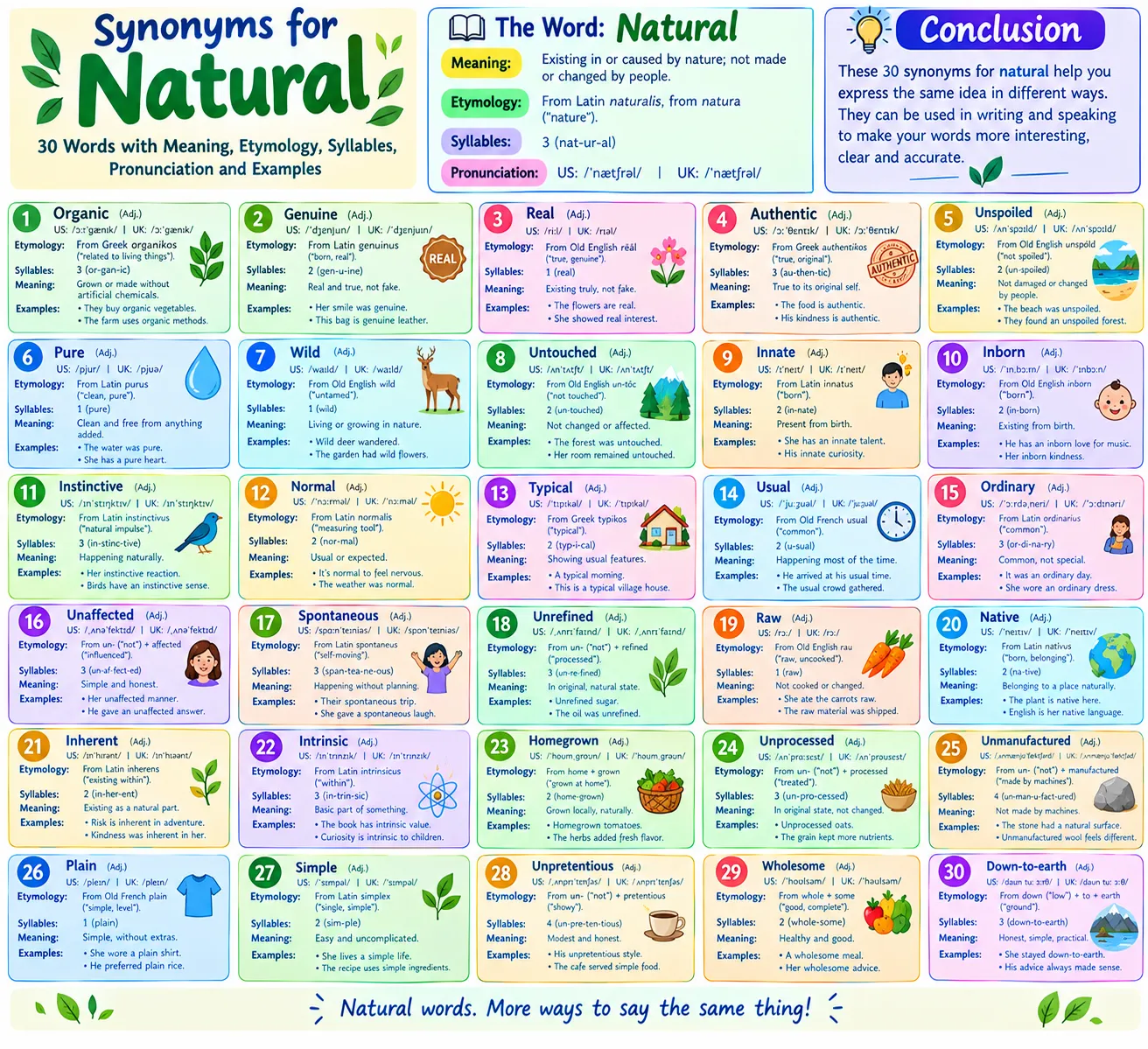
Natural means existing in nature, without being made or changed by people. Think about a family hiking through a quiet forest. They see tall trees, wild flowers, and a clear stream flowing over smooth rocks. The dad says, “Isn’t it amazing how natural everything looks here?” This word describes things that grow or happen on their own, without human help. Synonyms for natural can also describe a person’s normal, honest way of acting. People use this word a lot when talking about food, nature, feelings, and behavior. Learning new words like this is helpful for English learners and writers who want to describe nature and honesty in many different ways. Synonyms for natural also makes writing feel clearer and more thoughtful. This article explains the meaning of natural, its history, how to say it, and 30 words that share a similar meaning.
Meaning of Natural
Definition
Natural (Adjective): Existing in nature; not made, caused, or changed by people.
Examples
- The park is known for its natural beauty.
- She has a natural talent for painting.
Connotative Meaning
- Positive tone:
- This word often feels healthy and pure, like natural food or a natural smile.
- Negative tone:
- This word rarely feels negative, though “natural disaster” shows it can describe harmful events too.
- Neutral tone:
- In science, this word is often used in a plain way, like describing natural resources or natural processes.
Etymology
- This word comes from the Latin word “natura,” meaning “nature” or “birth.”
- “Natura” came from the verb “nasci,” meaning “to be born.”
- The word entered English through Old French “naturel” around the 13th century.
Short History
- Old English (450–1100):
- This word did not exist yet. People used other words, like “gecynde,” meaning “born” or “belonging by birth.”
- Middle English (1100–1500):
- The word “natural” entered English from French, which took it from Latin. It described things that came from nature or were part of someone’s true character.
- Modern English (1500–Present):
- The word grew to describe many things, from natural food and natural beauty to a person’s natural, honest way of behaving.
Pronunciation (US & UK – IPA)
- US: /ˈnætʃərəl/
- UK: /ˈnætʃrəl/
Syllables
nat-u-ral (3 syllables)
Affixation Pattern of Natural
- Root: natur (from Latin “natura,” meaning “nature”)
- Prefix: none
- Suffix: -al (turns the word into an adjective)
Word Formation:
- Nature (noun)
- Natural (adjective)
- Naturally (adverb)
- Naturalness (noun)
You also get more information about https://synonymhunting.com/synonyms-for-promote/
Synonyms for Natural
1. Organic (Adjective) — US: /ɔːrˈɡænɪk/ | UK: /ɔːˈɡænɪk/
Meaning: Grown or made without artificial chemicals. Examples:
- They only buy organic vegetables from the market.
- The farm uses organic methods to grow its crops.
2. Genuine (Adjective) — US: /ˈdʒɛnjuɪn/ | UK: /ˈdʒɛnjuɪn/
Meaning: Real and true, not fake or copied. Examples:
- Her smile was warm and genuine.
- This bag is made of genuine leather.
3. Real (Adjective) — US: /riːl/ | UK: /rɪəl/
Meaning: Existing truly, not imagined or fake. Examples:
- The flowers in the garden are real, not plastic.
- She showed real interest in the topic.
4. Authentic (Adjective) — US: /ɔːˈθɛntɪk/ | UK: /ɔːˈθɛntɪk/
Meaning: True to its original or true self. Examples:
- The restaurant serves authentic Italian food.
- His authentic kindness surprised everyone.
5. Unspoiled (Adjective) — US: /ʌnˈspɔɪld/ | UK: /ʌnˈspɔɪld/
Meaning: Not damaged or changed by people. Examples:
- The unspoiled beach had no litter or buildings.
- They found an unspoiled forest deep in the mountains.
6. Pure (Adjective) — US: /pjʊr/ | UK: /pjʊə/
Meaning: Clean and free from anything added or mixed in. Examples:
- The stream had pure, clear water.
- She has a pure and honest heart.
7. Wild (Adjective) — US: /waɪld/ | UK: /waɪld/
Meaning: Living or growing in nature, without human control. Examples:
- Wild deer wandered through the meadow.
- The garden was full of wild flowers.
8. Untouched (Adjective) — US: /ʌnˈtʌtʃt/ | UK: /ʌnˈtʌtʃt/
Meaning: Not changed or affected by anyone. Examples:
- The untouched forest looked exactly as it did years ago.
- Her old room remained untouched after she moved away.
9. Innate (Adjective) — US: /ɪˈneɪt/ | UK: /ɪˈneɪt/
Meaning: Present from birth, not learned. Examples:
- She has an innate ability to sing beautifully.
- His innate curiosity led him to explore new places.
10. Inborn (Adjective) — US: /ˈɪnˌbɔːrn/ | UK: /ˈɪnbɔːn/
Meaning: Existing in someone from birth. Examples:
- He has an inborn love for music.
- Her inborn kindness made her a great friend.
11. Instinctive (Adjective) — US: /ɪnˈstɪŋktɪv/ | UK: /ɪnˈstɪŋktɪv/
Meaning: Happening naturally, without thinking first. Examples:
- Her instinctive reaction was to protect the child.
- Birds have an instinctive sense of direction.
12. Normal (Adjective) — US: /ˈnɔːrməl/ | UK: /ˈnɔːməl/
Meaning: Usual or expected in a certain situation. Examples:
- It’s normal to feel nervous before a test.
- The weather was normal for that time of year.
13. Typical (Adjective) — US: /ˈtɪpɪkəl/ | UK: /ˈtɪpɪkəl/
Meaning: Showing the usual features of something. Examples:
- A typical morning starts with breakfast and school.
- This is a typical example of old village architecture.
14. Usual (Adjective) — US: /ˈjuːʒuəl/ | UK: /ˈjuːʒuəl/
Meaning: Happening most of the time, expected. Examples:
- He arrived at his usual time.
- The usual crowd gathered at the park.
15. Ordinary (Adjective) — US: /ˈɔːrdəˌnɛri/ | UK: /ˈɔːdɪnəri/
Meaning: Common and not special or different. Examples:
- It was an ordinary day at school.
- She wore an ordinary dress to the event.
16. Unaffected (Adjective) — US: /ˌʌnəˈfɛktɪd/ | UK: /ˌʌnəˈfɛktɪd/
Meaning: Behaving in a simple, honest way, without pretending. Examples:
- Her unaffected manner made her easy to talk to.
- He gave an unaffected, honest answer.
17. Spontaneous (Adjective) — US: /spɑːnˈteɪniəs/ | UK: /spɒnˈteɪniəs/
Meaning: Happening naturally, without planning. Examples:
- Their spontaneous trip to the beach was fun.
- She gave a spontaneous laugh at the joke.
18. Unrefined (Adjective) — US: /ˌʌnrɪˈfaɪnd/ | UK: /ˌʌnrɪˈfaɪnd/
Meaning: In its original, natural state, not processed. Examples:
- Unrefined sugar keeps more of its natural color.
- The oil was unrefined and straight from the plant.
19. Raw (Adjective) — US: /rɔː/ | UK: /rɔː/
Meaning: In its natural state, not cooked or changed. Examples:
- She ate the carrots raw.
- The raw material was shipped to the factory.
20. Native (Adjective) — US: /ˈneɪtɪv/ | UK: /ˈneɪtɪv/
Meaning: Belonging naturally to a certain place. Examples:
- The plant is native to this region.
- English is her native language.
21. Inherent (Adjective) — US: /ɪnˈhɪrənt/ | UK: /ɪnˈhɪərənt/
Meaning: Existing as a natural part of something. Examples:
- Risk is inherent in every adventure sport.
- Kindness was inherent in her personality.
22. Intrinsic (Adjective) — US: /ɪnˈtrɪnzɪk/ | UK: /ɪnˈtrɪnzɪk/
Meaning: Belonging naturally to something, as a basic part of it. Examples:
- The book has intrinsic value beyond its price.
- Curiosity is intrinsic to young children.
23. Homegrown (Adjective) — US: /ˈhoʊmˌɡroʊn/ | UK: /ˈhəʊmˌɡrəʊn/
Meaning: Grown at home or locally, in a natural way. Examples:
- They enjoyed homegrown tomatoes from the garden.
- The homegrown herbs added fresh flavor to the meal.
24. Unprocessed (Adjective) — US: /ʌnˈprɑːsɛst/ | UK: /ʌnˈprəʊsɛst/
Meaning: Left in its original state, without factory changes. Examples:
- They chose unprocessed oats for breakfast.
- The unprocessed grain kept more nutrients.
25. Unmanufactured (Adjective) — US: /ˌʌnmænjʊˈfæktʃərd/ | UK: /ˌʌnmænjʊˈfæktʃəd/
Meaning: Not made by machines or factories. Examples:
- The unmanufactured stone had a rough, natural surface.
- Unmanufactured wool feels different from factory-made fabric.
26. Plain (Adjective) — US: /pleɪn/ | UK: /pleɪn/
Meaning: Simple and without anything added or fancy. Examples:
- She wore a plain white shirt.
- He preferred plain rice with his meal.
27. Simple (Adjective) — US: /ˈsɪmpəl/ | UK: /ˈsɪmpəl/
Meaning: Easy and uncomplicated, in a natural way. Examples:
- She lives a simple life in the countryside.
- The recipe uses simple, natural ingredients.
28. Unpretentious (Adjective) — US: /ˌʌnprɪˈtɛnʃəs/ | UK: /ˌʌnprɪˈtɛnʃəs/
Meaning: Modest and honest, without trying to seem more important. Examples:
- His unpretentious style made him easy to like.
- The unpretentious cafe served simple, tasty food.
29. Wholesome (Adjective) — US: /ˈhoʊlsəm/ | UK: /ˈhəʊlsəm/
Meaning: Healthy and good, often in a natural way. Examples:
- The family enjoyed a wholesome home-cooked meal.
- Her wholesome advice helped the young students.
30. Down-to-earth (Adjective) — US: /daʊn tuː ɜːrθ/ | UK: /daʊn tuː ɜːθ/
Meaning: Honest, simple, and practical in a natural way. Examples:
- Despite her fame, she stayed down-to-earth.
- His down-to-earth advice always made sense.
Prototype Meaning
When people hear the word natural, they often picture something untouched by human hands, like a forest, a river, or a wild animal. It can also bring to mind honesty and simplicity in a person’s character. This word carries a feeling of purity, health, and truth.
Prototype Categorization
- Nature and environment: wild, unspoiled, untouched, native, homegrown
- Purity and honesty: genuine, authentic, pure, real, unaffected
- Born-in qualities: innate, inborn, instinctive, inherent, intrinsic
- Normal and expected: normal, typical, usual, ordinary
- Unprocessed or raw form: organic, raw, unrefined, unprocessed, unmanufactured
- Simple and modest: plain, simple, unpretentious, wholesome, down-to-earth, spontaneous
Antonyms of Natural
- Artificial
- Synthetic
- Fake
- Artificial
- Processed
Short Questions and Answers
- What does natural mean?
- It means existing in nature, without being made or changed by people.
- When should natural be used?
- Use it when describing things from nature, or honest, unforced behavior in people.
- Is natural positive or negative?
- It is usually positive, showing health, purity, and honesty.
- How is it different from similar words?
- “Organic” often refers to food or farming without chemicals. “Natural” is a broader word that can describe nature, feelings, talents, and honest behavior.
Conclusion
Synonyms for natural helps you build a richer, more thoughtful vocabulary. It strengthens your writing and speaking by giving you ways to describe simplicity. Synonyms for natural also helps you avoid repeating the same word again and again. Which keeps your writing clearer and more expressive. Most importantly, learning new words like this builds your confidence as an English speaker and writer. Try learning one new synonyms for natural from this list each day, and watch your vocabulary grow steadily over time.

I’m Zahid Abbas, an educator, researcher, and digital publishing strategist with a passion for linguistics, grammar, and clear communication. As a content creator and SEO specialist, I craft research-driven, reader-focused content that empowers learners and makes knowledge accessible worldwide.