Always means at all times, or every time without exception. Think about a grandmother who tells her grandson, “I will always love you, no matter what happens.” That single word carries a promise that never changes. People use synonyms for always often because it shows something is certain, steady, and true every time, not just sometimes. For English learners and content writers, learning synonyms for always is important. Synonyms for always helps you avoid repeating the same word again and again. It also makes writing sound more natural and engaging. This article explains the meaning of always. Its synonyms, examples, grammar, history, pronunciation, and word categories, all in clear sentences.
Meaning of Always
Definition
Always (Adverb): At all times, or every time without exception.
Examples
- She always wakes up early, even on weekends.
- He always keeps his promises.
Connotative Meaning
- Positive tone:
- Often feels warm and dependable, like a steady promise.
- Negative tone:
- Can feel frustrating when describing a repeated problem, like someone who is always late.
- Neutral tone:
- In science or fact-based writing, it simply shows something stays true every time.
Etymology
- Comes from the Old English phrase “ealne weg,” meaning “all the way.”
- This phrase shortened to “alway” in Middle English.
- Later, an “s” was added, forming the modern word “always.”
Short History
- Old English (450–1100):
- “Ealne weg” described something happening continuously, like traveling a full path.
- Middle English (1100–1500):
- The phrase shortened to “alway,” keeping the sense of happening at every point in time.
- Modern English (1500–Present):
- The final “s” was added, forming “always,” now used for habits, promises, and unchanging facts.
Pronunciation (US & UK – IPA)
- US: /ˈɔːlweɪz/
- UK: /ˈɔːlweɪz/
Syllables
al-ways (2 syllables)
Affixation Pattern of Always
- Root: way (from Old English “weg”)
- Prefix: al- (from “eall,” meaning “all”)
- Suffix: -s (an old adverb-forming ending)
Explore Related Topics https://synonymhunting.com/synonyms-for-natural/
Word Formation:
Always (adverb) is the main modern form; “alway” is an archaic variant rarely used today.
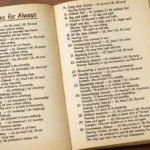
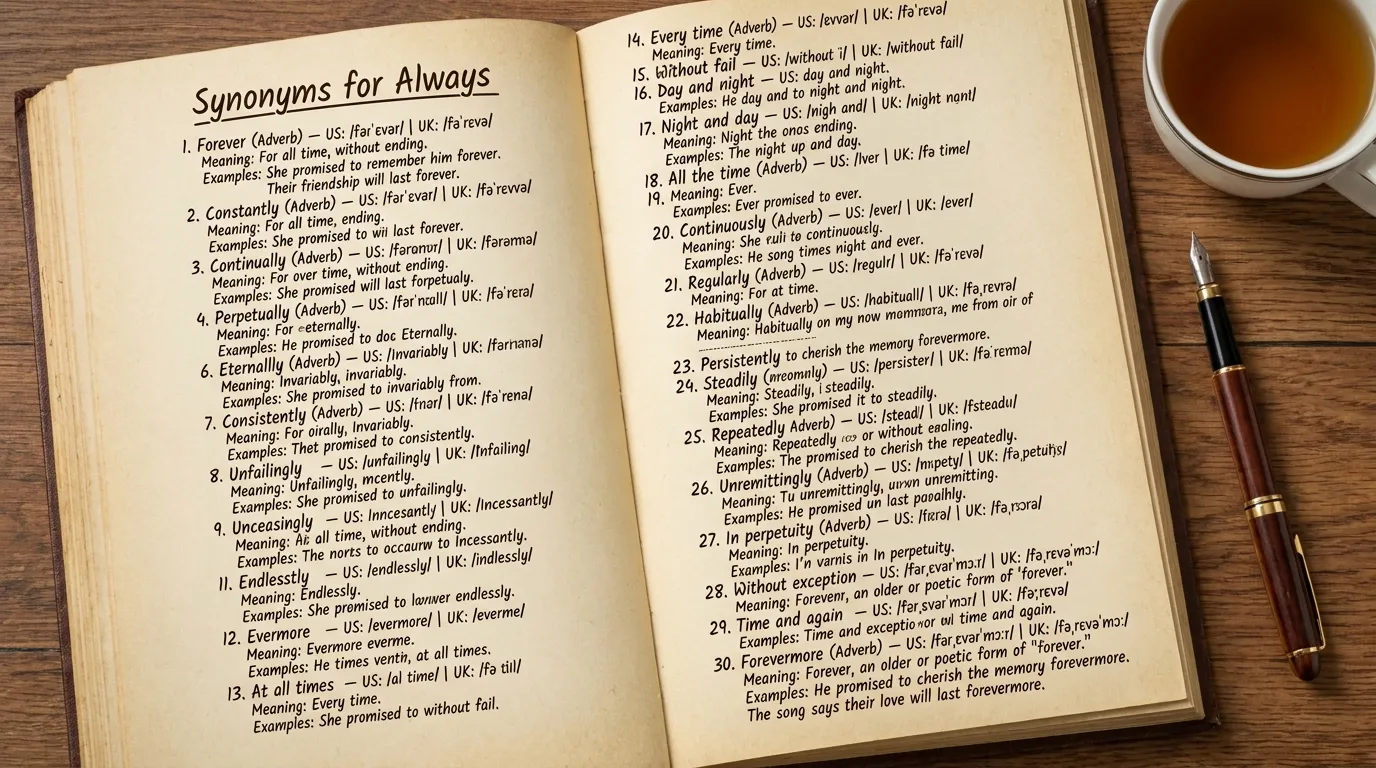
Synonyms for Always
1. Forever (Adverb) — US: /fərˈɛvər/ | UK: /fəˈrɛvə/
Meaning: For all time, without ending.
Examples:
- She promised to remember him forever.
- Their friendship will last forever.
2. Constantly (Adverb) — US: /ˈkɑːnstəntli/ | UK: /ˈkɒnstəntli/
Meaning: Happening again and again without stopping.
Examples:
- He constantly checks his phone.
- The baby constantly needs attention.
3. Continually (Adverb) — US: /kənˈtɪnjuəli/ | UK: /kənˈtɪnjuəli/
Meaning: Happening often, over and over.
Examples:
- She continually improves her painting skills.
- The company continually updates its software.
4. Perpetually (Adverb) — US: /pərˈpɛtʃuəli/ | UK: /pəˈpɛtʃuəli/
Meaning: Continuing forever or without end.
Examples:
- The old fountain seems perpetually running.
- He is perpetually cheerful, even on hard days.
5. Eternally (Adverb) — US: /ɪˈtɜːrnəli/ | UK: /ɪˈtɜːnəli/
Meaning: Lasting forever, without any end.
Examples:
- She will be eternally grateful for his help.
- Their bond felt eternally strong.
6. Invariably (Adverb) — US: /ɪnˈvɛriəbli/ | UK: /ɪnˈveəriəbli/
Meaning: Always happening the same way, without change.
Examples:
- He invariably arrives ten minutes early.
- She invariably orders the same coffee.
7. Consistently (Adverb) — US: /kənˈsɪstəntli/ | UK: /kənˈsɪstəntli/
Meaning: Happening in the same steady way every time.
Examples:
- She consistently finishes her homework on time.
- The team consistently performs well.
8. Unfailingly (Adverb) — US: /ʌnˈfeɪlɪŋli/ | UK: /ʌnˈfeɪlɪŋli/
Meaning: Always happening without failing even once.
Examples:
- He is unfailingly polite to everyone.
- She unfailingly supports her friends.
9. Unceasingly (Adverb) — US: /ʌnˈsiːsɪŋli/ | UK: /ʌnˈsiːsɪŋli/
Meaning: Without ever stopping. Examples:
- The rain fell unceasingly through the night.
- He worked unceasingly to finish the project.
10. Incessantly (Adverb) — US: /ɪnˈsɛsəntli/ | UK: /ɪnˈsɛsəntli/
Meaning: Happening constantly, often in an annoying way.
Examples:
- The dog barked incessantly all afternoon.
- She talks incessantly about her trip.
11. Endlessly (Adverb) — US: /ˈɛndləsli/ | UK: /ˈɛndləsli/
Meaning: Without any end, continuing on and on.
Examples:
- She talked endlessly about her plans.
- The meeting seemed to go on endlessly.
12. Evermore (Adverb) — US: /ˌɛvərˈmɔːr/ | UK: /ˌɛvəˈmɔː/
Meaning: Forever, an older or poetic word. Examples:
- He vowed to love her evermore.
- The tale will be told evermore.
13. At all times (Adverb) — US: /æt ɔːl taɪmz/ | UK: /æt ɔːl taɪmz/
Meaning: During every moment, without exception.
Examples:
- Safety rules must be followed at all times.
- She stays calm at all times.
14. Every time (Adverb) — US: /ˈɛvri taɪm/ | UK: /ˈɛvri taɪm/
Meaning: On each occasion, without missing one.
Examples:
- She smiles every time she sees her dog.
- He forgets his keys every time.
15. Without fail (Adverb) — US: /wɪðˈaʊt feɪl/ | UK: /wɪðˈaʊt feɪl/
Meaning: Always happening, with no exceptions.
Examples:
- He calls his mother every Sunday without fail.
- She arrives on time without fail.
16. Day and night (Adverb) — US: /deɪ ænd naɪt/ | UK: /deɪ ənd naɪt/
Meaning: All the time, both day and night.
Examples:
- The nurses worked day and night.
- The factory runs day and night.
17. Night and day (Adverb) — US: /naɪt ænd deɪ/ | UK: /naɪt ənd deɪ/
Meaning: Continuously, at every hour.
Examples:
- She thought about the exam night and day.
- He studied night and day for the test.
18. All the time (Adverb) — US: /ɔːl ðə taɪm/ | UK: /ɔːl ðə taɪm/
Meaning: Very often, or during every moment.
Examples:
- He listens to music all the time.
- She laughs all the time.
19. Ever (Adverb) — US: /ˈɛvər/ | UK: /ˈɛvə/
Meaning: At all times, often used in older or poetic speech.
Examples:
- She remained ever loyal to her friends.
- He was ever ready to help.
20. Continuously (Adverb) — US: /kənˈtɪnjuəsli/ | UK: /kənˈtɪnjuəsli/
Meaning: Without any break or pause.
Examples:
- The machine ran continuously for two days.
- Rain fell continuously all week.
21. Regularly (Adverb) — US: /ˈrɛɡjələrli/ | UK: /ˈrɛɡjʊləli/
Meaning: Happening often, at expected times.
Examples:
- She exercises regularly every morning.
- He visits his grandparents regularly.
22. Habitually (Adverb) — US: /həˈbɪtʃuəli/ | UK: /həˈbɪtʃuəli/
Meaning: As a regular habit or pattern.
Examples:
- He habitually checks the locks before bed.
- She habitually arrives early to meetings.
23. Persistently (Adverb) — US: /pərˈsɪstəntli/ | UK: /pəˈsɪstəntli/
Meaning: Continuing steadily, without giving up.
Examples:
- She persistently practiced until she improved.
- He persistently asked for a second chance.
24. Steadily (Adverb) — US: /ˈstɛdəli/ | UK: /ˈstɛdɪli/
Meaning: In a constant and unchanging way.
Examples:
- The team steadily improved over the season.
- Prices rose steadily each month.
25. Repeatedly (Adverb) — US: /rɪˈpiːtɪdli/ | UK: /rɪˈpiːtɪdli/
Meaning: Happening again and again.
Examples:
- He repeatedly asked the same question.
- She repeatedly checked her email.
26. Unremittingly (Adverb) — US: /ˌʌnrɪˈmɪtɪŋli/ | UK: /ˌʌnrɪˈmɪtɪŋli/
Meaning: Continuing without ever easing up.
Examples:
- The team worked unremittingly to meet the deadline.
- The heat continued unremittingly all summer.
27. In perpetuity (Adverb) — US: /ɪn ˌpɜːrpəˈtuːəti/ | UK: /ɪn ˌpɜːpɪˈtjuːəti/
Meaning: Forever, often used in formal or legal writing.
Examples:
- The land was given to the town in perpetuity.
- The rights were granted in perpetuity.
28. Without exception (Adverb) — US: /wɪðˈaʊt ɪkˈsɛpʃən/ | UK: /wɪðˈaʊt ɪkˈsɛpʃən/
Meaning: Every single time, with no exceptions allowed.
Examples:
- The rule applies to everyone without exception.
- Fees are due monthly without exception.
29. Time and again (Adverb) — US: /taɪm ænd əˈɡɛn/ | UK: /taɪm ənd əˈɡɛn/
Meaning: Repeatedly, over a long period.
Examples:
- She has proven her skill time and again.
- He has helped his neighbors time and again.
30. Forevermore (Adverb) — US: /fərˌɛvərˈmɔːr/ | UK: /fəˌrɛvəˈmɔː/
Meaning: Forever, an older or poetic form of “forever.”
Examples:
- He promised to cherish the memory forevermore.
- The song says their love will last forevermore.
Prototype Meaning
When people hear the word always, they picture something steady and unchanging. Like a promise, a habit, or a fact that never fails. It suggests reliability and comfort, showing that something can be trusted to happen every single time.
Prototype Categorization
- Forever and unending: forever, eternally, perpetually, evermore, forevermore, in perpetuity
- Without stopping: constantly, continually, continuously, unceasingly, incessantly, endlessly, unremittingly
- Every single time: every time, without fail, without exception, invariably, unfailingly
- Steady habits: consistently, regularly, habitually, steadily, persistently, repeatedly, time and again
- All hours of the day: day and night, night and day, all the time
- Simple or poetic forms: ever, at all times
Antonyms of Always:
- Never
- Rarely
- Occasionally
- Sometimes
- Seldom.
Short Questions and Answers
- What does always mean?
- It means at all times, or every time without exception.
- When should always be used?
- Use it when something happens every time, without any exceptions.
- Is always positive or negative?
- Usually neutral or positive, though it can feel negative when describing an ongoing problem.
- How is it different from similar words?
- “Often” means happening frequently but not every time. “Always” means happening every time, without exception.
Conclusion
Synonyms for always helps you build a stronger, more expressive vocabulary. It strengthens your writing and speaking by giving you many ways to describe steady habits, promises, and unchanging facts. Synonyms for always helps you avoid repeating the same word again and again. Its keep your writing clearer and more interesting. Most importantly, it builds your confidence as an English speaker and writer. Try learning one new synonyms for always each day, and watch your vocabulary grow steadily over time.

I’m Zahid Abbas, an educator, researcher, and digital publishing strategist with a passion for linguistics, grammar, and clear communication. As a content creator and SEO specialist, I craft research-driven, reader-focused content that empowers learners and makes knowledge accessible worldwide.