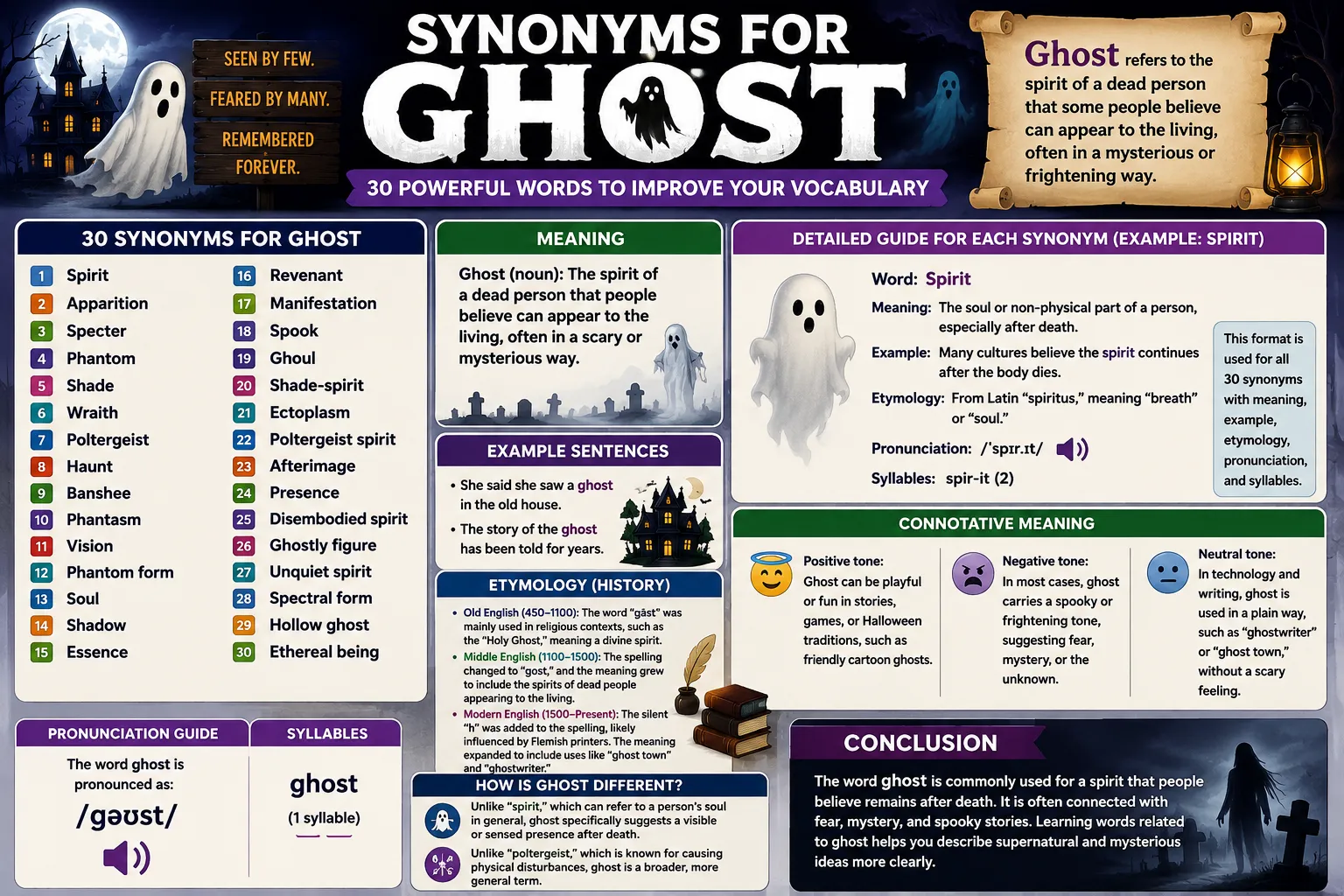
Ghost means the spirit of a dead person that some people believe can appear to the living, often in a mysterious way. Picture an old house at night, where floorboards creak. A cold wind passes through, even with the windows closed. Someone whispers, “This place is haunted by a ghost.” People often use synonyms for ghost in stories, or everyday talks about mysterious things.. For English learners and content writers, learning synonyms for ghost is important. Synonyms for ghost helps you avoid repeating the same word again and again. Also makes your writing sound more natural, and keeps readers interested. This article explains the meaning of ghost. Its synonyms, examples, grammar, history, pronunciation, and word categories, all explained in sentences.
Meaning of Ghost
Definition
Ghost (Noun): The spirit of a dead person that people believe can appear to the living, often in a scary or mysterious way.
Examples
- The old sailor swore he saw a ghost on the ship.
- Many people believe the castle is home to a ghost.
Connotative Meaning
- Positive tone: Ghost can sound fun or friendly in cartoons, games, or Halloween.
- Negative tone: Ghost usually has a scary feeling and can suggest fear or mystery.
- Neutral tone: Ghost can have a simple meaning in words like ghostwriter or ghost town.
Etymology
- The word ghost comes from Old English “gāst.”
- “Gāst” meant “spirit,” “soul,” or “breath.”
- It is related to the German word “Geist,” which also means “spirit” or “mind.”
Short History
- Old English (450–1100): The word “gāst” was mostly used to mean a spirit, especially in religious phrases like “Holy Ghost.”
- Middle English (1100–1500): The spelling changed to “gost.” It also began to mean the spirit of a dead person.
- Modern English (1500–Present): The spelling became “ghost.” The word later gained other uses, such as “ghost town” and “ghostwriter.”
Pronunciation (US & UK – IPA)
- US: /ɡoʊst/
- UK: /ɡəʊst/
Syllables
ghost (1 syllable)
Affixation Pattern of Ghost
- Root: ghost
- Prefix: none
- Suffix: -ly (forms “ghostly”), -ing (forms “ghosting”)
Explore our guide to https://synonymhunting.com/synonyms-for-uncomfortable/
Word Formation:
- Ghost (noun/verb)
- Ghostly (adjective)
- Ghosting (noun/verb form)
- Ghostwriter (noun, compound word)
Synonyms for Ghost
1. Spirit (Noun) — US: /ˈspɪrɪt/ | UK: /ˈspɪrɪt/
Meaning: The non-physical part of a person believed to live after death. Examples:
- They believe the spirit of their grandmother watches over them.
- The old house was said to hold many spirits.
2. Phantom (Noun) — US: /ˈfæntəm/ | UK: /ˈfæntəm/
Meaning: A ghost-like figure that is not fully real or solid. Examples:
- A phantom appeared at the end of the hallway.
- The story described a phantom haunting the theater.
3. Specter (Noun) — US: /ˈspɛktər/ | UK: /ˈspɛktə/
Meaning: A ghost, especially one that causes fear. Examples:
- A specter was said to roam the abandoned mansion.
- The specter vanished as quickly as it appeared.
4. Apparition (Noun) — US: /ˌæpəˈrɪʃən/ | UK: /ˌæpəˈrɪʃən/
Meaning: A ghost or ghost-like image that suddenly appears. Examples:
- Villagers spoke of an apparition near the old bridge.
- The apparition frightened everyone in the room.
5. Spook (Noun) — US: /spuːk/ | UK: /spuːk/
Meaning: An informal word for a ghost. Examples:
- The kids said the barn was full of spooks.
- A spook is said to live in the attic.
6. Wraith (Noun) — US: /reɪθ/ | UK: /reɪθ/
Meaning: A ghost-like figure, often thin and pale. Examples:
- A wraith drifted silently through the fog.
- The legend spoke of a wraith guarding the tomb.
7. Shade (Noun) — US: /ʃeɪd/ | UK: /ʃeɪd/
Meaning: A literary word for a ghost or spirit of the dead. Examples:
- In the poem, a shade wanders through the underworld.
- The old myth described the shade of a fallen warrior.
8. Poltergeist (Noun) — US: /ˈpoʊltərˌɡaɪst/ | UK: /ˈpɒltəˌɡaɪst/
Meaning: A noisy or mischievous ghost that moves objects. Examples:
- A poltergeist was blamed for the moving furniture.
- The poltergeist slammed doors throughout the night.
9. Revenant (Noun) — US: /ˈrɛvənənt/ | UK: /ˈrɛvənənt/
Meaning: A person who returns as a spirit after death. Examples:
- The revenant returned to haunt his old home.
- Legends describe the revenant seeking revenge.
10. Banshee (Noun) — US: /ˈbænʃiː/ | UK: /ˈbænʃiː/
Meaning: A spirit from Irish folklore known for its wailing cry. Examples:
- The banshee’s cry warned of coming death.
- Old stories describe the banshee near the castle.
11. Ghoul (Noun) — US: /ɡuːl/ | UK: /ɡuːl/
Meaning: An evil spirit or creature, often linked to graveyards. Examples:
- The ghoul was said to haunt the old cemetery.
- Children told scary stories about a ghoul at night.
12. Phantasm (Noun) — US: /ˈfæntæzəm/ | UK: /ˈfæntæzəm/
Meaning: A ghost-like image or illusion. Examples:
- A phantasm appeared briefly before fading away.
- The old tale spoke of a phantasm in the woods.
13. Manifestation (Noun) — US: /ˌmænɪfɛˈsteɪʃən/ | UK: /ˌmænɪfɛˈsteɪʃən/
Meaning: A visible or sensed sign of a spirit or ghost. Examples:
- Strange sounds were seen as a manifestation of the spirit.
- The medium claimed to sense a manifestation nearby.
14. Presence (Noun) — US: /ˈprɛzəns/ | UK: /ˈprɛzəns/
Meaning: A feeling that a spirit or ghost is nearby. Examples:
- She felt a strange presence in the empty house.
- The guests sensed a presence in the old library.
15. Shadow (Noun) — US: /ˈʃædoʊ/ | UK: /ˈʃædəʊ/
Meaning: A dark, ghost-like figure, often unclear or hard to see. Examples:
- A shadow moved across the wall with no source.
- The children saw a shadow near the window.
16. Vision (Noun) — US: /ˈvɪʒən/ | UK: /ˈvɪʒən/
Meaning: Something seen that may not be real, often spiritual. Examples:
- She described her vision of a ghostly figure.
- The old man spoke of a strange vision at night.
17. Haunt (Noun) — US: /hɔːnt/ | UK: /hɔːnt/
Meaning: A ghost or spirit connected to a specific place. Examples:
- The house is said to have a haunt from long ago.
- Locals believe a haunt still lives in the tower.
18. Soul (Noun) — US: /soʊl/ | UK: /səʊl/
Meaning: The spiritual part of a person, sometimes described as lingering after death. Examples:
- They believe the soul of the sailor remains at sea.
- The soul was said to wander the halls at night.
19. Essence (Noun) — US: /ˈɛsəns/ | UK: /ˈɛsəns/
Meaning: The invisible spirit or presence left behind by someone. Examples:
- Her essence seemed to linger in the quiet room.
- The old letters carried the essence of the past.
20. Doppelganger (Noun) — US: /ˈdɑːpəlˌɡæŋər/ | UK: /ˈdɒpəlˌɡæŋə/
Meaning: A ghostly double or look-alike of a living person. Examples:
- Seeing your doppelganger is said to bring bad luck.
- The story followed a man who met his doppelganger.
21. Eidolon (Noun) — US: /aɪˈdoʊlɒn/ | UK: /aɪˈdəʊlɒn/
Meaning: A ghost-like image or idealized spirit form, used mainly in literature. Examples:
- The poem described an eidolon rising from the mist.
- An eidolon appeared in the character’s dream.
22. Duppy (Noun) — US: /ˈdʌpi/ | UK: /ˈdʌpi/
Meaning: A ghost or spirit, especially in Caribbean folklore. Examples:
- The elders warned children about the duppy in the woods.
- A duppy is said to appear near old graves.
23. Haint (Noun) — US: /heɪnt/ | UK: /heɪnt/
Meaning: A dialect word for a ghost, common in Southern American folklore. Examples:
- The porch ceiling was painted blue to keep the haint away.
- Old stories speak of a haint near the swamp.
24. Wisp (Noun) — US: /wɪsp/ | UK: /wɪsp/
Meaning: A faint, ghost-like light or figure, often seen in folklore. Examples:
- A wisp led travelers deeper into the marsh.
- The wisp glowed faintly in the dark forest.
25. Incorporeal being (Noun) — US: /ˌɪnkɔːrˈpɔːriəl ˈbiːɪŋ/ | UK: /ˌɪnkɔːˈpɔːriəl ˈbiːɪŋ/
Meaning: A being without a physical body, such as a spirit. Examples:
- The story described an incorporeal being roaming the ruins.
- Legends spoke of an incorporeal being guarding the treasure.
26. Disembodied spirit (Noun) — US: /ˌdɪsɪmˈbɑːdid ˈspɪrɪt/ | UK: /ˌdɪsɪmˈbɒdid ˈspɪrɪt/
Meaning: A spirit without a physical body. Examples:
- A disembodied spirit was said to haunt the manor.
- The medium claimed to speak with a disembodied spirit.
27. Astral form (Noun) — US: /ˈæstrəl fɔːrm/ | UK: /ˈæstrəl fɔːm/
Meaning: A spiritual or ghost-like form separate from the body. Examples:
- Some believe the astral form can travel while sleeping.
- The book described the astral form leaving the body.
28. Night wanderer (Noun) — US: /naɪt ˈwɑːndərər/ | UK: /naɪt ˈwɒndərə/
Meaning: A ghost or spirit that moves about at night. Examples:
- The villagers feared the night wanderer near the woods.
- A night wanderer was blamed for the strange noises.
29. Spectral figure (Noun) — US: /ˈspɛktrəl ˈfɪɡjər/ | UK: /ˈspɛktrəl ˈfɪɡə/
Meaning: A ghost-like figure, often pale or glowing. Examples:
- A spectral figure stood at the end of the corridor.
- The photo seemed to show a spectral figure in the mist.
30. Unearthly figure (Noun) — US: /ʌnˈɜːrθli ˈfɪɡjər/ | UK: /ʌnˈɜːθli ˈfɪɡə/
Meaning: A strange, ghost-like figure that does not seem human or natural. Examples:
- An unearthly figure floated above the old graveyard.
- Witnesses described an unearthly figure near the lake.
Prototype Meaning
When people hear ghost, they often think of a scary, pale figure. A ghost is often shown in dark or quiet places. The word ghost is linked to fear, mystery, and spooky stories.
Prototype Categorization
- Classic ghostly figures: phantom, specter, apparition, wraith, spook
- Folklore-specific spirits: banshee, duppy, haint, revenant, poltergeist
- Literary or poetic terms: shade, eidolon, phantasm, wisp
- Spiritual or soul-related terms: spirit, soul, essence, presence
- Descriptive ghost-like figures: shadow, spectral figure, unearthly figure, night wanderer
- Formal or technical terms: incorporeal being, disembodied spirit, astral form, manifestation
Antonyms of Ghost
- Reality
- Substance
- Human
- Physical being
- Living person
Short Questions and Answers
- What does ghost mean?
- Ghost means the spirit of a dead person that some believe can appear to the living.
- When should ghost be used?
- Use ghost when describing supernatural stories, folklore, or spooky experiences involving spirits.
- Is ghost positive or negative?
- Ghost is usually negative because it is linked to fear and mystery. However, it can also sound fun in stories, cartoons, or Halloween.
- How is it different from similar words?
- A spirit can mean a person’s soul or a supernatural being. A ghost usually means the spirit of a dead person that is believed to appear or be felt. A poltergeist is a type of supernatural being often linked to strange noises.
Conclusion
Synonyms for ghost helps you build a stronger, more descriptive vocabulary. It improves your writing and speaking by giving you more ways to describe mystery, spirits, and supernatural events. Synonyms for ghost helps you avoid repeating the same words, which keeps your storytelling engaging. Most importantly, learning new words like this builds your confidence in English. Try using one new synonyms for ghost from this list every day. Small daily practice adds up to big improvement over time.

I’m Zahid Abbas, an educator, researcher, and digital publishing strategist with a passion for linguistics, grammar, and clear communication. As a content creator and SEO specialist, I craft research-driven, reader-focused content that empowers learners and makes knowledge accessible worldwide.