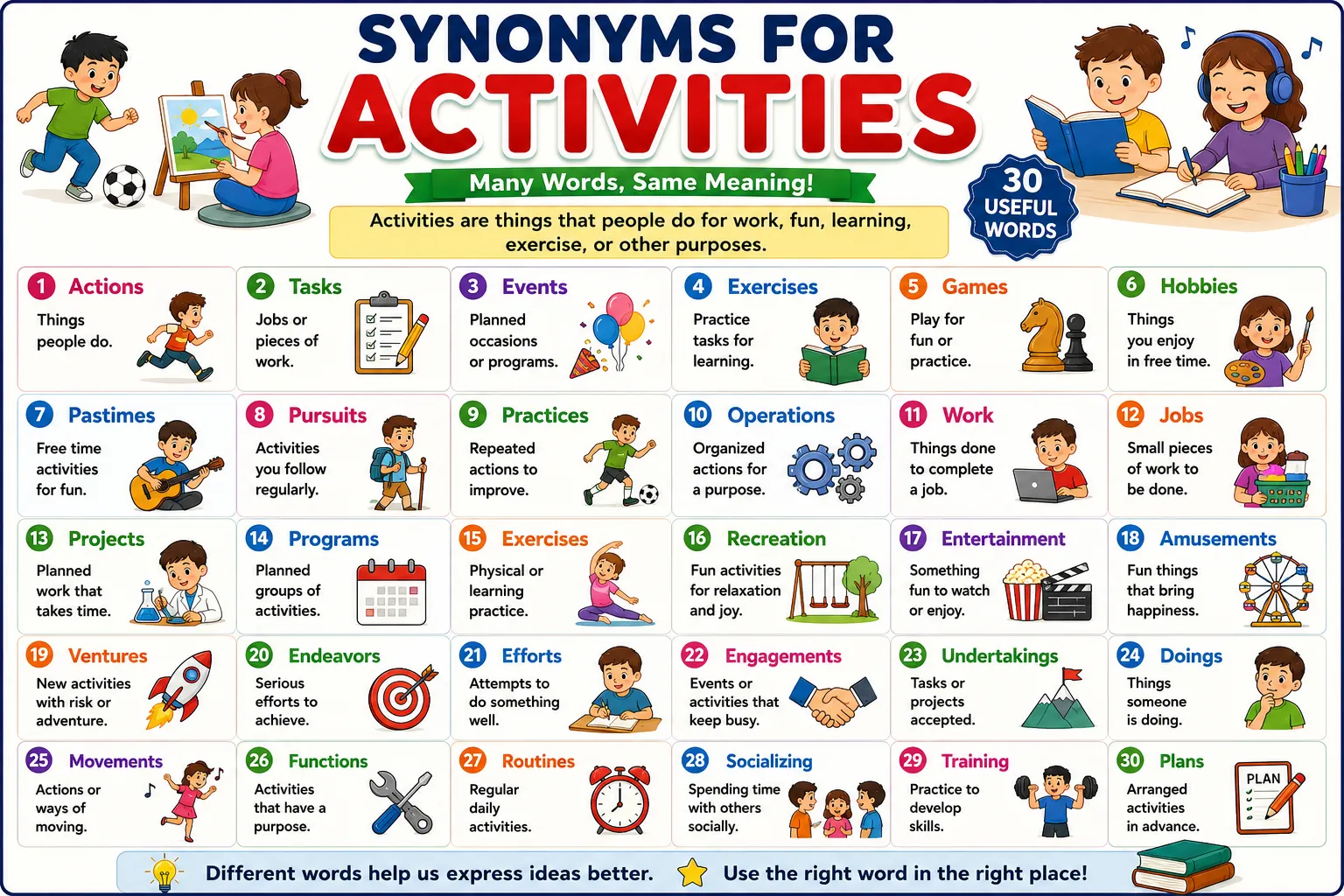
Activities means things that people do, usually for work, fun, learning, exercise, or other purposes. For example, a child may take part in school activities such as drawing, reading, playing games, or planting trees. The word activities is common because we use it to talk about many kinds of actions and events in daily life. Learning synonyms for activities helps English learners use more varied words instead of repeating the same word. It also helps students and content writers make their writing clearer. In this article, you will learn 30 easy synonyms for activities. Along with their meanings, examples, grammar, pronunciation, word history, and different meaning groups. These words will help you speak and write English with more confidence.
Meaning of Activities
Definition
Activities (Noun): Things that people do for a purpose, such as learning, working, playing, or having fun.
Examples
- The school planned many fun activities for the students.
- Outdoor activities can help children stay healthy.
Connotative Meaning
- Positive tone: Activities can suggest fun, learning, teamwork, and healthy action.
- Negative tone: Activities can suggest too much work or unwanted tasks in some contexts.
- Neutral tone: Activities can simply mean things people do.
Etymology
- The word activity comes from Latin activitas, meaning “activity” or “the quality of being active.”
- It came into English through French and Latin forms.
- The word is related to active, which means “doing something” or “full of action.”
Short History
- Old English (450–1100): The modern word activity was not commonly used. English used other words for action and doing.
- Middle English (1100–1500): Latin and French words became more common in English, helping words related to active enter the language.
- Modern English (1500–Present): Activity became a common word for things people do at school, work, home, and in free time.
Pronunciation
US: /ækˈtɪvəti/ UK: /ækˈtɪvəti/
Syllables
ac-tiv-i-ty
Affixation Pattern of Activities
- Root: act
- Prefix: None
- Suffix: -ive, -ity, -ies
- Word formation: act → active → activity → activities
- Grammatical categories: verb (act), adjective (active), noun (activity), plural noun (activities).
Synonyms of Activities
1. Actions (Noun) — US /ˈækʃənz/ | UK /ˈækʃənz/
Meaning: Things that people do.
Examples:
- His actions helped his friend.
- We talked about our daily actions.
2. Tasks (Noun) — US /tæsks/ | UK /tɑːsks/
Meaning: Jobs or pieces of work that need to be done.
Examples:
- I finished my school tasks before lunch.
- Dad gave me two simple tasks.
3. Events (Noun) — US /ɪˈvɛnts/ | UK /ɪˈvents/
Meaning: Things that happen at a planned time.
Examples:
- Our school held several events this month.
- The sports events were fun to watch.
4. Exercises (Noun) — US /ˈeksərsaɪzɪz/ | UK /ˈeksəsaɪzɪz/
Meaning: Activities done to practice or improve a skill.
Examples:
- We did reading exercises in class.
- These math exercises are easy.
5. Games (Noun) — US /ɡeɪmz/ | UK /ɡeɪmz/
Meaning: Activities played for fun or practice.
Examples:
- The children played outdoor games.
- We enjoy board games after dinner.
6. Hobbies (Noun) — US /ˈhɑːbiz/ | UK /ˈhɒbiz/
Meaning: Activities people enjoy doing in their free time.
Examples:
- Reading is one of my favorite hobbies.
- Her hobbies include drawing and singing.
7. Pastimes (Noun) — US /ˈpæstaɪmz/ | UK /ˈpɑːstaɪmz/
Meaning: Things people do for fun in their free time.
Examples:
- Playing chess is one of his favorite pastimes.
- Reading is a quiet pastime.
8. Pursuits (Noun) — US /pərˈsuːts/ | UK /pəˈsjuːts/
Meaning: Activities that people spend time doing or trying to achieve.
Examples:
- Art was one of her favorite pursuits.
- His studies and sports pursuits kept him busy.
9. Practices (Noun) — US /ˈpræktɪsɪz/ | UK /ˈpræktɪsɪz/
Meaning: Repeated actions done to improve a skill.
Examples:
- Soccer practices start after school.
- Daily writing practices can help students improve.
10. Operations (Noun) — US /ˌɑːpəˈreɪʃənz/ | UK /ˌɒpəˈreɪʃənz/
Meaning: Organized actions done for a purpose.
Examples:
- The team planned its daily operations.
- The store’s operations begin early each morning.
11. Work (Noun) — US /wɜːrk/ | UK /wɜːk/
Meaning: Things done to complete a job or reach a goal.
Examples:
- We have a lot of work to do today.
- Her work helps the whole team.
12. Jobs (Noun) — US /dʒɑːbz/ | UK /dʒɒbz/
Meaning: Pieces of work that need to be completed.
Examples:
- I have three small jobs to finish.
- Cleaning the room was one of my jobs.
13. Projects (Noun) — US /ˈprɑːdʒekts/ | UK /ˈprɒdʒekts/
Meaning: Planned pieces of work that take time to complete.
Examples:
- Our class started two science projects.
- She enjoyed her art project.
14. Programs (Noun) — US /ˈproʊɡræmz/ | UK /ˈprəʊɡræmz/
Meaning: Planned groups of activities.
Examples:
- The school has sports programs for children.
- We joined a reading program.
15. Exercises (Noun) — US /ˈeksərsaɪzɪz/ | UK /ˈeksəsaɪzɪz/
Meaning: Physical or learning activities done for practice.
Examples:
- We did simple writing exercises.
- Morning exercises keep the body active.
16. Recreation (Noun) — US /ˌrekriˈeɪʃən/ | UK /ˌrekriˈeɪʃən/
Meaning: Activities done for fun and relaxation.
Examples:
- Swimming is a fun form of recreation.
- The park is used for outdoor recreation.
17. Entertainment (Noun) — US /ˌentərˈteɪnmənt/ | UK /ˌentəˈteɪnmənt/
Meaning: Something people do or watch for fun.
Examples:
- The children enjoyed the entertainment.
- Music is a popular form of entertainment.
18. Amusements (Noun) — US /əˈmjuːzmənts/ | UK /əˈmjuːzmənts/
Meaning: Fun things that make people happy or help them enjoy their time.
Examples:
- The park has many amusements for children.
- The fair offered games and other amusements.
19. Ventures (Noun) — US /ˈventʃərz/ | UK /ˈventʃəz/
Meaning: New activities that involve some risk or effort.
Examples:
- They started a small business venture.
- The trip was an exciting new venture.
20. Endeavors (Noun) — US /enˈdevərz/ | UK /enˈdevəz/
Meaning: Serious efforts to do or achieve something.
Examples:
- Her school endeavors made her proud.
- We wish him success in his future endeavors.
21. Efforts (Noun) — US /ˈefərts/ | UK /ˈefəts/
Meaning: Attempts to do something well.
Examples:
- His efforts helped the team win.
- She made a great effort to learn English.
22. Engagements (Noun) — US /ɪnˈɡeɪdʒmənts/ | UK /ɪnˈɡeɪdʒmənts/
Meaning: Activities or events that keep someone busy.
Examples:
- He has several school engagements today.
- Her daily engagements keep her busy.
23. Undertakings (Noun) — US /ˈʌndərteɪkɪŋz/ | UK /ˈʌndərteɪkɪŋz/
Meaning: Tasks or projects that someone agrees to do.
Examples:
- The group began several new undertakings.
- Cleaning the park was a big undertaking.
24. Doings (Noun) — US /ˈduːɪŋz/ | UK /ˈduːɪŋz/
Meaning: Things that someone does.
Examples:
- We talked about the children’s daily doings.
- His doings made everyone curious.
25. Movements (Noun) — US /ˈmuːvmənts/ | UK /ˈmuːvmənts/
Meaning: Actions or ways of moving.
Examples:
- The dancer made smooth movements.
- Stretching helps improve body movements.
26. Events (Noun) — US /ɪˈvents/ | UK /ɪˈvents/
Meaning: Planned occasions where people meet or take part in something.
Examples:
- The school has many sports events.
- We joined the weekend event.
27. Recreation Activities (Noun Phrase) — US /ˌrekriˈeɪʃən ækˈtɪvətiz/ | UK /ˌrekriˈeɪʃən ækˈtɪvətiz/
Meaning: Fun activities people do during free time.
Examples:
- Swimming is one of our favorite recreation activities.
- The camp offers many recreation activities.
28. Socializing (Noun) — US /ˈsoʊʃəlaɪzɪŋ/ | UK /ˈsəʊʃəlaɪzɪŋ/
Meaning: Spending time with other people for friendship and fun.
Examples:
- Socializing with friends can be fun.
- The party gave us time for socializing.
29. Training (Noun) — US /ˈtreɪnɪŋ/ | UK /ˈtreɪnɪŋ/
Meaning: Activities that help someone learn or improve a skill.
Examples:
- The players had soccer training after school.
- Regular training helped her run faster.
30. Recreation (Noun) — US /ˌrekriˈeɪʃən/ | UK /ˌrekriˈeɪʃən/
Meaning: Fun activities done during free time.
Examples:
- Swimming is a healthy form of recreation.
- The children enjoyed outdoor recreation.
Prototype Meaning
The most typical meaning of activities is things people do. When people hear this word, they often think of actions. Such as playing games, studying, working, exercising, drawing, reading, or spending time. The exact meaning depends on the situation.
Prototype Categorization
- Fun and free-time activities: hobbies, pastimes, recreation, games, amusements.
- Learning activities: exercises, practices, training, projects.
- Work activities: tasks, jobs, work, operations, undertakings.
- Social activities: socializing, events, engagements.
- Goal-based activities: efforts, pursuits, endeavors, ventures.
Also read more about https://synonymhunting.com/synonyms-of-concept/
Antonyms of Activities
- Inactivity — lack of action.
- Rest — a period without activity.
- Stillness — a state without movement.
- Idleness — doing little or no work.
- Passivity — not taking action.
Short Questions and Answers
- What does activities mean? Activities means things that people do for work, learning, exercise, fun, or another purpose.
- When should activities be used? Use activities when talking about two or more things that people do.
- Is activities positive or negative? It is usually neutral. Its feeling depends on the activity being discussed.
- How is activities different from similar words? Activities is a broad word. Tasks usually means jobs to complete, hobbies means things done for fun, and events means planned occasions.
Conclusion
Synonyms for activities can make your English stronger and more interesting. Instead of using activities again and again, you can choose words such as tasks, hobbies, games, exercises, projects, events, recreation, or training. Each word gives a slightly different meaning and works best in a different situation. This helps English learners speak more clearly and write better sentences. Synonyms for activities also helps students and content writers avoid repeated words. Start by learning a few synonyms for activities each day and use them in your own sentences. With regular practice, you will build a stronger vocabulary, improve your writing and speaking.

I’m Zahid Abbas, an educator, researcher, and digital publishing strategist with a passion for linguistics, grammar, and clear communication. As a content creator and SEO specialist, I craft research-driven, reader-focused content that empowers learners and makes knowledge accessible worldwide.