Planning is a part of everyday life. Whether you are organizing a vacation, preparing for an exam, starting a business, or arranging a family event, you need a plan. A plan is a set of actions designed to achieve a goal. For example, a student may create a study plan before an important test. A business owner may develop a plan to increase sales.
The word plan is commonly used because it helps people talk about preparation, organization, and future actions. Learning synonyms of plan is important for English learners because it improves vocabulary and makes speaking and writing more natural. It is also useful for content writers who want to avoid repeating the same word. In this article, you will learn the meaning of plan, its pronunciation, history, grammar, connotations, and 30 powerful synonyms with examples to strengthen your English skills.
Meaning of Plan
Plan (Noun, Verb):
A plan is a detailed idea or method for doing something or achieving a goal. As a verb, it means to prepare or arrange something in advance.
Examples
- I made a plan for my weekend trip.
- We plan to visit our grandparents next month.
Connotative Meaning
- Positive tone: organization, preparation, success, foresight
- Negative tone: manipulation, plotting, excessive control
- Neutral tone: arrangement, schedule, intended action
Etymology
- Origin: From French plan and Latin planum
- Original meaning: a flat surface, drawing, or layout
Short History of the Keyword
- Old English (450–1100): The modern word was not commonly used.
- Middle English (1100–1500): Influenced by French words related to drawings and layouts.
- Modern English (1500–Present): Developed into the meaning of a scheme, design, or intended course of action.
Pronunciation (US & UK – IPA)
US: /plæn/
UK: /plæn/
Syllables
plan
Affixation Pattern of Plan
Root: plan
Prefix: None
Suffix: None
Word Formation of Plan
- Plan (noun)
- Plan (verb)
- Planner (noun)
- Planned (adjective/verb)
- Planning (noun/verb)
- Replan (verb)
- Unplanned (adjective)
- Overplanning (noun)
- Preplanned (adjective)
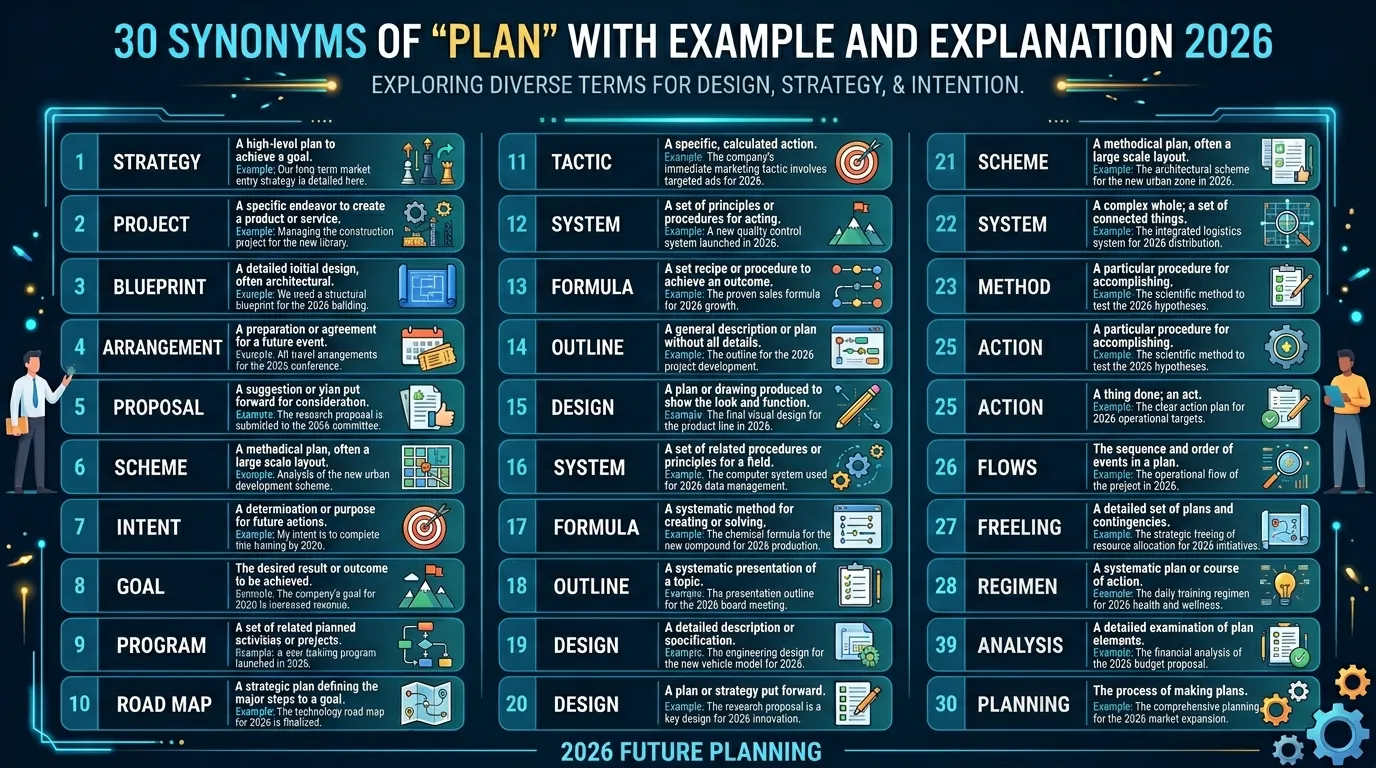
30 Synonyms of Plan
1. Strategy (Noun)
US: /ˈstrætədʒi/ | UK: /ˈstrætədʒi/
Meaning: A careful plan designed to achieve a specific goal.
Examples:
- The company created a strategy for growth.
- Our strategy helped us win the competition.
2. Scheme (Noun)
US: /skiːm/ | UK: /skiːm/
Meaning: An organized plan for achieving something.
Examples:
- The government announced a new housing scheme.
- She developed a scheme to improve efficiency.
3. Program (Noun)
US: /ˈproʊɡræm/ | UK: /ˈprəʊɡræm/
Meaning: A planned series of activities.
Examples:
- The school launched a reading program.
- We followed a training program.
4. Blueprint (Noun)
US: /ˈbluːprɪnt/ | UK: /ˈbluːprɪnt/
Meaning: A detailed plan or model.
Examples:
- The document serves as a blueprint for success.
- Engineers studied the blueprint carefully.
5. Design (Noun)
US: /dɪˈzaɪn/ | UK: /dɪˈzaɪn/
Meaning: A plan showing how something will be made.
Examples:
- The design was approved yesterday.
- She created a new design for the website.
6. Proposal (Noun)
US: /prəˈpoʊzəl/ | UK: /prəˈpəʊzəl/
Meaning: A suggested plan for consideration.
Examples:
- The proposal received support.
- We reviewed the proposal together.
7. Project (Noun)
US: /ˈprɑːdʒekt/ | UK: /ˈprɒdʒekt/
Meaning: A planned piece of work.
Examples:
- The project begins next week.
- She managed the project successfully.
8. Agenda (Noun)
US: /əˈdʒendə/ | UK: /əˈdʒendə/
Meaning: A list of planned activities or topics.
Examples:
- The agenda included three discussions.
- Please check today’s agenda.
9. Arrangement (Noun)
US: /əˈreɪndʒmənt/ | UK: /əˈreɪndʒmənt/
Meaning: Something organized beforehand.
Examples:
- Travel arrangements are complete.
- We made arrangements for the event.
10. Schedule (Noun)
US: /ˈskedʒuːl/ | UK: /ˈʃedjuːl/
Meaning: A timetable of planned activities.
Examples:
- My schedule is very busy.
- The meeting follows the schedule.
11. Roadmap (Noun)
US: /ˈroʊdmæp/ | UK: /ˈrəʊdmæp/
Meaning: A plan showing future steps.
Examples:
- The roadmap outlines company goals.
- We created a roadmap for development.
12. Framework (Noun)
US: /ˈfreɪmwɜːrk/ | UK: /ˈfreɪmwɜːk/
Meaning: A basic structure for a plan.
Examples:
- The framework guides the project.
- We developed a useful framework.
13. Outline (Noun)
US: /ˈaʊtlaɪn/ | UK: /ˈaʊtlaɪn/
Meaning: A general description of a plan.
Examples:
- He gave an outline of the proposal.
- The outline was easy to understand.
14. Draft (Noun)
US: /dræft/ | UK: /drɑːft/
Meaning: An early version of a plan.
Examples:
- I completed the first draft.
- The draft needs revisions.
15. Layout (Noun)
US: /ˈleɪaʊt/ | UK: /ˈleɪaʊt/
Meaning: The arrangement of parts in a plan.
Examples:
- The layout looks attractive.
- We changed the layout yesterday.
16. Objective (Noun)
US: /əbˈdʒektɪv/ | UK: /əbˈdʒektɪv/
Meaning: A goal within a plan.
Examples:
- Our objective is customer satisfaction.
- The objective was clearly defined.
17. Goal (Noun)
US: /ɡoʊl/ | UK: /ɡəʊl/
Meaning: Something you aim to achieve.
Examples:
- My goal is to learn English.
- The team reached its goal.
18. Mission (Noun)
US: /ˈmɪʃən/ | UK: /ˈmɪʃən/
Meaning: A planned purpose or task.
Examples:
- The mission was successful.
- Their mission focuses on education.
19. Intent (Noun)
US: /ɪnˈtent/ | UK: /ɪnˈtent/
Meaning: A planned purpose or aim.
Examples:
- His intent was clear.
- She acted with good intent.
20. Intention (Noun)
US: /ɪnˈtenʃən/ | UK: /ɪnˈtenʃən/
Meaning: Something a person plans to do.
Examples:
- My intention is to help.
- She explained her intention.
21. Tactic (Noun)
US: /ˈtæktɪk/ | UK: /ˈtæktɪk/
Meaning: A specific action within a strategy.
Examples:
- The tactic worked well.
- They changed their tactic.
22. Method (Noun)
US: /ˈmeθəd/ | UK: /ˈmeθəd/
Meaning: A planned way of doing something.
Examples:
- This method saves time.
- We adopted a new method.
23. Approach (Noun)
US: /əˈproʊtʃ/ | UK: /əˈprəʊtʃ/
Meaning: A way of dealing with something.
Examples:
- Her approach was effective.
- We need a better approach.
24. Procedure (Noun)
US: /prəˈsiːdʒər/ | UK: /prəˈsiːdʒə/
Meaning: A series of planned steps.
Examples:
- Follow the correct procedure.
- The procedure is simple.
25. Preparation (Noun)
US: /ˌprepəˈreɪʃən/ | UK: /ˌprepəˈreɪʃən/
Meaning: The act of getting ready.
Examples:
- Good preparation leads to success.
- The team completed its preparation.
26. Arrangement (Noun)
US: /əˈreɪndʒmənt/ | UK: /əˈreɪndʒmənt/
Meaning: An organized plan or setup.
Examples:
- The arrangement worked perfectly.
- We finalized the arrangement.
27. Plot (Noun)
US: /plɑːt/ | UK: /plɒt/
Meaning: A secret or detailed plan.
Examples:
- The movie featured a clever plot.
- They uncovered the plot.
28. Design Scheme (Noun)
US: /dɪˈzaɪn skiːm/ | UK: /dɪˈzaɪn skiːm/
Meaning: A structured planning concept.
Examples:
- The design scheme impressed everyone.
- We adopted a modern design scheme.
29. Course of Action (Noun)
US: /kɔːrs əv ˈækʃən/ | UK: /kɔːs əv ˈækʃən/
Meaning: A planned way to proceed.
Examples:
- We selected the best course of action.
- The course of action reduced risks.
30. Master Plan (Noun)
US: /ˈmæstər plæn/ | UK: /ˈmɑːstə plæn/
Meaning: A comprehensive long-term plan.
Examples:
- The city approved a master plan.
- The master plan guides future growth.
Prototype Meaning
The prototype meaning of plan is a set of ideas or actions prepared before doing something. When people hear the word plan, they usually imagine organizing future activities, setting goals, and deciding what steps to take to achieve success.
Prototype Categorization
- Business and Leadership: strategy, roadmap, framework, blueprint, master plan
- Organization and Scheduling: schedule, agenda, arrangement, layout
- Goals and Purpose: objective, goal, mission, intention, intent
- Methods and Actions: tactic, method, approach, procedure
- Project Development: proposal, draft, design, project, outline
- Special or Formal Planning: scheme, course of action, program
Antonyms of Plan
- Chaos (Noun): complete disorder and confusion
- Disorganization (Noun): lack of order or planning
- Improvisation (Noun): acting without preparation
- Neglect (Noun/Verb): failure to prepare properly
- Accident (Noun): an unplanned event
- Confusion (Noun): lack of clear direction
- Randomness (Noun): absence of planning
- Disorder (Noun): lack of organization
- Spontaneity (Noun): acting without a prior plan
- Carelessness (Noun): failure to think ahead
Short Questions and Answers
- What does plan mean?
A plan is a method or set of actions prepared to achieve a goal. - When should plan be used?
Use plan when talking about preparation, organization, or future actions. - Is plan positive or negative?
It is usually positive because it suggests preparation, but it can be negative when referring to a secret or harmful plot. - How is it different from similar words?
Plan is a general word. Strategy focuses on achieving goals, schedule focuses on time, and blueprint focuses on detailed design.
Conclusion
Learning the Synonyms of Plan and Synonyms of Plan can greatly improve your English vocabulary. These words help you express ideas more clearly in speaking and writing. Using different synonyms such as strategy, roadmap, proposal, and framework makes your language more interesting and professional. It also helps you avoid repeating the same word again and again. Understanding pronunciation, history, connotation, and usage gives you a deeper knowledge of English. The more synonyms you learn, the more confident you become when communicating. Practice using one new synonym each day in conversations and writing. Over time, your vocabulary will grow stronger, and your English skills will improve naturally.

I’m Zahid Abbas, an educator, researcher, and digital publishing strategist with a passion for linguistics, grammar, and clear communication. As a content creator and SEO specialist, I craft research-driven, reader-focused content that empowers learners and makes knowledge accessible worldwide.