The word information means facts, details, or knowledge about something. Imagine a student searching online for school project details. The student reads books, websites, and notes to collect information. In daily life, people use information to learn, communicate, solve problems, and make decisions.
This word is very common in education, business, science, media, and everyday conversations. However, using the same word repeatedly can make writing sound repetitive and weak. Learning synonyms of information helps English learners improve vocabulary and express ideas more clearly. It also helps writers choose the best word for formal, academic, or casual situations. In this article, you will learn the meaning of information, its pronunciation, grammar, history, and 30 useful synonyms with meanings and examples. You will also explore semantic categories, antonyms, and simple questions to strengthen your English skills.
Meaning of Information
Definition
Information (noun): facts, knowledge, or details about a person, thing, or situation.
Examples
- The teacher shared important information about the exam.
- We need more information before making a decision.
Connotative Meaning
- Positive tone: knowledge, learning, awareness
- Negative tone: overload, confusion, misinformation
- Neutral tone: facts or details about something
Etymology
- From Latin informare meaning “to shape” or “to instruct”
- Entered English through Old French and Latin roots
Short History:
- Old English (450–1100): knowledge was shared through speech and writing
- Middle English (1100–1500): “information” referred to instruction and education
- Modern English (1500–Present): the word became widely used for facts, news, and data
Pronunciation (US & UK – IPA)
- US: /ˌɪnfərˈmeɪʃən/
- UK: /ˌɪnfəˈmeɪʃən/
Syllables
- in-for-ma-tion
Affixation Pattern of Information
- Root: form
- Prefix: in-
- Suffix: -ation
Word Formation:
- inform (verb)
- information (noun)
- informative (adjective)
- informer (noun)
- informational (adjective)
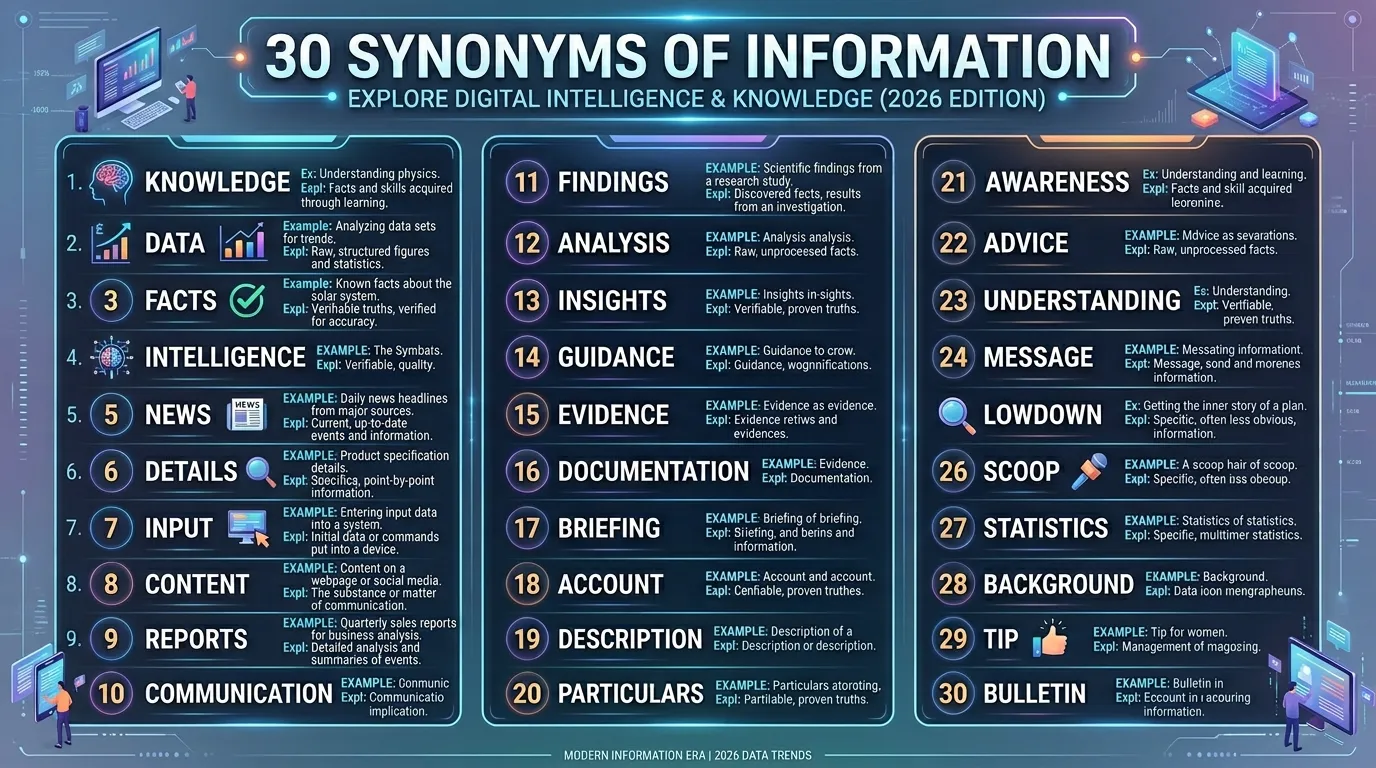
30 Synonyms of Information
1. Knowledge (noun)
US: /ˈnɑːlɪdʒ/ | UK: /ˈnɒlɪdʒ/
Meaning: understanding gained through learning or experience
Examples:
- She has deep knowledge of history.
- Reading builds knowledge.
2. Data (noun)
US: /ˈdeɪtə/ | UK: /ˈdeɪtə/
Meaning: facts or numbers collected for study
Examples:
- Scientists analyzed the data.
- The survey provided useful data.
3. Facts (noun)
US: /fækts/ | UK: /fækts/
Meaning: true details about something
Examples:
- Check the facts carefully.
- The report contains important facts.
4. Details (noun)
US: /ˈdiːteɪlz/ | UK: /ˈdiːteɪlz/
Meaning: small pieces of information
Examples:
- Please share the details.
- He explained every detail.
5. News (noun)
US: /nuːz/ | UK: /njuːz/
Meaning: new information about events
Examples:
- I heard exciting news today.
- The channel reports daily news.
6. Intelligence (noun)
US: /ɪnˈtelɪdʒəns/ | UK: /ɪnˈtelɪdʒəns/
Meaning: secret or important information
Examples:
- The agency gathered intelligence.
- Military intelligence is protected.
7. Evidence (noun)
US: /ˈevɪdəns/ | UK: /ˈevɪdəns/
Meaning: facts showing proof
Examples:
- Police found strong evidence.
- The study provided clear evidence.
8. Guidance (noun)
US: /ˈɡaɪdəns/ | UK: /ˈɡaɪdəns/
Meaning: helpful advice or direction
Examples:
- The teacher gave useful guidance.
- We need expert guidance.
9. Advice (noun)
US: /ædˈvaɪs/ | UK: /ədˈvaɪs/
Meaning: suggestions about what to do
Examples:
- She asked for career advice.
- His advice was helpful.
10. Instruction (noun)
US: /ɪnˈstrʌkʃən/ | UK: /ɪnˈstrʌkʃən/
Meaning: information about how to do something
Examples:
- Follow the instructions carefully.
- The manual includes clear instructions.
11. Report (noun)
US: /rɪˈpɔːrt/ | UK: /rɪˈpɔːt/
Meaning: organized information about a topic
Examples:
- She wrote a detailed report.
- The news report was accurate.
12. Message (noun)
US: /ˈmesɪdʒ/ | UK: /ˈmesɪdʒ/
Meaning: information sent from one person to another
Examples:
- I received your message.
- The email carried important messages.
13. Communication (noun)
US: /kəˌmjuːnɪˈkeɪʃən/ | UK: /kəˌmjuːnɪˈkeɪʃən/
Meaning: sharing information with others
Examples:
- Good communication is important.
- Technology improves communication.
14. Briefing (noun)
US: /ˈbriːfɪŋ/ | UK: /ˈbriːfɪŋ/
Meaning: short informational meeting or report
Examples:
- The manager held a briefing.
- We attended a safety briefing.
15. Explanation (noun)
US: /ˌekspləˈneɪʃən/ | UK: /ˌekspləˈneɪʃən/
Meaning: information that makes something clear
Examples:
- Her explanation was simple.
- I need an explanation.
16. Disclosure (noun)
US: /dɪsˈkloʊʒər/ | UK: /dɪsˈkləʊʒə/
Meaning: making information known
Examples:
- The company made a public disclosure.
- Full disclosure is necessary.
17. Insight (noun)
US: /ˈɪnsaɪt/ | UK: /ˈɪnsaɪt/
Meaning: deep understanding of something
Examples:
- The book gives useful insight.
- Her comments showed great insight.
18. Input (noun)
US: /ˈɪnpʊt/ | UK: /ˈɪnpʊt/
Meaning: ideas or information contributed by someone
Examples:
- We value your input.
- His input improved the project.
19. Material (noun)
US: /məˈtɪriəl/ | UK: /məˈtɪəriəl/
Meaning: information used for study or work
Examples:
- Students reviewed the course material.
- The training material was useful.
20. Content (noun)
US: /ˈkɑːntent/ | UK: /ˈkɒntent/
Meaning: information included in media or documents
Examples:
- The website offers educational content.
- Video content attracts viewers.
21. Documentation (noun)
US: /ˌdɑːkjəmenˈteɪʃən/ | UK: /ˌdɒkjʊmenˈteɪʃən/
Meaning: written records or supporting information
Examples:
- Submit all required documentation.
- Technical documentation helps users.
22. Record (noun)
US: /ˈrekərd/ | UK: /ˈrekɔːd/
Meaning: stored information about something
Examples:
- The hospital kept medical records.
- School records are important.
23. Statement (noun)
US: /ˈsteɪtmənt/ | UK: /ˈsteɪtmənt/
Meaning: spoken or written information
Examples:
- The witness gave a statement.
- The company released a public statement.
24. Notification (noun)
US: /ˌnoʊtɪfɪˈkeɪʃən/ | UK: /ˌnəʊtɪfɪˈkeɪʃən/
Meaning: official information or alert
Examples:
- I received a phone notification.
- The email served as official notification.
25. Tip (noun)
US: /tɪp/ | UK: /tɪp/
Meaning: a small helpful piece of information
Examples:
- She shared a cooking tip.
- Travel tips save time.
26. Clue (noun)
US: /kluː/ | UK: /kluː/
Meaning: information that helps solve something
Examples:
- Detectives found an important clue.
- The clue solved the mystery.
27. Update (noun)
US: /ˈʌpdeɪt/ | UK: /ˈʌpdeɪt/
Meaning: new information about progress
Examples:
- Please send an update.
- The app gives weather updates.
28. Findings (noun)
US: /ˈfaɪndɪŋz/ | UK: /ˈfaɪndɪŋz/
Meaning: results discovered through study
Examples:
- Researchers published their findings.
- The report included important findings.
29. Intelligence Report (noun)
US: /ɪnˈtelɪdʒəns rɪˈpɔːrt/ | UK: /ɪnˈtelɪdʒəns rɪˈpɔːt/
Meaning: detailed secret information report
Examples:
- Officials reviewed the intelligence report.
- The military shared an intelligence report.
30. Knowledge Base (noun)
US: /ˈnɑːlɪdʒ beɪs/ | UK: /ˈnɒlɪdʒ beɪs/
Meaning: a collection of organized information
Examples:
- The website has a helpful knowledge base.
- Employees used the company knowledge base.
Prototype Meaning
The most common meaning of information is facts or knowledge shared to help people understand something. People usually imagine books, websites, news reports, conversations, or educational materials when hearing this word.
Prototype Categorization
- General knowledge: knowledge, facts, details
- Media and communication: news, message, communication
- Research and records: data, evidence, findings
- Guidance and support: advice, instruction, guidance
Antonyms of Information
Antonyms
- Ignorance (noun): lack of knowledge
- Misinformation (noun): false or incorrect information
- Confusion (noun): unclear understanding
- Silence (noun): absence of communication
- Secrecy (noun): hiding information from others
Short Questions and Answers
What does information mean?
- Information means facts, knowledge, or details about something.
When should information be used?
- Use it when sharing facts, instructions, news, or details.
Is information positive or negative?
- It is usually neutral, but context can make it positive or negative.
How is it different from similar words?
- “Information” is general, while “data” is more technical and “advice” gives suggestions.
Conclusion
Learning Synonyms of Information and Synonyms of Information improves vocabulary and communication skills. It helps English learners express ideas clearly in speaking, writing, and professional communication. Using different synonyms also avoids repetition and makes sentences more natural and engaging. These words are useful in education, business, technology, media, and daily life. They help writers describe facts, knowledge, and communication more accurately. Practicing new vocabulary every day builds confidence and strengthens English fluency. Small daily learning habits can create strong language skills over time.

I’m Zahid Abbas, an educator, researcher, and digital publishing strategist with a passion for linguistics, grammar, and clear communication. As a content creator and SEO specialist, I craft research-driven, reader-focused content that empowers learners and makes knowledge accessible worldwide.