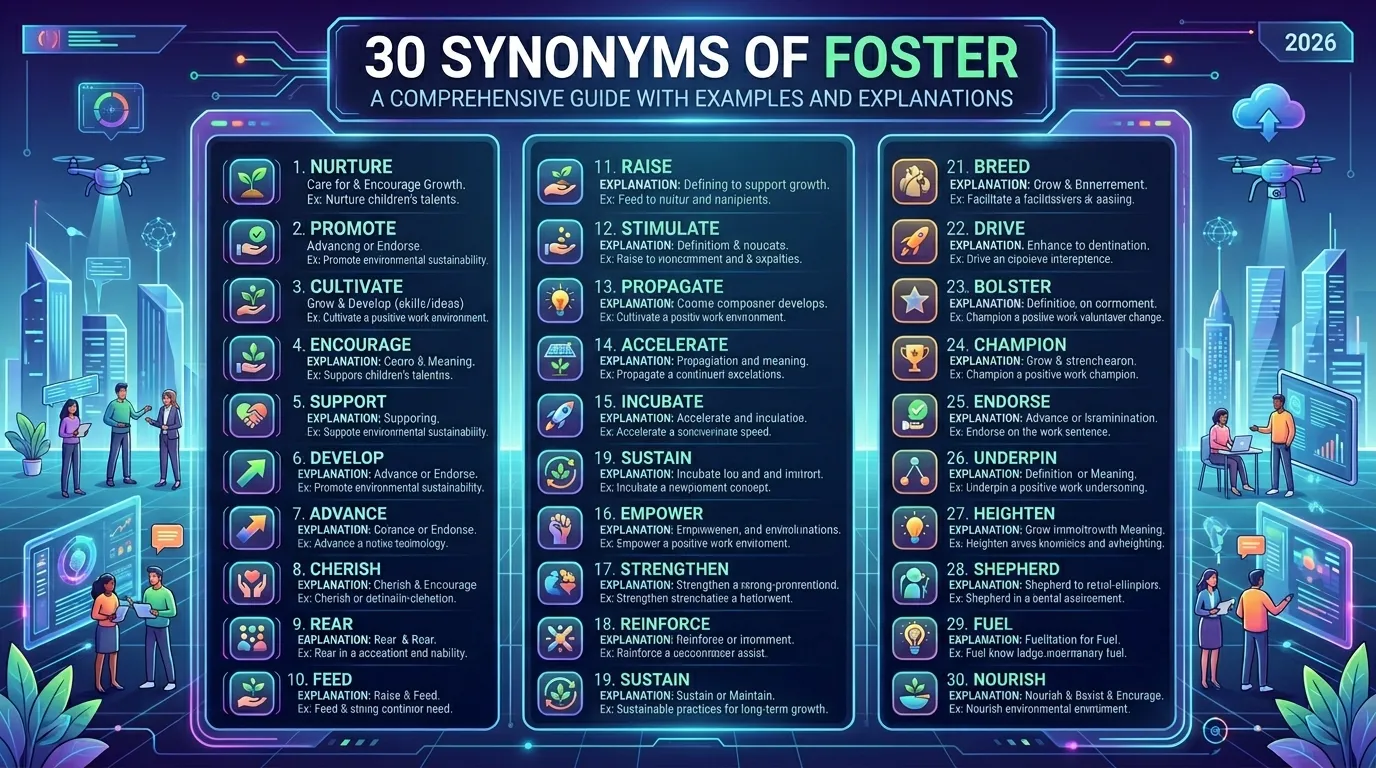
The word foster means to encourage, support, develop, or help something grow. Imagine a teacher helping students build confidence and learn new skills. The teacher fosters learning and personal growth in the classroom.
People use this word often in education, business, parenting, healthcare, and daily communication. It is a common English word because it describes support, care, and development. However, using the same word repeatedly can make writing less interesting.
Learning synonyms of foster helps English learners improve vocabulary and express ideas more clearly. It also helps writers create stronger and more natural sentences. In this article, you will learn the meaning of foster, its pronunciation, history, grammar, and 30 useful synonyms with meanings and examples. You will also explore semantic categories, antonyms, and simple questions to strengthen your English communication skills.
Meaning of Foster
Definition
Foster (verb): to encourage, support, or help something develop and grow.
Examples
- Good teachers foster creativity in students.
- Parents should foster kindness at home.
Connotative Meaning
(Connotation means the feeling or emotion a word suggests beyond its basic meaning.)
- Positive tone: supportive, caring, encouraging
- Negative tone: sometimes used for encouraging harmful behavior
- Neutral tone: helping something grow or develop
Etymology
- From Old English fōstrian meaning “to nourish” or “bring up”
- Related to the idea of feeding, supporting, and caring
Short History:
- Old English (450–1100): used for feeding and raising children
- Middle English (1100–1500): expanded to caring and supporting growth
- Modern English (1500–Present): widely used for encouragement and development
Pronunciation (US & UK – IPA)
- US: /ˈfɑːstər/
- UK: /ˈfɒstə/
Syllables
- fos-ter
Affixation Pattern of Foster
- Root: foster
- Prefix: none
- Suffix: none
Word Formation:
- foster (verb)
- foster (adjective)
- fostering (noun/verb)
- fostered (verb)
- fosterer (noun)
30 Synonyms of Foster
1. Encourage (verb)
US: /ɪnˈkɜːrɪdʒ/ | UK: /ɪnˈkʌrɪdʒ/
Meaning: to give support or confidence
Examples:
- Teachers encourage students to read.
- Parents should encourage honesty.
2. Support (verb)
US: /səˈpɔːrt/ | UK: /səˈpɔːt/
Meaning: to help or assist someone or something
Examples:
- Friends support each other.
- The program supports education.
3. Promote (verb)
US: /prəˈmoʊt/ | UK: /prəˈməʊt/
Meaning: to help something grow or become successful
Examples:
- Schools promote healthy habits.
- The campaign promotes peace.
4. Develop (verb)
US: /dɪˈvɛləp/ | UK: /dɪˈveləp/
Meaning: to grow or improve something
Examples:
- Reading helps develop language skills.
- Exercise can develop strength.
5. Nurture (verb)
US: /ˈnɜːrtʃər/ | UK: /ˈnɜːtʃə/
Meaning: to care for and help grow
Examples:
- Parents nurture their children.
- Teachers nurture creativity.
6. Cultivate (verb)
US: /ˈkʌltəˌveɪt/ | UK: /ˈkʌltɪveɪt/
Meaning: to develop carefully over time
Examples:
- She worked to cultivate patience.
- Good habits must be cultivated.
7. Advance (verb)
US: /ədˈvæns/ | UK: /ədˈvɑːns/
Meaning: to move something forward
Examples:
- Technology advances communication.
- The program advanced research.
8. Stimulate (verb)
US: /ˈstɪmjəˌleɪt/ | UK: /ˈstɪmjʊleɪt/
Meaning: to encourage activity or growth
Examples:
- Games stimulate the mind.
- Discussion can stimulate ideas.
9. Inspire (verb)
US: /ɪnˈspaɪər/ | UK: /ɪnˈspaɪə/
Meaning: to motivate someone positively
Examples:
- Great leaders inspire people.
- Her speech inspired students.
10. Aid (verb)
US: /eɪd/ | UK: /eɪd/
Meaning: to help or assist
Examples:
- Volunteers aid poor families.
- Exercise aids recovery.
11. Assist (verb)
US: /əˈsɪst/ | UK: /əˈsɪst/
Meaning: to help someone
Examples:
- Nurses assist doctors.
- Friends assist during hard times.
12. Boost (verb)
US: /buːst/ | UK: /buːst/
Meaning: to increase or improve something
Examples:
- Exercise can boost energy.
- Reading boosts vocabulary.
13. Strengthen (verb)
US: /ˈstrɛŋθən/ | UK: /ˈstreŋθən/
Meaning: to make stronger
Examples:
- Practice strengthens skills.
- Trust helps strengthen relationships.
14. Improve (verb)
US: /ɪmˈpruːv/ | UK: /ɪmˈpruːv/
Meaning: to make better
Examples:
- Exercise improves health.
- Study can improve grades.
15. Grow (verb)
US: /ɡroʊ/ | UK: /ɡrəʊ/
Meaning: to become larger or better
Examples:
- Plants grow with sunlight.
- Confidence can grow slowly.
16. Build (verb)
US: /bɪld/ | UK: /bɪld/
Meaning: to create or strengthen gradually
Examples:
- Reading helps build knowledge.
- Exercise builds strength.
17. Enrich (verb)
US: /ɪnˈrɪtʃ/ | UK: /ɪnˈrɪtʃ/
Meaning: to improve quality or value
Examples:
- Travel can enrich life.
- Books enrich vocabulary.
18. Nourish (verb)
US: /ˈnɜːrɪʃ/ | UK: /ˈnʌrɪʃ/
Meaning: to feed and support growth
Examples:
- Healthy food nourishes the body.
- Love can nourish confidence.
19. Facilitate (verb)
US: /fəˈsɪləˌteɪt/ | UK: /fəˈsɪlɪteɪt/
Meaning: to make something easier
Examples:
- Technology facilitates learning.
- Teachers facilitate discussion.
20. Encourage Growth (verb phrase)
US: /ɪnˈkɜːrɪdʒ ɡroʊθ/ | UK: /ɪnˈkʌrɪdʒ ɡrəʊθ/
Meaning: to help development happen
Examples:
- Schools encourage growth in children.
- Good habits encourage growth.
21. Mentor (verb)
US: /ˈmɛntɔːr/ | UK: /ˈmentɔː/
Meaning: to guide and teach someone
Examples:
- Senior workers mentor new employees.
- Coaches mentor young athletes.
22. Motivate (verb)
US: /ˈmoʊtəˌveɪt/ | UK: /ˈməʊtɪveɪt/
Meaning: to give someone a reason to act
Examples:
- Teachers motivate students.
- Success can motivate people.
23. Spark (verb)
US: /spɑːrk/ | UK: /spɑːk/
Meaning: to cause something to begin
Examples:
- Books can spark imagination.
- The speech sparked interest.
24. Feed (verb)
US: /fiːd/ | UK: /fiːd/
Meaning: to provide support or energy
Examples:
- Music can feed creativity.
- Hope feeds determination.
25. Raise (verb)
US: /reɪz/ | UK: /reɪz/
Meaning: to help grow or develop
Examples:
- Parents raise children carefully.
- The school raised awareness.
26. Train (verb)
US: /treɪn/ | UK: /treɪn/
Meaning: to teach skills or behavior
Examples:
- Coaches train athletes daily.
- Teachers train students in writing.
27. Guide (verb)
US: /ɡaɪd/ | UK: /ɡaɪd/
Meaning: to lead or direct someone
Examples:
- Parents guide their children.
- Mentors guide young workers.
28. Encourage Development (verb phrase)
US: /ɪnˈkɜːrɪdʒ dɪˈvɛləpmənt/ | UK: /ɪnˈkʌrɪdʒ dɪˈveləpmənt/
Meaning: to help progress happen
Examples:
- Good education encourages development.
- Practice encourages development.
29. Sustain (verb)
US: /səˈsteɪn/ | UK: /səˈsteɪn/
Meaning: to continue supporting something
Examples:
- Water helps sustain life.
- Encouragement sustains confidence.
30. Care For (verb phrase)
US: /ker fɔːr/ | UK: /keə fɔː/
Meaning: to look after and support
Examples:
- Nurses care for patients.
- Parents care for children.
Prototype Meaning
The most common meaning of foster is helping something positive grow and develop through care, support, or encouragement. People often imagine teachers, parents, mentors, or leaders helping others improve and succeed.
Prototype Categorization
- Support and help: support, assist, aid
- Growth and development: develop, cultivate, nurture
- Motivation and inspiration: inspire, motivate, spark
- Guidance and teaching: mentor, guide, train
Categorization helps writers choose the best synonym depending on context, tone, and purpose.
Antonyms of Foster
Antonyms
- Hinder (verb): to create difficulty or delay
- Discourage (verb): to reduce confidence or hope
- Prevent (verb): to stop something from happening
- Neglect (verb): to fail to care for something
- Suppress (verb): to stop growth or development
Short Questions and Answers
What does foster mean?
- Foster means to encourage, support, or help something grow.
When should foster be used?
- Use it when talking about growth, support, care, or development.
Is foster positive or negative?
- It is usually positive because it suggests help and encouragement.
How is it different from similar words?
- “Foster” focuses on helping growth over time, while “help” is more general.
Conclusion
Learning synonyms of foster and synonyms of foster improves vocabulary and communication skills. These words help English learners describe support, growth, encouragement, and development more clearly in speaking and writing. Using different synonyms also avoids repetition and makes sentences stronger and more natural. Understanding words connected to support and progress builds confidence in conversations, academic writing, and professional communication. These synonyms help express positive actions and relationships with greater accuracy. Practice learning and using new vocabulary daily. Small vocabulary habits can make your English more fluent, expressive, and confident over time.

I’m Zahid Abbas, an educator, researcher, and digital publishing strategist with a passion for linguistics, grammar, and clear communication. As a content creator and SEO specialist, I craft research-driven, reader-focused content that empowers learners and makes knowledge accessible worldwide.