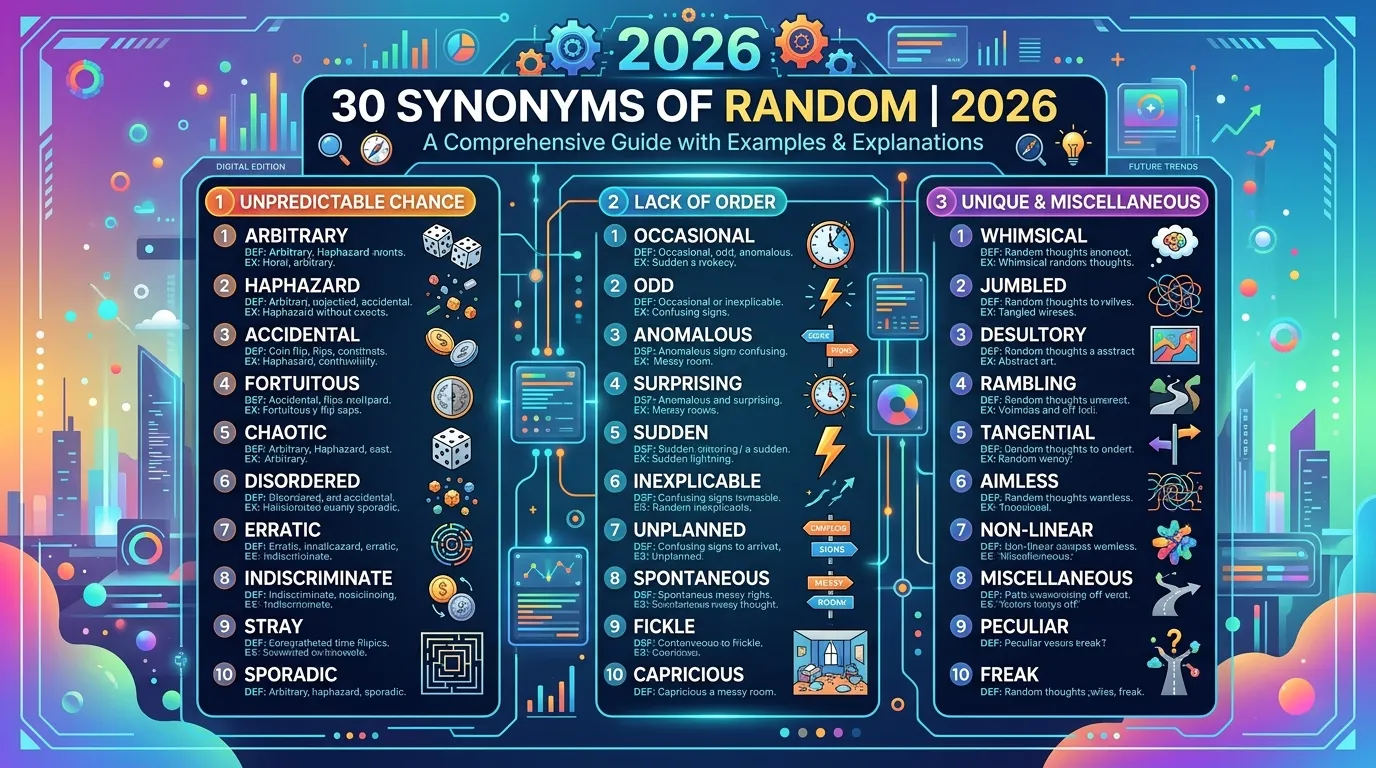
The word random means happening without a clear plan, order, or reason. Imagine walking into a room and picking a book without looking. That choice is random because you did not plan it carefully. People use this word often in daily conversation, technology, gaming, science, and social media.
Learning synonyms of random helps English learners and writers express ideas more clearly. Using different words also improves speaking and writing skills by avoiding repetition. Some synonyms describe surprise, while others describe disorder or unpredictability. In this article, you will learn the meaning of random, its pronunciation, history, grammar, and 30 useful synonyms with meanings and examples. You will also explore semantic categories, antonyms, and simple questions to strengthen your vocabulary and English confidence.
Meaning of Random
Definition
Random (adjective): happening without a plan, pattern, or clear purpose.
Examples
- I picked a random number.
- She asked a random question during class.
Connotative Meaning
(Connotation means the feeling or emotion a word suggests beyond its basic meaning.)
- Positive tone: surprising, spontaneous, exciting
- Negative tone: confusing, disorderly, careless
- Neutral tone: without pattern or planning
Etymology
- From Old French randir meaning “to run quickly”
- Later connected with chance and unpredictability in English
Short History:
- Old English (450–1100): no direct form of “random”
- Middle English (1100–1500): words about chance became common
- Modern English (1500–Present): “random” became popular for unpredictability and statistics
Pronunciation (US & UK – IPA)
- US: /ˈrændəm/
- UK: /ˈrændəm/
Syllables
- ran-dom
Affixation Pattern of Random
- Root: random
- Prefix: none
- Suffix: none
Word Formation:
- random (adjective)
- randomly (adverb)
- randomness (noun)
Synonyms of Random
1. Accidental (adjective)
US: /ˌæksɪˈdɛntl/ | UK: /ˌæksɪˈdentl/
Meaning: happening by chance
Examples:
- It was an accidental meeting.
- She made an accidental mistake.
2. Unplanned (adjective)
US: /ʌnˈplænd/ | UK: /ʌnˈplænd/
Meaning: not prepared in advance
Examples:
- We took an unplanned trip.
- His speech sounded unplanned.
3. Chance (adjective)
US: /tʃæns/ | UK: /tʃɑːns/
Meaning: happening unexpectedly
Examples:
- It was a chance encounter.
- She got a chance opportunity.
4. Arbitrary (adjective)
US: /ˈɑːrbɪtreri/ | UK: /ˈɑːbɪtrəri/
Meaning: based on personal choice rather than reason
Examples:
- The rule felt arbitrary.
- He made an arbitrary decision.
5. Haphazard (adjective)
US: /hæpˈhæzərd/ | UK: /hæpˈhæzəd/
Meaning: lacking organization
Examples:
- The papers were in a haphazard pile.
- Their plan looked haphazard.
6. Casual (adjective)
US: /ˈkæʒuəl/ | UK: /ˈkæʒuəl/
Meaning: relaxed and unplanned
Examples:
- We had a casual conversation.
- It was a casual visit.
7. Unpredictable (adjective)
US: /ˌʌnprɪˈdɪktəbl/ | UK: /ˌʌnprɪˈdɪktəbl/
Meaning: impossible to know beforehand
Examples:
- Weather can be unpredictable.
- His behavior seemed unpredictable.
8. Spontaneous (adjective)
US: /spɑːnˈteɪniəs/ | UK: /spɒnˈteɪniəs/
Meaning: done naturally without planning
Examples:
- They made a spontaneous decision.
- Her laugh was spontaneous.
9. Irregular (adjective)
US: /ɪˈrɛɡjələr/ | UK: /ɪˈreɡjələ/
Meaning: not following a pattern
Examples:
- The bus schedule is irregular.
- His heartbeat became irregular.
10. Disorderly (adjective)
US: /dɪsˈɔːrdərli/ | UK: /dɪsˈɔːdəli/
Meaning: messy or lacking order
Examples:
- The room looked disorderly.
- The crowd became disorderly.
11. Chaotic (adjective)
US: /keɪˈɑːtɪk/ | UK: /keɪˈɒtɪk/
Meaning: completely confused and uncontrolled
Examples:
- Traffic was chaotic.
- The office looked chaotic.
12. Aimless (adjective)
US: /ˈeɪmləs/ | UK: /ˈeɪmləs/
Meaning: without purpose or direction
Examples:
- He took an aimless walk.
- The discussion became aimless.
13. Unsystematic (adjective)
US: /ˌʌnsɪstəˈmætɪk/ | UK: /ˌʌnsɪstəˈmætɪk/
Meaning: lacking a clear system
Examples:
- Their process seemed unsystematic.
- Notes were kept unsystematic.
14. Coincidental (adjective)
US: /koʊˌɪnsɪˈdɛntl/ | UK: /kəʊˌɪnsɪˈdentl/
Meaning: happening by coincidence
Examples:
- Our meeting was coincidental.
- It felt like a coincidental event.
15. Unexpected (adjective)
US: /ˌʌnɪkˈspɛktɪd/ | UK: /ˌʌnɪkˈspektɪd/
Meaning: surprising and not planned
Examples:
- We received an unexpected gift.
- The news was unexpected.
16. Impulsive (adjective)
US: /ɪmˈpʌlsɪv/ | UK: /ɪmˈpʌlsɪv/
Meaning: acting suddenly without thought
Examples:
- He made an impulsive purchase.
- Her decision was impulsive.
17. Erratic (adjective)
US: /ɪˈrætɪk/ | UK: /ɪˈrætɪk/
Meaning: changing unpredictably
Examples:
- His driving was erratic.
- The signal became erratic.
18. Miscellaneous (adjective)
US: /ˌmɪsəˈleɪniəs/ | UK: /ˌmɪsəˈleɪniəs/
Meaning: made of many different kinds
Examples:
- The drawer held miscellaneous items.
- We discussed miscellaneous topics.
19. Hit-or-Miss (adjective)
US: /ˌhɪtərˈmɪs/ | UK: /ˌhɪtəˈmɪs/
Meaning: sometimes successful and sometimes not
Examples:
- Their strategy was hit-or-miss.
- Results seemed hit-or-miss.
20. Scattered (adjective)
US: /ˈskætərd/ | UK: /ˈskætəd/
Meaning: spread out without order
Examples:
- Papers were scattered everywhere.
- His thoughts felt scattered.
21. Uncertain (adjective)
US: /ʌnˈsɜːrtn/ | UK: /ʌnˈsɜːtn/
Meaning: not known or predictable
Examples:
- The future feels uncertain.
- Results remain uncertain.
22. Inconsistent (adjective)
US: /ˌɪnkənˈsɪstənt/ | UK: /ˌɪnkənˈsɪstənt/
Meaning: not staying the same
Examples:
- His performance was inconsistent.
- The rules felt inconsistent.
23. Freak (adjective)
US: /friːk/ | UK: /friːk/
Meaning: unusual and unexpected
Examples:
- It was a freak accident.
- They experienced a freak storm.
24. Wild (adjective)
US: /waɪld/ | UK: /waɪld/
Meaning: uncontrolled or unpredictable
Examples:
- He made a wild guess.
- The crowd became wild.
25. Unscheduled (adjective)
US: /ʌnˈskedʒuːld/ | UK: /ʌnˈʃedjuːld/
Meaning: not planned in time
Examples:
- We had an unscheduled meeting.
- The stop was unscheduled.
26. Randomized (adjective)
US: /ˈrændəmaɪzd/ | UK: /ˈrændəmaɪzd/
Meaning: arranged by chance
Examples:
- The study used randomized groups.
- Questions appeared in randomized order.
27. Uncoordinated (adjective)
US: /ʌnkoʊˈɔːrdəˌneɪtɪd/ | UK: /ʌnkəʊˈɔːdɪneɪtɪd/
Meaning: not organized together
Examples:
- Their actions looked uncoordinated.
- The response was uncoordinated.
28. Strange (adjective)
US: /streɪndʒ/ | UK: /streɪndʒ/
Meaning: unusual or unexpected
Examples:
- He asked a strange question.
- That was a strange moment.
29. Unrelated (adjective)
US: /ˌʌnrɪˈleɪtɪd/ | UK: /ˌʌnrɪˈleɪtɪd/
Meaning: not connected
Examples:
- They discussed unrelated topics.
- The events were unrelated.
30. Patternless (adjective)
US: /ˈpætərnləs/ | UK: /ˈpætənləs/
Meaning: without a clear pattern
Examples:
- The design looked patternless.
- The results seemed patternless.
Prototype Meaning
The most typical meaning of random is something happening by chance without planning or order. People usually imagine surprise choices, unexpected events, or actions without a clear reason.
Prototype Categorization
- Chance and surprise: accidental, coincidental, unexpected
- Disorder and confusion: chaotic, disorderly, scattered
- Lack of planning: unplanned, spontaneous, impulsive
- Unpredictability: erratic, unpredictable, irregular
Categorization helps writers choose the best synonym depending on tone, emotion, and context.
Antonyms of Random
- Planned (adjective): carefully prepared beforehand
- Organized (adjective): arranged properly
- Predictable (adjective): easy to know beforehand
- Systematic (adjective): done using a clear method
- Ordered (adjective): arranged in sequence
Short Questions and Answers
What does random mean?
- It means happening without a clear plan or pattern.
When should random be used?
- Use it when describing chance events, surprise actions, or unplanned situations.
Is random positive or negative?
- It can be both positive and negative depending on context.
How is it different from similar words?
- “Random” focuses on lack of pattern, while “chaotic” suggests confusion and disorder.
Conclusion
Learning synonyms of random and synonyms of random improves vocabulary and communication skills. It helps English learners describe surprise, unpredictability, disorder, and spontaneous actions more clearly. Using different synonyms also makes writing and speaking more natural and less repetitive. These words are useful in daily conversation, academic writing, storytelling, and professional communication. They help speakers express ideas with more precision and confidence. Practice learning and using new vocabulary every day. Small vocabulary improvements can greatly strengthen English fluency and communication skills over time.

I’m Zahid Abbas, an educator, researcher, and digital publishing strategist with a passion for linguistics, grammar, and clear communication. As a content creator and SEO specialist, I craft research-driven, reader-focused content that empowers learners and makes knowledge accessible worldwide.