Rich means having a lot of money or valuable things. Think about a man who built his own company from nothing. After years of hard work, he can now buy a big house and travel anywhere he wants. People say he became rich.
People use this word a lot, in stories, in news, and in daily talk. It can describe a person, a family, or even a whole country with lots of money.
But saying “rich” again and again can make writing feel plain. English learners and writers need other words too. Synonyms for rich help you show different levels and kinds of wealth. Synonyms for rich also help your writing sound more clear and full of life.
This article looks at the word “rich” in a simple way. You will learn what it means, how to say it, where it came from, and how to use it. Then you will learn 30 other words that mean almost the same thing.
Meaning of Rich
Definition
Rich (adjective): Having a lot of money, property, or valuable things.
Examples
- The rich family owned three large houses.
- She became rich after her business grew fast.
Connotative Meaning
- Positive tone: “Rich” often feels good, showing success, comfort, and hard work paying off.
- Negative tone: “Rich” can feel negative if it hints at unfairness, like “the rich getting richer” while others struggle.
- Neutral tone: In reports or facts, “rich” can simply describe wealth, like “rich countries invest more in schools.”
Etymology
- “Rich” comes from the Old English word rice, which meant powerful, strong, or wealthy.
- This word came from an old Germanic root, related to words for “ruler” or “kingdom,” since power and wealth often went together in the past.
- Over time, the word’s meaning narrowed to focus mostly on having a lot of money.
Short History
- Old English (450–1100): “Rice” meant powerful or mighty. It described strong rulers as well as wealthy people, since the two often went hand in hand.
- Middle English (1100–1500): The word became “rich.” Its meaning slowly moved away from power and focused more on having lots of money or property.
- Modern English (1500–Present): “Rich” kept its main meaning of wealth. It also grew to describe other kinds of abundance, like “rich soil” or “rich flavor.”
Pronunciation (US & UK – IPA)
- US: /rɪtʃ/
- UK: /rɪtʃ/
Syllables
rich (one syllable)
Affixation Pattern of Rich
- Root: rich
- Prefix: en- (used in the word “enrich,” meaning to make rich)
- Suffix: -ly (makes the adverb “richly”), -ness (makes the noun “richness”), -es (makes the noun “riches,” meaning wealth)
Word formation: This root gives us several words. “Rich” is an adjective. “Richly” is an adverb. “Richness” is a noun that means the state of being rich. “Riches” is a noun that means wealth or valuable things. “Enrich” is a verb that means to make something richer or better.
Also read more about https://synonymhunting.com/synonyms-for-comfort/
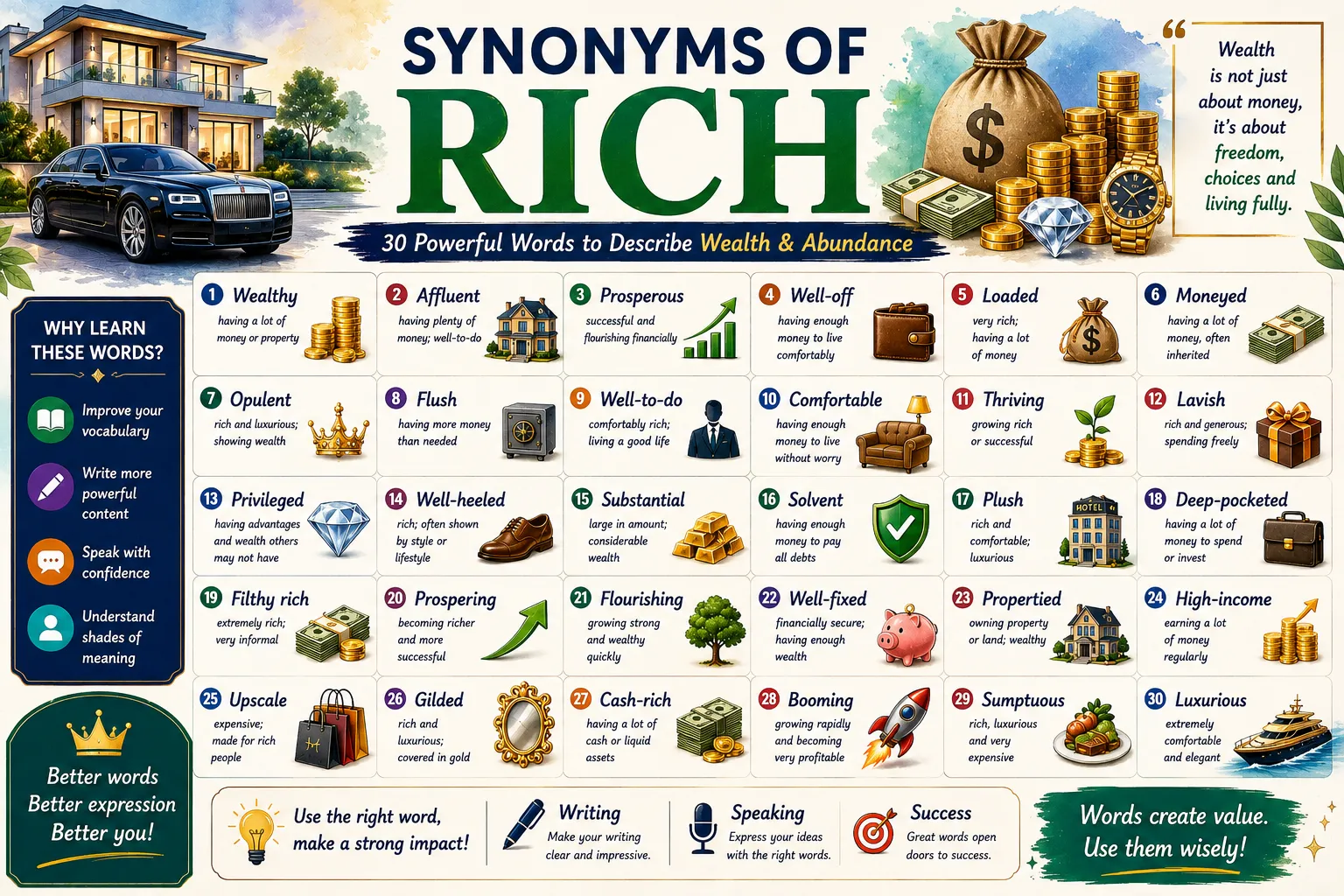
Synonyms of Rich
1. Wealthy (adjective) — US /ˈwɛlθi/ | UK /ˈwɛlθi/
Meaning: Having a lot of money or property. Examples:
- The wealthy family donated to the school.
- She grew up in a wealthy neighborhood.
2. Affluent (adjective) — US /ˈæfluənt/ | UK /ˈæfluənt/
Meaning: Having plenty of money, often used in formal writing. Examples:
- They live in an affluent part of the city.
- His affluent lifestyle included a big house and two cars.
3. Prosperous (adjective) — US /ˈprɑːspərəs/ | UK /ˈprɒspərəs/
Meaning: Successful and rich, often over time. Examples:
- The prosperous town had many new businesses.
- Her family became prosperous after years of hard work.
4. Well-off (adjective) — US /ˈwɛl ɔːf/ | UK /ˈwɛl ɒf/
Meaning: Having enough money to live comfortably. Examples:
- They were well-off, but never showed it.
- He grew up well-off compared to his friends.
5. Loaded (adjective) — US /ˈloʊdɪd/ | UK /ˈləʊdɪd/
Meaning: Very rich, used in casual speech. Examples:
- Everyone knew he was loaded after buying the mansion.
- She joked about being loaded after winning the lottery.
6. Moneyed (adjective) — US /ˈmʌnid/ | UK /ˈmʌnid/
Meaning: Having a lot of money, often inherited. Examples:
- The moneyed family owned land across the country.
- She married into a moneyed household.
7. Opulent (adjective) — US /ˈɑːpjələnt/ | UK /ˈɒpjʊlənt/
Meaning: Rich and showing wealth through luxury. Examples:
- The opulent hotel had gold decorations everywhere.
- Their opulent wedding lasted three full days.
8. Flush (adjective) — US /flʌʃ/ | UK /flʌʃ/
Meaning: Having plenty of money, often for a short time. Examples:
- He felt flush after his bonus came in.
- The company was flush with cash after the sale.
9. Well-to-do (adjective) — US /ˈwɛl tə duː/ | UK /ˈwɛl tə duː/
Meaning: Comfortably rich, often used for families. Examples:
- The well-to-do neighborhood had large gardens.
- She came from a well-to-do family in the city.
10. Comfortable (adjective) — US /ˈkʌmfərtəbəl/ | UK /ˈkʌmftəbəl/
Meaning: Having enough money to live without worry. Examples:
- After years of saving, they felt financially comfortable.
- He built a comfortable life for his family.
11. Thriving (adjective) — US /ˈθraɪvɪŋ/ | UK /ˈθraɪvɪŋ/
Meaning: Growing rich and successful. Examples:
- The thriving business expanded to three new cities.
- Their thriving farm brought in steady income.
12. Lavish (adjective) — US /ˈlævɪʃ/ | UK /ˈlævɪʃ/
Meaning: Rich and generous, often spending a lot. Examples:
- They threw a lavish party for the anniversary.
- His lavish gifts surprised everyone at the wedding.
13. Privileged (adjective) — US /ˈprɪvəlɪdʒd/ | UK /ˈprɪvəlɪdʒd/
Meaning: Having wealth and advantages others may not have. Examples:
- She grew up privileged, with the best schools available.
- His privileged background gave him early chances in life.
14. Well-heeled (adjective) — US /ˈwɛl hiːld/ | UK /ˈwɛl hiːld/
Meaning: Rich, often shown through style or comfort. Examples:
- The well-heeled guests arrived in fancy cars.
- Their well-heeled lifestyle included yearly trips abroad.
15. Substantial (adjective) — US /səbˈstænʃəl/ | UK /səbˈstænʃəl/
Meaning: Large in amount, often describing wealth or income. Examples:
- He earned a substantial income from his business.
- The family left behind a substantial fortune.
16. Solvent (adjective) — US /ˈsɑːlvənt/ | UK /ˈsɒlvənt/
Meaning: Having enough money to pay all debts. Examples:
- The company remained solvent through hard times.
- She felt relieved once she was fully solvent again.
17. Plush (adjective) — US /plʌʃ/ | UK /plʌʃ/
Meaning: Rich and comfortable, often describing places. Examples:
- They stayed in a plush hotel downtown.
- His plush office showed his success.
18. Deep-pocketed (adjective) — US /ˈdiːp ˈpɑːkɪtɪd/ | UK /ˈdiːp ˈpɒkɪtɪd/
Meaning: Having a lot of money to spend, often used casually. Examples:
- A deep-pocketed investor bought the small company.
- The deep-pocketed buyer paid full price for the house.
19. Filthy rich (adjective) — US /ˈfɪlθi rɪtʃ/ | UK /ˈfɪlθi rɪtʃ/
Meaning: Extremely rich, used in casual speech. Examples:
- His uncle is filthy rich after selling his company.
- They live like they’re filthy rich, even though they aren’t.
20. Prospering (adjective) — US /ˈprɑːspərɪŋ/ | UK /ˈprɒspərɪŋ/
Meaning: Growing richer and more successful. Examples:
- The prospering shop hired three new workers.
- Their prospering business earned praise in the news.
21. Flourishing (adjective) — US /ˈflɜːrɪʃɪŋ/ | UK /ˈflʌrɪʃɪŋ/
Meaning: Growing strong and rich, often quickly. Examples:
- The flourishing market brought new wealth to the town.
- His flourishing career made him financially secure.
22. Well-fixed (adjective) — US /ˈwɛl fɪkst/ | UK /ˈwɛl fɪkst/
Meaning: Financially secure, older or informal term for rich. Examples:
- He seemed well-fixed after retiring early.
- Their grandparents were well-fixed from years of saving.
23. Propertied (adjective) — US /ˈprɑːpərtid/ | UK /ˈprɒpətid/
Meaning: Owning land or property, a sign of wealth. Examples:
- The propertied family owned farms across the valley.
- He came from a long line of propertied landowners.
24. High-income (adjective) — US /ˈhaɪ ˈɪnkʌm/ | UK /ˈhaɪ ˈɪnkʌm/
Meaning: Earning a lot of money, often used in reports. Examples:
- High-income families paid more in taxes.
- She moved into a high-income job after graduating.
25. Upscale (adjective) — US /ˈʌpskeɪl/ | UK /ˈʌpskeɪl/
Meaning: Expensive and made for rich people. Examples:
- They shopped at an upscale mall downtown.
- The upscale restaurant served rare and costly dishes.
26. Gilded (adjective) — US /ˈɡɪldɪd/ | UK /ˈɡɪldɪd/
Meaning: Rich and glittering, often describing a fancy lifestyle. Examples:
- She grew up in a gilded world of parties and travel.
- The gilded ballroom shone under bright lights.
27. Cash-rich (adjective) — US /ˈkæʃ rɪtʃ/ | UK /ˈkæʃ rɪtʃ/
Meaning: Having a lot of ready money, often used for businesses. Examples:
- The cash-rich company bought two smaller firms.
- Being cash-rich gave them freedom to invest quickly.
28. Booming (adjective) — US /ˈbuːmɪŋ/ | UK /ˈbuːmɪŋ/
Meaning: Growing fast and becoming very profitable. Examples:
- The booming economy created thousands of jobs.
- Their booming sales made the owners very rich.
29. Sumptuous (adjective) — US /ˈsʌmptʃuəs/ | UK /ˈsʌmptʃuəs/
Meaning: Rich and expensive, often describing food or style. Examples:
- They enjoyed a sumptuous feast at the wedding.
- The sumptuous decor filled every room of the mansion.
30. Luxurious (adjective) — US /lʌɡˈʒʊriəs/ | UK /lʌɡˈʒʊəriəs/
Meaning: Rich and comfortable, full of expensive things. Examples:
- They stayed in a luxurious suite by the beach.
- Her luxurious car turned heads on the street.
Prototype Meaning
When people hear the word “rich,” they usually picture someone with a lot of money, a big house, and an easy, comfortable life. It brings to mind success, comfort, and freedom from money worries. This simple picture sits at the center of the word. Other synonyms add detail, showing whether the wealth is quiet and steady, flashy and grand, or newly earned.
Prototype Categorization
You can group these synonyms by the kind of wealth they show:
- General wealth: wealthy, affluent, prosperous, well-off, well-to-do
- Strong, casual wealth: loaded, flush, filthy rich, cash-rich, deep-pocketed
- Fancy or showy wealth: opulent, lavish, sumptuous, luxurious, gilded, plush, upscale
- Steady, secure wealth: comfortable, solvent, well-fixed, substantial
- Growing wealth: thriving, flourishing, prospering, booming
- Wealth linked to background or land: privileged, well-heeled, moneyed, propertied, high-income.
Antonyms of Rich
poor, needy, broke, penniless, impoverished
Short Questions and Answers
- What does “rich” mean? It means having a lot of money, property, or valuable things.
- When should “rich” be used? Use it to describe a person, family, business, or place with a lot of wealth.
- Is “rich” positive or negative? It is mostly positive, showing success and comfort. It can feel negative if it points to unfairness.
- How is it different from similar words? “Rich” is simple and common. “Affluent” fits formal writing. “Loaded” is casual. “Opulent” focuses on showy, fancy wealth.
Conclusion
Synonyms for rich will help your English grow strong. Each word shows a different kind of wealth, from a calm “comfortable” life to a grand “opulent” one. Synonyms for rich help your writing sound clear and full of detail, not repeated. They also help you describe wealth in a way that fits each story, whether quiet or flashy. Anyone learning English can use synonyms for rich to speak and write with more color. Try to learn one new word each day. Use synonyms for rich in a sentence about a story or goal you have. Over time, this small habit will make your English much stronger.

I’m Zahid Abbas, an educator, researcher, and digital publishing strategist with a passion for linguistics, grammar, and clear communication. As a content creator and SEO specialist, I craft research-driven, reader-focused content that empowers learners and makes knowledge accessible worldwide.