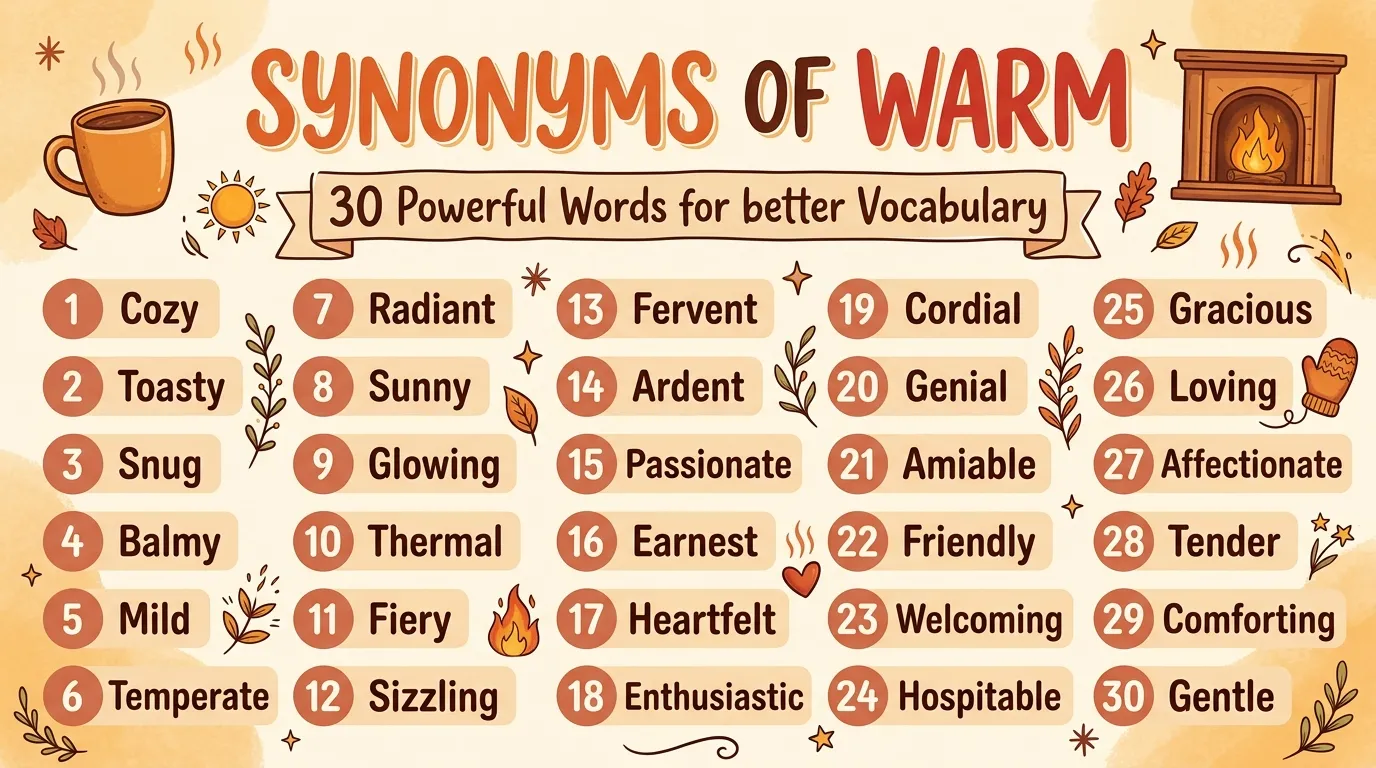
The word warm means having a little heat or giving a feeling of comfort. For example, on a cold morning, you may drink a warm cup of tea. It makes you feel good and cozy. A warm smile can also make someone feel happy and welcome.
People use the word warm in daily life. It can describe weather, food, clothes, feelings, and friendly people. It can also show care and love.
Learning synonyms of warm helps you use English in new ways. It helps students learn more words. It also helps writers make their work clear and fun to read. Instead of using warm again and again, you can choose words that fit each idea.
Meaning of Warm
Definition
Warm (Adjective/Verb):
As an adjective, warm means having gentle heat or giving a feeling of comfort and kindness.
As a verb, warm means to make something warmer or to become warmer.
Examples
- I drank a warm cup of milk before bed.
- Her warm smile made me feel happy.
- Please warm the food before dinner. (Verb)
Connotative Meaning
Connotation means the feelings or ideas that a word brings to mind.
- Positive tone: Warm can mean love, care, kindness, and comfort.
- Negative tone: Warm can mean too hot or uncomfortable in some situations.
- Neutral tone: Warm can simply describe the heat of food, water, or the air.
Read more about:https://synonymhunting.com/synonyms-of-expectations/
Etymology
The word warm has a long history in English.
- Source language: Old English.
- Original meaning: Having heat or giving off heat.
- Old English (450–1100): The word was written as wearm. It described something that had heat.
- Middle English (1100–1500): The word changed to forms such as warm and became closer to the spelling we use today.
- Modern English (1500–Present): Warm gained wider uses. It can now describe heat, friendly feelings, kind people, and rich colors.
Pronunciation (US & UK – IPA)
- US: /wɔrm/
- UK: /wɔːm/
- Syllables: warm (one syllable)
Affixation Pattern of Warm
- Root: warm
- Prefix: None in the basic word.
- Suffix: None in the basic word.
Word Formation
The word warm can form several related words.
- Warm: Adjective or verb.
- Warmly: Adverb. Example: She smiled warmly.
- Warmth: Noun. Example: I enjoyed the warmth of the sun.
- Warming: Verb form or adjective. Example: The soup is warming.
- Warmed: Past-tense verb. Example: He warmed the milk.
- Warmer: Comparative adjective or noun. Example: Today is warmer than yesterday.
- Warmest: Superlative adjective. Example: This is the warmest coat I own.
- Warm-hearted: Compound adjective. Example: She is a warm-hearted person.
These words share the same basic idea of heat or friendly feelings.
Synonyms of Warm
The best synonym depends on what you want to describe. Some words describe heat, while others describe feelings, weather, or comfort.
1. Hot (Adjective) — US /hɑːt/ | UK /hɒt/
Meaning: Having a high level of heat.
Examples:
- The tea is too hot to drink.
- It is hot outside today.
2. Mild (Adjective) — US /maɪld/ | UK /maɪld/
Meaning: Not very cold, hot, or strong.
Examples:
- We had a mild winter.
- The weather is mild today.
3. Toasty (Adjective) — US /ˈtoʊsti/ | UK /ˈtəʊsti/
Meaning: Pleasantly warm and cozy.
Examples:
- The room feels toasty.
- I sat by the fire and stayed toasty.
4. Cozy (Adjective) — US /ˈkoʊzi/ | UK /ˈkəʊzi/
Meaning: Warm, safe, and comfortable.
Examples:
- We sat in a cozy room.
- She wore a cozy sweater.
5. Snug (Adjective) — US /snʌɡ/ | UK /snʌɡ/
Meaning: Comfortable and warm in a small or safe space.
Examples:
- The baby was snug in a blanket.
- We stayed snug inside on the cold day.
6. Heated (Adjective) — US /ˈhiːtɪd/ | UK /ˈhiːtɪd/
Meaning: Made warm by heat.
Examples:
- We sat in a heated room.
- The pool has heated water.
7. Balmy (Adjective) — US /ˈbɑːmi/ | UK /ˈbɑːmi/
Meaning: Pleasantly warm and gentle.
Examples:
- We enjoyed a balmy evening.
- A balmy breeze came from the sea.
8. Temperate (Adjective) — US /ˈtɛmpərət/ | UK /ˈtɛmpərət/
Meaning: Having a mild temperature, without much heat or cold.
Examples:
- The island has a temperate climate.
- We enjoyed the temperate weather.
9. Lukewarm (Adjective) — US /ˌluːkˈwɔːrm/ | UK /ˌluːkˈwɔːm/
Meaning: Slightly warm, but not hot.
Examples:
- The water is lukewarm.
- I prefer lukewarm milk.
10. Tepid (Adjective) — US /ˈtɛpɪd/ | UK /ˈtɛpɪd/
Meaning: Slightly warm, often less warm than expected.
Examples:
- The bath water felt tepid.
- He drank a cup of tepid tea.
11. Burning (Adjective) — US /ˈbɜːrnɪŋ/ | UK /ˈbɜːnɪŋ/
Meaning: Extremely hot or giving off strong heat.
Examples:
- The burning sun made us tired.
- Be careful with the burning pan.
12. Scorching (Adjective) — US /ˈskɔːrtʃɪŋ/ | UK /ˈskɔːtʃɪŋ/
Meaning: Very hot.
Examples:
- It was a scorching summer day.
- The scorching heat dried the soil.
13. Fiery (Adjective) — US /ˈfaɪəri/ | UK /ˈfaɪəri/
Meaning: Very hot, like fire, or full of strong feelings.
Examples:
- The fiery sun shone above us.
- He gave a fiery speech.
14. Sunny (Adjective) — US /ˈsʌni/ | UK /ˈsʌni/
Meaning: Bright with sunlight.
Examples:
- We enjoyed a sunny afternoon.
- It was a warm and sunny day.
15. Springlike (Adjective) — US /ˈsprɪŋˌlaɪk/ | UK /ˈsprɪŋˌlaɪk/
Meaning: Like spring weather, often mild and pleasant.
Examples:
- We had springlike weather in March.
- The warm air felt springlike.
16. Friendly (Adjective) — US /ˈfrɛndli/ | UK /ˈfrɛndli/
Meaning: Kind and pleasant toward others.
Examples:
- Our new teacher is friendly.
- He gave me a friendly greeting.
17. Kind (Adjective) — US /kaɪnd/ | UK /kaɪnd/
Meaning: Caring and helpful to others.
Examples:
- She is kind to every child.
- His kind words made me smile.
18. Affectionate (Adjective) — US /əˈfɛkʃənət/ | UK /əˈfɛkʃənət/
Meaning: Showing love and care.
Examples:
- The mother gave her child an affectionate hug.
- He is very affectionate toward his family.
19. Loving (Adjective) — US /ˈlʌvɪŋ/ | UK /ˈlʌvɪŋ/
Meaning: Showing love and care.
Examples:
- She comes from a loving family.
- He gave his son a loving smile.
20. Caring (Adjective) — US /ˈkɛrɪŋ/ | UK /ˈkeərɪŋ/
Meaning: Showing that you care about others.
Examples:
- She is a caring teacher.
- A caring friend listens to you.
21. Welcoming (Adjective) — US /ˈwɛlkəmɪŋ/ | UK /ˈwɛlkəmɪŋ/
Meaning: Making people feel wanted and comfortable.
Examples:
- The school has a welcoming atmosphere.
- We received a welcoming smile.
22. Cordial (Adjective) — US /ˈkɔːrdʒəl/ | UK /ˈkɔːdiəl/
Meaning: Friendly and polite.
Examples:
- They had a cordial talk.
- Our host gave us a cordial welcome.
23. Amiable (Adjective) — US /ˈeɪmiəbəl/ | UK /ˈeɪmiəbəl/
Meaning: Friendly and easy to like.
Examples:
- Our neighbor is amiable.
- She has an amiable nature.
24. Hospitable (Adjective) — US /hɑːˈspɪtəbəl/ | UK /hɒˈspɪtəbəl/
Meaning: Kind and welcoming to guests.
Examples:
- The family was hospitable to us.
- We enjoyed their hospitable home.
25. Heartfelt (Adjective) — US /ˈhɑːrtfɛlt/ | UK /ˈhɑːtfɛlt/
Meaning: Showing real and deep feelings.
Examples:
- She gave a heartfelt thank-you.
- He sent a heartfelt message.
26. Sincere (Adjective) — US /sɪnˈsɪr/ | UK /sɪnˈsɪə/
Meaning: Honest and true in what you say or feel.
Examples:
- He gave me a sincere apology.
- Her sincere words touched my heart.
27. Tender (Adjective) — US /ˈtɛndər/ | UK /ˈtɛndə/
Meaning: Gentle, kind, and full of care.
Examples:
- The mother gave her baby a tender kiss.
- He spoke in a tender voice.
28. Comforting (Adjective) — US /ˈkʌmfərtɪŋ/ | UK /ˈkʌmfətɪŋ/
Meaning: Making someone feel calm and safe.
Examples:
- Her words were comforting.
- The warm blanket felt comforting.
29. Inviting (Adjective) — US /ɪnˈvaɪtɪŋ/ | UK /ɪnˈvaɪtɪŋ/
Meaning: Making someone want to come in or join.
Examples:
- The room looked warm and inviting.
- The small café had an inviting look.
30. Genial (Adjective) — US /ˈdʒiːniəl/ | UK /ˈdʒiːniəl/
Meaning: Friendly, cheerful, and pleasant.
Examples:
- Our host was genial and kind.
- He greeted us with a genial smile.
Prototype Meaning
The most common meaning of warm is having a gentle amount of heat. People often think of warm tea, warm clothes, sunlight, or a cozy room. These things help us feel comfortable when the weather is cold. Warm can also describe a person who is kind and friendly. For example, a warm smile can make someone feel welcome. The exact meaning depends on the sentence. When talking about temperature, words such as mild, toasty, and lukewarm may fit. When talking about feelings, words such as kind, caring, and loving may be better.
Prototype Categorization
Synonyms of warm can be placed into groups based on their meanings.
- Gentle heat: Mild, lukewarm, tepid, balmy, and temperate. Use these words to describe weather, water, or other things that are not very hot.
- Strong heat: Hot, burning, scorching, and fiery. Use these words when something has a high level of heat.
- Comfort and safety: Cozy, snug, toasty, heated, and comforting. Use these words to describe a room, blanket, or feeling of comfort.
- Kindness and care: Kind, caring, affectionate, loving, and tender. Use these words to describe people and their actions.
- Friendly behavior: Friendly, cordial, amiable, genial, and hospitable. Use these words to describe social behavior.
- Welcome and honest feelings: Welcoming, heartfelt, sincere, and inviting. Use these words to describe words, smiles, messages, or places.
- Pleasant weather: Sunny, springlike, and balmy. Use these words to describe a pleasant day or season.
Grouping synonyms helps writers choose words that fit the exact meaning. For example, a warm room may be cozy, while a warm person may be caring. The right word makes writing clearer and more natural.
Antonyms of Warm
Antonyms are words with opposite meanings.
- Cold: Having little heat.
- Cool: Slightly cold or not very warm.
- Chilly: Uncomfortably cold.
- Freezing: Extremely cold.
- Icy: Covered with ice or very cold.
- Frosty: Very cold, or unfriendly in manner.
- Unfriendly: Not kind or welcoming.
- Hostile: Showing anger or opposition.
- Distant: Not showing much feeling or closeness.
- Aloof: Not friendly or not willing to connect with others.
Short Questions and Answers
- What does warm mean? Warm means having gentle heat or showing kindness and care.
- When should warm be used? Use warm to describe temperature, weather, clothes, food, feelings, or friendly people.
- Is warm positive or negative? Warm is often positive when it describes comfort or kindness. It may be negative when something is too warm.
- How is warm different from similar words? Warm usually means gentle heat or friendly feelings. Hot means more heat, while cozy means comfortable and snug. Caring and loving describe kindness and affection.
Conclusion
Learning the word warm and its synonyms can help you become a better English speaker and writer. You can use words such as cozy, mild, and toasty to describe heat and comfort. You can use caring, loving, and friendly to describe people and their feelings.
These words help you avoid using the same word many times. They also help you share your ideas in a clear and natural way. When you know the meaning and tone of each synonym, you can choose the best word for every sentence.
Try to learn three new words each day. Read them, say them aloud, and use them in your own sentences.

I’m Zahid Abbas, an educator, researcher, and digital publishing strategist with a passion for linguistics, grammar, and clear communication. As a content creator and SEO specialist, I craft research-driven, reader-focused content that empowers learners and makes knowledge accessible worldwide.










